Juttmunda

vip
Age 0.6 Year
Peak Tier 0
No content yet
#周末交易计划 .
Gate Square Weekend Session:
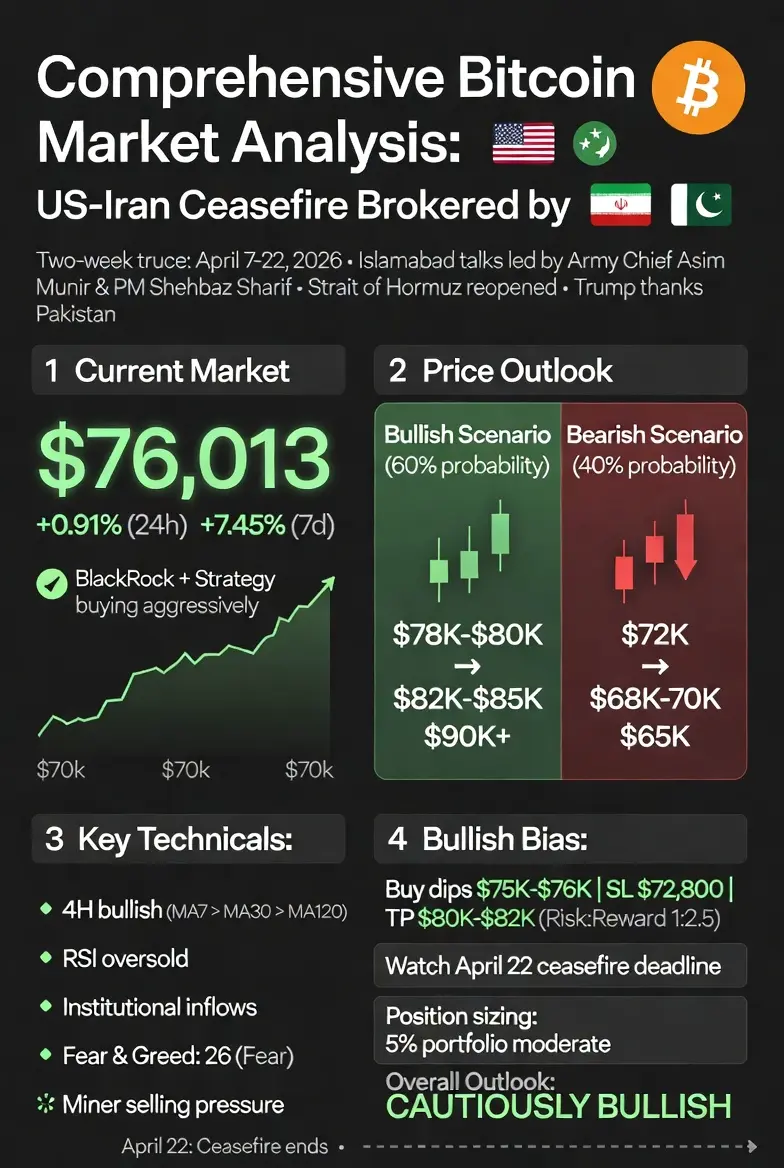
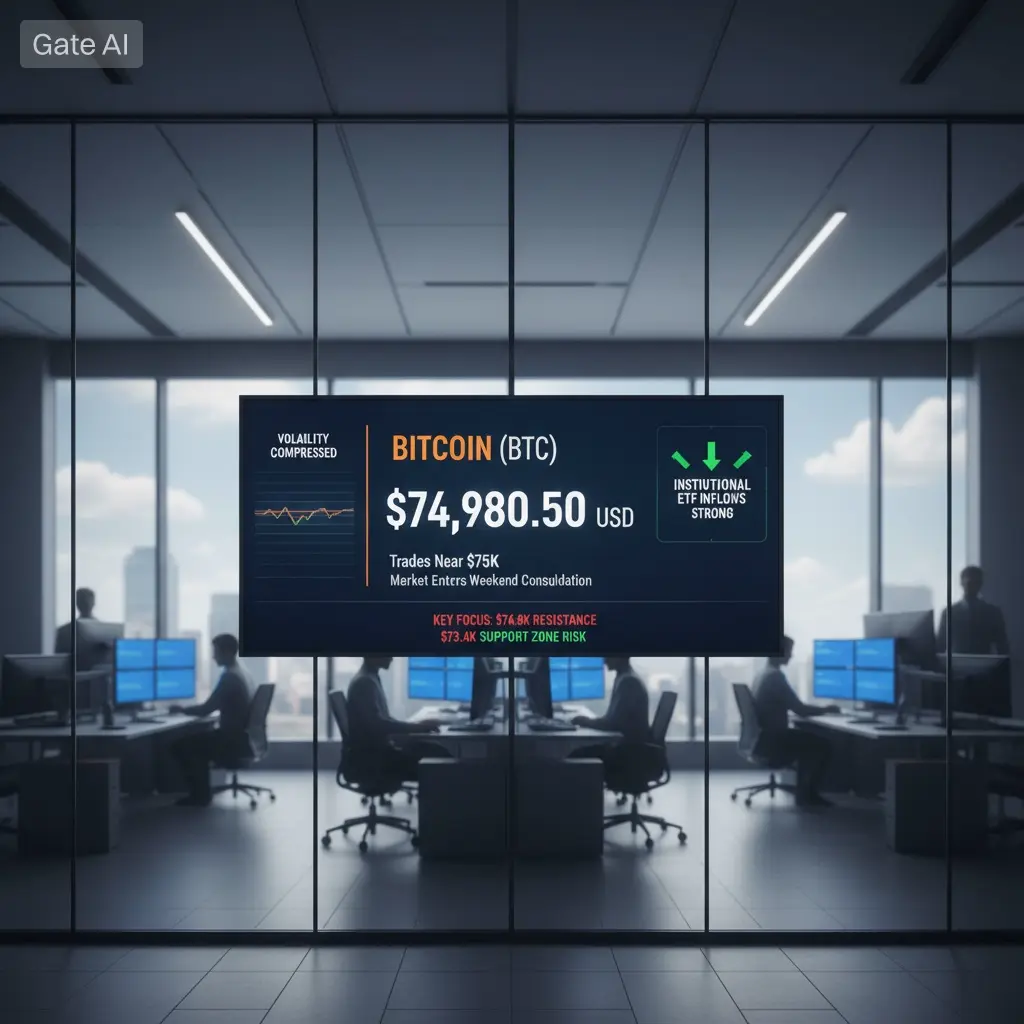
The cryptocurrency market enters the weekend of April 19-20, 2026, at a critical juncture. Bitcoin is trading around $75,234 (down 1.8% in 24h), while
Ethereum sits at $2,319 (down 2.4%). The Fear & Greed Index reads 27 (“Fear”), reflecting cautious sentiment despite strong institutional inflows.
This weekend presents a classic consolidation phase with three possible scenarios: continued range-bound action (70% probability), a bullish breakout toward $78,000–$80,000 (20%), or a bearish breakdown to $71,000–$73,000 (10%). Institutional accumulation conti
HighAmbition
#周末交易计划 .
Gate Square Weekend Session:
The cryptocurrency market enters the weekend of April 19-20, 2026, at a critical juncture. Bitcoin is trading around $75,234 (down 1.8% in 24h), while
Ethereum sits at $2,319 (down 2.4%). The Fear & Greed Index reads 27 (“Fear”), reflecting cautious sentiment despite strong institutional inflows.
This weekend presents a classic consolidation phase with three possible scenarios: continued range-bound action (70% probability), a bullish breakout toward $78,000–$80,000 (20%), or a bearish breakdown to $71,000–$73,000 (10%). Institutional accumulation continues to provide strong underlying support.
Part 1: Macro Market Landscape
Bitcoin (BTC) – The Anchor Asset
Bitcoin is currently priced at $75,234.1 USDT. In the past 24 hours, it traded between $74,888.8 – $76,787.8, down 1.8%. The market structure indicates an institutional accumulation phase, with whales buying dips.
Key technical levels include resistance at $76,800–$77,000 (near-term ceiling; breakout signals reversal). The $75,000 level acts as a major pivot and whale accumulation zone. Critical support lies at $73,400–$74,400 — a break below risks deeper correction. Bullish targets are $78,000–$80,000, aligning with Fibonacci and psychological resistance.
Institutional flows remain strong. Spot Bitcoin ETFs recorded nearly $1 billion in weekly net inflows — the strongest in over three months. BlackRock’s IBIT alone saw $284 million in a single day, pushing total ETF AUM beyond $101.4 billion. This provides a solid structural floor.
On-chain data supports a constructive outlook. The RHODL Ratio is at historically high levels, showing long-term holders accumulating while retail has been shaken out. The Coinbase Premium Index stayed positive for nine consecutive days, indicating U.S. buying pressure. Bitcoin dominance hovers around 57% — any peak could trigger altcoin rotation.
Ethereum (ETH) – The DeFi Powerhouse
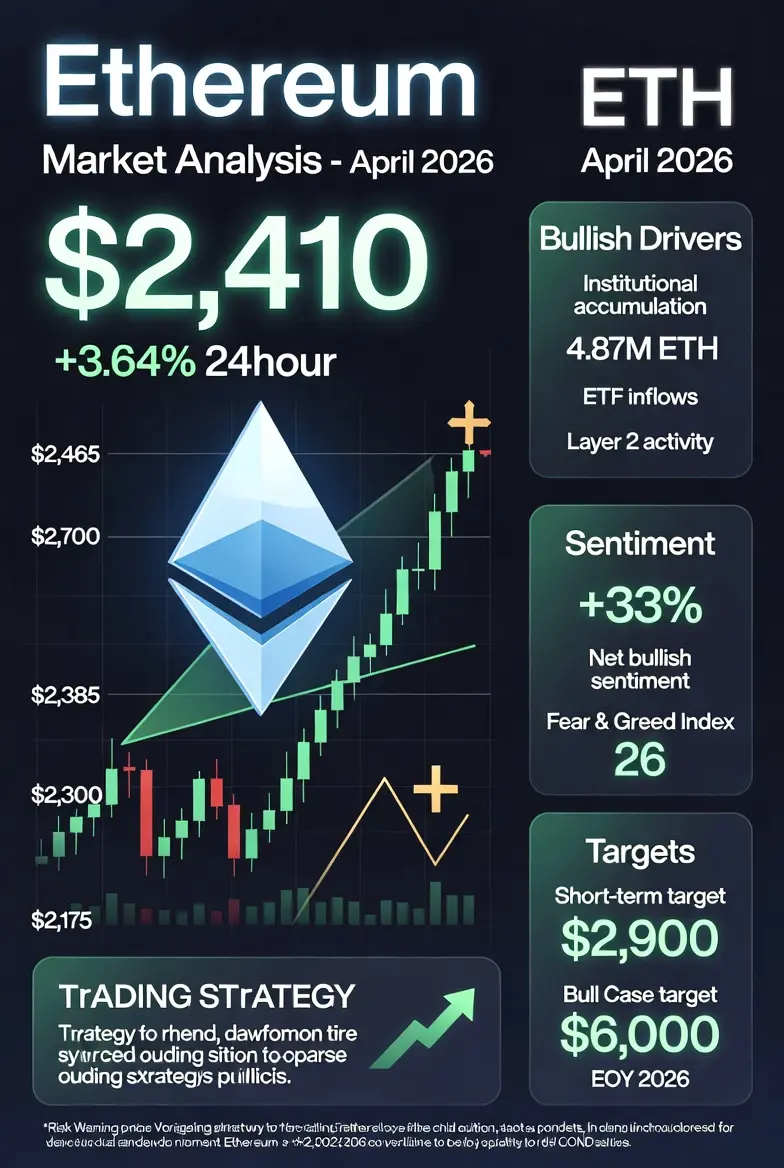
Ethereum trades at $2,318.87 USDT, ranging between $2,298.13 – $2,382.32 in the last 24 hours (down 2.4%).
Fundamentally, ETH shows strength with over 200 million on-chain transactions in Q1 2026 (all-time high) and stablecoin supply reaching $180 billion. Spot ETH ETFs recorded seven consecutive days of net inflows, while the Layer-2 ecosystem continues rapid expansion.
However, the Kelp DAO exploit stole approximately $292 million in rsETH via a LayerZero bridge vulnerability. Aave froze rsETH markets, and over $5.4 billion was withdrawn from lending protocols. Spark Protocol’s ETH deposit rates spiked to 130% before normalizing. On the positive side, the Ethereum Foundation recovered $5.8 million from state-sponsored hackers, demonstrating ecosystem resilience.
Part 2: Weekend Trading Scenarios (April 19-20, 2026)
Scenario A: Range-Bound Consolidation (70% Probability – Base Case)
Bitcoin is expected to trade between $75,200 – $76,800 with low weekend volume due to thin liquidity and lack of major news.
Strategy: Buy near $75,000 support with tight stops below $73,400. Scalp shorts near $76,800 resistance. Avoid chasing breakouts without volume confirmation. Risk: Choppy action and false breakouts.
Scenario B: Bullish Breakout (20% Probability)
If BTC breaks and holds above $76,800 on strong volume, it could target $78,000 initially then $80,000, supported by continued ETF flows and risk-on sentiment.
Strategy: Enter longs on confirmed breakout. Use trailing stops. Risk: Fakeout reversal.
Scenario C: Bearish Breakdown (10% Probability)
Rejection at $76,000–$77,000 could lead to a drop toward $73,400 and possibly $71,000, triggered by profit-taking or liquidity squeezes.
Strategy: Short on rejection with stops above $77,500. Target $73,400 first. Risk: Sudden reversal after stop hunts.
Part 3: Top Market Movers & Opportunities
In the last 24 hours, IMAYC led gainers with +81.51% at $0.2995 (NFT fractionalization play).
REQ rose 64.61% to $0.115 (payment infrastructure). GWEI gained 54.34% at $0.123 (gas optimization).
Other notable gainers included AIC (+50.01%), FIRE, ROCK, ST, PACE, D2T, and STRIKE (40-51% range).
On the loser side, RAVE plunged 92.68% to $1.876 after a pump (high volume $65.3M).
TAKER dropped 59.42%, VANRY fell 36.64% (gaming weakness).
Other corrections included the meme coin “我踏马来了” (-32.90%), TAKE, LIGHT, LWP, AIOT, SIREN, and INX (26-32%).
High volatility in altcoins demands caution — use small positions for parabolic movers and oversold tokens.
Part 4: Key Market Events & Catalysts
The Kelp DAO exploit ($292M rsETH stolen via LayerZero) created temporary DeFi uncertainty. Aave froze markets and large withdrawals followed, though the Ethereum Foundation’s recovery of $5.8M showed resilience.
Positive developments include $1 billion weekly Bitcoin ETF inflows (BlackRock IBIT: $284M single-day) and Ethereum’s Q1 milestones (200M transactions, $180B stablecoins).
Macro backdrop remains supportive: S&P 500 near highs, easing Iran tensions, oil below $100, with the Fed meeting on April 28-29 as the next major catalyst.
Part 5: Weekend Trading Strategy Framework
Conservative Traders: Accumulate BTC near $75,000 (DCA to $73,400–$74,400). Medium-term target $78K–$80K, stop below $71,000. For ETH, current levels offer value (support $2,250–$2,300, target $2,500–$2,600, stop below $2,200). Use stablecoin yield during consolidation.
Aggressive Traders: Target momentum in AI tokens (AIC, STRIKE) and new listings (ST, ROCK, LWP). Consider small contrarian plays in oversold names like RAVE or TAKER. Scalp BTC range ($75K–$76.8K) on 15-min charts with tight stops.
Risk Management: Limit risk to 2–5% per trade, always use stops, and watch wider weekend spreads. BTC dominance will drive most altcoin moves.
Part 6: Social Sentiment & Community Insights
On X/Twitter, bullish voices note whales accumulating at $75K while retail panics, strong ETF inflows as institutional signal, and April’s historical strength (median +7.1%). Extreme fear at 27 often marks bottoms.
Cautious views highlight low weekend volume (risk of fakeouts), recent whale profit-taking (~$500M), and DeFi risks from the Kelp exploit. Some watch for altcoin rotation if BTC dominance peaks.
Common quotes: “Smart money buying the $75K dip,” “$1B ETF inflows is accumulation,” and “Expect chop between $75K–$77K.”
Part 7: Week Ahead Preview (April 21–25, 2026)
The Fed meeting (April 28-29) is the biggest event — markets price a hawkish hold, but Powell’s tone could drive volatility. Tech earnings will also influence risk sentiment.
Technically, BTC needs a break abo
ve $77K for $80K+, while a drop below $73.4K risks $70K–$71K. Consolidation is likely until Fed clarity.
ETH should reclaim $2,400 for bullish structure ($2,200 key support). It is currently underperforming BTC, offering potential catch-up if DeFi fear eases.
Altcoins: Selective plays in AI and meme sectors for risk-tolerant traders. Avoid low-liquidity tokens on weekends.
Part 8: Gate Square Weekend Session – Discussion Topics
Topic 1: Market Recovery vs. Continued Cooling
Recovery case: Strong ETF inflows, fading geopolitical risks, April seasonality, and extreme fear signaling bottoms. Cooling case: Thin liquidity, Kelp FUD, whale profit-taking. Verdict: Consolidation with slight upward bias. Full recovery needs Fed clarity and sustained inflows.
Topic 2: Watchlist Candidates
BTC: Accumulation at $75K with institutional backing. ETH: Value post-Kelp FUD with strong fundamentals. AI tokens (AIC, STRIKE): Narrative momentum. New listings (ST, ROCK): High upside but elevated risk.
Topic 3: Signals That Could Break the Calm
Bullish: Fresh ETF data, Iran progress, breakout above $77K on volume. Bearish: More exploits, regulatory news, breakdown below $73.4K. Watch BTC dominance, funding rates, exchange flows, and stablecoin velocity.
Conclusion: Weekend Trading Plan
The weekend of April 19-20, 2026, is a “wait and see” period. With BTC consolidating around $75,000 and $1B weekly ETF inflows providing support, range-bound trading between $75,200–$76,800 remains the base case.
Key takeaways: Patience is key due to low volume, $75,000 support is critical, institutional backing is strong, and risk management is essential. The Fed meeting will likely set the next major direction.
Recommended actions:
Conservative: Accumulate BTC/ETH near support and earn yield on stables.
Moderate: Trade the range with tight stops.
Aggressive: Small positions in momentum altcoins.
Sometimes the best trade is no trade. Let the market show its hand.
repost-content-media
  • Reward
  • Comment
  • Repost
  • Share
#JaneStreetBets$7BonCoreWeave
📊 Headline 1: Bitcoin at $75,911 — A High-Liquidity Battlefield Where Institutional Strategy Is Quietly Unfolding
At its current level near $75,911, Bitcoin is not merely trading within a random consolidation band, but rather operating inside a highly strategic liquidity zone where large institutional participants are actively managing exposure, absorbing volatility, and positioning for the next directional move, all while maintaining a controlled market structure that reflects confidence rather than uncertainty.
This price behavior indicates that instead of pan
HighAmbition
#JaneStreetBets$7BonCoreWeave
📊 Headline 1: Bitcoin at $75,911 — A High-Liquidity Battlefield Where Institutional Strategy Is Quietly Unfolding
At its current level near $75,911, Bitcoin is not merely trading within a random consolidation band, but rather operating inside a highly strategic liquidity zone where large institutional participants are actively managing exposure, absorbing volatility, and positioning for the next directional move, all while maintaining a controlled market structure that reflects confidence rather than uncertainty.
This price behavior indicates that instead of panic-driven selling or emotionally driven market reactions, we are witnessing a deliberate and calculated environment where liquidity is being distributed and accumulated in phases, derivatives markets are playing a central role in shaping short-term price action, and long-term participants are maintaining exposure due to continued belief in broader macro and technological narratives.
What makes this phase particularly important is that it reflects a shift away from chaotic volatility toward engineered volatility, where movements are not random but influenced by advanced trading systems, structured liquidity flows, and algorithmic positioning that collectively create a more stable yet highly reactive market environment capable of rapid expansion once key thresholds are breached.
🧠 Headline 2: The $7B CoreWeave Narrative — A Signal of Strategic Infrastructure Control Rather Than Speculative Capital Deployment
The ongoing discussion surrounding #JaneStreetBets$7BonCoreWeave, especially the perceived association between Jane Street and CoreWeave, should not be interpreted through the traditional lens of speculative investment or directional betting, but rather understood as a reflection of a much deeper institutional strategy focused on securing long-term access to one of the most critical resources of the modern era: high-performance compute power.
Even if the exact structure of the widely discussed $7B exposure is not fully verified as a single direct transaction, the narrative itself carries weight because it aligns perfectly with observable institutional behavior across global markets, where capital is increasingly being deployed not toward end-user applications or short-term revenue opportunities, but toward the foundational infrastructure that enables entire technological ecosystems to function and scale.
This means that institutions are no longer asking which applications will dominate the future, but instead asking a more fundamental question:
👉 Who will control the infrastructure that all future applications depend on?
And the answer to that question lies in securing compute capacity at scale before supply constraints become even more restrictive.
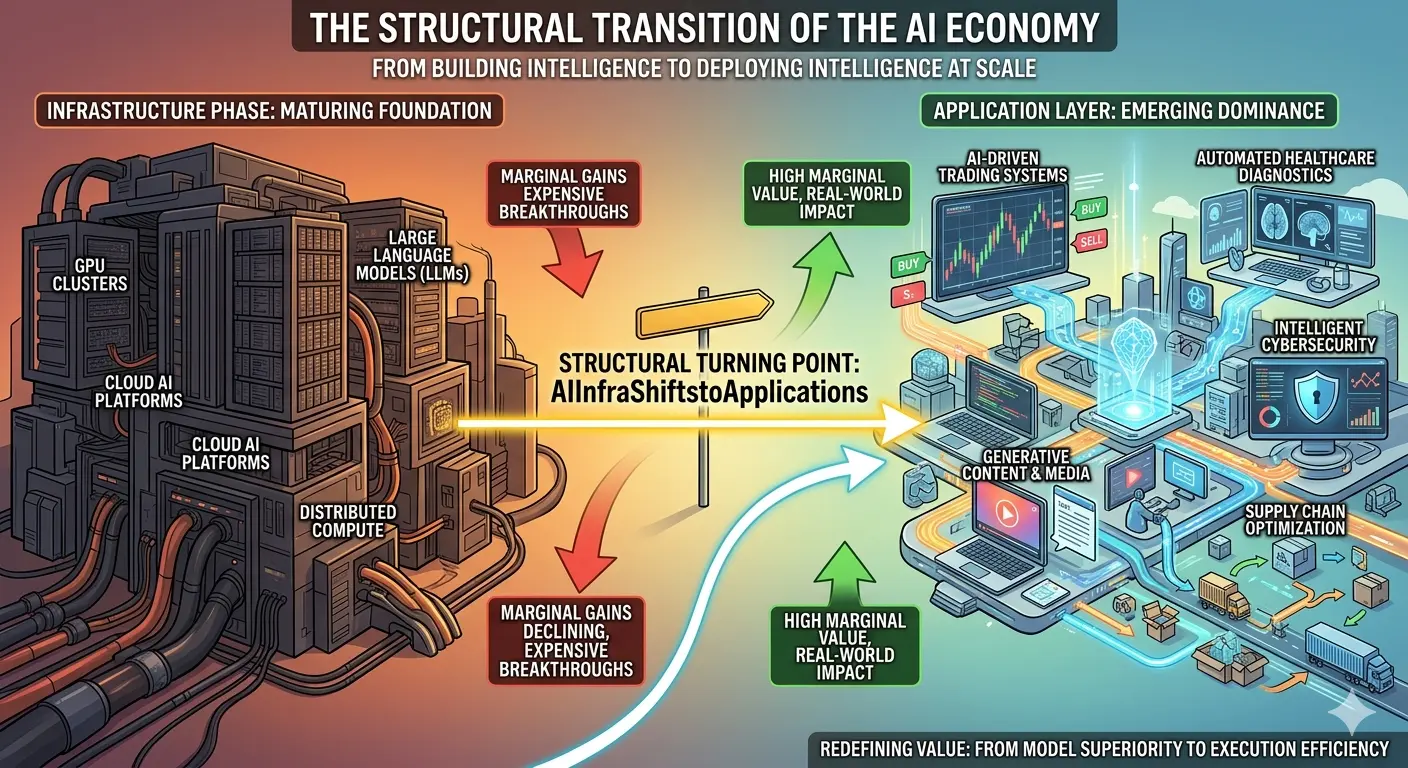
⚙️ Headline 3: Compute Power as the New Core Asset — The Transition From Capital Markets to Processing Power Economies
The global economy is undergoing a profound transformation in which compute power is evolving into a primary asset class, comparable in importance to oil during the industrial era or capital during the financial expansion era, with the key difference being that compute does not merely support economic activity—it actively defines the speed, scale, and capability of innovation itself.
Companies such as CoreWeave are positioned at the center of this transformation because they provide the specialized GPU-based infrastructure required to train and deploy artificial intelligence models, run complex simulations, execute quantitative trading strategies, and process massive datasets in real time, all of which are essential components of modern technological and financial systems.
The scarcity of high-performance GPUs, combined with increasing global demand from AI labs, financial institutions, and technology companies, has created a bottleneck that elevates compute from a background utility to a strategic resource, where access is limited, competition is intensifying, and long-term contracts are becoming the norm rather than the exception.
This shift fundamentally changes how value is created and measured, moving markets away from purely financial metrics and toward infrastructure-based dominance, where those who control processing capability effectively control the pace of innovation and market evolution.
📈 Headline 4: The Beginning of Institutional Compute Wars — Competition for Speed, Scale, and Execution Advantage
Following large-scale moves and narratives such as the $7B CoreWeave exposure, the market is entering a new competitive phase that can best be described as institutional compute wars, where the primary objective is no longer simply to deploy capital efficiently, but to secure the fastest, most scalable, and most reliable computational resources available.
In this environment, hedge funds, quantitative trading firms, and technology companies are increasingly:
Locking in long-term GPU supply agreements
Investing directly in infrastructure providers
Building proprietary AI systems powered by dedicated compute clusters
Competing for ultra-low latency environments that provide execution advantages
This shift reflects a deeper understanding that in modern markets, speed is not just an advantage—it is a necessity, and that even marginal improvements in processing capability can translate into significant gains in trading performance, predictive accuracy, and overall market positioning.
As a result, the competitive landscape is evolving from one defined by capital allocation strategies to one defined by computational efficiency and technological integration, where the ability to process information faster and more effectively becomes the ultimate differentiator.
💧 Headline 5: Liquidity Dynamics — How AI Infrastructure Investment Is Fueling Crypto Market Strength
One of the most important yet often overlooked aspects of this transformation is the way in which liquidity flows through interconnected markets, particularly how capital allocated to AI infrastructure eventually influences the crypto market, creating a multi-layered flow of value that reinforces overall market strength.
When institutions invest heavily in infrastructure providers like CoreWeave, the immediate impact is seen in equity markets and private valuations, but the secondary and tertiary effects extend much further, influencing derivatives markets, increasing overall risk appetite, and ultimately driving capital into digital assets such as Bitcoin.
This process can be understood as a cascading liquidity model:
Capital enters AI infrastructure
Confidence in technology sectors increases
Risk appetite expands across markets
Liquidity flows into crypto as a high-growth, high-volatility asset class
This is why Bitcoin’s current stability near $75,911 should not be viewed in isolation, but rather as part of a broader system in which technological investment and financial markets are increasingly interconnected.
🔄 Headline 6: AI and Crypto Convergence — The Formation of a Unified Technological-Financial Ecosystem
The relationship between artificial intelligence and crypto is rapidly evolving from parallel development into deep integration, where each sector enhances and reinforces the other, creating a hybrid ecosystem that combines decentralized infrastructure with advanced computational intelligence.
AI systems are increasingly being used to:
Analyze market data
Execute trades
Optimize portfolio strategies
While crypto networks are simultaneously evolving to:
Support decentralized compute distribution
Enable tokenized infrastructure marketplaces
Provide financial rails for global digital systems
This convergence suggests that in the near future, crypto will function as the economic layer of AI, while AI will act as the intelligence layer of crypto, resulting in a tightly integrated system where value creation, distribution, and optimization occur simultaneously across both domains.
📊 Headline 7: Market Evolution — From Human Decision-Making to Machine-Optimized Systems
As compute infrastructure continues to expand and AI systems become more advanced, financial markets are undergoing a fundamental transformation from environments driven primarily by human decision-making to systems increasingly optimized by machines capable of processing vast amounts of data and executing strategies at speeds far beyond human capability.
This transition is leading to:
More efficient price discovery
Reduced emotional volatility
Increased reliance on algorithmic trading
Faster reaction to market signals
However, it also introduces new dynamics, such as:
Sudden and highly precise volatility spikes
Increased correlation between assets
Greater dependence on technological infrastructure
In this new environment, understanding market behavior requires not only financial knowledge but also an awareness of how algorithms and AI systems interact with liquidity and data flows.
⚠️ Headline 8: Structural Risks — Centralization, Accessibility, and Narrative Volatility
Despite the opportunities presented by this new compute-driven paradigm, there are also significant risks that must be carefully considered, particularly those related to centralization of resources, unequal access to technology, and the increasing influence of narrative-driven market movements.
As large institutions secure the majority of available compute capacity, smaller participants may face limitations in accessing the same level of infrastructure, leading to a widening gap between institutional and retail capabilities, especially in areas such as algorithmic trading and AI-driven analysis.
Additionally, the rapid spread of narratives like the $7B CoreWeave exposure highlights the potential for markets to react strongly to perceived information, even when full verification is lacking, creating environments where sentiment can shift quickly and unpredictably, amplifying both opportunities and risks.
🌐 Headline 9: The Macro Transformation — Redefining Value in a Compute-Driven World
The broader implication of these developments is a redefinition of value itself, where traditional metrics based on revenue, earnings, and capital flows are increasingly supplemented—and in some cases replaced—by metrics related to infrastructure, processing capability, and technological integration.
This transformation can be summarized as a shift from:
Capital allocation → Compute allocation
Information advantage → Processing advantage
Market timing → Execution speed
In this new paradigm, success is determined not only by how much capital an entity controls, but by how effectively it can process information, deploy technology, and integrate systems across multiple layers of the economy.
🎯 Final Conclusion: A Market Cycle Built on Infrastructure, Intelligence, and Liquidity Alignment
The convergence of institutional AI infrastructure investment, compute scarcity, and the sustained strength of Bitcoin near $75,911 indicates that we are in the early stages of a structural market transformation, where the foundations of the next financial cycle are being actively constructed rather than passively anticipated.
This is not a cycle driven solely by speculation or short-term narratives, but one grounded in real technological advancement, strategic resource allocation, and evolving market dynamics that collectively point toward a future in which compute power plays a central role in shaping economic outcomes.
⚡ Ultimate Insight
In the era of global finance, capital will remain important, but it will no longer be the ultimate source of power; instead, that role will be taken by compute, because in a world driven by data, algorithms, and machine intelligence, the ability to process information efficiently is what ultimately determines who leads and who follows—and those who understand this shift today are not just participating in the market, but actively shaping its future trajectory.
repost-content-media
  • Reward
  • Comment
  • Repost
  • Share
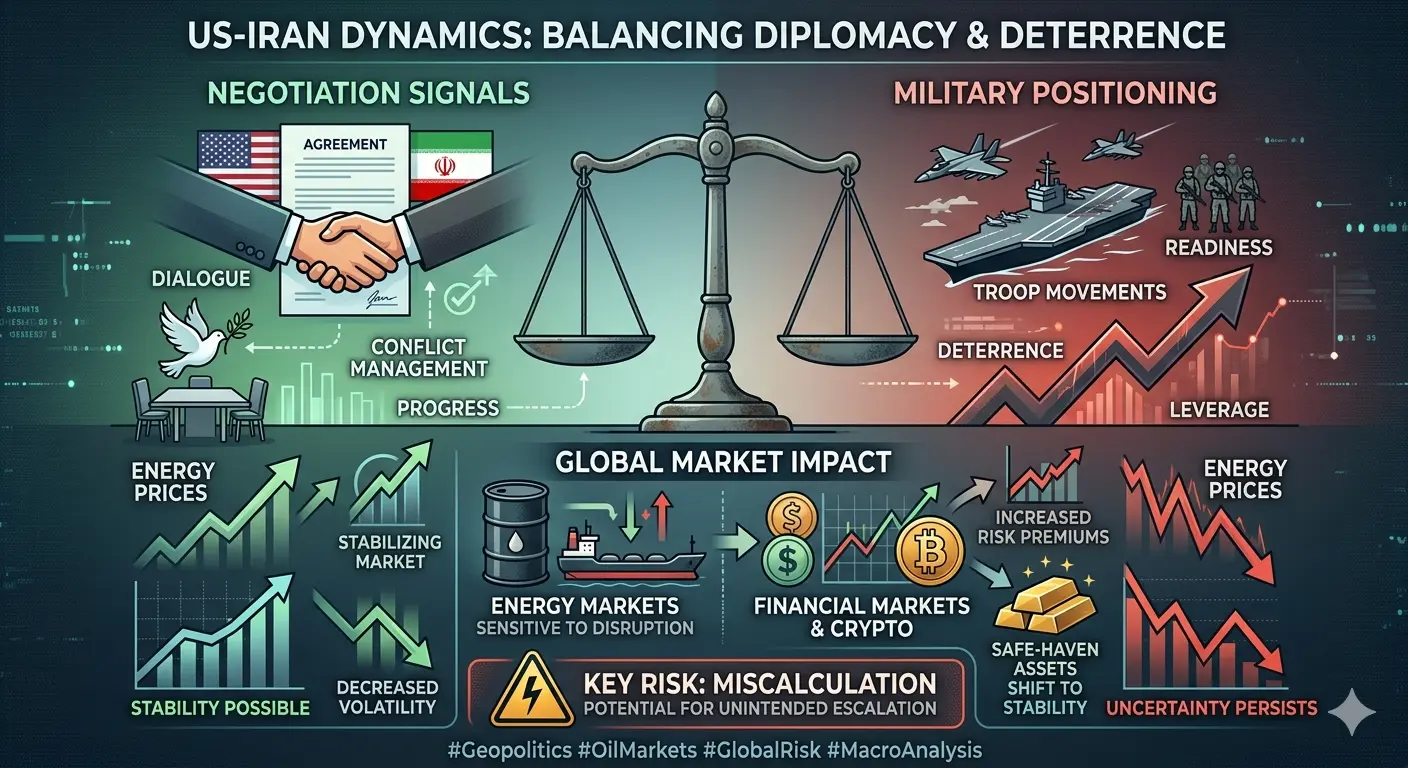
#US-IranTalksVSTroopBuildup
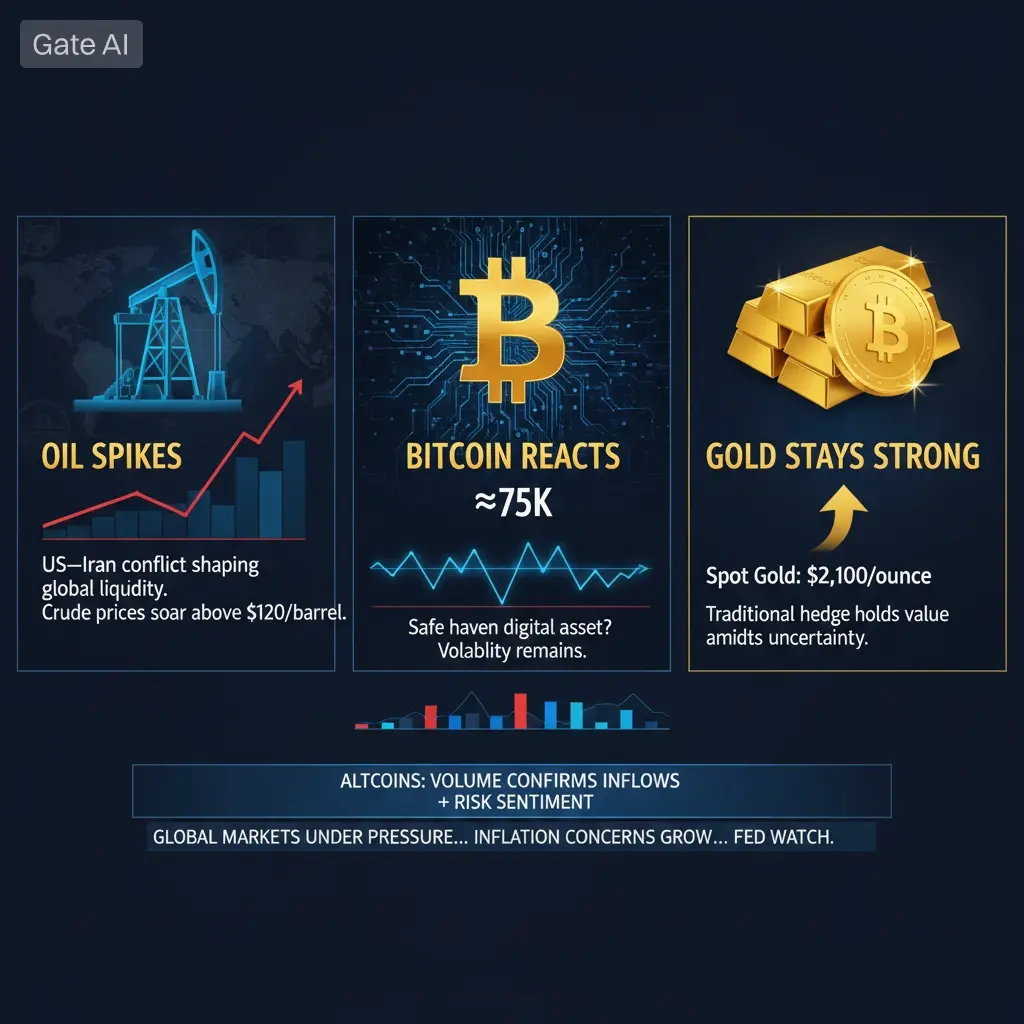
The global financial system in April 2026 is operating under extreme geopolitical pressure, driven by escalating US–Iran tensions, military positioning in the Middle East, and the strategic importance of the Strait of Hormuz. This is no longer a regional political issue — it has evolved into a global liquidity shock event directly influencing oil markets, inflation expectations, gold prices, Bitcoin, and altcoin valuation cycles.
Markets are now reacting not only to economic data but also to diplomatic headlines, military signals, and energy supply disruptions in r
BTC-1.35%
ETH-2.62%
SOL-1.5%
XRP-1.6%
HighAmbition
#US-IranTalksVSTroopBuildup
The global financial system in April 2026 is operating under extreme geopolitical pressure, driven by escalating US–Iran tensions, military positioning in the Middle East, and the strategic importance of the Strait of Hormuz. This is no longer a regional political issue — it has evolved into a global liquidity shock event directly influencing oil markets, inflation expectations, gold prices, Bitcoin, and altcoin valuation cycles.
Markets are now reacting not only to economic data but also to diplomatic headlines, military signals, and energy supply disruptions in real time.
🌍 1. US–Iran Talks vs Military Pressure (Diplomacy vs Force)
US–Iran negotiations began in 2025 across multiple global locations including Oman, Rome, Geneva, and later Islamabad. While early discussions showed cautious progress, no final agreement has been reached.
A temporary ceasefire in April 2026 provided short-term relief, but the situation remains fragile due to unresolved structural issues:
Iran demands sanctions relief and frozen asset release
US demands nuclear limitations and regional de-escalation
Both sides disagree on control of the Strait of Hormuz
Trust deficit remains extremely high
At the same time, the United States maintains approximately 50,000 troops in the Middle East, representing one of the largest regional military deployments in recent years.
📌 This creates a dual system:
Diplomacy is active, but military pressure remains fully operational.
🌊 2. Strait of Hormuz — The Global Liquidity Switch
The Strait of Hormuz is the most critical energy chokepoint in the world.
It handles:
~20% of global oil supply
Large portion of LNG exports
Key route for Gulf energy exports
This makes it a direct control point for global inflation and liquidity.
Market Reaction Pattern:
Open Strait → Oil falls, crypto rises
Closed Strait → Oil spikes, crypto drops
Uncertainty → Global volatility increases
📌 Conclusion:
The Strait of Hormuz now functions as a global liquidity switch controlling risk sentiment across all asset classes.
🛢️ 3. Oil Market Structure (Inflation Engine)
Current oil levels:
Brent Crude: ~$90 – $95
WTI Crude: ~$83 – $94
Crisis Scenario:
Escalation → Oil $100 – $120+
Prolonged closure → extreme supply shock
Oil is now the primary global inflation driver, meaning:
Higher oil → higher inflation → tighter monetary policy → reduced liquidity → pressure on crypto & equities.
₿ 4. Bitcoin Market Structure (Macro Risk Indicator)
Bitcoin is currently trading in a macro-sensitive range:
BTC Price: ~$75,000 – $77,000
Resistance: ~$80,000
Support: ~$70,000 – $72,000
Market Behavior:
Peace signals → BTC moves toward $78K+
Escalation → BTC drops toward $70K zone
Uncertainty → sideways volatility with liquidations
📌 Key Insight:
Bitcoin is no longer purely a crypto asset — it behaves as a global risk sentiment and liquidity indicator.
Key Drivers:
ETF inflows and institutional demand
Geopolitical news flow
Oil price shocks
Liquidation cascades in derivatives market
📊 5. Altcoin Market Structure (Selective Liquidity Phase)
The altcoin market is NOT in full altseason. It is operating in a selective liquidity rotation phase.
🟦 Large Caps
Ethereum (ETH): ~$2,300 – $2,400
Solana (SOL): ~$85 – $90
XRP: ~$1.40 – $1.50
BNB: ~$620 – $640
DOGE: ~$0.09 – $0.10
🟨 Mid Caps
Chainlink (LINK): ~$9 – $10
Bittensor (TAO): ~$240 – $250
Render (RENDER): ~$1.7 – $1.8
Sui (SUI): ~$0.9 – $1.0
Ondo (ONDO): ~$0.25 – $0.30
🟥 High Momentum Assets
Hyperliquid (HYPE): ~$40 – $45
Arbitrum (ARB): ~$0.12 – $0.15
Toncoin (TON): ~$1.30 – $1.40
📌 Key Insight:
Altcoins only perform strongly when liquidity expands and trading volume confirms momentum.
🟡 6. Gold & Tokenized Gold (Safe Haven Flow)
Gold remains the strongest safe-haven asset in this environment:
Gold Price: ~$4,700 – $4,800
XAUT: ~$4,750 – $4,800
Safe-Haven Drivers:
Geopolitical escalation
Inflation rise from oil shocks
Dollar weakness
Risk-off sentiment in markets
📌 Extreme scenario projection: Gold can move toward $5,000+ during prolonged instability.
⚔️ 7. War vs Peace Market Scenarios
If escalation continues:
Bitcoin: $60K – $70K risk zone
Oil: $100 – $120+ spike
Gold: $5,000+ rally
Altcoins: sharp liquidity crash
If peace stabilizes:
Bitcoin: $78K – $85K upside
Oil: correction toward $80–$85
Gold: consolidation phase
Altcoins: selective expansion rally
📌 Market hierarchy in crisis: Gold strongest → Oil volatile → Bitcoin mixed → Altcoins weakest
🧠 8. Core Macro Logic (Most Important Insight)
This market is not driven by crypto fundamentals alone.
It is controlled by a macro chain reaction:
Geopolitics → Oil → Inflation → Central Banks → Liquidity → Crypto
📌 Final principle: Price always follows liquidity, and liquidity follows geopolitical stability.
⚠️ 9. Risk Reality (Critical Understanding)
Current market environment is extremely fragile:
News can trigger instant volatility spikes
Fake breakouts are common
Liquidity traps dominate short-term trading
Derivatives liquidations amplify moves
📌 Survival Rule: Risk management is more important than prediction accuracy.
🧭 10. Final Market Outlook
The US–Iran situation and Strait of Hormuz crisis represent one of the most important macro events of 2026.
Current roles:
Bitcoin → global sentiment indicator (~$75K–$77K)
Oil → inflation engine (~$90–$100 volatile range)
Gold → stability hedge (~$4,700–$4,800)
Altcoins → selective liquidity-driven assets
Until a stable diplomatic agreement is reached, markets will remain:
Highly volatile
News-driven
Liquidity-sensitive
Structurally unstable in short term
🔥 FINAL TAKEAWAY
This is not a normal crypto cycle.
This is a global liquidity war phase, where:
Geopolitics controls oil
Oil controls inflation
Inflation controls liquidity
Liquidity controls crypto markets
📌 In simple terms: Everything in financial markets is currently reacting to geopolitical tension first, and fundamentals second.
repost-content-media
  • Reward
  • Comment
  • Repost
  • Share
#Gate13thAnniversaryLive
Gate is celebrating its 13th Anniversary under the powerful theme “Your Gateway to iWeb3”, marking a major milestone in its journey as a global digital asset platform. The celebration runs from April 9 to May 27, 2026 (UTC) and includes a wide range of campaigns, trading competitions, live global events, and community engagement activities designed to reward active users worldwide.
This anniversary is not just a celebration, but a large-scale ecosystem activation combining social interaction, trading incentives, and Web3 innovation.
Main Event Tag
This is the central
BTC-1.35%
GT0.42%
HighAmbition
#Gate13thAnniversaryLive
Gate is celebrating its 13th Anniversary under the powerful theme “Your Gateway to iWeb3”, marking a major milestone in its journey as a global digital asset platform. The celebration runs from April 9 to May 27, 2026 (UTC) and includes a wide range of campaigns, trading competitions, live global events, and community engagement activities designed to reward active users worldwide.
This anniversary is not just a celebration, but a large-scale ecosystem activation combining social interaction, trading incentives, and Web3 innovation.
Main Event Tag
This is the central hashtag used for real-time updates, announcements, and community discussions across social platforms. It connects all live event activities and keeps users engaged with ongoing developments throughout the campaign period.
#Gate13thAnniversary – Community Engagement Campaign
This campaign encourages users to actively participate through storytelling, predictions, and platform feedback.
Topic 1: #MyGateStory
Users share their personal experiences, trading milestones, or platform journey highlights.
It focuses on how Gate influenced their trading strategy, learning curve, or financial growth.
Rewards: Selected winners receive exclusive anniversary gift boxes.
Topic 2: #WhatIWantToSayToGate
A community feedback and appreciation segment where users share messages, suggestions, or wishes for the platform’s future development.
Rewards:
Top engagement posts receive 500 USDT Position Vouchers + Gate Ukey, with additional rewards for high interaction posts.
Topic 3: #Next13YearsPrediction
A forward-looking campaign where users predict the future of crypto markets, Bitcoin price trends, and the evolution of Gate over the next 13 years.
Rewards:
Selected winners receive 500 USDT vouchers and exclusive merchandise items.
Major Campaign Events & Prize Pools
1. Early Bird Boarding Plan
This interactive campaign included quizzes, boarding tickets, lucky draws, and collectible “Time Capsule” items.
Total prize pool distributed in millions
Special mystery rewards for full Time Capsule completion
Designed to increase early participation and engagement before the main celebration peak
2. Invitation Speed Competition
A referral-based competition encouraging user growth and network expansion.
Total prize pool: 130,000 USDT
20 USDT cashback per valid referral
Top performers rewarded with 5,000 USDT bonus prizes
Additional lottery rewards in GT tokens
3. WCTC S8 – World Cup Trading Competition
One of the largest trading tournaments in the campaign.
Prize pool: $8 million
Global participation across multiple trading categories
Focus on spot and derivatives trading performance
Pre-registration and ranking-based rewards system
4. Gate DEX New World Explorers Program
A decentralized ecosystem engagement campaign focused on on-chain trading and activity.
Prize pool: 69,300 USDT
Includes Perpetual trading tasks, leaderboard rankings, and hidden social rewards
Encourages users to explore decentralized trading infrastructure
Global Live Events & Offline Celebrations
Major International Events
Paris Blockchain Week – Industry networking and ecosystem showcase
Hong Kong Web3 Carnival – Large-scale community engagement event
Gate Gala 13 (Hong Kong, Rosewood Hotel) – Exclusive anniversary dinner and VIP gathering
Founder Dialogues – Direct global interaction sessions with leadership team
Victoria Harbour Exhibition
A special anniversary exhibition held in Hong Kong that attracted over 10,000 visitors on the first day, highlighting strong public interest and community engagement.
Platform Growth & Achievements (13 Years)
Over 13 years, Gate has achieved major global milestones:
50+ million users worldwide
4,500+ listed digital assets
$74 billion monthly spot trading volume (Feb 2026)
125% reserve coverage (~$9.47 billion total reserves)
100+ million on-chain addresses via Gate Layer infrastructure
Strong expansion across Web3, DeFi, and multi-chain ecosystems
How Users Can Participate & Earn Rewards
Participants can engage in multiple ways:
Posting on Gate Square using official hashtags
Completing daily quizzes and interactive missions
Inviting new users to join the ecosystem
Participating in trading competitions and leaderboard events
Engaging with community content (likes, comments, shares)
Each activity contributes to reward eligibility, ranking points, and lucky draw chances.
Important Participation Rules
Content must be original and relevant
Minimum engagement requirements apply for reward eligibility
Multiple accounts are treated as a single user
Rewards are distributed within 14 business days after campaign completion
Certain regional restrictions may apply
Final Conclusion
The Gate 13th Anniversary celebration represents a large-scale fusion of trading, community engagement, and Web3 ecosystem growth. It combines global events, massive prize pools, and interactive campaigns to strengthen user participation and platform expansion.
This milestone reflects Gate’s transformation from a trading platform into a full-scale digital finance ecosystem integrating social, trading, and blockchain innovation under one global network.
Final Insight
This anniversary is not just an event — it is a global Web3 activation campaign combining community, trading competition, and ecosystem expansion at scale.
repost-content-media
  • Reward
  • Comment
  • Repost
  • Share
#KalshiFacesNevadaRegulatoryClash
⚖️ Kalshi vs Nevada — The Battle That Could Redefine Financial Markets
The intensifying clash between Kalshi and Nevada has evolved far beyond a routine legal dispute. It now represents a structural turning point in modern finance—one that could determine how prediction markets, digital assets, and next-generation trading systems are defined, regulated, and scaled globally.
🧠 The Core Conflict: Definition Decides Everything
At the center of this battle lies a single, powerful question:
👉 Are prediction markets financial ins
DEFI-5.36%
HighAmbition
#KalshiFacesNevadaRegulatoryClash
⚖️ Kalshi vs Nevada — The Battle That Could Redefine Financial Markets
The intensifying clash between Kalshi and Nevada has evolved far beyond a routine legal dispute. It now represents a structural turning point in modern finance—one that could determine how prediction markets, digital assets, and next-generation trading systems are defined, regulated, and scaled globally.
🧠 The Core Conflict: Definition Decides Everything
At the center of this battle lies a single, powerful question:
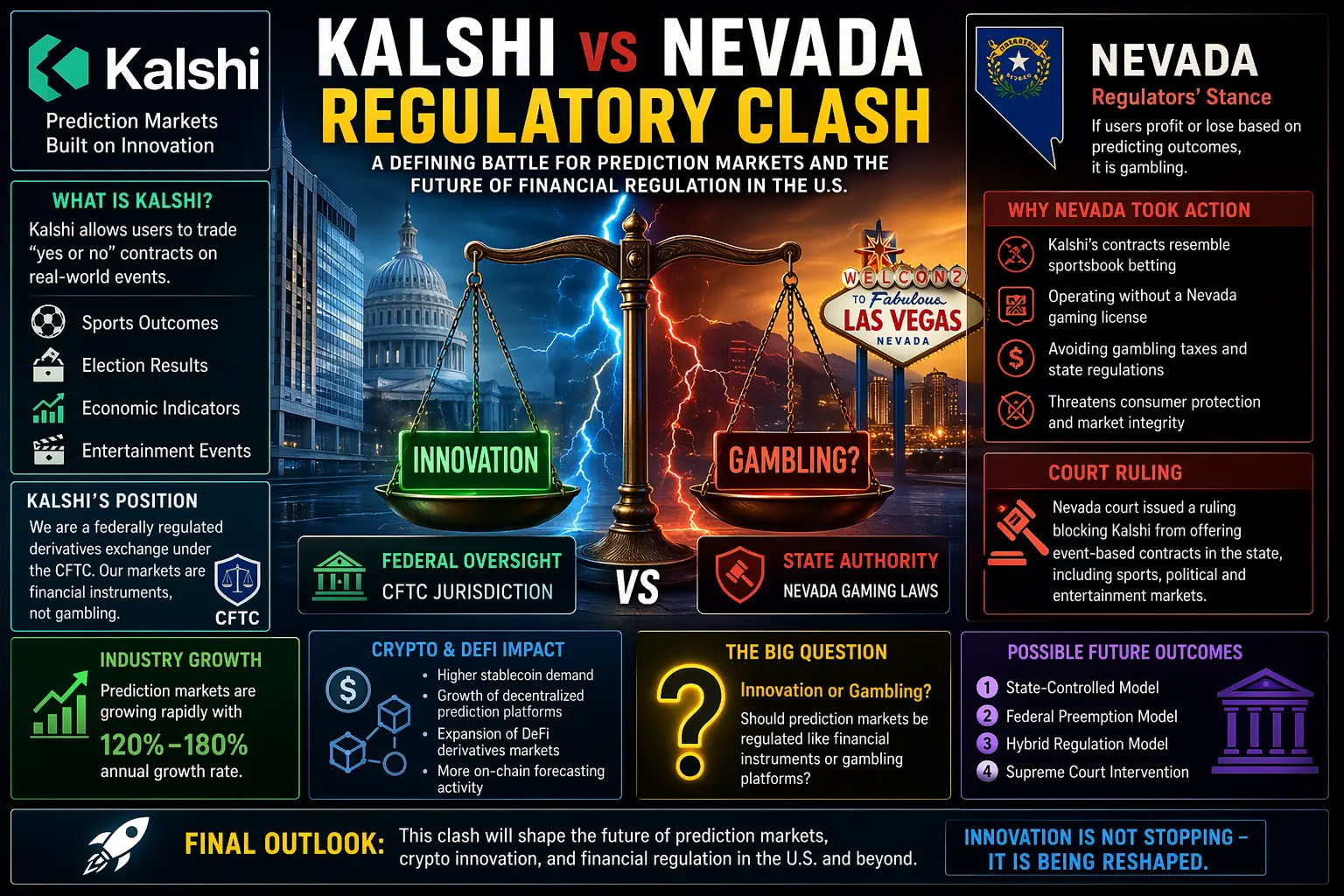
👉 Are prediction markets financial instruments or gambling products?
Kalshi operates under the oversight of the Commodity Futures Trading Commission, positioning its platform as a regulated exchange offering event-based derivatives. These contracts allow users to trade probabilities tied to real-world outcomes—transforming uncertainty into measurable, tradable signals.
Nevada regulators reject this framework entirely. Their position is rooted in a traditional legal interpretation:
👉 If users risk money on uncertain outcomes for profit, it is gambling—regardless of structure.
This creates a direct and unavoidable collision between federal financial authority and state gaming control.
⚖️ A Deeper Structural Tension
This isn’t just about Kalshi—it exposes a long-standing fault line in regulatory architecture:
Federal Perspective (CFTC):
Prediction markets = derivatives
National oversight = consistency
Innovation-friendly framework
State Perspective (Nevada):
Prediction markets = wagering
Local jurisdiction = strict control
Compliance via licensing + taxation
👉 The result: fragmentation, uncertainty, and a bottleneck for innovation.
📊 What Makes Prediction Markets Different?
Prediction markets are not traditional betting platforms. They function as:
Probability engines → pricing the likelihood of events
Information aggregators → capturing collective intelligence
Forecasting tools → used for economics, politics, and beyond
Users don’t just “bet”—they trade market sentiment.
👉 This shifts the paradigm from chance-based wagering to data-driven forecasting markets.
🚨 Legal Escalation & Strategic Impact
Nevada’s move to restrict Kalshi’s event contracts—especially in sports, politics, and entertainment—marks a critical precedent.
👉 It signals that states are willing to directly challenge federally aligned platforms.
If replicated, this could lead to:
State-by-state restrictions
Increased compliance costs
Limited national scalability
At the same time, it pressures federal authorities to clarify jurisdiction more aggressively.
📈 Market Expansion vs Regulatory Friction
Despite legal headwinds, prediction markets are expanding rapidly:
Growth rates estimated at 120%–180% annually
Rising institutional interest
Integration into trading and analytics systems
Meanwhile, traditional betting platforms are adopting prediction-style mechanics—further blurring boundaries.
👉 The line between finance and gambling is dissolving in real time.
🔗 Crypto & DeFi: The Silent Beneficiaries
One of the most important second-order effects is happening beneath the surface:
If centralized platforms face restrictions:
➡️ Users migrate to decentralized systems
➡️ Stablecoin usage increases
➡️ On-chain derivatives expand
➡️ Censorship-resistant prediction protocols grow
👉 Regulation doesn’t eliminate demand—it redirects liquidity.
This creates a powerful tailwind for DeFi-based prediction ecosystems.
⚡ A Fundamental Market Evolution
Traditional financial markets revolve around:
➡️ Trading price movements
Prediction markets introduce:
➡️ Trading probabilities of real-world outcomes
This is a structural upgrade:
From reactive trading → to anticipatory positioning
From price signals → to information signals
From individual analysis → to collective intelligence
👉 Markets are evolving into real-time knowledge systems.
🌍 Global Ripple Effects
This case is being closely monitored worldwide. Regulators across major economies are studying how the U.S. resolves this conflict.
👉 The outcome could become a blueprint for:
Digital asset regulation
Event-based financial products
Hybrid financial-gaming frameworks
🔮 What Comes Next?
Several high-impact scenarios are emerging:
1. State Dominance
Fragmented rules, slower innovation, regional barriers
2. Federal Preemption
Unified markets, institutional scale, rapid expansion
3. Hybrid Regulation
Selective restrictions with partial clarity
4. Judicial Resolution
A higher court decision defining the industry long-term
🧠 The Real Battle: Control of Market Structure
This isn’t just about compliance—it’s about who controls the next financial layer.
Prediction markets represent:
The front-end of information pricing
The intersection of AI, data, and finance
The next evolution of derivatives markets
👉 Whoever defines them… controls how they scale.
🔥 Final Insight
The Kalshi vs Nevada clash is not about stopping prediction markets—it’s about shaping them.
Regulation will set the boundaries.
Technology will push beyond them.
And markets will adapt—faster than policy can react.
👉 The outcome of this case won’t just impact one platform.
It will define how future financial systems price reality itself.
repost-content-media
  • Reward
  • Comment
  • Repost
  • Share
#USStocksHitRecordHighs
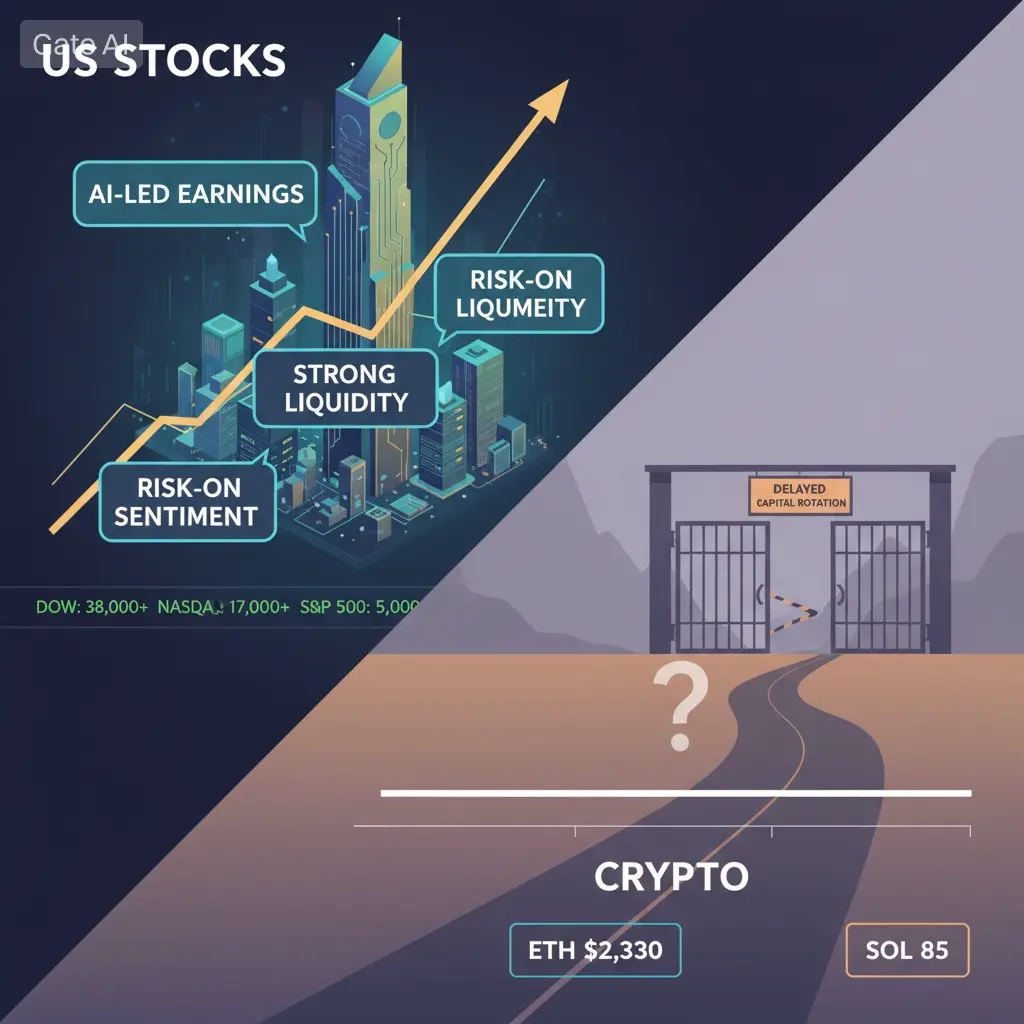
🚀 US STOCKS AT RECORD HIGHS & GLOBAL LIQUIDITY SHIFT
🌍 A HISTORIC GLOBAL FINANCIAL EXPANSION PHASE
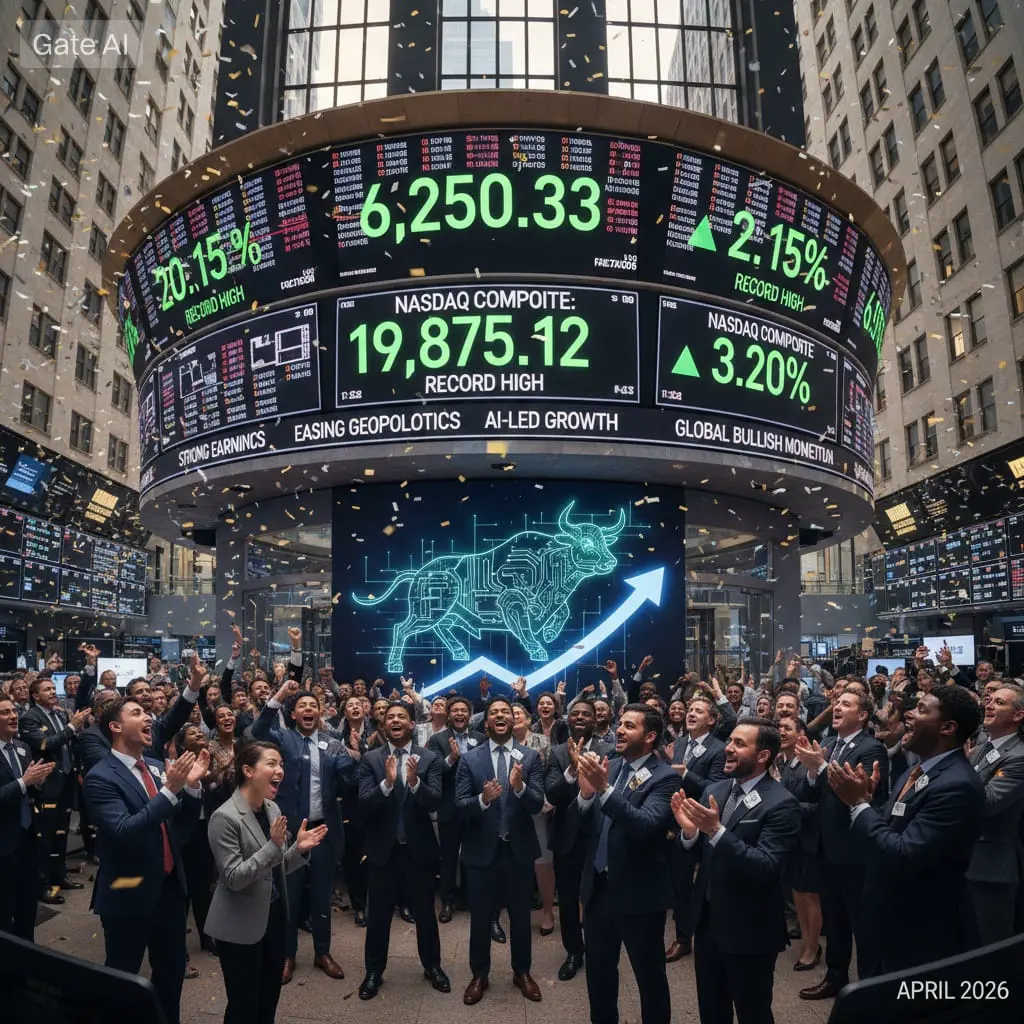
The global financial system in mid-April 2026 is deep into one of the most powerful synchronized liquidity-driven expansion cycles in recent history. US equity markets have not only recovered from earlier volatility but have surged into fresh all-time high territory, breaking key psychological barriers with strong momentum.
S&P 500: Recently closed above 7,000 for the first time (hitting intraday highs near 7,148), currently trading around 7,126 with multiple record cl
HighAmbition
#USStocksHitRecordHighs
🚀 US STOCKS AT RECORD HIGHS & GLOBAL LIQUIDITY SHIFT
🌍 A HISTORIC GLOBAL FINANCIAL EXPANSION PHASE
The global financial system in mid-April 2026 is deep into one of the most powerful synchronized liquidity-driven expansion cycles in recent history. US equity markets have not only recovered from earlier volatility but have surged into fresh all-time high territory, breaking key psychological barriers with strong momentum.
S&P 500: Recently closed above 7,000 for the first time (hitting intraday highs near 7,148), currently trading around 7,126 with multiple record closes in recent sessions.bf9dc1
Nasdaq Composite: Leading the charge with tech strength, closing above 24,000 and posting extended winning streaks (including an 11-day run, the longest in years).
Dow Jones Industrial Average: Hovering near 48,500–49,400, showing resilience despite occasional underperformance relative to tech-heavy indices.
This is a liquidity-powered structural bull phase. Capital is rotating aggressively into equities, with technology and AI-related sectors acting as primary anchors. The recovery from the sharp 2025 drawdown (where trillions were temporarily erased due to macro uncertainty, geopolitical flares, and liquidity squeezes) has been explosive rather than gradual. Markets formed a solid bottom in early 2025, followed by rapid institutional re-entry, multi-trillion-dollar valuation rebounds, and sustained momentum that has defied typical mean-reversion expectations.
This behavior mirrors deep structural bull markets where liquidity cycles temporarily overshadow fundamentals in the short-to-medium term.
⚡ FROM SHARP DRAWDOWN TO RAPID RECOVERY — DETAILED TIMELINE
Early 2025 saw steep contractions triggered by macro headwinds, inflation concerns, and geopolitical risks (including tensions around Iran). Sentiment deteriorated quickly, leading to defensive positioning and forced selling.
However, the reversal was decisive:
Strong technical bottoming patterns emerged within weeks.
Institutional capital returned at scale, fueled by improving risk appetite.
Earnings resilience, especially from mega-cap tech, reinforced confidence.
Volatility compressed sharply, encouraging risk-on behavior and FOMO (fear of missing out) among retail and hedge fund participants.
The result: An accelerated recovery that pushed major indices into price discovery mode at all-time highs. Unlike previous cycles, momentum has not slowed — it has broadened and strengthened as liquidity flows accelerate.
🔥 CORE DRIVERS BEHIND THE MARKET EXPANSION — IN-DEPTH ANALYSIS
GLOBAL GEOPOLITICAL RISK COOL-DOWN
A notable de-escalation in key hotspots (including progress on Iran-related tensions and truce discussions) has reduced uncertainty. Lower risk premiums have encouraged institutional reallocation from defensive assets (bonds, cash) into higher-beta equities and growth sectors. This shift acts as a powerful tailwind for broad market participation.
STRONG CORPORATE EARNINGS, ESPECIALLY IN MEGA-CAP TECH
The earnings cycle continues to beat expectations. Key contributors include:
AI monetization at scale across enterprise software, cloud, and productivity tools.
Explosive demand for cloud infrastructure and semiconductors.
Stabilizing and growing advertising revenues (boosted by AI-driven targeting).
Supply chain normalization in chips and hardware.
Companies like Microsoft, Alphabet (Google), Meta Platforms, and leading semiconductor firms are providing consistent revenue growth and optimistic forward guidance, anchoring the entire market.
THE ARTIFICIAL INTELLIGENCE SUPER-CYCLE — NOW STRUCTURAL
AI has evolved from hype to the foundational driver of valuations. It is powering:
Enterprise digital transformation and productivity gains.
Massive scaling of data centers and cloud capacity.
Semiconductor demand surge (with Big Tech collectively planning $650+ billion in AI-related capex for 2026 across Microsoft, Alphabet, Meta, and Amazon).84fbba
Investors are pricing in multi-year structural earnings growth tied to AI adoption. This explains the heavy concentration of capital in tech indices and the premium valuations in AI-exposed names. The supercycle is delivering real efficiencies (e.g., Meta’s AI ad tools) while infrastructure spend remains elevated.
VOLATILITY COMPRESSION & RISK-ON SENTIMENT
Declining volatility (VIX in moderate territory) signals broad risk appetite. This environment favors momentum continuation, high-beta assets, and speculative flows. Sector rotation is active, but the overall trend remains upward unless interrupted by a major shock.
🧠 MARKET PSYCHOLOGY: DUAL STRUCTURE AT ALL-TIME HIGHS
Bullish side: Rising FOMO as indices break resistances and post record after record.
Cautious side: Institutions remain disciplined, managing position sizes carefully while participating selectively.
At these elevated levels, price action is driven more by liquidity flows, positioning dynamics, and expectation shifts than traditional valuation metrics alone. Discipline and risk management are critical.
💰 CRYPTO MARKET: LAGGING BUT CORRELATED BENEFICIARY OF EQUITY LIQUIDITY
Crypto is not leading this cycle — it is reacting to the liquidity and risk appetite spilling over from traditional markets. Correlation with equities (especially tech and crypto-linked stocks like Coinbase, MicroStrategy, and Robinhood) remains high.
Current Crypto Levels (as of mid-April 2026):
Ethereum (ETH): Trading around $2,330 – $2,358, in a consolidation/accumulation phase. It benefits from Layer-2 growth, staking dynamics, institutional interest, and dApp ecosystem strength, but remains range-bound amid broader market caution.
Solana (SOL): Hovering near $85 – $86, reflecting a mid-cycle cooling after earlier volatility. Strong fundamentals persist (high throughput, developer activity, DeFi/NFT ecosystems, and occasional memecoin liquidity bursts), yet price action stays sensitive to overall risk sentiment
Bitcoin (BTC): Recently showing strength around the $74,000 – $75,000 zone in recent sessions, acting as a key liquidity trigger and macro barometer.
Crypto-linked equities continue to serve as important bridges between TradFi and digital assets.
🔄 GLOBAL LIQUIDITY ROTATION MECHANISM — THE BIG PICTURE
The dominant theme is capital rotation rather than isolated asset performance. When liquidity expands aggressively into equities:
Risk appetite broadens across asset classes.
Institutional portfolios tilt toward growth.
Crypto and other risk assets often lag initially but eventually capture spillover flows.
This delayed transmission has repeated in multiple macro cycles. Central bank policies show some divergence in 2026 (Fed maintaining an easing bias with possible further cuts, alongside global variations), but overall liquidity conditions remain supportive for risk assets in the near term.
📈 STRATEGIC MARKET SCENARIOS — UPDATED FOR 2026
🟢 Bullish Structural Case (Base Scenario): AI earnings keep outperforming, liquidity stays accommodative, equities push into higher valuation zones, and crypto enters a delayed but meaningful expansion phase.
🟡 Neutral Consolidation Case: Markets stabilize at highs with increased sector rotation; volatility rises modestly without breaking the uptrend; crypto stays range-bound with selective opportunities.
🔴 Risk Reversal Case: Unexpected tightening, major tech earnings misses, renewed geopolitical shocks, or liquidity contraction could pressure all risk assets simultaneously.
🎯 KEY LEVELS TO WATCH
S&P 500: Extended discovery mode above 7,000–7,100.
Nasdaq: Momentum continuation above 24,000.
Dow Jones: Support near recent closes with upside toward 49,000+.
Bitcoin: Breakout zone around current levels for broader crypto catalyst.
Ethereum: Accumulation base near $2,300; resistance higher.
Solana: Volatility-sensitive zone around $85; watch for ecosystem-driven moves.
🧾 FINAL THOUGHT
This is not a conventional bull market fueled purely by economic fundamentals. It is a liquidity-powered structural expansion phase anchored by the AI super-cycle, global capital rotation, cooling geopolitical risks, and sustained institutional risk appetite.
US equities are currently leading, technology (especially AI infrastructure) is defining the architecture, and crypto is positioning as a secondary but high-beta beneficiary once liquidity transmission accelerates.
At record highs, success depends less on precise predictions and more on strategic positioning, disciplined risk management, patience, and alignment with the evolving liquidity environment.
repost-content-media
  • Reward
  • Comment
  • Repost
  • Share
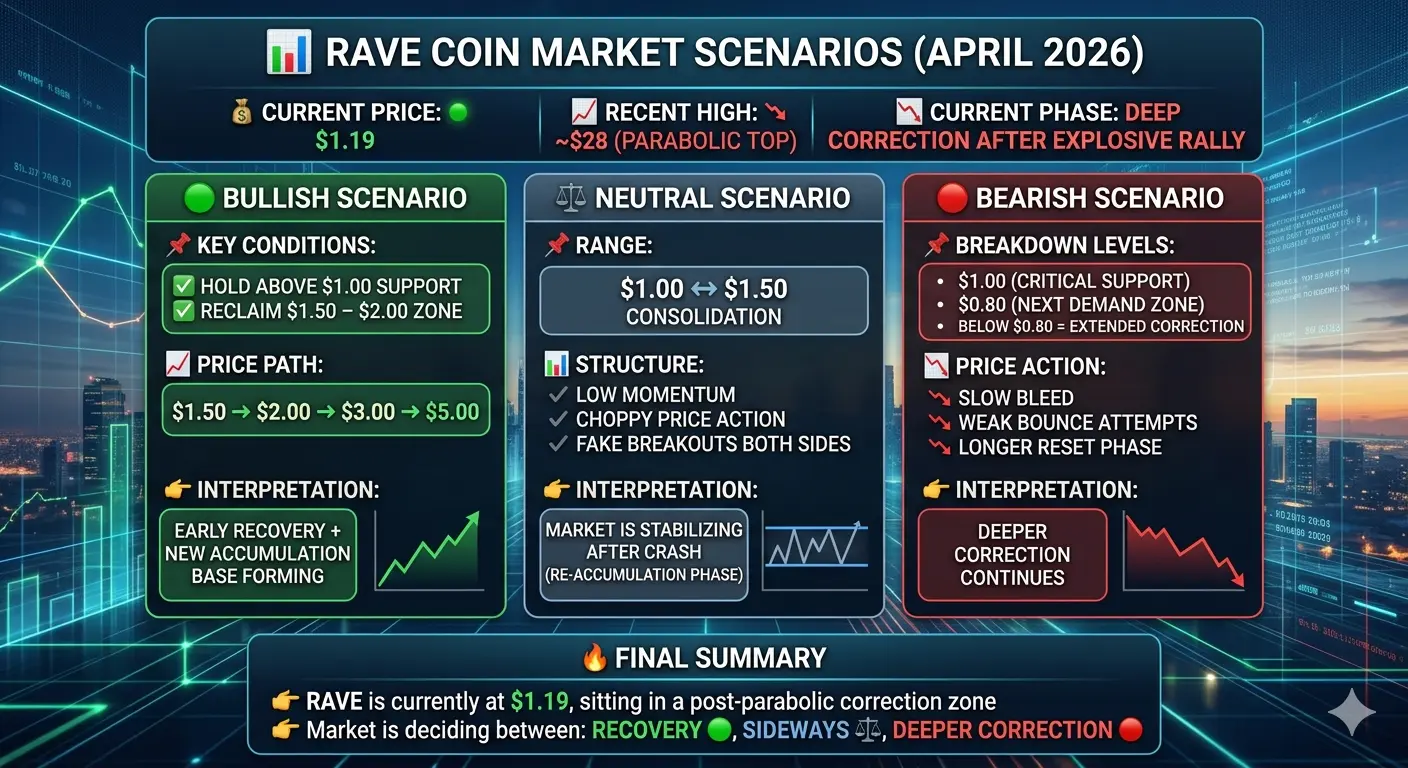
#FirstTradeOfTheWeek :
📊 RAVE Coin Market Scenarios (April 2026)
💰 Current Price: $1.19
📈 Recent High: ~$28 (parabolic top)
📉 Current Phase: Deep correction after explosive rally
🟢 BULLISH SCENARIO
If buyers return strongly:
📌 Key Conditions:
Hold above $1.00 support
Reclaim $1.50 – $2.00 zone
📈 Price Path:
$1.50 → $2.00 → $3.00 → $5.00
👉 Interpretation: Early recovery + new accumulation base forming
⚖️ NEUTRAL SCENARIO
If market stays sideways:
📌 Range:
$1.00 ↔ $1.50 consolidation
📊 Structure:
Low momentum
Choppy price action
Fake breakouts both sides
👉 Interpretation: Market is st
RAVE41.91%
HighAmbition
#FirstTradeOfTheWeek :
📊 RAVE Coin Market Scenarios (April 2026)
💰 Current Price: $1.19
📈 Recent High: ~$28 (parabolic top)
📉 Current Phase: Deep correction after explosive rally
🟢 BULLISH SCENARIO
If buyers return strongly:
📌 Key Conditions:
Hold above $1.00 support
Reclaim $1.50 – $2.00 zone
📈 Price Path:
$1.50 → $2.00 → $3.00 → $5.00
👉 Interpretation: Early recovery + new accumulation base forming
⚖️ NEUTRAL SCENARIO
If market stays sideways:
📌 Range:
$1.00 ↔ $1.50 consolidation
📊 Structure:
Low momentum
Choppy price action
Fake breakouts both sides
👉 Interpretation: Market is stabilizing after crash (re-accumulation phase)
🔴 BEARISH SCENARIO
If sellers dominate:
📌 Breakdown Levels:
$1.00 (critical support)
$0.80 (next demand zone)
Below $0.80 = extended correction
📉 Price Action:
Slow bleed
Weak bounce attempts
Longer reset phase
🔥 FINAL SUMMARY
👉 RAVE is currently at $1.19, sitting in a post-parabolic correction zone
👉 Market is deciding between:
Recovery 🟢
Sideways ⚖️
Deeper correction 🔴
repost-content-media
  • Reward
  • Comment
  • Repost
  • Share
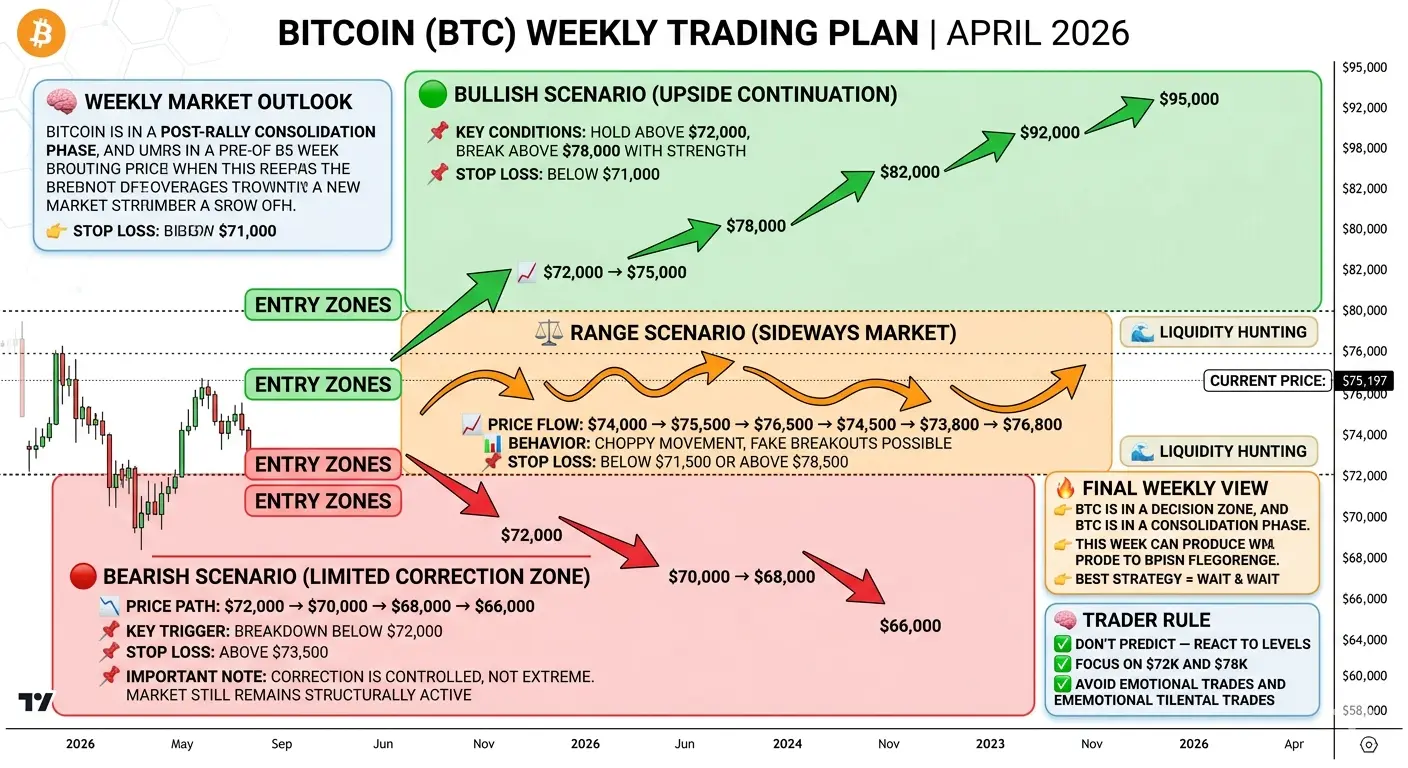
#FirstTradeOfTheWeek
📊 Bitcoin (BTC) Weekly Trading Plan | April 2026
💰 Current Price: $75,197
🧠 WEEKLY MARKET OUTLOOK
Bitcoin is in a post-rally consolidation phase where price is balancing between continuation and correction. Market is waiting for a clear breakout direction.
🟢 BULLISH SCENARIO (Upside Continuation)
📌 Key Conditions:
Hold above $72,000
Break above $78,000 with strength
📈 Price Path: 👉 $72,000 → $75,000 → $78,000 → $82,000 → $88,000 → $92,000 → $95,000
📌 Stop Loss:
Below $71,000
⚖️ RANGE SCENARIO (Sideways Market)
📌 Range Zone: 👉 $72,000 ↔ $78,000
📊 Behavior:
Chopp
BTC-1.35%
HighAmbition
#FirstTradeOfTheWeek
📊 Bitcoin (BTC) Weekly Trading Plan | April 2026
💰 Current Price: $75,197
🧠 WEEKLY MARKET OUTLOOK
Bitcoin is in a post-rally consolidation phase where price is balancing between continuation and correction. Market is waiting for a clear breakout direction.
🟢 BULLISH SCENARIO (Upside Continuation)
📌 Key Conditions:
Hold above $72,000
Break above $78,000 with strength
📈 Price Path: 👉 $72,000 → $75,000 → $78,000 → $82,000 → $88,000 → $92,000 → $95,000
📌 Stop Loss:
Below $71,000
⚖️ RANGE SCENARIO (Sideways Market)
📌 Range Zone: 👉 $72,000 ↔ $78,000
📊 Behavior:
Choppy movement
Fake breakouts possible
Liquidity hunting both sides
📈 Price Flow: 👉 $74,000 → $75,500 → $76,500 → $74,500 → $73,800 → $76,800
📌 Stop Loss:
Below $71,500 or above $78,500
🔴 BEARISH SCENARIO (Limited Correction Zone)
📌 Key Trigger:
Breakdown below $72,000
📉 Price Path: 👉 $72,000 → $70,000 → $68,000 → $66,000
📌 Important Note:
Correction is controlled, not extreme
Market still remains structurally active
📌 Stop Loss:
Above $73,500
🔥 FINAL WEEKLY VIEW
👉 BTC is in a decision zone after strong upward move
👉 This week can produce either breakout or controlled pullback
👉 Best strategy = wait for confirmation before entering
🧠 TRADER RULE
✔ Don’t predict — react to levels
✔ Focus on $72K and $78K
✔ Avoid emotional trades inside range
repost-content-media
  • Reward
  • Comment
  • Repost
  • Share
#FirstTradeOfTheWeek
BLESS MARKET WAR ANALYSIS
April 2026 | “Liquidity Decides the Winner, Not Emotion”
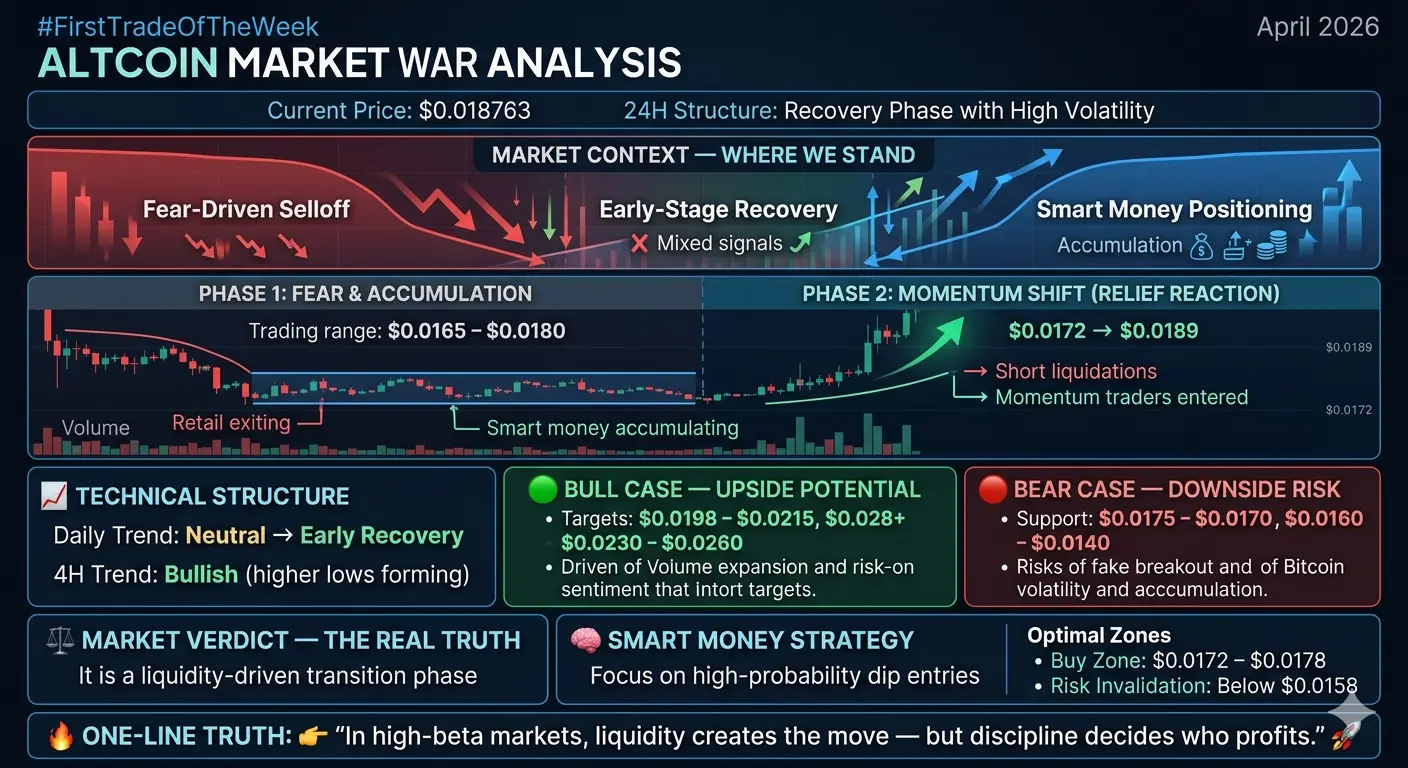
💰 BLESS Price: $0.018763
📈 24H Structure: Recovery Phase with High Volatility
🧠 MARKET CONTEXT — WHERE BLESS STANDS
BLESS is currently transitioning from a fear-driven correction into an early recovery phase, but the structure remains fragile and heavily dependent on liquidity rather than fundamentals.
After a 40–55% drawdown from recent highs, BLESS has:
Flushed weak hands
Reduced selling pressure
Entered a quiet accumulation phase
👉 This behavior typically signals
BLESS-11.4%
HighAmbition
#FirstTradeOfTheWeek
BLESS MARKET WAR ANALYSIS
April 2026 | “Liquidity Decides the Winner, Not Emotion”
💰 BLESS Price: $0.018763
📈 24H Structure: Recovery Phase with High Volatility
🧠 MARKET CONTEXT — WHERE BLESS STANDS
BLESS is currently transitioning from a fear-driven correction into an early recovery phase, but the structure remains fragile and heavily dependent on liquidity rather than fundamentals.
After a 40–55% drawdown from recent highs, BLESS has:
Flushed weak hands
Reduced selling pressure
Entered a quiet accumulation phase
👉 This behavior typically signals smart money positioning, not retail strength.
However, this is still a transition zone, not a confirmed trend reversal.
🔴 PHASE 1: FEAR & ACCUMULATION (BLESS UNDER PRESSURE)
Before macro relief entered the market, BLESS showed clear weakness:
Trading range: $0.0165 – $0.0180
Strong accumulation base: $0.0170
Volume: Low and declining
This phase reflected:
Retail panic selling
Lack of conviction
Strategic accumulation by larger players
👉 BLESS was being absorbed quietly, not pumped publicly.
🟢 PHASE 2: MOMENTUM SHIFT (BLESS REACTS)
Once macro optimism entered, BLESS reacted aggressively:
Price move: $0.0172 → $0.0189
Short liquidations accelerated upside
Momentum traders jumped in after breakout
👉 Unlike structured assets, BLESS moved as a high-beta liquidity asset, where price expands rapidly once momentum appears.
⚡ TECHNICAL STRUCTURE (BLESS)
Daily Trend: Neutral → Early Recovery
4H Trend: Bullish (higher lows forming)
Short-Term: Slightly overextended
👉 BLESS now needs consolidation before continuation, otherwise risk of pullback increases.
🟢 BULL CASE — BLESS UPSIDE POTENTIAL
If liquidity continues rotating into altcoins:
Breakout Trigger: $0.019
Short-Term Target: $0.0198 – $0.0215
Mid-Term Expansion: $0.0230 – $0.0260
High Momentum Zone: $0.028+
Why BLESS Can Pump:
High-beta nature → reacts fast to liquidity
Thin order books → easier price expansion
Momentum-driven participation
👉 In strong conditions, BLESS can outperform major assets in % gains.
🔴 BEAR CASE — BLESS DOWNSIDE RISK
If momentum fades:
First Support: $0.0175 – $0.0170
Breakdown: $0.0160 – $0.0155
Capitulation: $0.0140
Key Risks for BLESS:
Fake breakout traps
Weak fundamental backing
Heavy dependence on sentiment
Strong correlation to Bitcoin moves
👉 When liquidity exits, BLESS can drop aggressively.
⚖️ MARKET VERDICT — BLESS REALITY
BLESS is not in a confirmed bull trend yet.
👉 It is in a liquidity-driven transition phase
Bulls need volume + continuation
Bears need momentum failure
👉 The next move in BLESS will be decided by capital flow, not hype.
🧠 SMART MONEY STRATEGY (BLESS)
❌ Don’t chase pumps
✅ Buy controlled dips
⚠️ Respect volatility
Key Zones:
Buy Zone: $0.0172 – $0.0178
Strong Accumulation: $0.0165 – $0.0170
Invalidation: Below $0.0158
👉 BLESS rewards timing, not emotions.
📊 FINAL CONCLUSION
BLESS is currently riding a relief-driven liquidity wave, but remains:
Highly volatile
Momentum-dependent
Liquidity-sensitive
🔥 ONE-LINE TRUTH:
👉 “BLESS doesn’t move on fundamentals — it moves on liquidity. Control risk, or the market will control you.” 🚀
repost-content-media
  • Reward
  • Comment
  • Repost
  • Share
#GatePreIPOsLaunchesWithSpaceX
🚀 Gate Pre-IPO SpaceX Launch — Complete Simple Breakdown
🔥 Introduction
Gate.io has launched a new Pre-IPO trading system where users can trade a token called SPCX that follows the value of SpaceX, allowing global users to access private company exposure before its official IPO while staying fully inside the crypto ecosystem using USDT without relying on traditional financial systems.
📊 Basic Details
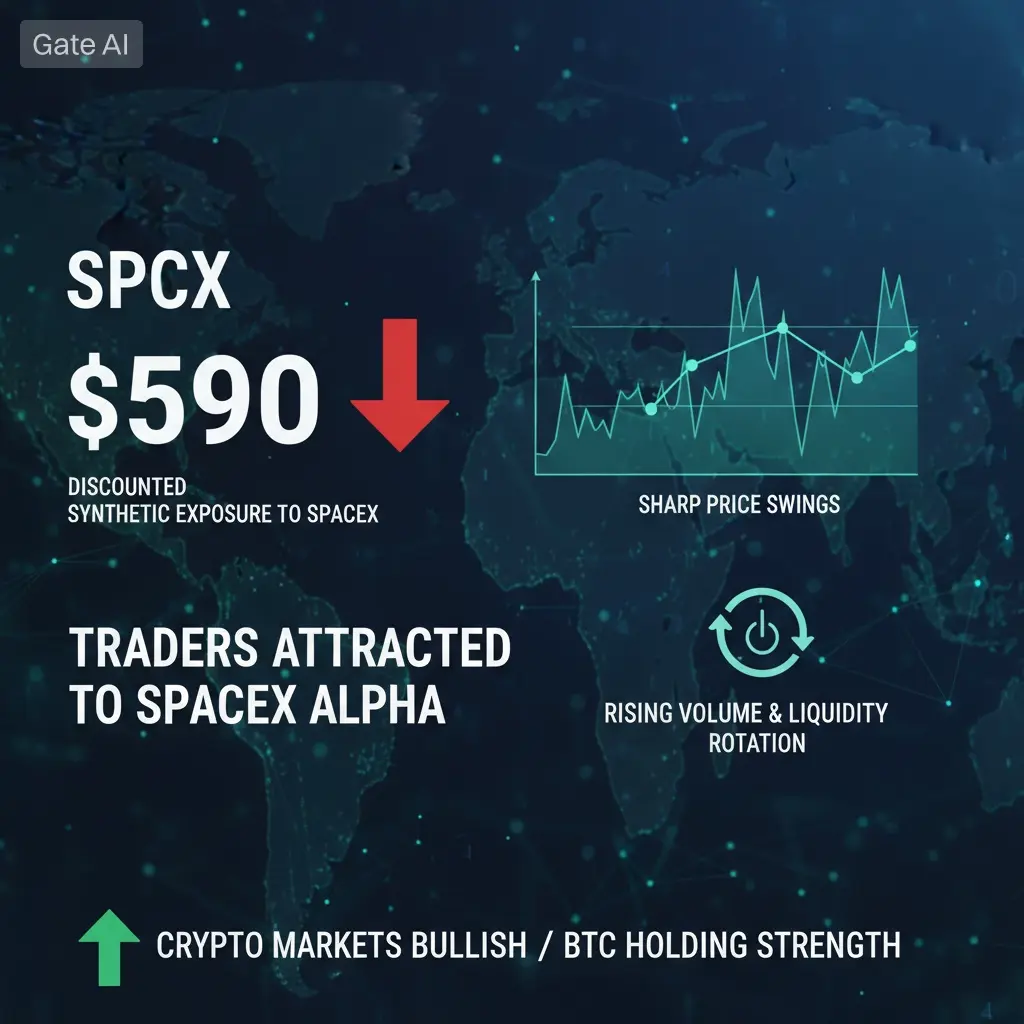
The SPCX token is priced around $590 with a minimum entry of 100 USDT and a full unlock after listing on April 24, which means users will be able to buy and sell
HighAmbition
#GatePreIPOsLaunchesWithSpaceX
🚀 Gate Pre-IPO SpaceX Launch — Complete Simple Breakdown
🔥 Introduction
Gate.io has launched a new Pre-IPO trading system where users can trade a token called SPCX that follows the value of SpaceX, allowing global users to access private company exposure before its official IPO while staying fully inside the crypto ecosystem using USDT without relying on traditional financial systems.
📊 Basic Details
The SPCX token is priced around $590 with a minimum entry of 100 USDT and a full unlock after listing on April 24, which means users will be able to buy and sell freely from the first day without any lockup period, making it much more flexible compared to traditional pre-IPO investments that usually restrict access and withdrawals.
📈 Price Movement Expectations
The price of SPCX is expected to show strong volatility in the early phase because high demand and market excitement can push the price up by around 10% to 30% quickly, while sharp intraday swings and later corrections may happen when early investors start taking profits, meaning traders should expect fast movements instead of slow and stable growth.
💧 Liquidity Flow Explained
During the subscription phase, funds are locked and demand builds quietly in the background, but after the launch those funds enter active trading which creates a sudden increase in buying and selling pressure, leading to rapid price discovery and heavy activity especially within the first 24 to 72 hours.
📊 Trading Volume Behavior
Trading volume is expected to increase significantly on launch day because new listings usually attract speculators, short-term traders, and early participants who want to secure profits, while after the initial excitement the volume may stabilize but still remain higher than normal due to continued interest in the asset.
🚀 Why This Product is Important
Gate.io is building a bridge between traditional finance and crypto by offering synthetic exposure to a private company without giving actual shares, which allows everyday users to access opportunities that were previously limited to large investors while keeping trading fast, liquid, and globally accessible.
🧠 Why SpaceX is Attracting Demand
SpaceX is gaining strong attention because it represents future growth through satellite internet like Starlink, expanding space technology, and potential for one of the biggest IPOs in history, which creates strong interest among traders who are focused on high-growth opportunities.
🌍 Impact on Crypto Market
This launch can increase overall market activity because it attracts new liquidity, encourages users to move funds from stablecoins into SPCX, and later pushes that capital back into major cryptocurrencies like Bitcoin and altcoins, creating a cycle that boosts trading volume and engagement across the platform.
⚠️ Risk Factors
It is important to understand that SPCX does not provide real ownership of SpaceX shares, the price can move aggressively based on market sentiment, and uncertainty about IPO timing or valuation can create unexpected outcomes, which means this product is better suited for active traders who understand high-risk environments.
🧩 Future Insight
This launch may be the beginning of a new trend where more private companies become tokenized and tradable before their IPO, gradually transforming global investing into a faster, more open, and more accessible system for everyone.
📌 Final Conclusion
The SpaceX Pre-IPO launch by Gate.io represents a new way of investing where access becomes easier, liquidity becomes instant, and global users can participate in early-stage opportunities with higher risk and higher potential rewards.
⚡ Final One-Line Insight
Early access to future big companies is now tradable, but it comes with fast price movement and high risk.
repost-content-media
  • Reward
  • Comment
  • Repost
  • Share
#AltcoinsRallyStrong
The crypto market is buzzing with fresh optimism as the phrase Altcoins Rally Strong spreads rapidly across social platforms like X (Twitter). Traders and analysts are highlighting encouraging signs of momentum in major altcoins, including impressive technical breakouts, rising ETF inflows, and notable market cap gains. While Bitcoin continues to dominate the market, many see this as the early stage of capital rotation toward altcoins, driven by improving fundamentals and strong institutional interest. However, caution remains high because a full-scale altseason has not y
HighAmbition
#AltcoinsRallyStrong
The crypto market is buzzing with fresh optimism as the phrase Altcoins Rally Strong spreads rapidly across social platforms like X (Twitter). Traders and analysts are highlighting encouraging signs of momentum in major altcoins, including impressive technical breakouts, rising ETF inflows, and notable market cap gains. While Bitcoin continues to dominate the market, many see this as the early stage of capital rotation toward altcoins, driven by improving fundamentals and strong institutional interest. However, caution remains high because a full-scale altseason has not yet been confirmed, keeping the current phase as a selective rally rather than a broad one
Institutional and ETF Inflows: A major talking point is the continued inflows into spot ETFs for Ethereum, Solana, and XRP. Users highlight accumulation by large holders (e.g., institutions adding significant ETH) and how these flows provide a structural tailwind. Recent daily inflows are seen as signals that traditional capital is slowly rotating into the broader crypto ecosystem.
Ecosystem Developments and Utility Expansion: Posts discuss real-world utility boosts, such as XRP becoming available as a wrapped token on Solana (wXRP), enhancing cross-chain liquidity. Other highlights include Solana’s high-speed advantages for DeFi and NFTs, Ethereum’s dominant role in staking and DeFi, and regulatory clarity benefiting XRP’s institutional adoption. Privacy upgrades like ZK tech on XRP Ledger also get attention.
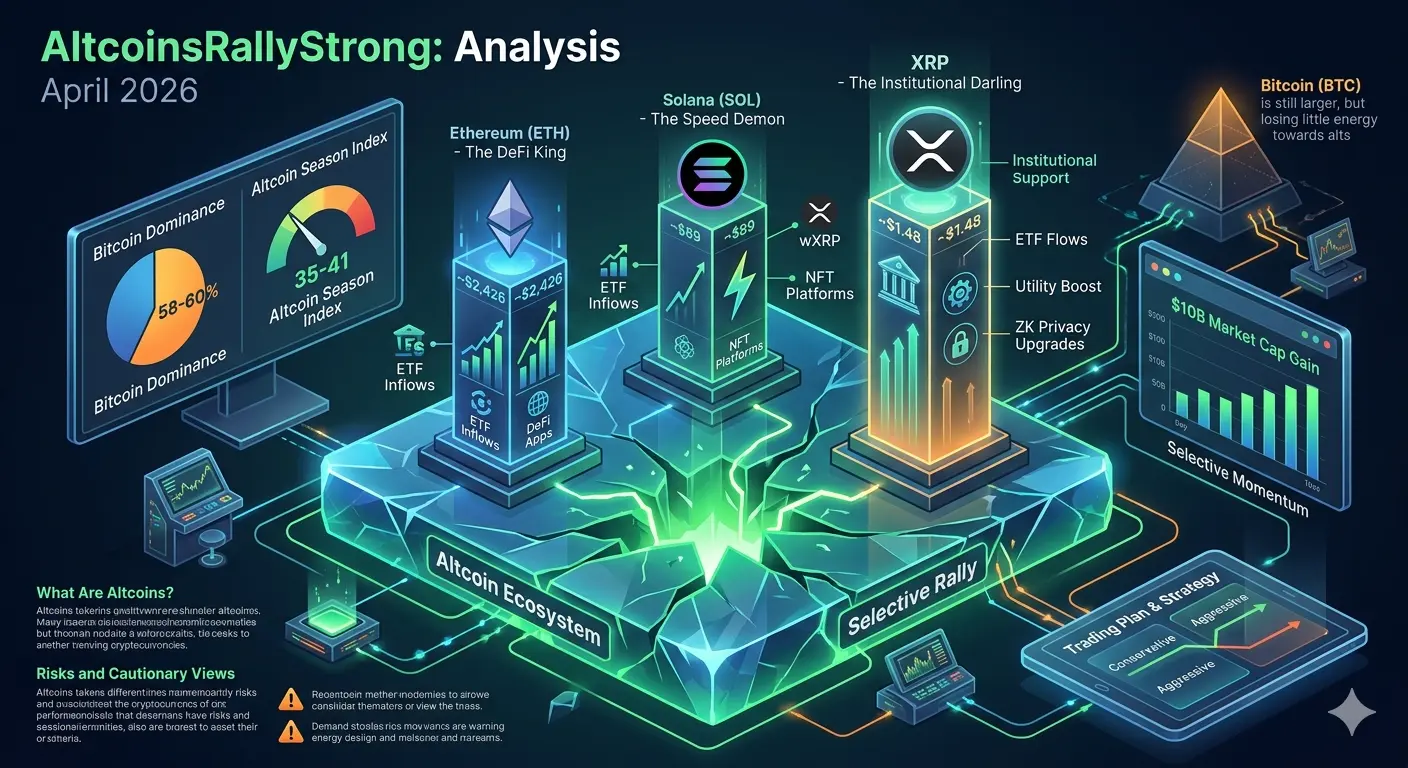
Market Structure Signals: Users debate Bitcoin dominance (currently hovering around 58-60%), noting it remains elevated but showing early signs of potential decline. The Altcoin Season Index sits in the 35-41 range — well below the 75+ threshold for a confirmed altseason — leading to descriptions of a “selective alt rally” rather than a broad one. Recent altcoin market cap additions (around $10B in a single day in recent weeks) and falling wedges on long-term charts are viewed positively.
Risks and Cautionary Views: Not all sentiment is bullish. Some analysts point out overbought indicators (e.g., high CCI or RSI nearing extremes), potential short-term pullbacks, and external factors like macroeconomic uncertainty. Discussions stress that while optimism is building, capital is still Bitcoin-heavy, and a full rotation requires BTC dominance to drop meaningfully (ideally below 55%).
Price Speculation and Targets: Traders post short- and medium-term forecasts, with many expecting ETH to challenge $2,600–$3,500, SOL toward $100–$150, and XRP pushing $1.75–$3.00 if momentum sustains. Aggressive voices talk about bigger upside in a maturing bull cycle, but most emphasize risk management.
Overall, Altcoins Rally Strong captures a phase of cautious optimism: genuine improvements in select altcoins are visible, but the market is still in a Bitcoin-led environment with altcoins showing strength in pockets rather than uniformly.
Comprehensive Altcoin Rally Analysis
Here is the complete, detailed analysis combining the social discussions with an in-depth review of major altcoins, technicals, catalysts, forecasts, and strategies..
What Are Altcoins?
Altcoins are all cryptocurrencies except Bitcoin. They include thousands of projects with varied use cases — from Ethereum’s smart contracts and DeFi dominance to Solana’s high throughput for NFTs and apps, XRP’s focus on cross-border payments, and others emphasizing interoperability, oracles, or scalability. Altcoins generally offer higher volatility and potential returns than Bitcoin during bullish phases, but they also carry greater risk due to lower liquidity and more speculative nature in many cases.
Overview of 8 Major Altcoins
In the current market (mid-April 2026), Ethereum trades near $2,426 with a market cap of roughly $292–293 billion. XRP sits around $1.48 with a market cap near $91 billion. Solana is priced at approximately $89 with a $51 billion market cap. Cardano holds at about $0.259 with a $9.6 billion cap. Chainlink is near $9.64 ($7 billion cap), Avalanche at $9.77 ($4.2 billion), and Polkadot at $1.34 ($2.2 billion). Polygon trades lower near $0.09 with a smaller market cap. These assets represent core infrastructure layers, payment rails, data solutions, and scaling technologies that often lead altcoin movements.
Top 3 Trending Altcoins Deep Dive
1. Ethereum (ETH) – The DeFi King
Ethereum currently trades at around $2,426, showing a 24h gain of about +3.5%, 7-day rise near +10%, and 30-day performance around +13%. Its market cap exceeds $292 billion.
Technically, 4-hour moving averages are bullishly aligned, with ADX around 27 indicating solid trend strength and a double-bottom pattern hinting at reversal potential. Volume has surged notably, while daily RSI sits at ~65 — elevated but not fully overbought.
Key catalysts include massive institutional accumulation (one entity holding over 4% of supply) and consistent ETH ETF inflows. Staking demand remains robust.
Short-term resistance lies near $2,465, with breakouts eyeing $2,600–$2,800. Medium-term, if Bitcoin holds above $76K, ETH could target $3,000–$3,500 (20–45% upside in Q2 2026).
Strategy: Accumulate at current levels or dips to $2,350–$2,400. Stop below $2,300; targets at $2,800 then $3,200.
2. Solana (SOL) – The Speed Demon
SOL trades near $89, with modest 24h change (+0.2–1%), stronger 7-day gains (~9%), but slight 30-day softness. Market cap is approximately $51 billion.
On charts, 4-hour trends show bullish alignment with a high ADX (~38) confirming momentum, plus MACD bullish divergence daily. However, CCI near 174 signals overbought risk for possible pullbacks. Liquidity is healthy with solid daily volume.
Catalysts include ecosystem growth, XRP integration as a wrapped asset on Solana, disclosed institutional holdings, and ongoing SOL ETF inflows (though tempered by some unstaking events).
Short-term: Resistance at $90; breakout could push to $100–$110. Medium-term targets range $120–$150 (12–68% upside).
Strategy: Buy dips in the $85–$88 zone. Stop below $82; conservative target $100, aggressive $120.
3. XRP – The Institutional Darling
XRP is at approximately $1.48, up ~3% in 24h, +11–12% over 7 days, and modestly positive over 30 days, with a market cap near $91 billion.
It displays the strongest relative momentum, breaking upper Bollinger Bands with high PDI vs low MDI. Volume is 2.5x average, and RSI (~65) still has room to run.
Drivers include over $1.5 billion in XRP ETF inflows, expanded utility via Solana integration, ZK privacy upgrades on its ledger, and post-regulatory clarity boosting institutional interest.
Short-term: Testing $1.50; breakout aims for $1.75–$2.00. Medium-term with ETF support: $2.50–$3.00 (17–102% potential).
Strategy: Accumulate dips to $1.40–$1.45. Stop below $1.35; targets $1.75 then $2.20.
Market Context: Is Altseason Here?
As of April 2026, Altcoins Rally Strong sentiment is supported by technical progress and ETF flows, but data shows we are in a selective rally phase, not a full altseason. Bitcoin dominance remains high at 58–60%, keeping most capital in BTC. The Altcoin Season Index hovers between 35–41 (far below 75), confirming altcoins are not broadly outperforming Bitcoin over recent 90-day periods. Positive notes include recent altcoin market cap gains of ~$10B in a day (reaching ~$190B) and long-term chart breakouts like a 5-year falling wedge. USDT dominance failing prior highs is another encouraging sign.
Key signals to monitor: BTC dominance falling below 55%, Alt Season Index crossing 75, sustained mid-cap volume, and ETH/BTC pair recovery.
Trading Plan & Strategy
Conservative Traders: Prioritize liquid majors like ETH and SOL. Use DCA on dips and wait for clearer BTC dominance decline before heavy alt exposure.
Aggressive Traders: Lean into XRP’s current momentum, watch AVAX for ETF-related plays, and consider DOT as a potential recovery/value opportunity.
Risk Management Essentials:
Limit any single altcoin to 5–10% of portfolio.
Cap total alt exposure at 30–50%.
Always use technical stop losses.
Scale out profits gradually (e.g., 25% at each target).
How High Can They Go? Price Targets (April 2026 Context)
ETH (~$2,426): Conservative $2,800 | Aggressive $3,500 (15–44% upside)
SOL (~$89): Conservative $110 | Aggressive $150 (24–68% upside)
XRP (~$1.48): Conservative $2.00 | Aggressive $3.00 (35–103% upside)
ADA (~$0.26): Conservative $0.32 | Aggressive $0.40 (23–54%)
LINK (~$9.64): Conservative $12 | Aggressive $15 (24–56%)
AVAX (~$9.77): Conservative $13 | Aggressive $16 (33–64%)
Higher targets assume continued ETF support, macro improvement, and eventual capital rotation.
Conclusion & Key Takeaways
The Altcoins Rally Strong narrative has solid backing from technical improvements, ETF inflows, and ecosystem progress — especially in ETH, SOL, and XRP. However, with Bitcoin dominance still elevated and the Altcoin Season Index low, this remains a selective rally rather than a broad altseason.
Key Takeaways:
ETH stands out due to institutional accumulation and strong ETF flows.
SOL gains from speed, ecosystem expansion, and growing adoption.
XRP leads in short-term momentum thanks to regulatory wins and utility growth.
Monitor BTC dominance closely — a drop below 55% would likely accelerate altcoin moves.
Prioritize risk management, as altcoins stay highly volatile.
repost-content-media
  • Reward
  • Comment
  • Repost
  • Share
#AnthropicvsOpenAIHeatsUp
🚀 Anthropic vs OpenAI (2026): The AI War That’s Reshaping the Future
The battle between Anthropic (Claude) and OpenAI (ChatGPT) is no longer just competition — it’s a full-scale AI power war involving billions of dollars, global influence, and the future direction of artificial intelligence.
What started as a quiet split between researchers has now turned into the most important tech rivalry of this decade.
⚔️ 1. The Origins — From Partners to Rivals
At the center of this battle are two key figures:
Sam Altman — the aggressive visionary pushing rapid AI adoption
Dar
HighAmbition
#AnthropicvsOpenAIHeatsUp
🚀 Anthropic vs OpenAI (2026): The AI War That’s Reshaping the Future
The battle between Anthropic (Claude) and OpenAI (ChatGPT) is no longer just competition — it’s a full-scale AI power war involving billions of dollars, global influence, and the future direction of artificial intelligence.
What started as a quiet split between researchers has now turned into the most important tech rivalry of this decade.
⚔️ 1. The Origins — From Partners to Rivals
At the center of this battle are two key figures:
Sam Altman — the aggressive visionary pushing rapid AI adoption
Dario Amodei — the safety-first architect of controlled intelligence
Anthropic was born out of internal disagreements at OpenAI — especially around AI safety vs speed.
👉 Translation:
This is not just business… it’s ideology vs ideology.
🧠 2. Model War — Power vs Precision
🔹 Latest Models:
Claude Opus 4.7 (Anthropic)
GPT-5.4 (OpenAI)
🔍 Who Wins Where?
✔ Claude Dominates:
Long-context reasoning (1M tokens 🔥)
Complex coding & debugging
Deep document analysis
Lower hallucination rate in long tasks
✔ ChatGPT Dominates:
Speed ⚡
Everyday usability
Structured answers
Mass adoption & UI experience
👉 Reality Check:
There is no single winner — the best users are now using BOTH.
💰 3. The Money War — Where It Gets Serious
This is where things get shocking:
Anthropic
~$30B annual revenue
~$380B valuation
FASTEST growth in AI right now
OpenAI
~$25B revenue
~$850B valuation
Still the global brand leader
👉 Key Insight:
OpenAI leads perception. Anthropic leads momentum.
🧨 4. The Hidden Battlefield — Enterprise AI
The real war is NOT retail users…
It’s about who controls AI inside companies, governments, and infrastructure.
Anthropic is winning:
Enterprise contracts
Long-form analysis tools
Secure AI deployments
OpenAI is winning:
Consumer market
Developer ecosystem
Product integration (Microsoft edge)
👉 This is like:
Anthropic = “AI for serious work”
OpenAI = “AI for the world”
⚡ 5. Controversies & Clashes
This war has turned public and aggressive:
🔥 Ad War
Anthropic criticized ChatGPT for ads
Positioned Claude as “clean & unbiased AI”
🔥 Military Contracts
Pentagon deals sparked major backlash
Safety vs national security debate intensified
🔥 Public Accusations
Amodei accused OpenAI of “safety theater”
Trust vs speed became the core conflict
👉 This is no longer polite competition — it’s reputation warfare.
👥 6. What Smart Users Are Doing
Power users are evolving:
Developers → Claude for heavy coding
Traders & researchers → Claude for deep analysis
Everyday users → ChatGPT for speed & convenience
👉 New trend:
AI Multi-Tool Strategy
(Using different AIs like switching between apps)
🔮 7. What Happens Next?
🚀 Both heading toward IPO (late 2026)
💸 Anthropic expected to raise $60B+
🏢 Enterprise AI market explosion incoming
But the BIGGEST shift?
👉 AI is moving from: “Cool tool” → “Global infrastructure layer”
🧠 8. My Strategic Insight (Important)
This war is not about chatbots anymore.
It’s about:
Who controls knowledge systems
Who powers governments & finance AI
Who becomes the default intelligence layer of the internet
👉 The real winner will be: Not the fastest model…
But the one that becomes impossible to replace.
⚖️ Final Verdict — Who’s Winning?
🏆 OpenAI = Brand, scale, global reach
🚀 Anthropic = Technology depth, enterprise dominance, growth
👉 If this were crypto:
OpenAI = Bitcoin (dominant, trusted, everywhere)
Anthropic = Ethereum (powerful, flexible, growing fast)
💥 Simple One-Line Take
OpenAI owns the present.
Anthropic is aggressively building the future.
🚀 Closing Thought
This is just the beginning.
The AI war of 2026 will define:
Tech markets
Job markets
Global power structures
And for users?
👉 You’re in the best position ever —
because competition is making AI faster, smarter, and cheaper every month.
repost-content-media
  • Reward
  • Comment
  • Repost
  • Share
#周末交易计划
Weekend Trading Plan: A Comprehensive Market Analysis for April 18-19, 2026
The crypto market is currently going through a highly sensitive phase where global geopolitical news, institutional capital flows, and technical market structures are all interacting at the same time. This creates a complex environment where both opportunities and risks exist simultaneously, and the market direction can shift quickly based on new information.
Below is a simplified but detailed breakdown of the current situation and key discussion points for this weekend.
1. Market Recovery vs. Continued Coolin
BTC-1.35%
ETH-2.62%
SOL-1.5%
HighAmbition
#周末交易计划
Weekend Trading Plan: A Comprehensive Market Analysis for April 18-19, 2026
The crypto market is currently going through a highly sensitive phase where global geopolitical news, institutional capital flows, and technical market structures are all interacting at the same time. This creates a complex environment where both opportunities and risks exist simultaneously, and the market direction can shift quickly based on new information.
Below is a simplified but detailed breakdown of the current situation and key discussion points for this weekend.
1. Market Recovery vs. Continued Cooling: Current Situation
The market is currently divided between two main views: whether this is the beginning of a stronger recovery or just a temporary relief phase inside a broader consolidation structure.
Bitcoin has shown a strong recovery move recently, rising from the mid-$70,000 range and briefly reaching $78,320, before stabilizing around $77,282. This represents a 3.55% gain over 24 hours, while Ethereum also followed with a 3.84% increase at $2,419. A major driver behind this movement has been improving global sentiment after positive geopolitical developments related to energy supply stability, which reduced immediate fear in risk markets.
From a bullish perspective, several factors are supporting the idea of continued recovery:
Institutional participation remains strong, with large financial institutions consistently increasing exposure through Bitcoin ETFs.
On-chain data shows long-term holders increasing their dominance, while short-term speculative pressure has decreased.
Funding conditions in derivatives markets suggest many leveraged positions are leaning short, which could lead to forced buying if prices continue rising.
Large investors and whales continue accumulating both Bitcoin and Ethereum during dips, indicating long-term confidence.
However, there are still reasons for caution. The market is not fully stable yet:
Bitcoin is facing strong resistance near the $76,000–$78,000 zone, where price has struggled to break and hold above.
Global geopolitical conditions remain uncertain, and any negative development could quickly shift sentiment.
Technical structure still shows signs of consolidation rather than a clean upward trend.
Some indicators suggest that while recovery is happening, it is not yet strong enough to confirm a full bullish continuation.
Overall, the market is currently in a partial recovery phase with ongoing uncertainty, where direction is still not fully confirmed.
2. Assets Showing Strength and Market Attention
Several major assets are currently being closely watched due to their technical behavior and ecosystem developments.
Bitcoin (BTC) — Institutional Strength Leader
Bitcoin continues to be the strongest asset in terms of institutional demand and long-term confidence. ETF inflows and accumulation trends show that major investors are still actively positioning in BTC.
Key price behavior shows a controlled range between support and resistance, with strong reactions near key levels. If Bitcoin breaks above $78,000, it may open further upside momentum, while failure to hold support could lead to short-term correction.
Ethereum (ETH) — Expanding Ecosystem Activity
Ethereum remains one of the most active networks in terms of real usage and transaction growth. Increased activity from Layer 2 networks and stablecoin flows continues to strengthen its long-term position.
At the same time, Ethereum is also seeing strong participation from leveraged traders and large position holders, indicating high interest but also increased volatility.
Key levels show resistance near $2,465, while support remains strong near $2,350. A breakout above higher resistance zones could extend bullish momentum further.
Solana (SOL) — High Volatility Growth Asset
Solana continues to attract attention as a high-speed blockchain ecosystem with increasing trading activity and futures participation. It is often viewed as a high-beta asset, meaning it reacts strongly to overall market sentiment.
While not as stable as BTC or ETH, it remains an important speculative asset during periods of rising risk appetite.
Layer 2 Ecosystem Tokens
Tokens linked to Ethereum scaling solutions are also gaining attention due to increasing adoption of Layer 2 networks. Lower transaction costs and higher efficiency are making these networks more competitive and widely used.
This creates long-term growth potential, especially if Ethereum network activity continues expanding.
3. Key Signals That Could Change Market Direction
This weekend, the market is highly sensitive to external triggers that could quickly change price direction.
Geopolitical Developments
Energy and global supply chain stability remain important factors. Any changes in international relations or energy flow agreements can impact risk sentiment across all financial markets, including crypto.
Positive developments generally support risk-on behavior
Negative developments can quickly trigger volatility and risk reduction
Options Expiry Impact
Large crypto options contracts are expiring this weekend, which may influence short-term price movement. Prices often move toward areas where most options contracts expire, creating temporary pressure zones.
This can result in short-term volatility even without major fundamental changes.
Institutional Flow Behavior
Large wallet movements and ETF-related positioning remain important signals. Any sudden accumulation or distribution from major players can significantly impact short-term market direction.
The market is still highly sensitive to institutional behavior, especially during low-liquidity weekend conditions.
Technical Breakout Zones
Key technical levels are very important for determining next direction:
If Bitcoin moves above $78,000, it may trigger stronger bullish continuation
If it falls below $73,300, it could enter a deeper correction phase
Ethereum above $2,500 may confirm upward continuation
Ethereum below $2,300 may indicate short-term weakness
Trading Strategy Overview
In this type of environment, the market requires careful planning rather than aggressive positioning.
For bullish positioning, traders generally prefer confirmation above resistance levels before entering strong positions. For bearish positioning, rejection from resistance zones is often used for short-term opportunities.
For neutral traders, patience is important. The weekend environment is typically low liquidity, meaning price can move quickly in both directions without strong confirmation.
Final Thoughts
The crypto market is currently at an important decision point where both bullish continuation and corrective risk remain possible. Strong institutional participation and improving long-term structure support optimism, but technical resistance and macro uncertainty still prevent a clear breakout confirmation.
This weekend should be viewed as a transition phase, where the market is preparing for its next major move rather than already committing to a clear direction.
Careful observation, patience, and risk control remain essential in this environment, as the next significant breakout or breakdown could define the broader trend for the coming weeks.
repost-content-media
  • Reward
  • Comment
  • Repost
  • Share
#BTCMarketAnalysis
🌍 1. Geopolitical Market Catalyst and Global Impact
The global financial environment is currently influenced by the US–Iran temporary ceasefire agreement, which has reduced immediate geopolitical tension and shifted market sentiment toward a short-term risk-on phase. This has improved liquidity conditions across global markets and supported risk assets like Bitcoin.
However, the situation remains fragile due to the temporary nature of the agreement, meaning markets are still highly sensitive to any breakdown in negotiations or renewed geopolitical stress.
📊 2. Bitcoin Pri
BTC-1.35%
HighAmbition
#BTCMarketAnalysis
🌍 1. Geopolitical Market Catalyst and Global Impact
The global financial environment is currently influenced by the US–Iran temporary ceasefire agreement, which has reduced immediate geopolitical tension and shifted market sentiment toward a short-term risk-on phase. This has improved liquidity conditions across global markets and supported risk assets like Bitcoin.
However, the situation remains fragile due to the temporary nature of the agreement, meaning markets are still highly sensitive to any breakdown in negotiations or renewed geopolitical stress.
📊 2. Bitcoin Price, Performance & Market Condition
Bitcoin is currently trading at $76,013, showing:
24H Change: +0.91%
7D Performance: +7.45%
Recent Recovery: from below $70,000
Current Zone: $75,000 – $76,013 consolidation area
The market is in a compression phase where price is stabilizing between support and resistance zones, preparing for a potential breakout or pullback depending on liquidity direction.
💧 3. Liquidity, Volume & Market Structure
24H Volume: $612.8M (strong participation)
Liquidity Zones: $74,500 – $75,000 – $76,500 – $78,000
Market Behavior:
Buyers defending $75K support
Sellers concentrated near $78K resistance
Liquidity thinning above $78K (potential breakout zone)
📌 The market is currently in a liquidity compression phase, where energy is building for a larger directional move.
📈 4. Technical Structure (Price Zones)
🟢 Support Levels:
$72,000 → strong structural support
$70,000 → accumulation zone
$68,000 → deeper liquidity safety zone
🔴 Resistance Levels:
$78,000 → breakout trigger
$80,000 → momentum acceleration zone
$85,000 → extended bullish target
📌 Current price $76,013 is sitting in the middle of a key decision zone.
🚀 5. What Can Make Bitcoin Go UP (Bullish Drivers)
💰 Institutional Buying & ETF Inflows
Large-scale investors such as ETFs and institutions continuously buying Bitcoin creates strong demand pressure. This reduces circulating supply and pushes price upward gradually.
🌍 Geopolitical Stability
When global tensions reduce (like the current ceasefire situation), investors move toward risk assets. Bitcoin benefits as capital rotates from safe assets into high-growth assets.
💵 Global Liquidity Expansion
When central banks inject liquidity or reduce interest rates, more money enters financial markets. This increases investment flow into Bitcoin and crypto.
📈 Breakouts Above Key Levels
If Bitcoin breaks:
$78,000 → momentum starts
$80,000 → strong retail FOMO begins
$85,000+ → full trend acceleration
🧠 Market Sentiment Shift
When fear turns into greed, retail participation increases, often driving rapid upward moves.
🔻 6. What Can Make Bitcoin Go DOWN (Bearish Drivers)
⚠️ Geopolitical Shock Return
If the ceasefire fails or tensions rise again:
Risk-off sentiment increases
Investors move to USD and safe assets
Bitcoin may drop sharply toward support zones
💸 Liquidity Drain
If ETF inflows slow or capital leaves exchanges:
Buying pressure decreases
Market becomes weak even without bad news
Price starts drifting downward
🏭 Miner Selling Pressure
Miners selling BTC to cover operational costs increases supply in the market and creates short-term downward pressure.
📉 Technical Overextension
If price becomes overbought:
Short-term corrections occur
Market resets before continuation
🌐 Global Risk-Off Environment
If stock markets or global economy weaken:
Bitcoin can temporarily fall due to correlation with risk assets
🧠 7. Market Psychology & Behavior
Current market behavior shows a clear divide:
Institutions are accumulating quietly
Retail traders are uncertain due to volatility
Market is moving in compression rather than trend
This type of structure usually leads to a sharp expansion move once liquidity imbalance breaks.
🎯 8. Final Market Outlook
Bitcoin is currently in a cautiously bullish consolidation phase, where institutional demand supports price stability while macro uncertainty limits breakout speed.
The market is building energy between $75K–$78K, preparing for a potential expansion phase once liquidity direction becomes clear.
🧩 FINAL VERDICT
Bitcoin is currently in a highly compressed market structure where $75,000 acts as strong support, $78,000 acts as breakout trigger, and institutional accumulation is balancing against geopolitical uncertainty, liquidity flow changes, and macroeconomic conditions, creating a setup for a major directional move either toward $80K–$85K or back toward $72K–$70K depending on which forces dominate next.
repost-content-media
  • Reward
  • Comment
  • Repost
  • Share
#AIInfraShiftstoApplications
.#AIInfraShiftstoApplications – The Structural Turning Point of the AI Economy
The artificial intelligence landscape is entering a decisive phase of evolution, where the center of gravity is shifting away from infrastructure-heavy development toward large-scale, real-world application deployment. This is not a minor adjustment in trend—it is a structural transition that will redefine how value is created, captured, and distributed across the entire AI ecosystem.
🔷 1. The Infrastructure Phase Is Maturing
The first major cycle of AI growth was dominated by infrastr
HighAmbition
#AIInfraShiftstoApplications
.#AIInfraShiftstoApplications – The Structural Turning Point of the AI Economy
The artificial intelligence landscape is entering a decisive phase of evolution, where the center of gravity is shifting away from infrastructure-heavy development toward large-scale, real-world application deployment. This is not a minor adjustment in trend—it is a structural transition that will redefine how value is created, captured, and distributed across the entire AI ecosystem.
🔷 1. The Infrastructure Phase Is Maturing
The first major cycle of AI growth was dominated by infrastructure expansion. This included the development of:
Large language models trained on massive datasets
High-performance GPU clusters and distributed compute systems
Cloud-based AI platforms and foundational APIs
Advanced model optimization and scaling techniques
During this phase, competition was primarily about capability and scale. The goal was to build stronger, larger, and more intelligent systems that could serve as the backbone for future innovation.
However, this phase is now reaching maturity. Marginal gains in infrastructure are becoming more expensive and less transformative compared to earlier breakthroughs. As a result, the industry is naturally transitioning toward the next logical stage.
🔷 2. The Shift Toward Application-Layer Dominance
The new phase is defined by AI application integration at scale. Instead of focusing on building models from scratch, companies are now focused on embedding intelligence into usable products and services.
This includes:
AI-powered financial trading systems and market intelligence platforms
Automated healthcare diagnostics and decision-support tools
Intelligent cybersecurity systems capable of adaptive threat detection
AI-driven supply chain optimization and logistics automation
Generative AI platforms for content, media, and digital production
The key shift is simple but powerful:
👉 From “building intelligence” → to “deploying intelligence”
🔷 3. Value Migration Across the Ecosystem
One of the most important implications of this shift is the movement of economic value across layers of the AI stack.
Infrastructure Layer (Earlier Dominant): GPU providers, cloud platforms, model training systems
Application Layer (Now Emerging Dominant): AI-native software, automation platforms, and end-user tools
While infrastructure remains essential, its explosive growth phase is stabilizing. The strongest upside potential is increasingly concentrated in applications that sit directly on top of this foundation.
This is where real monetization happens—where AI directly interacts with users, businesses, and markets.
🔷 4. Financial Markets & AI Integration
In financial ecosystems, including crypto markets, this shift is particularly visible. AI is no longer just a supporting tool—it is becoming a central decision-making engine.
Key developments include:
Algorithmic trading systems reacting to real-time sentiment
Predictive models analyzing liquidity flows and volatility patterns
Automated portfolio rebalancing systems
AI-driven risk management frameworks
This reduces latency in decision-making and increases dependency on machine intelligence for short-term execution strategies.
🔷 5. The New Competitive Advantage
In the application era, the competitive edge is no longer defined by who builds the largest model, but by who can:
Integrate AI seamlessly into workflows
Reduce friction between data and decision-making
Create scalable, user-friendly AI products
Convert intelligence into measurable outcomes
In other words, the advantage is shifting from model superiority to execution efficiency and productization capability.
🔷 6. Economic and Technological Implications
This transition represents a broader economic restructuring of the AI sector:
Capital flows are moving toward AI application startups
Product innovation is becoming more important than model innovation
Enterprise adoption of AI is accelerating rapidly
AI is becoming embedded in nearly every digital workflow
The long-term implication is clear: AI is moving from a specialized technology domain into a universal utility layer of the digital economy.
🔷 Final Insight
The AI industry is now entering a phase where the foundation is largely built, and the focus shifts to what is constructed on top of it.
We are witnessing a transition from:
“Who can build the most powerful intelligence?”
to
“Who can apply intelligence most effectively at scale?”
This is the real essence of the AIInfraShiftstoApplications era—a move from infrastructure dominance to application-driven value creation, which will define the next decade of technological and economic leadership.
repost-content-media
  • Reward
  • Comment
  • Repost
  • Share
#ETHMarketAnalysis
🔥 Ethereum Market Analysis
📊 Executive Snapshot (April 18, 2026)
Ethereum is currently trading around $2,409.39, posting a +3.64% daily gain, with price fluctuating between $2,324.70 and $2,465 in the last 24 hours. Market capitalization stands near $290.5 billion, while 24-hour trading volume is approximately $294.47 million.
Liquidity conditions remain stable, supported by continuous ETF inflows and rising institutional participation. Overall, the market structure reflects controlled bullish momentum rather than speculative overheating.
⚡ Headline Narrative: What’s Dri
ETH-2.62%
RWA-1.82%
HighAmbition
#ETHMarketAnalysis
🔥 Ethereum Market Analysis
📊 Executive Snapshot (April 18, 2026)
Ethereum is currently trading around $2,409.39, posting a +3.64% daily gain, with price fluctuating between $2,324.70 and $2,465 in the last 24 hours. Market capitalization stands near $290.5 billion, while 24-hour trading volume is approximately $294.47 million.
Liquidity conditions remain stable, supported by continuous ETF inflows and rising institutional participation. Overall, the market structure reflects controlled bullish momentum rather than speculative overheating.
⚡ Headline Narrative: What’s Driving the Market?
Ethereum is no longer just moving on retail speculation—it is now being structurally driven by institutional capital, supply compression, and macro positioning.
Key headlines shaping the market:
Institutional accumulation is accelerating (Bitmine, ETFs, TradFi exposure)
Over 30% ETH supply locked in staking, reducing circulating liquidity
Strong Layer 2 activity signaling real ecosystem usage
Growing narrative around tokenization + AI demand for blockspace
👉 In simple terms: Demand is rising while available supply is shrinking — a classic bullish setup.
🧠 Technical Structure: Momentum vs Exhaustion Debate
Bullish Argument (Momentum Continuation)
From a technical perspective, Ethereum has:
Broken key resistance near $2,385
Formed a double bottom reversal pattern
Confirmed short-term momentum via MACD bullish crossover
Maintained strong moving average alignment (short > mid > long term)
The breakout from an ascending triangle suggests a projected move toward $2,900.
👉 If price sustains above $2,465, the next logical move is a test of $2,700, followed by expansion.
Bearish Argument (Overextension Risk)
Despite bullish momentum, caution signals are building:
CCI above 100 indicates overbought conditions
Price approaching major resistance ($2,700 zone)
Short-term bearish divergence forming on lower timeframes
Liquidity pockets above and below price suggest volatility spikes
👉 Translation: Market is strong, but not risk-free—pullbacks are likely before continuation.
⚖️ The Core Debate: Is This Sustainable or Temporary?
🟢 Bull Case (Structural Growth Thesis)
Bulls argue this is not just a rally—it’s a regime shift:
ETF inflows create continuous buy pressure
Staking + burn mechanism reduces sell-side supply
Institutions are treating ETH as a yield-bearing digital asset
Tokenization (RWA) could unlock trillions in value
📈 Bullish targets:
Short-term: $2,700 → $2,900
Mid-term (2026): $3,000 – $5,200
Long-term: $6,000+
🔴 Bear Case (Market Reality Check)
Bears remain cautious and highlight:
Ethereum still faces scalability competition (e.g., faster chains)
Macro risks (interest rates, geopolitics) remain unresolved
Overbought technicals suggest cooling phase likely
Whale movements show mixed conviction (some selling pressure exists)
📉 Bearish scenarios:
Pullback to $2,300 support
Deeper correction toward $2,000 liquidity zone
Range-bound consolidation before next major move
💰 Liquidity & Positioning Dynamics
Market positioning reveals a critical setup:
$771M short positions at risk above $2,540
$1.77B long positions at risk below $2,299
👉 This creates a liquidation-driven volatility zone, where sharp moves can accelerate quickly in either direction.
Institutional wallets accumulating stablecoins signal buy-side readiness, but also strategic patience.
🧩 Smart Money Behavior
The market is not moving randomly—key players are positioning carefully:
Some whales accumulating aggressively
Others partially taking profits near resistance
Institutions entering gradually, not chasing price
👉 This indicates a healthy market structure, not a hype-driven spike.
📊 Strategy Outlook: How Traders Are Approaching This
Short-Term View
Momentum traders favor breakout above $2,465
Smart traders prefer pullback entries near $2,350–$2,385
Volatility traders are watching liquidation zones
Medium-Term View
Accumulation strategy remains dominant
Positioning for $3,000+ targets
Risk managed via scaling and trailing stops
🌍 Macro & Future Narrative
Ethereum’s trajectory is increasingly tied to bigger themes:
Monetary policy (rate cuts = bullish fuel)
Institutional adoption cycle
AI + blockchain integration
Tokenization of real-world assets
👉 Ethereum is evolving from a “crypto asset” into financial infrastructure.
🔮 Final Outlook: Balanced Conclusion
Ethereum is currently in a high-probability bullish structure, supported by:
Strong technical breakout
Institutional demand
Supply constraints
However, the market is not in a straight-line rally phase.
👉 Expect:
Short-term volatility
Possible pullbacks
Continued upward bias overall
🎯 Key Levels That Matter
Bullish confirmation: Above $2,700
Support zone: Around $2,300
Breakdown risk: Below $2,175
⚡ Final Thought
This is no longer a retail-driven market cycle.
👉 Ethereum is entering a phase where fundamentals, liquidity, and institutional flows matter more than hype.
The opportunity is real—but so is the risk.
Smart traders are not chasing price.
They are waiting, positioning, and managing risk.
Trade smart. Stay disciplined. Always DYOR.
repost-content-media
  • Reward
  • Comment
  • Repost
  • Share
#KalshiFacesNevadaRegulatoryClash
🔥 Kalshi vs Nevada Regulatory Clash – A Turning Point for Prediction Markets
The escalating legal battle between Kalshi and Nevada regulators has become one of the most consequential regulatory disputes in the evolution of modern digital finance. This is no longer a narrow platform-level disagreement—it represents a foundational conflict that could reshape prediction markets, derivatives innovation, and the future structure of financial regulation in the United States.
⚖️ The Core Regulatory Question
At the center of this dispute lies a critical question tha
HighAmbition
#KalshiFacesNevadaRegulatoryClash
🔥 Kalshi vs Nevada Regulatory Clash – A Turning Point for Prediction Markets
The escalating legal battle between Kalshi and Nevada regulators has become one of the most consequential regulatory disputes in the evolution of modern digital finance. This is no longer a narrow platform-level disagreement—it represents a foundational conflict that could reshape prediction markets, derivatives innovation, and the future structure of financial regulation in the United States.
⚖️ The Core Regulatory Question
At the center of this dispute lies a critical question that regulators, courts, and markets are now forced to confront:
👉 Should prediction markets be classified as financial instruments or gambling products?
Kalshi argues that its platform operates as a federally regulated derivatives exchange under the authority of the Commodity Futures Trading Commission (CFTC). From this perspective, event-based contracts are legitimate financial tools designed for price discovery, hedging, and forecasting.
Nevada regulators, however, take a fundamentally different stance. They argue that Kalshi’s contracts function essentially as wagers on uncertain outcomes, placing the platform squarely within the definition of gambling under state law.
This creates a direct regulatory conflict between:
Federal financial market regulation (CFTC jurisdiction)
State-level gaming and gambling enforcement (Nevada authority)
📊 How Kalshi’s Model Works
Kalshi enables users to trade “yes” or “no” contracts based on real-world outcomes, including:
Sports events
Political elections
Economic indicators
Entertainment results
Unlike traditional betting platforms, users are not simply placing wagers—they are trading probabilities. Each contract reflects market sentiment about the likelihood of an event occurring, similar in structure to financial derivatives.
Kalshi positions this system as a forecasting mechanism that aggregates collective intelligence and transforms it into tradable market signals.
🚨 Why Nevada Intervened
Nevada regulators strongly reject this classification. Their position is direct and uncompromising:
👉 If users profit or lose money based on predicting uncertain outcomes, it constitutes gambling—regardless of structure or terminology.
From Nevada’s perspective, Kalshi’s system closely resembles sportsbook operations and therefore falls under state gaming regulation, which requires:
Licensing under Nevada gaming laws
Tax compliance for gambling operations
Regulatory approval for all wagering activity
Because Kalshi does not operate under Nevada’s gaming framework, it is considered non-compliant within the state.
⚖️ Legal Escalation and Court Ruling
The dispute escalated significantly when a Nevada court issued a ruling restricting Kalshi’s ability to offer event-based contracts within the state.
The restrictions include markets tied to:
Sports outcomes
Political predictions
Entertainment events
The court concluded that Kalshi’s contracts closely mirror traditional betting instruments used in casinos and sportsbooks.
👉 This marked the first major legal precedent in which a US state directly restricted Kalshi’s operations.
It also raises the possibility of similar actions by other state regulators.
🧠 The Bigger Conflict: Federal vs State Authority
This case exposes a long-standing structural tension within the US regulatory system:
Federal View (CFTC Framework)
Prediction markets are financial instruments
Regulated at the federal level
Should operate under a unified national standard
State View (Nevada Framework)
Prediction markets are gambling activities
Subject to state gaming laws
Require local licensing and oversight
This divergence creates regulatory fragmentation, increasing uncertainty for innovation, scaling, and market participation.
📈 Rapid Industry Expansion
Prediction markets are experiencing accelerated global growth, especially in:
Sports forecasting systems
Political prediction markets
Macroeconomic event trading
Market trends suggest annual growth rates of 120%–180%, driven by rising retail participation, improved infrastructure, and growing institutional curiosity.
Simultaneously, traditional sportsbooks are increasingly integrating prediction-style products, blurring the line between gambling and financial trading.
🔥 Impact on Crypto and Decentralized Markets
The implications extend deeply into the crypto ecosystem:
Higher demand for stablecoins in event-based trading
Growth of decentralized prediction platforms
Expansion of DeFi derivatives ecosystems
Increased adoption of on-chain forecasting protocols
If regulatory pressure intensifies on centralized platforms, users may increasingly migrate toward decentralized alternatives, reshaping the competitive landscape.
🌍 The Innovation vs Regulation Debate
Prediction markets occupy a complex intersection between:
Financial derivatives
Gambling systems
Data-driven forecasting tools
Supporters argue they enhance transparency, improve collective decision-making, and create more efficient information pricing. Critics, however, view them as rebranded gambling mechanisms requiring strict oversight.
At its core, the debate reflects a broader question in modern financial evolution:
👉 Should emerging technologies be constrained by existing regulatory categories, or allowed to define entirely new ones?
🔮 Potential Future Scenarios
Several outcomes could emerge from this ongoing conflict:
1. State-Controlled Framework
Prediction markets are regulated individually as gambling platforms across each state.
2. Federal Preemption Model
Federal law overrides state restrictions, enabling nationwide operation under CFTC oversight.
3. Hybrid Regulatory Structure
Prediction markets are permitted but restricted in sensitive categories such as sports and political elections.
4. Supreme Court Resolution
A final ruling by the US Supreme Court could establish a definitive legal framework.
⚡ Final Outlook
The Kalshi vs Nevada dispute represents far more than a legal disagreement—it is a defining moment in the evolution of digital financial systems.
It forces regulators and markets to address fundamental questions about:
The classification of financial innovation
The boundary between gambling and derivatives
The future role of decentralized forecasting systems
Regardless of the outcome, one reality is clear:
👉 Prediction markets are not being eliminated—they are being redefined by regulation, legal interpretation, and market evolution.
The outcome of this case will likely influence not only US financial law but also the global trajectory of prediction-based digital markets.
repost-content-media
  • Reward
  • Comment
  • Repost
  • Share
#USStocksHitRecordHighs
Overview of the Current Market Situation
The US stock market has achieved remarkable milestones in April 2026. The S&P 500 closed above 7,000 for the first time on April 15, 2026, reaching 7,022.95 and marking its first record high since January. The Nasdaq Composite surged to 24,016.02, notching its 11th consecutive winning session - a streak unseen since 1992. The Dow Jones Industrial Average also participated in the rally, reaching 49,448 by April 17, its best close since late February.
This represents one of the fastest recoveries in market history. The S&P 500 has
HighAmbition
#USStocksHitRecordHighs
Overview of the Current Market Situation
The US stock market has achieved remarkable milestones in April 2026. The S&P 500 closed above 7,000 for the first time on April 15, 2026, reaching 7,022.95 and marking its first record high since January. The Nasdaq Composite surged to 24,016.02, notching its 11th consecutive winning session - a streak unseen since 1992. The Dow Jones Industrial Average also participated in the rally, reaching 49,448 by April 17, its best close since late February.
This represents one of the fastest recoveries in market history. The S&P 500 has added approximately $7.3 trillion in market capitalization since the March 30 low, demonstrating the market's resilience and investor optimism.
Key Drivers Behind the Record Highs
1. Geopolitical De-escalation
The primary catalyst for this rally has been the rapid de-escalation of tensions in the Middle East. President Trump announced that the Iran conflict is "very close to over," and Iran declared the Strait of Hormuz "completely open." This has created a "peace premium" in the markets, causing oil prices to crash (WTI down 10% to $85, Brent down 8% to $91) and easing inflation pressures.
2. Strong Corporate Earnings
First-quarter earnings have exceeded expectations across multiple sectors:
Goldman Sachs: +7.4% earnings beat
Bank of America (BAC) and Morgan Stanley (MS): Solid financial sector performance
TSMC: +58% profit surge, driving semiconductor strength
Broadcom: Rose 4% on Meta partnership extension for custom chips
3. Technical Momentum
The Nasdaq has experienced its fastest momentum reversal in decades - moving from oversold (RSI below 30 on March 30) to overbought (RSI above 70) in just 11 trading days. This is the fastest such swing since the early 1980s.
4. Federal Reserve Policy
The Fed's "Beige Book" reported moderate economic growth, and with oil prices declining, inflation concerns have eased. This has reduced pressure for aggressive rate hikes, supporting risk assets.
Top 2 Stocks to Watch
Based on Wall Street analyst consensus and current market leadership, here are the two most significant stocks:
1. NVIDIA (NVDA)
Current Status: Wall Street's favorite "Magnificent Seven" stock for 2026
Analyst Consensus: 37% upside potential over the next 12 months
Why It Matters: NVIDIA continues to dominate the AI infrastructure space. The demand for its GPUs shows no signs of slowing, and the company maintains a reasonable forward P/E ratio of 24.2
Recent Performance: The stock gained 39% in 2025 and analysts expect similar strength in 2026
Key Catalyst: Agentic AI adoption is accelerating, driving demand for NVIDIA's data center chips
2. Microsoft (MSFT)
Current Status: Wall Street darling with strong analyst support
Current Price Context: Trading near all-time highs
Analyst Consensus: 31% upside potential; 55 out of 57 analysts rate it as "buy" or "strong buy"
Why It Matters: Microsoft's Azure cloud platform is benefiting from rising AI adoption. The company's integration of AI across its product suite (Office 365, Teams, Azure) creates multiple revenue streams
Key Catalyst: Agentic AI adoption serves as a major tailwind for Azure growth in 2026
Current Price Forecasts
S&P 500 Targets:
JPMorgan: 7,200 (revised down from 7,500 due to geopolitical concerns)
Ed Yardeni (Yardeni Research): 7,700 (suggesting 12.5% gain)
Long Forecast Model: Projects 7,088 by December 2026
Key Levels to Watch:
Immediate Support: 7,000 (psychological level)
Resistance: 7,200-7,500 range
Nasdaq Target: Could reach 25,000+ if momentum continues
Trading Strategy Recommendations
For Short-Term Traders (1-3 months):
1. Momentum Strategy: Ride the current uptrend in tech and financials
2. Buy Dips: Look for entry points on any 3-5% pullbacks
3. Sector Rotation: Focus on AI/tech (NVIDIA, Microsoft, Broadcom) and financials (Goldman Sachs, Morgan Stanley)
For Medium-Term Investors (3-6 months):
1. Diversified Approach: Maintain exposure to the "Magnificent Seven" but avoid overconcentration
2. Defensive Positions: Consider adding consumer staples and healthcare as hedges
3. Earnings Plays: Target companies with strong Q1 beats and raised guidance
Risk Management:
Stop Losses: Set at 5-7% below entry points
Position Sizing: Limit single-stock exposure to 5-10% of portfolio
Volatility Watch: Monitor VIX levels; consider protective puts if VIX drops below 15
What is the Next Plan? Market Outlook
Bullish Scenario (60% probability):
Iran peace deal is finalized by late April/early May
Oil prices stabilize below $90
S&P 500 reaches 7,500+ by summer
Tech sector continues leading with AI-driven earnings growth
Neutral Scenario (30% probability):
Geopolitical tensions persist but don't escalate
Market consolidates around current levels (7,000-7,200)
Range-bound trading through Q2 2026
Bearish Scenario (10% probability):
Iran negotiations break down
Oil spikes above $100, reigniting inflation fears
S&P 500 retreats to 6,500-6,800 support levels
Key Events to Monitor
1. April 21-26: Ceasefire extension deadlines and Iran deal negotiations
2. Earnings Season: Continue monitoring Q1 results, especially from tech giants
3. Fed Meetings: Watch for any shifts in monetary policy guidance
4. Oil Prices: WTI and Brent movements will signal geopolitical risk perception
Conclusion
The US stock market's record highs reflect a powerful combination of geopolitical relief, strong earnings, and technical momentum. The rally has been led by mega-cap tech stocks, particularly NVIDIA and Microsoft, which remain the top picks according to Wall Street analysts.
However, investors should remain cautious. The speed of this recovery is historically unprecedented, and markets are pricing in a best-case scenario for Iran. Any breakdown in negotiations could trigger a sharp reversal. The recommended approach is to maintain exposure to quality growth stocks while keeping defensive positions and tight risk management protocols in place.
The key to navigating this market will be balancing participation in the momentum with protection against potential volatility spikes. Focus on companies with strong earnings trajectories, reasonable valuations, and exposure to secular growth trends like AI and cloud computing.
repost-content-media
  • Reward
  • Comment
  • Repost
  • Share
#US-IranTalksVSTroopBuildup
Negotiation Signals vs Military Positioning
The current US-Iran dynamic reflects a high-stakes balance between diplomacy and deterrence. While renewed signals of dialogue suggest a possible pathway toward de-escalation, simultaneous troop movements and military readiness indicate that underlying tensions remain unresolved.
This dual-track approach is strategic rather than contradictory. Diplomatic engagement provides a channel for conflict management, while military positioning reinforces leverage and ensures preparedness in case negotiations fail. However, operat
BlackRiderCryptoLord
#US-IranTalksVSTroopBuildup
Negotiation Signals vs Military Positioning
The current US-Iran dynamic reflects a high-stakes balance between diplomacy and deterrence. While renewed signals of dialogue suggest a possible pathway toward de-escalation, simultaneous troop movements and military readiness indicate that underlying tensions remain unresolved.
This dual-track approach is strategic rather than contradictory. Diplomatic engagement provides a channel for conflict management, while military positioning reinforces leverage and ensures preparedness in case negotiations fail. However, operating on both tracks at once increases the complexity of the situation and narrows the margin for error.
For global markets, this creates a persistent layer of uncertainty. Energy markets are particularly sensitive due to the region’s importance in global oil supply and key maritime routes. Even without direct conflict, the risk of disruption is enough to influence pricing, elevate volatility, and impact broader economic sentiment.
Beyond energy, financial markets tend to adjust by increasing risk premiums. Investors become more cautious, liquidity can tighten, and capital often shifts toward safer or more stable assets. This environment affects not only traditional markets but also risk-sensitive sectors such as crypto, which increasingly responds to macro and geopolitical developments.
From a strategic perspective, the current phase is less about immediate confrontation and more about positioning. Both sides are attempting to strengthen their negotiating stance while maintaining optionality. This creates a situation where headlines may shift rapidly, but underlying uncertainty persists.
A key risk in this environment is miscalculation. When diplomatic efforts and military signals operate simultaneously, the potential for unintended escalation increases. Markets are particularly sensitive to such risks, often reacting sharply even to minor developments.
At the same time, prolonged tension without escalation can lead to a normalization of risk. Markets may begin to absorb geopolitical uncertainty as a constant factor, reducing the intensity of reactions unless a clear shift occurs.
The critical variable remains the trajectory of engagement. Progress in negotiations could ease tensions, stabilize energy expectations, and reduce volatility. Conversely, stalled talks combined with increased military activity could amplify uncertainty and trigger broader market reactions.
In essence, this is a leverage-driven phase where diplomacy and force are being used in parallel to shape outcomes. Stability is possible, but it depends on whether dialogue can maintain momentum and prevent escalation.
Until clearer direction emerges, the environment favors caution, adaptability, and close monitoring of geopolitical developments, as these factors will continue to influence both regional stability and global market behavior.
repost-content-media
  • Reward
  • Comment
  • Repost
  • Share
#US-IranTalksVSTroopBuildup
Negotiation Signals vs Military Positioning
The current US-Iran dynamic reflects a high-stakes balance between diplomacy and deterrence. While renewed signals of dialogue suggest a possible pathway toward de-escalation, simultaneous troop movements and military readiness indicate that underlying tensions remain unresolved.
This dual-track approach is strategic rather than contradictory. Diplomatic engagement provides a channel for conflict management, while military positioning reinforces leverage and ensures preparedness in case negotiations fail. However, operat
BlackRiderCryptoLord
#US-IranTalksVSTroopBuildup
Negotiation Signals vs Military Positioning
The current US-Iran dynamic reflects a high-stakes balance between diplomacy and deterrence. While renewed signals of dialogue suggest a possible pathway toward de-escalation, simultaneous troop movements and military readiness indicate that underlying tensions remain unresolved.
This dual-track approach is strategic rather than contradictory. Diplomatic engagement provides a channel for conflict management, while military positioning reinforces leverage and ensures preparedness in case negotiations fail. However, operating on both tracks at once increases the complexity of the situation and narrows the margin for error.
For global markets, this creates a persistent layer of uncertainty. Energy markets are particularly sensitive due to the region’s importance in global oil supply and key maritime routes. Even without direct conflict, the risk of disruption is enough to influence pricing, elevate volatility, and impact broader economic sentiment.
Beyond energy, financial markets tend to adjust by increasing risk premiums. Investors become more cautious, liquidity can tighten, and capital often shifts toward safer or more stable assets. This environment affects not only traditional markets but also risk-sensitive sectors such as crypto, which increasingly responds to macro and geopolitical developments.
From a strategic perspective, the current phase is less about immediate confrontation and more about positioning. Both sides are attempting to strengthen their negotiating stance while maintaining optionality. This creates a situation where headlines may shift rapidly, but underlying uncertainty persists.
A key risk in this environment is miscalculation. When diplomatic efforts and military signals operate simultaneously, the potential for unintended escalation increases. Markets are particularly sensitive to such risks, often reacting sharply even to minor developments.
At the same time, prolonged tension without escalation can lead to a normalization of risk. Markets may begin to absorb geopolitical uncertainty as a constant factor, reducing the intensity of reactions unless a clear shift occurs.
The critical variable remains the trajectory of engagement. Progress in negotiations could ease tensions, stabilize energy expectations, and reduce volatility. Conversely, stalled talks combined with increased military activity could amplify uncertainty and trigger broader market reactions.
In essence, this is a leverage-driven phase where diplomacy and force are being used in parallel to shape outcomes. Stability is possible, but it depends on whether dialogue can maintain momentum and prevent escalation.
Until clearer direction emerges, the environment favors caution, adaptability, and close monitoring of geopolitical developments, as these factors will continue to influence both regional stability and global market behavior.
repost-content-media
  • Reward
  • Comment
  • Repost
  • Share
  • Pin