MingDragonX

vip
Age 0.4 Year
Peak Tier 0
No content yet
#GateSquarePizzaDay #GateSquarePizzaDay 🍕🚀
Markets change every cycle, but some moments in crypto history continue to inspire entire communities. Pizza Day is more than just a celebration — it represents belief, innovation, and the early vision of a decentralized financial future.
Years ago, very few people understood the potential of digital assets. Today, institutions, AI-driven systems, blockchain infrastructure, and global liquidity are reshaping how modern finance operates.
The market is evolving faster than ever.
Successful traders and investors will not be the ones chasing hype every
  • Reward
  • Comment
  • Repost
  • Share
#PlatinumCardCreatorExclusive
Gate Platinum Card — The Moment Crypto Stops Feeling Like “Crypto” and Starts Feeling Like Real Money
The Gate Platinum Card is not just another shiny product in the crypto industry trying to grab attention, it feels more like a deliberate signal that the line between digital assets and real-world money is not just fading, but actively collapsing in front of us. For years, crypto lived in a separate mental box where people traded it, watched charts, argued about cycles, and treated it like something futuristic but still disconnected from daily life, yet this card
HighAmbition
#PlatinumCardCreatorExclusive
Gate Platinum Card — The Moment Crypto Stops Feeling Like “Crypto” and Starts Feeling Like Real Money
The Gate Platinum Card is not just another shiny product in the crypto industry trying to grab attention, it feels more like a deliberate signal that the line between digital assets and real-world money is not just fading, but actively collapsing in front of us. For years, crypto lived in a separate mental box where people traded it, watched charts, argued about cycles, and treated it like something futuristic but still disconnected from daily life, yet this card challenges that entire mindset by turning crypto into something you can actually live with, spend with, and move through the world with.
What makes it powerful is not only the payment function, but the way it redefines what financial access even means in a globalized internet economy. When a system allows you to hold digital assets and directly use them across real-world merchant networks through Visa infrastructure, supported by platforms like Gate.io, the experience stops feeling like “conversion” and starts feeling like natural financial flow. Money no longer sits in categories like crypto or fiat, it simply becomes usable energy that moves wherever life demands it.
A Financial Product That Feels Like It Belongs to the Future, Not the Present
The Gate Platinum Card stands out because it does not behave like a traditional banking tool trying to adapt to crypto, it behaves like a crypto-native system that has already accepted that the future of finance is borderless, instant, and always connected. The idea that you can spend digital assets globally, without constantly thinking about exchange friction or banking delays, changes the psychological structure of money itself, because suddenly assets are not just stored value, they are active instruments of life participation.
When a card offers premium-level financial flexibility, high daily spending capacity, global usability, and crypto integration in one ecosystem, it is not just targeting retail users, it is clearly positioned for a new class of global participants who do not operate inside one country’s financial boundaries. Digital entrepreneurs, remote professionals, creators, traders, and international operators all start to fall into this category where financial movement is constant and geography becomes irrelevant.
The Real Revolution Is Psychological, Not Just Technical
The most underrated part of the Gate Platinum Card is not its technology, but its psychological impact on how people think about spending and value. In traditional banking systems, spending is usually perceived as loss, where money exits your account permanently and reduces your financial position. But when spending is tied to crypto ecosystems, rewards, cashback structures, and asset-linked incentives, the meaning of every transaction starts to change.
A simple daily purchase is no longer just consumption, it becomes part of a larger financial loop where value circulates instead of disappears. That shift may sound subtle, but over time it completely changes how users behave financially. People start paying attention to how their money moves, not just how much they have, and that alone is a major evolution in financial consciousness.
Crypto Market Utility Phase Is Replacing Speculation Phase
Another important layer behind the Gate Platinum Card is what it represents for the crypto market itself. The industry is clearly moving away from pure speculation and entering a utility-driven phase where long-term relevance depends on real-world usage, not just trading activity. Markets mature when assets stop existing only on charts and start existing in everyday financial systems, and that is exactly the direction this kind of product supports.
When crypto becomes spendable, it increases liquidity demand in a different way. It is no longer just traders pushing volume, it becomes real users creating continuous transactional flow across ecosystems. That changes how value is distributed, how platforms compete, and how ecosystems grow over time, because utility always builds stronger foundations than speculation ever can.
Lifestyle Upgrade: Money Becomes Mobile, Not Fixed
From a lifestyle perspective, the Gate Platinum Card represents something even more interesting: financial mobility. It supports a world where people are no longer financially tied to one banking system, one currency structure, or one geographical limitation. Instead, money becomes something that travels with the user across borders, platforms, and economies without interruption.
This is especially important in a world where digital work, freelancing, global entrepreneurship, and creator-driven income are becoming the norm. In that environment, waiting for banking systems to adapt is no longer acceptable, and users naturally gravitate toward tools that already function at internet speed rather than traditional finance speed.
Creator Economy and Attention-Based Finance Era
The rise of creator-driven economies also gives products like the Gate Platinum Card a deeper role than just spending. In a world where attention itself generates income, financial tools must evolve to support fast-moving, multi-platform revenue streams. Creators, traders, and digital entrepreneurs do not earn from a single source anymore, they earn from ecosystems, audiences, and digital interactions that operate 24/7.
A financial system that integrates crypto assets with real-world spending becomes more than a convenience, it becomes infrastructure for modern digital livelihoods. The ability to receive, hold, and spend value in one continuous loop without friction is exactly what this new generation of global users requires.
Final Reality — This Is Not Just a Card, It’s a Direction Signal
At the deepest level, the Gate Platinum Card is not trying to convince people that it is revolutionary, it simply exists in a way that reflects where the entire financial world is already heading. Borderless payments, instant liquidity, digital asset integration, creator-driven income systems, and AI-accelerated economies are all converging at the same time, and financial tools are being forced to evolve with them.
So the real significance of this card is not in what it offers today, but in what it represents about tomorrow. It signals a world where crypto is no longer an alternative system sitting beside traditional finance, but a fully integrated layer inside global economic life.
And once that shift fully completes, the distinction between “crypto money” and “real money” will stop existing altogether — because everything will simply become money again, just faster, smarter, and more connected than before.

repost-content-media
  • Reward
  • 2
  • Repost
  • Share
discovery:
To The Moon 🌕
View More
#SpaceXOfficiallyFilesforIPO
SpaceX has officially filed its S-1 registration statement with the U.S. SEC on May 20, 2026, setting the stage for one of the biggest IPOs in financial history. The company is expected to list on Nasdaq under ticker “SPCX” with a projected debut on June 12, 2026. Estimated valuation ranges between $1.5 trillion and $2 trillion, instantly placing SpaceX among the world’s most valuable publicly traded companies alongside Apple, Microsoft, and Nvidia. The IPO could raise $70–80 billion, potentially breaking every historical IPO record ever seen in global capital mar
HighAmbition
#SpaceXOfficiallyFilesforIPO
SpaceX has officially filed its S-1 registration statement with the U.S. SEC on May 20, 2026, setting the stage for one of the biggest IPOs in financial history. The company is expected to list on Nasdaq under ticker “SPCX” with a projected debut on June 12, 2026. Estimated valuation ranges between $1.5 trillion and $2 trillion, instantly placing SpaceX among the world’s most valuable publicly traded companies alongside Apple, Microsoft, and Nvidia. The IPO could raise $70–80 billion, potentially breaking every historical IPO record ever seen in global capital markets.
1. IPO Timeline and Key Dates
Filing Details
Confidential filing completed in April 2026
Public S-1 officially filed on May 20, 2026
IPO roadshow expected June 8, 2026
Pricing expected June 11, 2026
Nasdaq debut expected June 12, 2026 under ticker SPCX
Underwriting Syndicate
The IPO is being led by Wall Street giants including Goldman Sachs, Morgan Stanley, Bank of America, Citigroup, and JPMorgan Chase. Their participation reflects enormous institutional confidence in the deal size and long-term market impact.
2. Valuation and Fundraising Targets
Record Numbers
Target valuation: $1.5T–$2T
Capital raise target: $70B–$80B
Previous private valuation after xAI merger: $1.25T
Public float expected near 4.3%
If SpaceX reaches the $2 trillion mark, it would surpass the historic IPO of Saudi Aramco and become the largest IPO ever recorded. Market capitalization would immediately rival mega-cap technology leaders globally.
3. Financial Performance Overview
Revenue Growth
2023 revenue: $10.4B
2024 revenue: $14B
2025 revenue: $18.7B
Q1 2026 revenue: $4.7B
Growth remains explosive despite broader macroeconomic tightening and higher financing costs across global markets.
Profitability Challenges
2025 net loss: $4.9B
Q1 2026 net loss: $4.3B
2025 Adjusted EBITDA: $6.58B
The company continues investing aggressively into AI infrastructure, Starship development, and orbital computing initiatives, creating enormous operating expenses.
Segment Performance
Space Launch Division
Q1 2026 operating loss: $619M
Falcon 9, Falcon Heavy, and Starship remain core products
Major contracts include NASA and military launches
Starlink Division
Q1 2026 revenue: $3.26B
2025 revenue: nearly $11.4B
EBITDA margin: 63%
Global subscribers: 10.3M
Starlink is currently the strongest and only consistently profitable division inside SpaceX.
xAI Division
Q1 2026 operating loss: $2.5B
2025 operating loss: $6.35B
Revenue contribution remains below 7%
Massive GPU infrastructure spending and data center expansion remain the primary reason behind elevated cash burn.
4. Business Segments Deep Dive
Starlink — The Crown Jewel
Starlink has become the engine driving SpaceX revenue growth. Subscriber count surpassed 10.3 million globally while annual revenue growth exceeded 50% during 2025. EBITDA reached approximately $7.2B with margins around 63%, making Starlink one of the most profitable satellite communication businesses ever created.
The addressable broadband and mobile connectivity market exceeds $1.6T combined. Expansion into aviation, maritime communications, military contracts, and remote regions continues accelerating aggressively.
Space Launch Operations
SpaceX remains the dominant commercial launch provider globally with more than 400 successful Falcon 9 missions and 18 crewed missions. Reusable rocket technology dramatically reduced launch costs and gave the company a major advantage against rivals including Blue Origin and Rocket Lab.
Starship remains central to future Mars ambitions but also represents one of the largest cost centers inside the company.
AI Expansion Through xAI
The 2026 merger with xAI transformed SpaceX into an AI infrastructure giant. Key developments include:
$15B annual Anthropic compute agreement
Colossus 1 data center in Memphis
Planned Cursor acquisition valued near $60B
Development of Macrohard AI agent platform
However, AI spending remains extremely aggressive, with over $10B in Q1 2026 capital expenditures alone.
5. Total Addressable Market (TAM)
SpaceX estimates a combined TAM above $28.5 trillion across multiple industries:
Enterprise AI: $22.7T
AI Infrastructure: $2.4T
Starlink Broadband: $1.6T
Starlink Mobile: $740B
Space-enabled services: $370B
Digital advertising via X: $600B
The company is effectively positioning itself at the center of AI, connectivity, aerospace, robotics, and planetary infrastructure markets simultaneously.
6. Strategic Partnerships and Bitcoin Holdings
Government and Commercial Deals
NASA contributes roughly $1.1B annually
U.S. military launch contracts continue expanding
International governments increasingly adopting Starlink
Commercially, the company maintains deep partnerships with Tesla and major AI firms.
Bitcoin Treasury Holdings
SpaceX reportedly holds 18,712 BTC valued around $1.3B–$1.45B depending on Bitcoin price fluctuations. This places the company among the world’s largest corporate Bitcoin holders and signals strong conviction toward digital assets as treasury reserves.
7. Elon Musk’s Role and Ownership
Elon Musk serves simultaneously as CEO, CTO, and Chairman, maintaining enormous influence over strategic direction.
Pre-IPO ownership estimated near 42%
Retains dominant voting power
Mars performance package tied to building a permanent colony of one million people
If IPO valuation approaches $2T, Musk could become the world’s first trillionaire on paper.
8. Risks and Challenges
Financial Risks
$4.9B annual net loss
Massive AI-related cash burn
Over $20B annual capital expenditures
More than $25B contractual obligations
Operational Risks
Starship development delays
FCC approval requirements for expanded satellite constellation
Growing global launch competition
Governance Risks
Critics continue highlighting concentrated executive control, related-party transactions involving Tesla and X, and the company’s dependence on Musk’s leadership.
9. Future Projects and Innovation
Orbital Data Centers
SpaceX aims to launch solar-powered orbital GPU clusters by 2028, potentially transforming AI computing economics globally. These systems could reduce terrestrial energy costs while providing ultra-fast AI infrastructure capabilities.
Starship Program
The fully reusable Starship rocket remains critical for future cargo launches, Mars missions, and next-generation Starlink deployment. The V3 variant is currently under testing ahead of expanded launch schedules in H2 2026.
AI Infrastructure Vision
Macrohard AI agents, autonomous systems integration, and enterprise AI platforms position SpaceX directly against rivals like OpenAI and Google DeepMind.
10. Investor Considerations
Bull Case
Dominant reusable rocket leadership
Starlink profitability and recurring revenue
Massive AI optionality
Strong government relationships
Proven innovation track record
Bear Case
Extremely high valuation expectations
Heavy AI losses and capital intensity
Governance concerns
Increasing competition from Amazon and Blue Origin
Dependence on continued hypergrowth
Key Metrics To Watch
Starlink subscriber growth
AI revenue scaling
Free cash flow trajectory
Starship milestones
Government contract renewals
11. Impact on Capital Markets
The SpaceX IPO could reignite the global IPO market and trigger a new wave of mega-tech listings including potential public offerings from OpenAI and Anthropic.
The listing may also reshape Nasdaq index allocations due to the company’s enormous market capitalization despite a low public float. Retail investor participation is expected to reach record levels.
SpaceX’s IPO represents far more than a standard public offering. It combines space exploration, satellite internet dominance, AI infrastructure expansion, and trillion-dollar market ambitions into a single company. The opportunity is enormous, but so are the risks.
The company remains unprofitable, AI spending continues accelerating aggressively, and the valuation requires near-perfect execution across several technologically difficult industries. Yet despite these concerns, SpaceX has already transformed aerospace economics, global connectivity, and investor expectations surrounding innovation-driven companies.
June 12, 2026 could become one of the most historic trading debuts ever witnessed in modern financial markets.
repost-content-media
  • Reward
  • 1
  • Repost
  • Share
discovery:
2026 GOGOGO 👊
#GateSquarePizzaDay
2026 — From Two Pizzas to a Global Financial Revolution
The Historic Beginning of Bitcoin Pizza Day
On May 22, 2010, a simple online forum post created one of the most legendary moments in financial history and unknowingly started a global crypto tradition that is now celebrated every single year across the blockchain industry.
A Florida-based programmer named Laszlo Hanyecz posted on the BitcoinTalk forum offering 10,000 BTC to anyone willing to order and deliver two large Papa John’s pizzas to his house. Another user accepted the offer, the pizzas were delivered successf
HighAmbition
#GateSquarePizzaDay
2026 — From Two Pizzas to a Global Financial Revolution
The Historic Beginning of Bitcoin Pizza Day
On May 22, 2010, a simple online forum post created one of the most legendary moments in financial history and unknowingly started a global crypto tradition that is now celebrated every single year across the blockchain industry.
A Florida-based programmer named Laszlo Hanyecz posted on the BitcoinTalk forum offering 10,000 BTC to anyone willing to order and deliver two large Papa John’s pizzas to his house. Another user accepted the offer, the pizzas were delivered successfully, and for the first time ever Bitcoin was used in a real-world commercial transaction.
At that moment, Bitcoin was still considered a tiny internet experiment discussed mainly by programmers, cryptographers, and decentralization enthusiasts who believed that money should exist outside government and banking control.
The 10,000 BTC used for those pizzas was worth only around $41 at the time, making each pizza cost roughly $20, but the importance of the transaction was never about the dollar value. The real importance was that Bitcoin finally proved it could function as actual money in the real world.
That single transaction transformed Bitcoin from a theoretical digital idea into a usable medium of exchange, validating Satoshi Nakamoto’s vision of a peer-to-peer electronic cash system.
Today, with Bitcoin trading near $76,660 in May 2026, those same 10,000 BTC would be worth approximately $766.6 million, making those pizzas the most expensive food purchase in human history.
Yet the deeper meaning of Pizza Day is not about “lost millions.” Without early adopters like Laszlo who were willing to actually spend Bitcoin and prove its utility, the network might never have achieved global adoption.
Why Bitcoin Pizza Day Matters So Much
Bitcoin Finally Became Real
Before the pizza purchase, Bitcoin technically existed, but it had no proven real-world use case. Nobody had successfully used it to buy a physical product.
The moment those pizzas arrived at Laszlo’s home, Bitcoin crossed a major psychological barrier because it demonstrated that decentralized digital currency could support real economic activity without relying on banks or payment processors.
That single purchase proved that blockchain technology was not just an idea for internet forums or computer science discussions. It was a functioning economic system capable of supporting actual commerce between individuals anywhere in the world.
Every crypto payment system, every blockchain transaction, every trading pair, every exchange, and every decentralized financial platform operating today can conceptually trace its roots back to those two pizzas purchased in 2010.
The Birth of Bitcoin Price Discovery
How Two Pizzas Created the Foundation of the Entire Crypto Market
The Pizza Day transaction also established the first widely recognized exchange rate for Bitcoin, valuing BTC at approximately $0.004 per coin.
This tiny valuation became the starting point for Bitcoin’s incredible financial journey toward becoming one of the world’s most important digital assets.
Without this transaction there would have been no meaningful market pricing mechanism, no trading infrastructure, no exchange valuation models, and no pathway for future institutional adoption.
Every Bitcoin chart viewed today on trading platforms across the world conceptually started with the value assigned during this pizza transaction.
The crypto industry now processes trillions of dollars in trading volume annually, but the first spark of real market value began with two pizzas and a bold experiment by a small online community.
Bitcoin’s Evolution Across Sixteen Years
From Internet Experiment to Global Macro Asset
Bitcoin’s transformation over the past sixteen years has been one of the most extraordinary technological and financial stories in modern history.
2010 — Utility Was Proven
Bitcoin successfully completed its first real-world transaction and proved it could function as money.
2011 — BTC Reached $1
Bitcoin achieved parity with the US dollar and began attracting wider attention from retail users and early investors.
2013 — First Major Bull Run
BTC surged above $1,000 for the first time and introduced the world to the idea that digital scarcity could create enormous value.
2017 — Mainstream Recognition
Bitcoin nearly touched $20,000 as crypto entered global mainstream conversation during the ICO boom.
2021 — Institutional Adoption Era
Large corporations, hedge funds, and financial institutions entered the crypto market while Bitcoin ETFs became a major narrative.
2025 — All-Time High
BTC crossed above $110,000 as institutional adoption accelerated and regulatory clarity improved globally.
2026 — Consolidation Before the Next Phase
Bitcoin now trades around $76,660 while the market navigates macroeconomic uncertainty, ETF outflows, regulatory transitions, and changing institutional sentiment.
Gate’s Global Celebration
Celebrating Community, History, and Innovation
Gate Square Pizza Day represents Gate Square’s official participation in one of crypto’s most iconic cultural celebrations.
Gate.io uses Pizza Day to educate users about Bitcoin’s history while also engaging the global crypto community through campaigns, giveaways, trading competitions, memes, educational discussions, and special ecosystem events.
The spirit of Pizza Day perfectly represents the philosophy of cryptocurrency itself because it celebrates innovation, experimentation, decentralization, and community-driven progress instead of centralized control.
Events like Gate Square Pizza Day help remind the crypto industry that blockchain technology is not only about trading profits and price speculation but also about creating new systems of ownership, value transfer, and financial freedom.
Bitcoin at $76,660 — Understanding the Current Market Situation
The Market Is Consolidating, Not Failing
Bitcoin currently trades near $76,660 after experiencing significant volatility over recent months, remaining below its 2025 all-time highs but still holding above major long-term support levels.
The current trading range between approximately $74,000 and $82,000 reflects a market attempting to find direction while processing macroeconomic uncertainty, institutional positioning changes, ETF outflows, and geopolitical developments.
Despite short-term fear in certain parts of the market, many long-term indicators continue showing strength beneath the surface.
Major Factors Influencing Bitcoin in 2026
Federal Reserve Leadership Transition
Jerome Powell’s departure as Federal Reserve Chair and the arrival of Kevin Warsh created uncertainty regarding future monetary policy direction, causing increased volatility across risk assets including Bitcoin.
Markets are still trying to determine whether future policy will remain restrictive or eventually shift toward looser financial conditions that historically benefit crypto assets.
ETF Outflows and Institutional Caution
US Bitcoin spot ETFs experienced approximately $2.26 billion in outflows over two weeks, reflecting temporary institutional caution during a period of macro uncertainty.
However, this does not necessarily mean institutions have abandoned Bitcoin completely because many investors are reducing exposure across multiple risk assets simultaneously.
Long-term institutional interest in crypto still appears structurally strong despite short-term hesitation.
Regulatory Clarity Is Improving
The advancement of the Clarity Act through the Senate Banking Committee became one of the most important regulatory developments for the crypto industry in recent years.
Clearer regulations could ultimately encourage greater institutional participation by reducing uncertainty surrounding digital asset classification and trading infrastructure.
Long-term adoption generally becomes stronger when legal clarity improves.
Whale Accumulation and Falling Exchange Reserves
One of the Strongest Bullish Signals Right Now
While retail sentiment remains mixed, on-chain data shows heavy accumulation activity by large Bitcoin holders.
Whales reportedly accumulated approximately 270,000 BTC over the past thirty days while exchange reserves dropped to their lowest levels in seven years.
Historically, declining exchange reserves indicate that investors are moving Bitcoin into long-term storage rather than preparing for immediate selling.
The last major period of extremely low exchange reserves occurred shortly before Bitcoin’s explosive 2017 rally.
Although history never repeats perfectly, these conditions strongly suggest that long-term conviction among sophisticated investors remains very strong.
Is Bitcoin Preparing for Another Major Breakout?
History Suggests Consolidation Often Comes Before Expansion
Bitcoin has repeatedly experienced long consolidation periods throughout its history before eventually entering major expansion phases.
The current market environment shares several similarities with previous pre-breakout periods:
Low implied volatility
Strong whale accumulation
Declining exchange reserves
Improving regulatory clarity
Mixed short-term sentiment but strong long-term fundamentals
These conditions often appear before major market moves once a strong catalyst finally arrives.
Possible future catalysts include ETF inflows returning, improved global liquidity conditions, stronger regulatory frameworks, or renewed institutional accumulation.
The Future of Crypto — Moving Beyond Speculation
Utility Will Define the Next Era
One of the most important lessons of Pizza Day is that utility comes before valuation.
Bitcoin first had to prove it could buy a pizza before it could become a trillion-dollar asset.
The next phase of crypto growth will likely focus heavily on real-world adoption including:
Crypto payment systems
Stablecoin remittances
Tokenized assets
AI and blockchain integration
TradFi and DeFi connectivity
Cross-border payment infrastructure
Real-world financial applications
The industry is slowly returning toward Bitcoin’s original purpose: creating decentralized systems that people can actually use in everyday life.
The True Meaning of Bitcoin Pizza Day
Every Slice Represents Belief in the Future
Sixteen years ago, two pizzas proved that decentralized digital money could work in the real world.
Today, Bitcoin stands as one of the most influential financial innovations ever created, attracting institutional capital, government attention, corporate adoption, and global recognition.
The journey from $0.004 BTC to $76,660 BTC was not driven only by speculation. It was driven by belief, experimentation, innovation, infrastructure development, and community participation.
Bitcoin Pizza Day reminds us that revolutionary systems often begin quietly before eventually changing the world.
The market may currently be consolidating.
Volatility may continue.
Institutions may hesitate temporarily.
But Bitcoin’s long-term story is still unfolding.
And just like in 2010, the people building, supporting, and believing in crypto today may once again be participating in the early stages of another transformational financial era.
Happy Gate Square Pizza Day 2026.
Every slice tells a story.
Every block writes history.@@Gate_Square @Gate广场_Official
repost-content-media
  • Reward
  • 1
  • Repost
  • Share
discovery:
To The Moon 🌕
#WarshSwornInAsFedChair
The Federal Reserve has officially entered one of the most consequential monetary chapters in modern financial history — and global markets, especially crypto, are already being violently repriced in real time.
On May 22, 2026, Kevin Warsh was sworn in as the 17th Chairman of the Federal Reserve, replacing Jerome Powell during a period of extreme macro instability that now resembles a hybrid of inflation shock, energy crisis, and liquidity tightening simultaneously. The ceremony was held at the White House in the East Room with President Donald Trump presiding, and Sup
HighAmbition
#WarshSwornInAsFedChair
The Federal Reserve has officially entered one of the most consequential monetary chapters in modern financial history — and global markets, especially crypto, are already being violently repriced in real time.
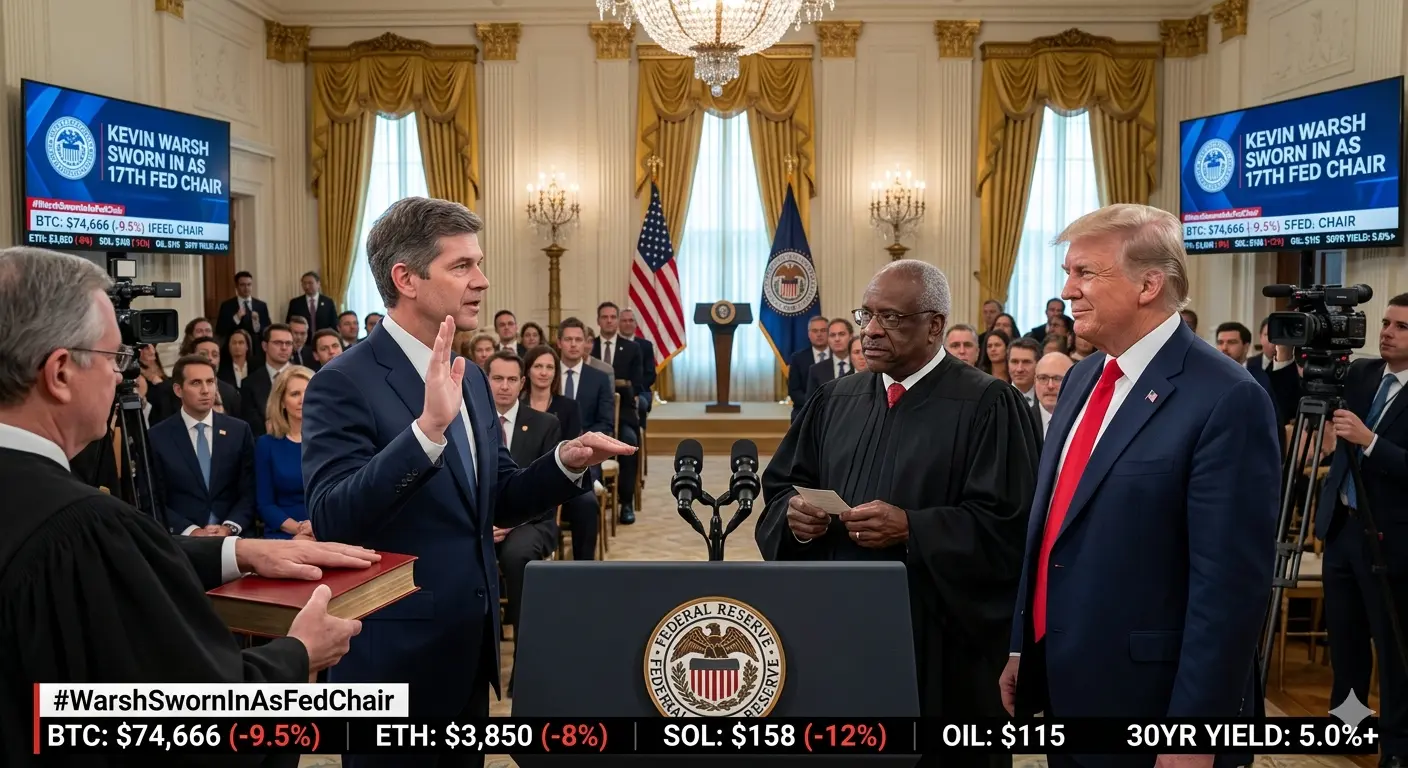
On May 22, 2026, Kevin Warsh was sworn in as the 17th Chairman of the Federal Reserve, replacing Jerome Powell during a period of extreme macro instability that now resembles a hybrid of inflation shock, energy crisis, and liquidity tightening simultaneously. The ceremony was held at the White House in the East Room with President Donald Trump presiding, and Supreme Court Justice Clarence Thomas administering the oath — a highly unusual setting that immediately sparked debate about central bank independence and whether political influence over monetary policy is entering a new phase.
The reaction across global markets was immediate, sharp, and deeply risk-off.
Bitcoin dropped violently from approximately $81,650 → $74,000–$76,000, marking a drawdown of nearly -8% to -10% within days, while triggering more than $430M–$580M in leveraged liquidations across derivatives markets. Ethereum fell roughly -7% to -11%, slipping below key support clusters near $3,850, while Solana experienced an aggressive retracement of nearly -10% to -15%, falling toward the $158–$162 zone. The total crypto market capitalization shed hundreds of billions in valuation within a short time window as traders rapidly recalibrated expectations for liquidity conditions, interest-rate policy, and global risk appetite.
This is not just another Federal Reserve transition.
This is a structural macro regime shift that may define the entire 2026 crypto cycle.
KEVIN WARSH ERA — THE START OF A MONETARY REPRICING CYCLE
Kevin Warsh enters the Federal Reserve with a strongly reform-driven monetary philosophy that immediately alters how markets interpret future liquidity flows.
Warsh is widely associated with a framework that prioritizes:
• Shrinking the Federal Reserve balance sheet from multi-trillion-dollar levels
• Reducing long-term dependence on quantitative easing
• Restoring market-driven price discovery in interest rates
• Limiting emergency liquidity interventions
• Rebuilding inflation credibility at any cost
This is critical because markets over the last decade have been structurally conditioned to assume one thing:
“The Fed will always intervene to support risk assets.”
Warsh’s policy direction challenges that assumption directly.
And when that belief breaks, liquidity repricing begins immediately across all high-beta markets — especially crypto.
MACRO CONDITIONS WARSH INHERITS — EXTREME SYSTEM PRESSURE
Warsh is stepping into a macro environment that is already under severe structural strain:
US CPI Inflation: ~3.8% and trending upward again
Core inflation persistence: broad-based pricing pressure returning
Oil prices: ~$115 per barrel due to geopolitical escalation and supply disruptions
Consumer sentiment: collapsed near 44.8 (historic lows)
Inflation expectations: ~4.8% forward outlook
30-year Treasury yields: above 5.0% (multi-decade highs)
10-year yields: persistent upward pressure
This combination is highly dangerous because it creates a textbook stagflation risk environment:
• Slowing economic expansion
• Weak consumer demand
• Persistent inflation pressure
• Elevated energy costs
• Tight financial conditions
• Rising borrowing costs
This is the worst possible macro mix for speculative assets like:
Bitcoin, Ethereum, Solana, altcoins, AI tokens, venture-backed crypto infrastructure, and high-leverage derivatives markets.
Because in this environment:
👉 Liquidity contracts
👉 Discount rates rise
👉 Risk premiums expand
👉 Speculation gets repriced aggressively
BOND MARKET REPRICING — THE MOST IMPORTANT SIGNAL
One of the most significant reactions following Warsh’s appointment was the rapid shift in Treasury market expectations.
Before Warsh: Markets were pricing potential easing cycles in late 2026.
After Warsh: Markets aggressively shifted toward:
• Near-zero probability of near-term rate cuts
• Higher-for-longer interest rate regime
• Possible additional tightening cycles
• Reduced expectation of liquidity expansion
This immediately pushed Treasury yields higher and strengthened the dollar environment — both historically negative conditions for crypto performance.
Because Bitcoin’s strongest historical bull phases occur during:
• Liquidity expansion cycles
• Falling real yields
• Aggressive central bank easing
• Weak dollar regimes
Warsh introduces the opposite macro signal.
BITCOIN CRASH MECHANICS — LIQUIDITY SHOCK IN REAL TIME
Bitcoin’s decline was not random — it was a direct macro repricing event.
BTC moved:
• May 15: ~$81,650 local peak
• May 22: ~$74,666 intraday low region
• Weekly drawdown: approximately -8% to -10.5%
Below $76,000, the market experienced a liquidation cascade:
• Estimated liquidations: $430M – $580M
• Long leverage unwinding accelerated volatility
• Funding rates collapsed sharply
• Open interest dropped significantly
This confirms a critical structural insight:
👉 The current crypto market is leverage-driven, not spot-driven.
Which means macro shocks amplify instantly.
WHY ETHEREUM AND SOLANA MOVED EVEN HARDER
Ethereum and Solana experienced sharper volatility because they sit higher on the risk curve than Bitcoin.
ETH dropped from approximately $4,200 → $3,600–$3,850 range, reflecting:
• ETF flow sensitivity
• Staking regulatory uncertainty
• Institutional rotation out of risk
• Reduced liquidity appetite
ETH downside risk range now sits at:
• $3,850 → pivot resistance
• $3,600 → structural support
• $3,250 → correction zone
• $2,900 → macro liquidation zone
Estimated volatility bands: • Downside: -15% to -25% potential in stress cycles
• Upside rebound: +35% to +70% in liquidity recovery phases
Solana (SOL) saw even higher beta movement:
• $185 → recent cycle high
• Current range: $150–$162 zone
Key levels:
• $162 → short-term resistance pivot
• $150 → breakdown confirmation level
• $138 → major support
• $120 → macro flush region
Volatility profile:
• Downside: -20% to -35% in liquidity stress events
• Upside: +50% to +100% in expansion cycles
WARSH VS LIQUIDITY CYCLE — THE CORE CONFLICT
The key market conflict is now structural:
Warsh philosophy: • Reduce liquidity dependence
• Strengthen monetary discipline
• Reduce Fed intervention
Market dependency: • Crypto requires liquidity expansion
• Risk assets depend on falling yields
• Leverage requires cheap capital
This creates a direct structural mismatch.
And when macro policy shifts against liquidity-dependent assets:
👉 volatility increases
👉 correlation with bonds rises
👉 downside accelerates faster than upside
BITCOIN HISTORICAL FED TRANSITION PATTERN
Across previous Federal Reserve leadership cycles, Bitcoin has consistently experienced major drawdowns during transition or tightening phases:
• Yellen era cycle: Bitcoin drawdown ~80%+
• Powell tightening phase: BTC decline ~70%+
• Rate hike cycles: extreme volatility compression phases
The repeating pattern is not purely coincidental:
👉 New Fed regimes often coincide with liquidity resets
👉 Crypto is extremely sensitive to those resets
Warsh now enters the same structural cycle environment.
CRITICAL BITCOIN STRUCTURE — CURRENT MARKET MAP
Bitcoin is now trading in a macro-sensitive corridor:
Major support zones: • $74,000 → immediate defense level
• $72,500 → liquidity absorption zone
• $69,000 → breakdown confirmation
• $64,000 → macro correction level
• $58,000 → deep liquidation zone
Major resistance zones: • $78,000 → recovery rejection level
• $81,500 → structural pivot
• $85,000 → trend recovery confirmation
• $92,000 → bullish continuation zone
• $100,000 → psychological breakout barrier
If BTC loses $74K–$72K decisively:
👉 accelerated liquidation risk increases toward $69K → $64K → $58K
If macro stabilizes:
👉 BTC can recover toward $85K–$92K and retest $100K later in cycle
MACRO DRIVERS NOW CONTROLLING CRYPTO MARKETS
Crypto is no longer driven purely by internal narratives.
The dominant macro forces now include:
• Federal Reserve policy direction
• Treasury yield trajectory
• Inflation expectations
• Energy market shocks (oil above $115)
• Geopolitical risk (Middle East tensions)
• Dollar strength cycles
• Institutional ETF flows
• Global liquidity conditions
This shift means:
👉 crypto is now a macro asset class, not a standalone speculative market
THREE MAJOR BITCOIN SCENARIOS — EXTENDED
Bearish Liquidity Contraction Scenario
Probability: Elevated volatility continuation
BTC Range: $58K – $70K
Conditions: • Inflation persistence
• Higher yields
• QT continuation
• Weak risk appetite
Neutral Macro Consolidation Scenario
Probability: Base case
BTC Range: $72K – $92K
Conditions: • Fed pause
• Inflation stabilizes
• Controlled growth slowdown
Bullish Liquidity Re-Expansion Scenario
Probability: Cyclical expansion later phase
BTC Range: $100K – $150K+
Conditions: • Economic slowdown forces easing
• Liquidity returns
• Dollar weakens
• Risk appetite returns
FINAL CONCLUSION — A STRUCTURAL SHIFT IN GLOBAL MARKETS
Kevin Warsh’s arrival at the Federal Reserve represents far more than a political or administrative change.
It represents a potential transition in how global liquidity is managed.
And in financial markets:
👉 liquidity is everything
Bitcoin, Ethereum, and the entire crypto ecosystem are now fully embedded within:
• Central bank policy cycles
• Bond market dynamics
• Energy-driven inflation shocks
• Global geopolitical risk structures
• Institutional capital allocation flows
Warsh introduces a regime that prioritizes monetary discipline over market support.
That may create short-term pain across crypto markets.
But in the long term, if fiat systems remain under structural inflation pressure and debt expansion continues globally, Bitcoin’s role as a decentralized monetary hedge may become even more significant than in previous cycles.
The next phase is not just volatility.
It is macro regime re-pricing at global scale.@Gate_Square @Gate广场_Official
repost-content-media
  • Reward
  • Comment
  • Repost
  • Share
#PlatinumCardCreatorExclusive
Gate Platinum Card — The Moment Crypto Fully Blends Into Real-World Money Systems
The Gate Platinum Card represents more than just another crypto payment product — it represents a structural transition in how money itself is defined in the modern digital economy. For years, crypto existed in a parallel financial universe, separated from traditional banking systems, treated as speculative, volatile, and disconnected from everyday life. But this type of infrastructure begins to collapse that separation entirely, replacing the idea of “crypto vs fiat” with something
BTC3.05%
ETH4.6%
HighAmbition
#PlatinumCardCreatorExclusive
Gate Platinum Card — The Moment Crypto Fully Blends Into Real-World Money Systems
The Gate Platinum Card represents more than just another crypto payment product — it represents a structural transition in how money itself is defined in the modern digital economy. For years, crypto existed in a parallel financial universe, separated from traditional banking systems, treated as speculative, volatile, and disconnected from everyday life. But this type of infrastructure begins to collapse that separation entirely, replacing the idea of “crypto vs fiat” with something far more unified: a single, continuous financial layer where value moves without friction across systems, borders, and platforms.
This is not just a product evolution.
This is a financial identity shift.
FROM DIGITAL ASSET STORAGE TO REAL-WORLD SPENDING POWER
The most important transformation introduced by the Gate Platinum Card is not technological — it is functional. Crypto is no longer just something held, traded, or stored for potential appreciation. It becomes directly usable in real-world economic environments through Visa-supported global merchant networks.
That changes everything about how users perceive value:
• Assets are no longer “inactive holdings”
• Crypto is no longer locked inside exchanges
• Financial value becomes instantly deployable ko
When a user can hold BTC, ETH, or stablecoins and immediately use them for daily transactions, the psychological barrier between investment and consumption disappears completely.
Bitcoin stops feeling like an “asset you wait on” and starts feeling like “money you can use anywhere.”
THE GLOBAL FINANCIAL NETWORK EFFECT — WHY THIS MATTERS AT SCALE
The real power of the Gate Platinum Card is not just individual usability — it is network expansion. Every merchant integrated through Visa rails becomes a potential crypto-access point without requiring direct crypto adoption from the merchant side.
This creates a layered financial effect:
• Crypto becomes indirectly accepted everywhere Visa is accepted
• Exchange friction is reduced to near-zero abstraction
• Conversion delays between crypto and fiat disappear in user experience
• Cross-border spending becomes seamless and instant
In practical terms, this means:
A user in Asia, Europe, or the Middle East can hold digital assets and spend globally without traditional banking delays, SWIFT limitations, or currency conversion bottlenecks.
That is not just convenience.
That is infrastructure-level financial compression.
THE DEATH OF “CONVERSION THINKING” IN MONEY FLOW
Traditional finance forces users to constantly think in conversions:
Crypto → Fiat → Bank → Card → Merchant
Each step introduces:
• Time delays
• Fees
• Banking friction
• Psychological separation from asset value
The Gate Platinum Card removes that mental chain entirely.
Instead of conversion, users experience:
👉 “Direct usability of stored value”
This is a massive cognitive shift.
Money stops being something that “moves through systems” and becomes something that “flows naturally.”
That is why this type of product is not just financial innovation — it is behavioral engineering at scale.
FINANCIAL MOBILITY — THE RISE OF BORDERLESS MONEY USERS
A major hidden trend behind this evolution is the rise of globally mobile individuals:
• Remote professionals
• Digital entrepreneurs
• Traders operating across multiple exchanges
• Content creators with multi-currency income streams
• Freelancers paid in crypto or stablecoins
For these users, traditional banking systems are no longer aligned with their lifestyle.
They require:
• Instant settlement
• Multi-asset support
• Cross-border accessibility
• Unified spending systems
The Gate Platinum Card fits directly into this shift by allowing financial identity to move with the user instead of being locked to geography.
CRYPTO IS SHIFTING FROM SPECULATION TO UTILITY-DRIVEN ECONOMY
One of the most important macro signals this card represents is the transition of crypto from speculation to utility.
For years, crypto markets were driven by:
• Trading cycles
• Liquidity waves
• Narrative speculation
• Exchange-driven volume
Now a new layer is emerging:
👉 Real transactional usage
When crypto is used for payments, subscriptions, travel, and daily spending, it introduces continuous demand independent of market speculation.
That creates:
• Organic liquidity demand
• Real-world asset circulation
• Reduced dependency on trading cycles
• Stronger ecosystem stability over time
Utility always builds longer-lasting value structures than speculation.
THE PSYCHOLOGY OF SPENDING CRYPTO — A NEW FINANCIAL BEHAVIOR MODEL
One of the most overlooked transformations is psychological.
Traditional banking teaches users:
• Spending = loss
• Saving = safety
• Consumption = value reduction
Crypto-integrated spending systems change that perception.
When spending is linked with:
• Rewards
• Cashback in digital assets
• Asset appreciation potential
• Portfolio-based financial tracking
Then every transaction becomes part of a larger financial loop instead of a simple expense.
Users start thinking in:
• Value circulation
• Asset velocity
• Portfolio flow
• Net financial movement
This is a fundamental upgrade in financial awareness.
LAYERED FINANCIAL INFRASTRUCTURE — NOT JUST A CARD
The Gate Platinum Card should not be viewed as a standalone product.
It is part of a broader emerging infrastructure stack:
• Crypto exchanges (liquidity layer)
• Stablecoins (settlement layer)
• Visa/Mastercard rails (global acceptance layer)
• Digital wallets (user interface layer)
• Payment cards (execution layer)
When all these layers converge, the result is a fully integrated financial ecosystem where:
👉 value can move instantly from blockchain to real economy without friction
That is the real transformation happening underneath.
8️⃣ IMPACT ON GLOBAL FINANCIAL SYSTEMS
If adoption of such systems continues expanding, long-term implications include:
• Reduced dependence on traditional banking intermediaries
• Increased competition for cross-border payment networks
• Pressure on legacy remittance systems
• Faster capital velocity in global markets
• Blurring boundaries between fiat and crypto economies
This does not replace traditional finance overnight.
But it gradually integrates crypto into everyday economic behavior until separation becomes irrelevant.
FINAL REALITY — THIS IS NOT A PRODUCT EVOLUTION, IT IS A FINANCIAL ERA SHIFT
At the deepest level, the Gate Platinum Card is not simply about spending crypto.
It represents a directional shift in global finance where:
• Digital assets become usable currency
• Payment systems become borderless by default
• Financial identity becomes global rather than local
• Money becomes programmable, mobile, and continuous
The most important transformation is not technological.
It is structural.
And once this structure fully matures, the distinction between “crypto money” and “traditional money” will no longer matter — because the entire system will converge into one unified financial layer.
A layer where money is no longer defined by where it comes from…
But by how instantly it can move.
And how seamlessly it can be used anywhere in the world.@Gate_Square @Gate广场_Official
repost-content-media
  • Reward
  • Comment
  • Repost
  • Share
#TradfiTradingChallenge
Oracle Corporation is currently trading in one of the most complex phases of its modern market history. The stock has shifted from a long-term “AI cloud growth winner” narrative into a highly debated, risk-heavy infrastructure play where expectations, debt exposure, and hyperscaler competition are all colliding at the same time.
As of recent market data, ORCL is trading around $190–$193, after previously hitting highs above $300+ earlier in the cycle. This means the stock has already experienced a 35% to 45% correction, depending on the exact peak reference used. The
ORCL1.19%
HighAmbition
#TradfiTradingChallenge
Oracle Corporation is currently trading in one of the most complex phases of its modern market history. The stock has shifted from a long-term “AI cloud growth winner” narrative into a highly debated, risk-heavy infrastructure play where expectations, debt exposure, and hyperscaler competition are all colliding at the same time.
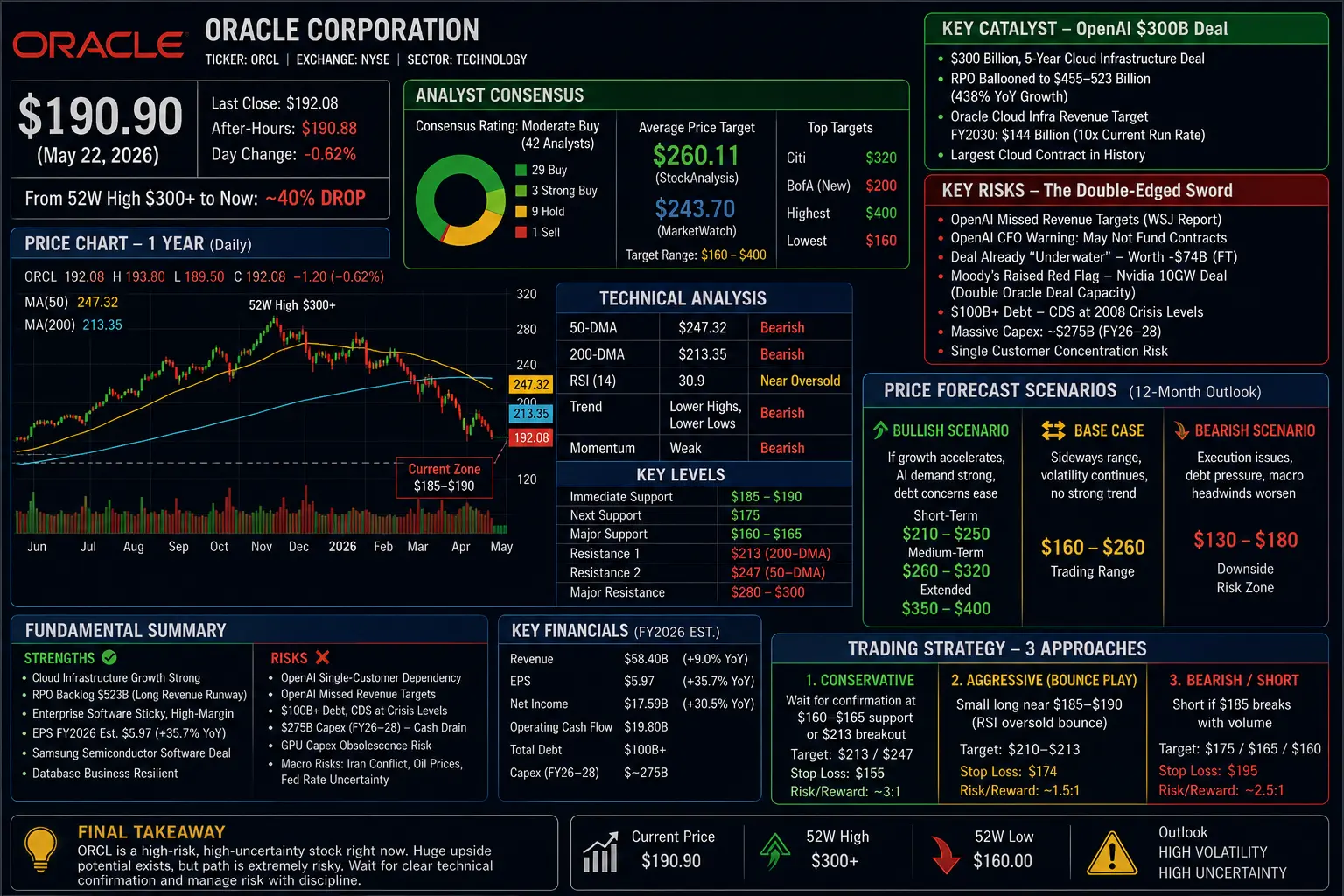
As of recent market data, ORCL is trading around $190–$193, after previously hitting highs above $300+ earlier in the cycle. This means the stock has already experienced a 35% to 45% correction, depending on the exact peak reference used. The market is now essentially trying to decide whether this is a healthy reset in valuation or the beginning of a deeper structural re-rating phase.
📊 Current Market Structure & Price Behavior
The most important observation is that Oracle is no longer trending in a clean bullish structure. Instead, price action has shifted into a distribution and revaluation phase.
Key Price Zones (Extended View)
Current Zone: $188 – $195 (critical equilibrium area)
Immediate Resistance: $200 – $213 (200-day moving average region)
Strong Resistance: $235 – $250 (previous breakdown zone)
Major Resistance: $280 – $300 (historical top supply area)
Short-Term Support: $185 – $190 (current defense line)
Weak Support Below: $175
Structural Support: $160 – $165 (major accumulation zone if tested)
The most important technical reality is simple:
Oracle is trading below both its 50-day and 200-day moving averages, which confirms that momentum remains under pressure and buyers are not yet in full control of trend direction.
Trend Analysis — Market Sentiment Shift
Oracle’s trend structure has transitioned from strong bullish expansion into a mean reversion correction cycle.
The earlier rally toward $300+ was driven by extreme expectations around AI infrastructure demand and long-term cloud contracts. However, the market is now reassessing:
Whether growth projections were overly aggressive
Whether capital expenditure is becoming too heavy
Whether revenue realization matches “booked” contracts
Whether AI infrastructure demand is sustainable at current pricing
This shift is not just technical — it is psychological and institutional. Large funds typically begin reducing exposure when uncertainty increases around cash flow timing and debt scaling efficiency.
Fundamental Drivers — Growth vs Pressure
Oracle is currently balancing two opposing forces.
Positive Growth Engine
Strong cloud infrastructure expansion
Large-scale enterprise migration to Oracle Cloud
Multi-year contracted revenue backlog (RPO expansion)
Continued enterprise database dominance
Strategic positioning in AI infrastructure hosting
The AI cloud narrative still exists and remains structurally valid. Oracle is not losing relevance — it is scaling aggressively into next-generation infrastructure demand.
Pressure Side (Market Concern Factors)
However, the risk side has become more visible:
1. Capital Intensity Expansion
Oracle’s infrastructure expansion requires extremely high capital deployment, including:
Data center construction
GPU procurement
Networking infrastructure scaling
Energy consumption expansion
This creates pressure on free cash flow timing.
2. Debt & Financial Leverage Concerns
The market is closely watching rising leverage levels as Oracle funds long-term infrastructure commitments. Higher debt levels increase sensitivity to:
Interest rate cycles
Credit market tightening
Revenue delay risks
3. Contract Concentration Risk
A large portion of future expectations is tied to major hyperscale AI contracts. This creates dependency risk where:
Any delay in client revenue growth
Any revision in AI spending budgets
Any restructuring of compute demand
can significantly impact sentiment. Price Forecast Scenarios (Extended Range Model)
Instead of a single target, Oracle should be viewed in scenario-based probability bands.
Bullish Expansion Scenario (Strong Recovery Case)
If Oracle successfully converts infrastructure demand into stable revenue realization:
Price Range:
Short-term: $210 – $250
Medium-term: $260 – $320
Extended bullish case: $350 – $400
This scenario requires:
Strong earnings acceleration
Stable AI cloud monetization
Reduced debt anxiety
Market-wide risk-on environment
Probability: Moderate but not dominant in current conditions.
Base Case Scenario (Sideways Repricing Phase)
This is the most structurally realistic path:
Price Range:
$160 – $260 trading band over 6–12 months
In this scenario:
Stock remains volatile
No strong trend emerges
Market continuously reprices expectations
Earnings cause sharp swings in both directions
This reflects uncertainty equilibrium where neither bulls nor bears fully dominate.
Bearish Stress Scenario (Risk Repricing Event)
If macro conditions or execution issues worsen:
Price Range:
$130 – $180 potential downside window
Triggers could include:
Slower AI infrastructure monetization
Debt market tightening
Lower-than-expected cash flow conversion
Broader tech sector correction
This scenario is lower probability but higher emotional impact.
Technical Outlook — Momentum State
Current technical structure shows:
Momentum remains bearish to neutral
Buyers are defending $185–$190 region repeatedly
Rejection pressure visible near $200–$213
Volume spikes suggest institutional repositioning rather than accumulation
Key Technical Truth:
Until Oracle reclaims $213 (200-day moving average) with strong volume confirmation, the market will continue treating rallies as distribution rallies rather than trend reversals.
Trading Strategy Framework (Multi-Scenario)
1. Conservative Strategy (Capital Preservation Mode)
Avoid aggressive entries at current mid-zone levels
Wait for either:
$160–$165 accumulation confirmation
OR $213 breakout confirmation
Focus is patience over prediction
2. Range Trading Strategy (Active Traders)
Buy near: $185–$190 support zone
Sell near: $210–$213 resistance zone
Keep tight stop losses below $175
Objective: capture volatility swings rather than trend
3. Breakdown Strategy (Bearish Momentum Play)
Trigger: break below $185 with volume
Targets:
$175 first objective
$165 secondary zone
Stop loss: above $195
Works best in risk-off market conditions
Market Psychology — What Price Is Really Telling Us
Oracle is currently in a phase where:
The market still respects its long-term strategic importance
But questions its short-term execution efficiency
Investors are no longer pricing “certainty of growth”
Instead, they are pricing “probability of delivery”
This shift is extremely important because valuation compression often happens before fundamental confirmation appears in earnings reports.
Final Interpretation — Structural Position
Oracle is not a broken company. It is not a weak business. Instead, it is a transitioning mega-cap infrastructure player undergoing valuation recalibration.
The core debate is simple:
Is Oracle becoming the backbone of AI cloud infrastructure for the next decade?
OR
Is it over-investing ahead of monetization speed?
The answer to that question will determine whether the stock trends toward $400+ expansion or remains stuck in a $160–$260 valuation corridor.#ORCL @Gate_Square @Gate广场_Official
repost-content-media
  • Reward
  • Comment
  • Repost
  • Share
#DailyPolymarketHotspot
Market Is Now Pricing “Controlled De-escalation”
The current global expectation around the Strait of Hormuz situation is increasingly being shaped not only by traditional macro analysis, but also by real-time prediction market positioning, especially on Polymarket, where sentiment reflects a cautiously optimistic bias toward gradual normalization by end of June 2026.
Across aggregated probabilities, the market is effectively pricing a 61% likelihood of partial-to-meaningful traffic recovery by late June, while assigning roughly 39% probability to continued restrictions
BTC3.05%
HighAmbition
#DailyPolymarketHotspot
Market Is Now Pricing “Controlled De-escalation”
The current global expectation around the Strait of Hormuz situation is increasingly being shaped not only by traditional macro analysis, but also by real-time prediction market positioning, especially on Polymarket, where sentiment reflects a cautiously optimistic bias toward gradual normalization by end of June 2026.
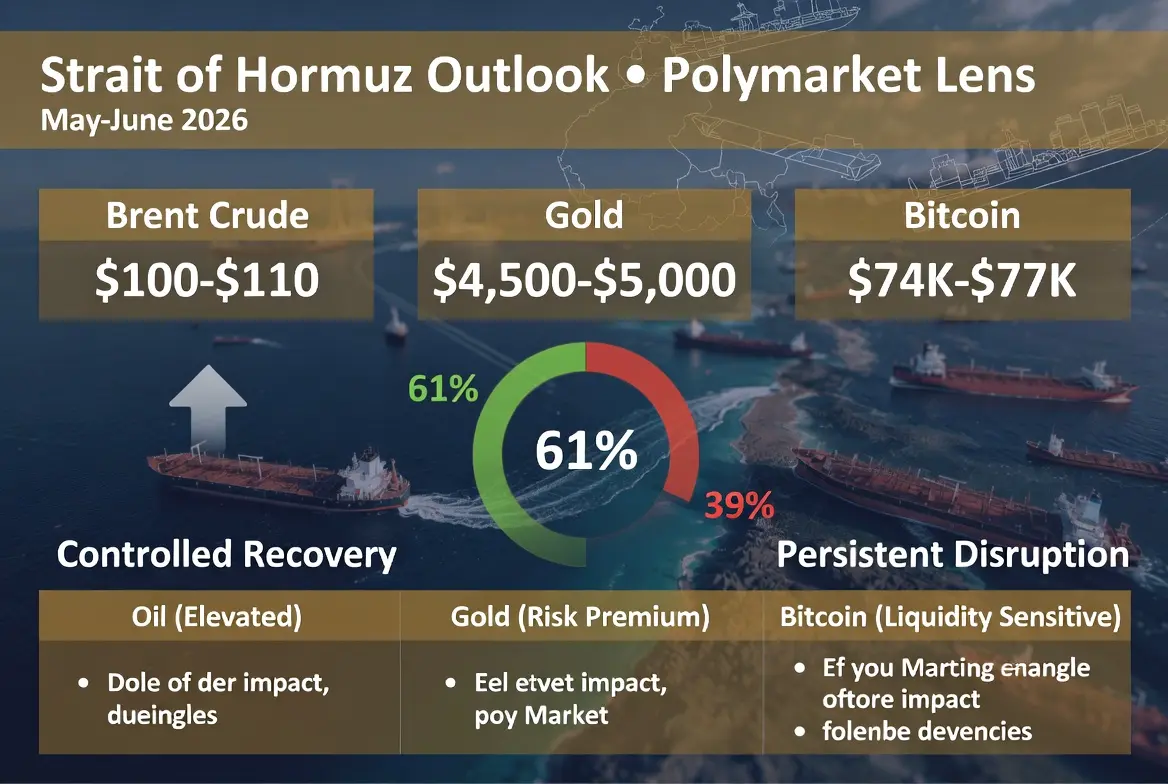
Across aggregated probabilities, the market is effectively pricing a 61% likelihood of partial-to-meaningful traffic recovery by late June, while assigning roughly 39% probability to continued restrictions, intermittent delays, or unstable shipping conditions. This is not a binary “open or closed” pricing structure anymore; instead, it reflects a hybrid expectation of partial normalization with persistent risk premiums embedded into energy and freight markets.
The key takeaway is simple: markets are not pricing resolution, they are pricing controlled tension with gradual easing.
Polymarket Sentiment Structure: What Traders Are Really Pricing In
On prediction markets like Polymarket, pricing behavior is currently driven by three overlapping narratives:
First, traders are assigning weight to observable shipping recovery signals. Partial tanker movement, especially from Asian-linked crude carriers, is interpreted as early confirmation that full blockage scenarios are becoming less likely. This is the core driver behind the 61% recovery probability cluster.
Second, there is persistent hedging against escalation risk. The 39% downside probability is not passive; it reflects active fear of sudden reversals, localized incidents, or breakdowns in maritime coordination. This keeps premiums elevated even during calm headline periods.
Third, liquidity conditions in prediction markets are amplifying short-term sentiment swings. Even minor updates in naval escorts, insurance rate adjustments, or diplomatic statements are producing outsized probability shifts, making Polymarket a real-time volatility mirror rather than a stable forecasting model.
Strait of Hormuz Reality Check: Flow Still Far Below Normal
Despite improving sentiment, physical shipping data remains heavily constrained.
Current throughput remains approximately 10% of normal capacity, with daily transits estimated around 12–13 vessels versus a standard range of 55–65 ships per day. This disconnect between sentiment and physical flow is important: prediction markets are forward-looking, while logistics data confirms that normalization is still in its earliest phase.
If recovery continues on its current trajectory, gradual normalization could begin accelerating in June, but even in the bullish scenario, full restoration of pre-crisis flow efficiency would likely lag behind sentiment by several weeks due to insurance friction, rerouting delays, and compliance verification requirements.
Oil Market Implications: Sentiment vs Physical Tightness
Crude oil remains the most sensitive macro instrument reacting to Strait of Hormuz developments.
Brent crude has been trading in an elevated macro band of $100–$110 per barrel, with intermittent spikes reaching toward $120 during tension spikes or supply uncertainty bursts. The market is effectively pricing a blended scenario: partial recovery, but not full normalization.
If the 61% Polymarket recovery scenario materializes, oil prices are likely to gradually retrace toward a $80–$90 equilibrium range, reflecting restored supply confidence and reduced freight premiums.
If the 39% disruption scenario persists or worsens, oil could re-enter a volatility expansion phase, potentially revisiting $110–$130+ zones, where demand destruction risk begins to emerge and global growth expectations weaken.
Gold Market Reaction: Risk Premium Still Embedded
Gold continues to reflect structural uncertainty even as sentiment improves.
Price ranges remain elevated near $4,500–$5,000 per ounce, with upside extensions possible if disruptions persist longer than expected. Under Polymarket’s base-case recovery probability (61%), gold would likely stabilize into a consolidation band around $4,800–$5,200, as risk appetite rotates back into equities and digital assets.
However, the key insight is that gold is no longer reacting only to headlines—it is pricing probability-weighted geopolitical tail risk, meaning even “optimistic” scenarios still sustain a higher baseline than pre-crisis levels.
Bitcoin and Crypto Market Structure: Risk-On Sensitivity Returns
The crypto market has become increasingly reactive to macro liquidity expectations and geopolitical normalization signals.
Bitcoin is currently consolidating in the $74,000–$77,000 range, with recent price behavior showing strong dip absorption near $74K followed by recovery toward $77K. This indicates that accumulation is occurring even during uncertainty phases.
Under the 61% Polymarket normalization scenario, Bitcoin likely trends toward:
Short-term range: $80,000–$85,000
Extended bullish continuation: $90,000+ if liquidity improves and volatility declines
Under the 39% disruption scenario, Bitcoin may remain volatile but structurally supported, with downside ranges centered around:
$72,000–$74,000 accumulation zone
Importantly, crypto is increasingly behaving like a macro liquidity proxy rather than a pure risk hedge or speculative asset.
Key Market Insight: Prediction Markets Are Now Leading Narrative Flow
The most important structural change in this cycle is that platforms like Polymarket are no longer just reflecting sentiment—they are actively shaping it.
Oil traders are watching probability shifts for directional bias
Crypto traders are using sentiment moves as liquidity timing signals
Gold positioning is increasingly hedged around probability-weighted escalation risk
This creates a feedback loop where expectations influence positioning, and positioning reinforces expectations, especially in low-liquidity geopolitical regimes.
Probabilistic Recovery With Persistent Fragility
The current macro equilibrium can be summarized as follows:
61% probability: Gradual normalization of Strait of Hormuz traffic by end of June
39% probability: Continued restrictions, delays, or episodic disruption
Markets are not pricing resolution—they are pricing managed instability with improving flow conditions.
Oil remains structurally elevated, gold retains risk premium support, and Bitcoin continues to act as a liquidity-sensitive asset reacting to macro stabilization signals.
The next major repricing trigger will not be speculation, but verified shipping flow normalization data combined with sustained diplomatic signaling, which will determine whether the 61% probability evolves into reality or gradually compresses back toward uncertainty.
Until then, markets remain in a probability-trading regime, not a certainty-driven cycle.
repost-content-media
  • Reward
  • Comment
  • Repost
  • Share
#HYPEOutperformsAgain
The crypto market narrative has increasingly shifted toward a new class of high-performance decentralized infrastructure assets, and HYPE has emerged as one of the most dominant large-cap outperformers of 2026, delivering approximately 120% year-to-date gains while Bitcoin has declined nearly 14% over the same period. This divergence reflects a deeper structural capital rotation where liquidity is no longer simply chasing speculative momentum, but actively re-pricing revenue-generating decentralized exchange infrastructure that is beginning to rival centralized trading v
HighAmbition
#HYPEOutperformsAgain
The crypto market narrative has increasingly shifted toward a new class of high-performance decentralized infrastructure assets, and HYPE has emerged as one of the most dominant large-cap outperformers of 2026, delivering approximately 120% year-to-date gains while Bitcoin has declined nearly 14% over the same period. This divergence reflects a deeper structural capital rotation where liquidity is no longer simply chasing speculative momentum, but actively re-pricing revenue-generating decentralized exchange infrastructure that is beginning to rival centralized trading venues in both efficiency and institutional adoption.
At the core of Hyperliquid’s expansion lies a transition from a niche on-chain derivatives platform into a globally recognized liquidity hub, where order execution speed, deep market liquidity, and transparent settlement have converged into a system that increasingly resembles institutional-grade exchange architecture. This evolution has created a direct relationship between trading activity, protocol revenue, and token value accrual, forming a compounding feedback loop that continues to amplify both valuation and liquidity inflows across the 2026 cycle.
Current Market State — Price, Momentum, Positioning
HYPE is currently trading in the $60–$61 range, after forming short-term highs near $62–$63 and maintaining strong weekly upside momentum exceeding 40%+. The price structure reflects a controlled expansion phase rather than a short-lived speculative spike, supported by sustained derivatives demand and continuous inflow of liquidity into leveraged markets.
Market capitalization is approximately $14.5B, while fully diluted valuation stands near $58B, positioning the asset in a category where the market is no longer pricing early uncertainty but instead assigning long-term dominance probability within decentralized derivatives infrastructure. Circulating supply remains constrained near 238M tokens (~24%), which continues to amplify liquidity sensitivity, creating both rapid upside acceleration during inflow phases and sharp volatility during distribution cycles.
Open interest remains elevated above $1.3B, representing a significant portion of platform-wide exposure, while positive funding rates confirm that long positioning continues to dominate short-side hedging. Taker flow remains mildly buyer-biased, indicating that while momentum is strong, the market has not yet entered a fully euphoric imbalance phase, leaving room for continuation.
Structural Drivers — Why HYPE Is Outperforming
HYPE’s outperformance is driven by multiple reinforcing structural catalysts rather than isolated speculative behavior.
The first major driver is rapid expansion in decentralized derivatives market share, where Hyperliquid has captured approximately 15–16% of global futures activity. This marks a structural redistribution of liquidity away from centralized exchanges toward on-chain execution environments that offer transparency, lower friction, and programmable settlement.
A second catalyst is the emergence of ETF-linked demand channels, where spot exposure products have recorded sustained inflows exceeding $80M+ within short trading windows, reflecting growing institutional comfort with structured exposure to on-chain derivatives infrastructure. This transition represents a shift from exploratory capital to allocation-based capital.
A third structural pillar is the protocol’s revenue-linked buyback mechanism, where daily buybacks and burns exceeding $1.5M–$1.8M create continuous supply contraction directly tied to trading volume. This effectively transforms Hyperliquid from a speculative token model into a cash-flow-linked asset, where valuation is increasingly anchored in real economic activity.
Institutional accumulation further reinforces this structure, with large wallets and strategic funds holding multi-hundred-million-dollar positions, while treasury reserves provide additional liquidity stability during corrective phases.
Finally, expansion into tokenized real-world assets, including equities, commodities, and pre-IPO exposure, significantly broadens the platform’s total addressable market, positioning Hyperliquid as a hybrid between decentralized derivatives exchange and a broader on-chain financial ecosystem.
Price Forecast — Expanded Scenario Model
Given the early-stage nature of decentralized exchange valuation cycles, price discovery remains highly elastic and structurally asymmetric.
Base Case: $60 – $110
Stable adoption, moderate ETF inflows, sustained trading dominance.
Bull Case: $120 – $240
Accelerated institutional participation, rising market share, consistent buyback expansion.
Aggressive Expansion Cycle: $250 – $500+
Global adoption of on-chain derivatives infrastructure, deep liquidity migration from centralized exchanges, and exponential growth in protocol fee generation.
Short-term structure suggests continuation potential toward $65–$75, with breakout acceleration zones between $80–$100 if liquidity remains stable and funding conditions do not turn overly restrictive.
Technical Structure — Momentum Expansion Phase
Market structure remains strongly directional, with daily momentum indicators reflecting elevated conditions but no confirmed structural breakdown. Price action continues to form higher lows, indicating sustained buyer control.
Resistance is concentrated in the $61–$63 zone, which represents a key breakout threshold. A clean break above this region could open acceleration toward $70+ levels in a relatively short time frame.
Support remains layered between $55 and $50, with deeper structural protection near $44, which would represent a full invalidation of the current bullish expansion structure.
Bull vs Bear Framework
Bullish Case:
Institutional inflows, increasing protocol revenue, aggressive buyback pressure, and structural migration of derivatives liquidity into decentralized systems.
Bearish Case:
High future emissions, dilution pressure due to low circulating supply, and elevated leverage positioning that increases liquidation risk during volatility spikes.
Sentiment & Whale Behavior
Market sentiment remains strongly positive, driven by consistent narrative reinforcement around institutional adoption and revenue-backed valuation models. Whale behavior reflects a balanced distribution between long-term accumulation and strategic profit realization, which reduces extreme one-sided positioning risk while preserving upward structural bias.
Tokenomics — Supply Mechanics
Total supply remains fixed near 1B tokens, with circulating supply still constrained at approximately 24%. This creates a dual-phase structure where scarcity drives early expansion, while future emissions introduce long-term dilution pressure that must be offset by sustained revenue growth and buyback intensity.
Trading Strategy — Structured Positioning
A disciplined approach emphasizes staged accumulation:
• $58–$55 → primary accumulation zone
• $52–$50 → deep value scaling zone
• Below $44 → structural invalidation zone
Upside scaling targets:
• $70 → first breakout expansion
• $85 → continuation phase
• $100 → psychological breakout zone
• $120–$150 → macro trend extension
• $200+ → long-cycle speculative expansion scenario
Catalysts Ahead
Key catalysts include ETF inflow acceleration, rising protocol revenue, increased market share, deeper institutional allocation frameworks, and macro liquidity expansion conditions.
Structural Repricing Phase
HYPE is undergoing a broader structural repricing cycle driven by real revenue generation, institutional participation, and on-chain exchange dominance. While volatility and supply dilution remain key risk factors, the overall trajectory reflects a multi-phase valuation shift where decentralized derivatives infrastructure is being re-priced as a core component of global financial market architecture rather than a niche speculative segment.
repost-content-media
  • Reward
  • Comment
  • Repost
  • Share
#GateSquarePizzaDay
🍕 Bitcoin Pizza Day 2026: The Most Expensive Meal in Financial History
May 22, 2026 | BTC Current Price: $76,745
The Origin: Two Pizzas That Changed the World
On May 22, 2010, a Florida-based programmer named Laszlo Hanyecz posted a simple offer on the Bitcointalk forum: "I'll pay 10,000 BTC for two large pizzas." At the time, 10,000 BTC was worth approximately $41 — roughly the price of two Papa John's pizzas delivered to his doorstep in Jacksonville.
A 19-year-old named Jeremy Sturdivant, going by the nickname "Jercos," saw the post, called Papa John's from California,
HighAmbition
#GateSquarePizzaDay
🍕 Bitcoin Pizza Day 2026: The Most Expensive Meal in Financial History
May 22, 2026 | BTC Current Price: $76,745
The Origin: Two Pizzas That Changed the World
On May 22, 2010, a Florida-based programmer named Laszlo Hanyecz posted a simple offer on the Bitcointalk forum: "I'll pay 10,000 BTC for two large pizzas." At the time, 10,000 BTC was worth approximately $41 — roughly the price of two Papa John's pizzas delivered to his doorstep in Jacksonville.
A 19-year-old named Jeremy Sturdivant, going by the nickname "Jercos," saw the post, called Papa John's from California, paid with his debit card, and had the pizzas shipped across the country. Laszlo sent him 10,000 BTC for the favor. The transaction was confirmed. The pizzas arrived. And history was made.
This was the first known real-world purchase using Bitcoin. It was the moment Bitcoin stopped being a theoretical internet experiment and became something tangible — a currency that could buy actual goods in the physical world. That single transaction proved Bitcoin had real-world utility, and it would go on to spark one of the greatest financial revolutions in modern history.
The Price Journey: From $0.004 to $76,745
The sheer magnitude of Bitcoin's price appreciation over the past 16 years is staggering. Here is BTC's price trajectory through Pizza Day each year:
Year BTC Price (Pizza Day) 10,000 BTC Value
2010 $0.004 ~$41
2011 $6.12 ~$61,200
2012 $5.10 ~$51,000
2013 $123 ~$1.23M
2014 $523 ~$5.23M
2015 $241 ~$2.41M
2016 $439 ~$4.39M
2017 $2,109 ~$21.09M
2018 $8,355 ~$83.55M
2019 $7,958 ~$79.58M
2020 $9,060 ~$90.60M
2021 $37,340 ~$373.4M
2022 $29,492 ~$294.92M
2023 $26,774 ~$267.74M
2024 $70,190 ~$701.9M
2025 $110,568 ~$1.1B
2026 $76,745 ~$767.45M
At today's price of $76,745, those two pizzas would be worth roughly $767 million. From a $41 meal to a three-quarter-billion-dollar milestone — that is a return of approximately 18,726,000% over 16 years.
The Untold Story: Laszlo Hanyecz's Bigger Contributions
Most people know Pizza Day as the tale of "the guy who spent a billion dollars on pizza." But what most people miss is that Laszlo Hanyecz had already made far more significant contributions to Bitcoin before he ever ordered those pizzas.
The macOS Client: In April 2010, when Bitcoin was still just code on Windows and Linux, Hanyecz built the first macOS client for Bitcoin Core. Satoshi had only created versions for Windows and Linux. Hanyecz's work opened the door for Mac users to participate, and every macOS Bitcoin wallet in existence today traces back to that contribution.
GPU Mining Discovery: Weeks later, Hanyecz realized you could mine Bitcoin using graphics cards (GPUs) instead of CPUs. On May 10, 2010, he posted about using NVIDIA cards to mine Bitcoin, effectively igniting the first mining revolution. Bitcoin's hashrate surged 130,000% by the end of that year. This was the origin story of Bitcoin mining as we know it today — basement rigs, garage setups, and eventually industrial-scale mining farms.
Satoshi's Concern: Satoshi Nakamoto himself reached out to Hanyecz about GPU mining, worried it would concentrate coins too quickly and discourage CPU-only users. This conversation apparently troubled Hanyecz, who felt he had disrupted Bitcoin's early egalitarian spirit.
The Deeper Meaning of Pizza Day: Perhaps Hanyecz's famous pizza offer wasn't just about food. Maybe it was a form of atonement — a statement that Bitcoin should circulate, be used for real things, not just hoarded. Between April and November 2010, Hanyecz received and spent approximately 81,432 BTC — worth roughly $6.2 billion at today's prices. Whether he spent it all on pizza, gave it away to newcomers, or both, nobody knows for certain.
Jeremy Sturdivant: The Other Side of the Pizza
Jeremy Sturdivant, the teenager who facilitated the pizza delivery, sold those 10,000 BTC shortly after receiving them — reportedly to fund a trip with his girlfriend. If he had held, those coins would be worth roughly $770 million today.
Years later, Jeremy admitted he regrets selling. But his framing is surprisingly mature: he's not bitter about the lost fortune. Instead, he speaks about being proud to have participated in something that evolved from a niche project into a global phenomenon. He was just helping out. "It seemed fair to both parties, and well, who doesn't like pizza?" he said in an interview.
Laszlo shares a similar perspective: "I mined that Bitcoin and at the time it was like I was getting free food. I wouldn't have spent $100 million on pizza, right? But if I hadn't done that, maybe Bitcoin wouldn't have become so popular."
What Pizza Day Really Means for Crypto
Beyond the memes and the "what-if" regret, Bitcoin Pizza Day carries profound significance for the crypto community:
1. Proof of Real-World Utility
Those two pizzas were the first proof that Bitcoin could function as actual currency — not just a digital curiosity. The transaction demonstrated that a decentralized, peer-to-peer currency could facilitate real commerce between strangers across the internet.
2. The Power of Early Experimentation
Early adopters like Hanyecz were not waiting for Bitcoin to "moon." They were using it, spending it, testing it, and making it real. Pizza Day is a reminder that innovation requires people willing to experiment — even when the outcome is uncertain.
3. Small Moments Become Legendary
Nobody knew those pizzas would become historic. Nobody knew Bitcoin would become a trillion-dollar asset class. Nobody knew blockchain technology would disrupt industries worldwide. Yet here we are. And right now, somewhere in the crypto space, another "small moment" may be unfolding that people will laugh at today but celebrate decades later.
4. The Irony of Crypto Culture
Pizza Day also captures the humor of crypto culture — the same people who once dismissed Bitcoin are now asking "Is it too late to buy?" One green candle and everyone becomes a professional analyst. One red candle and suddenly everyone believes in "long-term investing." This emotional rollercoaster is now part of the blockchain experience.
BTC at $76,745: Where We Stand Today
As of Pizza Day 2026, Bitcoin trades at $76,745. While the price has seen significant swings — from the highs above $110,000 in 2025 to the current level — Bitcoin has firmly established itself as a global financial asset. Key developments shaping the current landscape include:
Institutional adoption: Major financial institutions, asset managers, and corporations now hold BTC on their balance sheets
ETF integration: Bitcoin ETFs have brought mainstream exposure to crypto assets
Regulatory clarity: Growing regulatory frameworks worldwide are providing structure for crypto markets
Layer 2 scaling: Advances in Lightning Network and other Layer 2 solutions are making Bitcoin transactions faster and cheaper
AI + Crypto convergence: The intersection of artificial intelligence and blockchain technology is creating new possibilities for decentralized applications
From an internet experiment mocked by outsiders to a trillion-dollar movement celebrated globally — Bitcoin's journey from two pizzas to institutional adoption is arguably the most extraordinary financial story of the 21st century.
The Community Celebration
The crypto community marks Pizza Day each year with events, memes, reflections, and gatherings across exchanges and social platforms. Gate Square has been buzzing with Pizza Day content — stories, artwork, memes, and trading screenshots flooding the platform as users celebrate this iconic moment in Bitcoin history.
Community posts on Gate Square highlight the enduring cultural impact of Pizza Day, from nostalgic reflections on Bitcoin's humble beginnings to memes about the "most expensive meal ever." The celebration is not just about regret — it is about honoring the spirit of experimentation, risk-taking, and belief in decentralized technology that has defined crypto from the very beginning.
The Lesson: Innovation Always Looks Ridiculous Before It Changes the World
Pizza Day's deepest lesson is this: the future always looks ridiculous before it changes the world. Bitcoin was dismissed as a hacker's toy. Cryptocurrency was called a bubble. Blockchain was labeled a fad. Yet from two pizzas worth $41, an entire financial revolution was born.
Whether you are a trader, holder, developer, or simply curious about crypto — Pizza Day is a reminder that participation matters. The early builders didn't wait for certainty. They experimented. They spent. They built. And occasionally, they bought pizza.
Happy Bitcoin Pizza Day 2026. 🍕@Gate_Square @Gate广场_Official #GateSquarePizzaDay
repost-content-media
  • Reward
  • Comment
  • Repost
  • Share
#30YearTreasuryYieldBreaks5% Markets are moving from a “zero-rate liquidity era” into a “structurally expensive capital era.”
That is the real story underneath the 30-year Treasury yield crossing 5%.
But the implications are more nuanced than “financial crisis incoming” or “crypto doomed.” What’s happening is a repricing of risk across the entire global system.

Why the 30-Year Yield Matters So Much
The U.S. 30-year Treasury yield is effectively the market’s long-term pricing mechanism for:
* inflation,
* fiscal credibility,
* future growth,
* monetary policy expectations,
* and sovereign deb
  • Reward
  • Comment
  • Repost
  • Share
#30YearTreasuryYieldBreaks5% Your analysis captures a real and important macro shift, but it mixes solid structural observations with several claims that should be treated more cautiously or verified before being presented as established fact.
Here’s the balanced macro view.
What’s correct and important
The core thesis is valid:
* Rising long-duration Treasury yields matter enormously for global liquidity.
* A sustained move in the U.S. 30-year yield above 5% changes discount rates, financing costs, and risk appetite across markets.
* Crypto is now deeply linked to macro conditions, especially
  • Reward
  • Comment
  • Repost
  • Share
#TradfiTradingChallenge #AMZN — The Next AI Infrastructure Expansion Leg (Future Outlook)
Amazon is no longer trading like a traditional retail giant.
The market is progressively reclassifying Amazon into a different category entirely:
An AI infrastructure compounder built around AWS dominance.
Current consolidation around the mid-$260s is not showing classic distribution behavior. Structurally, this looks more like a controlled digestion phase after a major institutional re-pricing driven by:
• Accelerating AWS growth
• Enterprise AI compute demand
• Expanding operating leverage
• Long-
AMZN0.01%
  • Reward
  • Comment
  • Repost
  • Share
#TradfiTradingChallenge #TradFi交易分享挑战
#TradFiTradeShareChallenge
#USIDX
📊 USIDX remains one of the key market focus points as traders continue reacting to the evolving U.S. interest rate outlook and stronger dollar positioning.
After recent central bank commentary, expectations for aggressive rate cuts weakened, helping support the dollar index while Treasury yields continue strengthening the bullish structure.
Current price action stays near the 99.239 area, where buyers still appear active.
📈 Market structure outlook:
As long as USIDX remains above the 98.85 support zone, the probabi
USIDX0.12%
  • Reward
  • Comment
  • Repost
  • Share
🍕 #GateSquarePizzaFestival
#BTCPizzaDay
14 years ago, 10,000 BTC bought two pizzas.
Today, that same Bitcoin would be worth billions.
What once looked like a simple food payment became one of the most legendary moments in financial history — proving that innovation often starts small before changing the world forever.
🚀 To celebrate BTC Pizza Day, Gate Square is launching a community-wide Pizza Festival filled with memes, trading ideas, Bitcoin stories, and creative content from across the crypto space.
🎁 Event Rewards:
✅ Gate Pizza Day themed gift box ×10
✅ 10 USDT pizza rewards fo
BTC3.05%
  • Reward
  • 2
  • Repost
  • Share
discovery:
To The Moon 🌕
View More
#PolymarketDailyHot #PolymarketDailyHot 🔥
Today my position stays with OpenAI in the AI IPO race.
From the latest market flow, OpenAI currently looks like the strongest candidate to take the first major step into public capital markets.
📊 Why I lean toward OpenAI:
• Reports suggest IPO-related preparation discussions are already advancing
• Goldman Sachs and Morgan Stanley are increasingly linked to the narrative
• OpenAI continues expanding enterprise partnerships globally
• Revenue channels and commercial integrations are scaling rapidly
• Consumer adoption remains unmatched acro
OPENAI3.63%
  • Reward
  • 1
  • Repost
  • Share
discovery:
2026 GOGOGO 👊
#GateLivePizzaDayCarnival 🍕
#BitcoinPizzaDay
Crypto culture meets rewards season on Gate Live.
To celebrate Bitcoin Pizza Day, Gate Live has launched a special carnival event where users can join livestream activities and compete for exclusive gift boxes and community rewards.
🎁 What makes the event exciting:
• Limited-time Pizza Day themed campaign
• Opportunity to win exclusive Gate merchandise and gift boxes
• Community interaction through Gate Live streams
• Growing focus on creator-driven crypto engagement
Bitcoin Pizza Day remains one of the most symbolic moments in crypto
BTC3.05%
  • Reward
  • Comment
  • Repost
  • Share
#SpaceXOfficiallyFilesforIPO #SpaceXOfficiallyFilesforIPO 🚀
SpaceX is officially heading toward Nasdaq, and global markets are preparing for what could become the largest IPO in financial history.
After submitting its S-1 registration to the SEC, the company has now revealed its financial structure publicly for the first time — giving investors a rare look into the economics behind rockets, AI infrastructure, Starlink, and even Bitcoin reserves.
📊 Key IPO details:
• Ticker: SPCX
• Roadshow expected: June 4
• Pricing date: June 11
• Nasdaq debut target: June 12
• Estimated valuation
BTC3.05%
SPCX4.21%
  • Reward
  • Comment
  • Repost
  • Share
#DailyPolymarketHotspot #DailyPolymarketHotspot
#Polymarket每日热点
🚨 The next major AI IPO race is becoming one of the hottest prediction market narratives of 2026.
After SpaceX officially advanced its IPO filing process, market focus is now rapidly shifting toward the artificial intelligence sector — especially the growing competition between OpenAI and Anthropic.
Prediction markets, institutional traders, and venture capital firms are now watching one key question:
📊 Which AI giant reaches public markets first?
At the center of this battle are two very different strengths:
🟢 OpenAI
• M
SPACEX4.75%
OPENAI3.63%
  • Reward
  • Comment
  • Repost
  • Share
#PolymarketLaunchesPrivateCompanyPredictionMarkets #PolymarketLaunchesPrivateCompanyPredictionMarkets 🚀
A major transformation is happening in global finance.
Polymarket’s new private company prediction markets are changing how the world tracks the future of innovation by turning expectations into live tradable probabilities powered by blockchain technology.
Instead of relying only on analysts, venture capital firms, or delayed reports, global participants can now trade real-time expectations around companies like OpenAI, SpaceX, Stripe, Anthropic, and Databricks.
📊 What makes this system
  • Reward
  • Comment
  • Repost
  • Share
  • Pinned