#USMayPCEInflationRisesTo4.1%HighestIn3Years
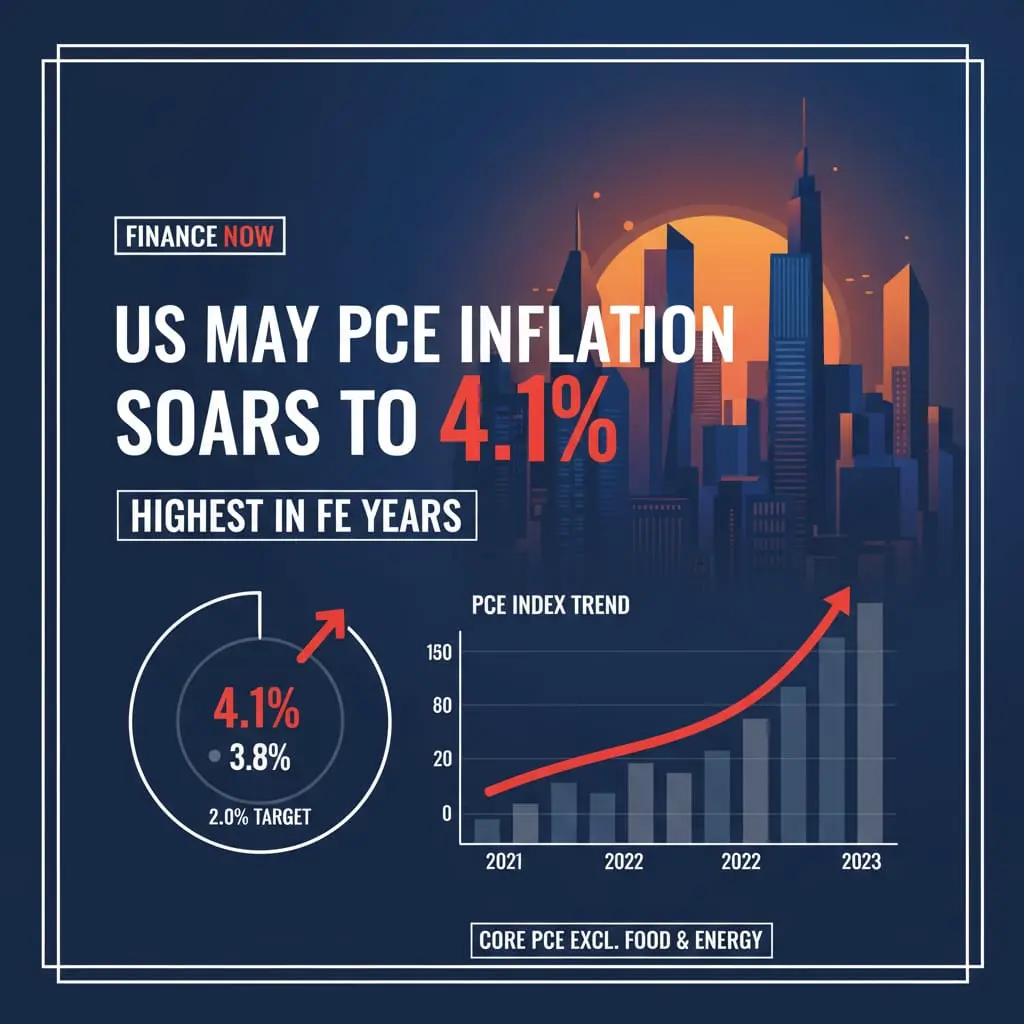
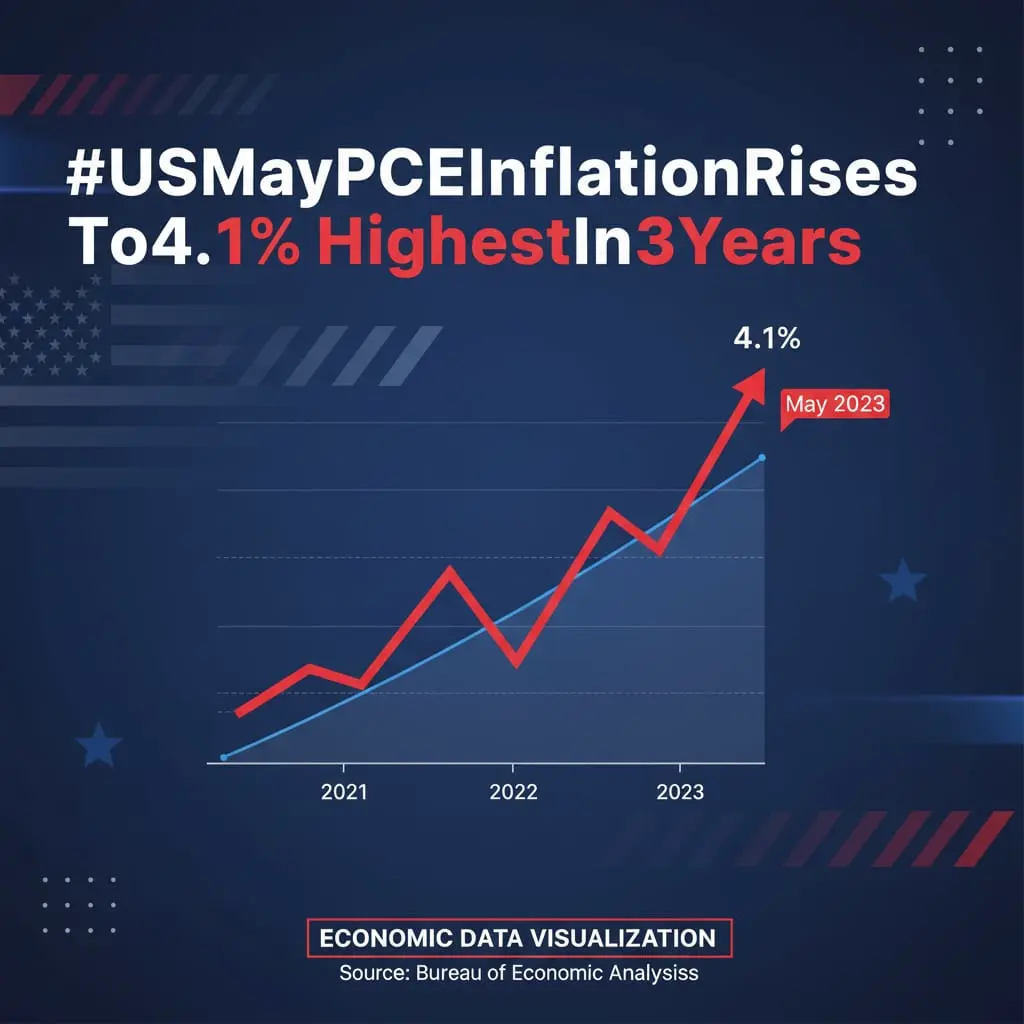
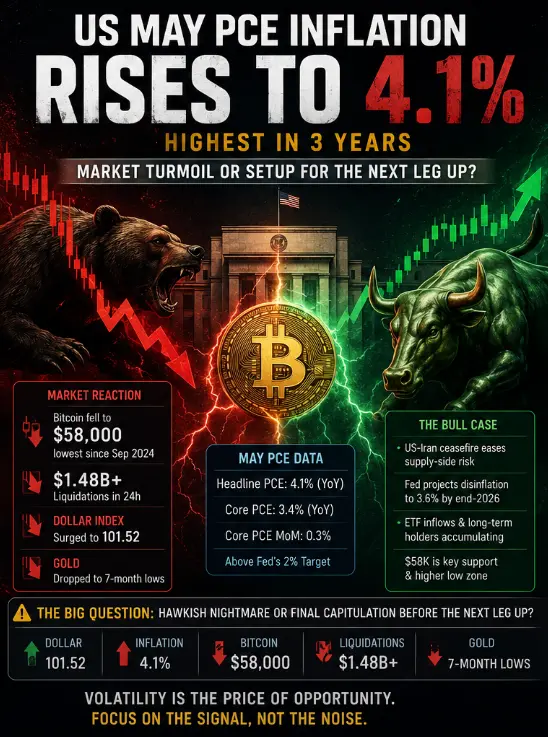
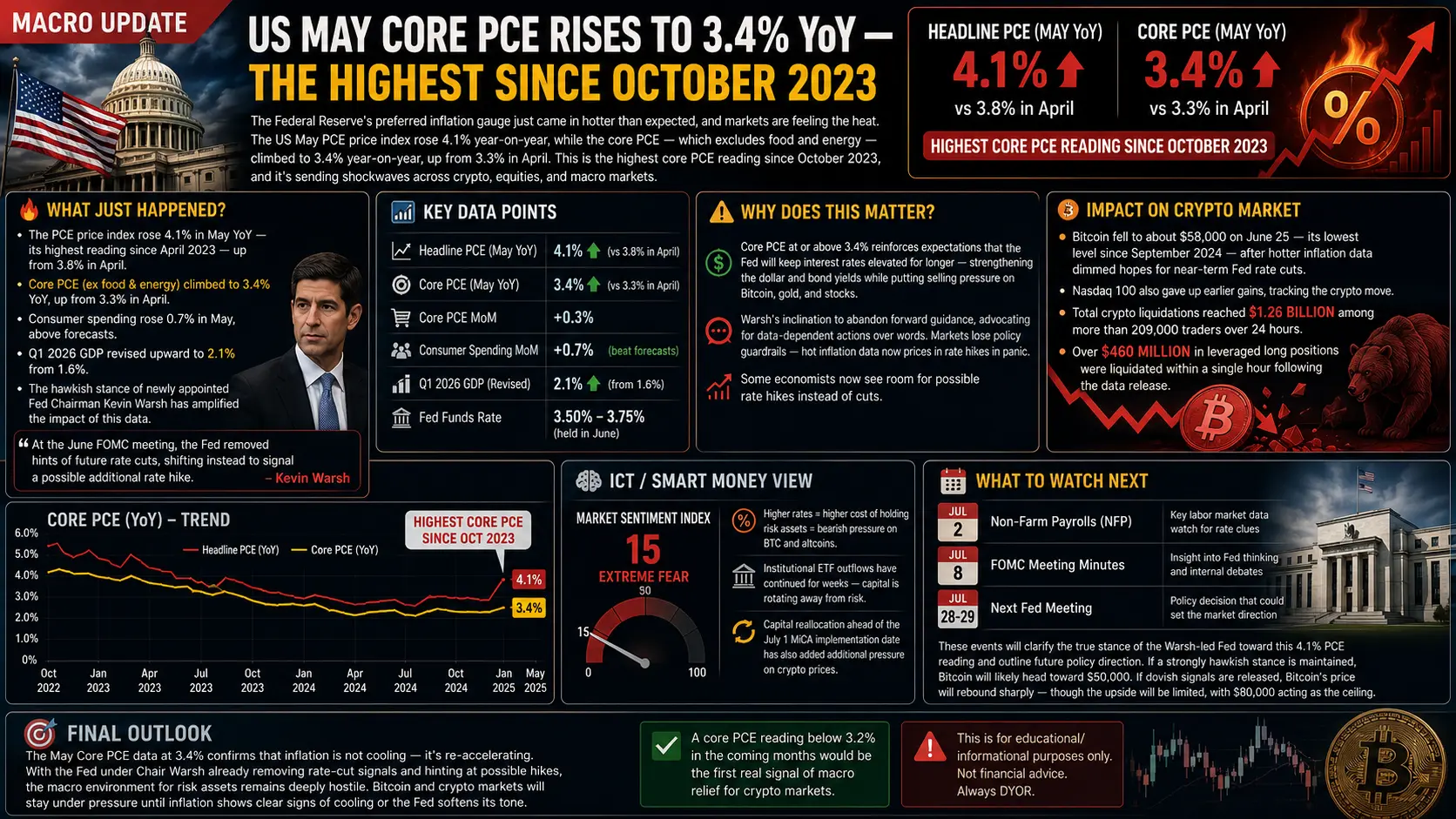
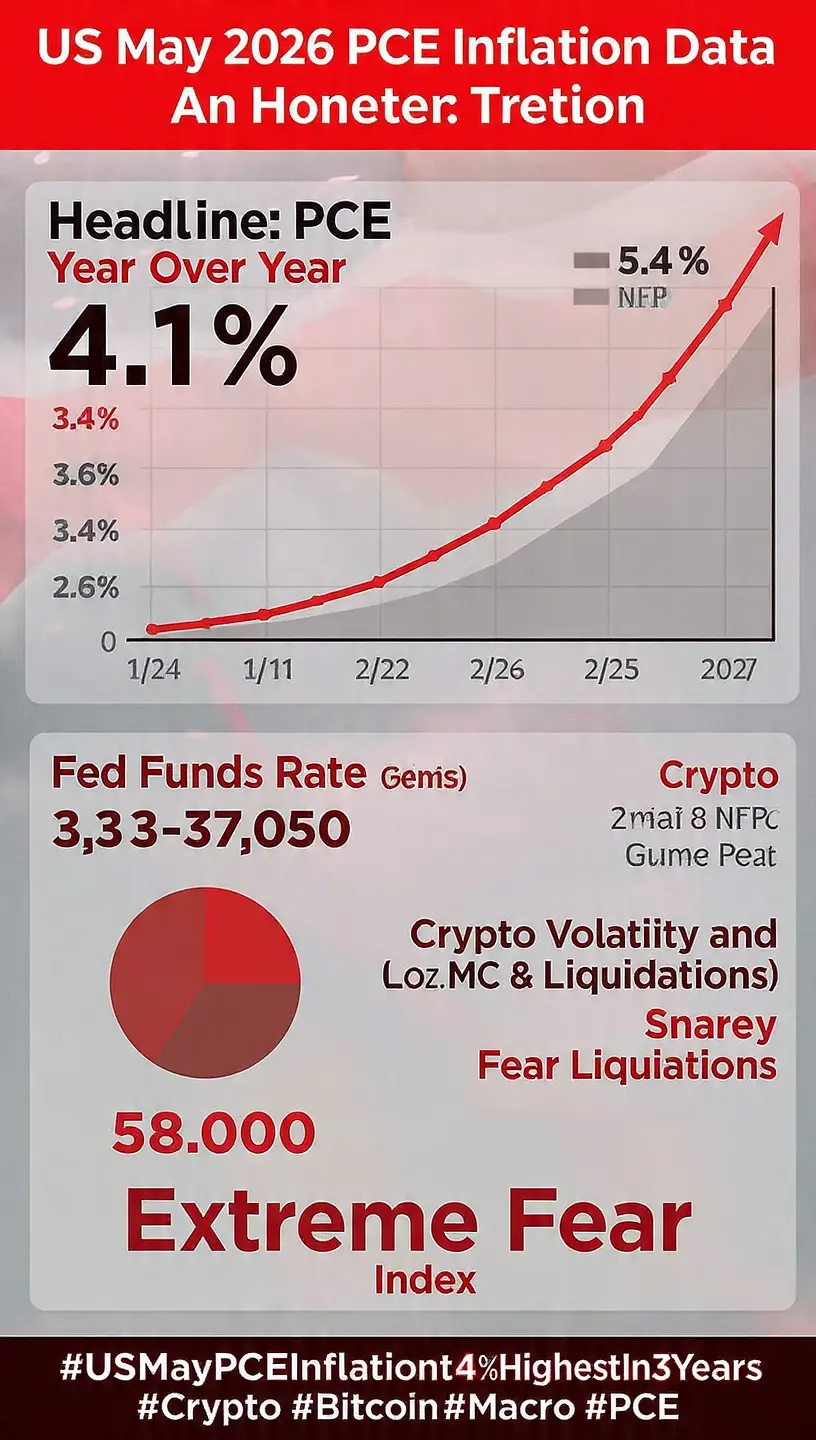
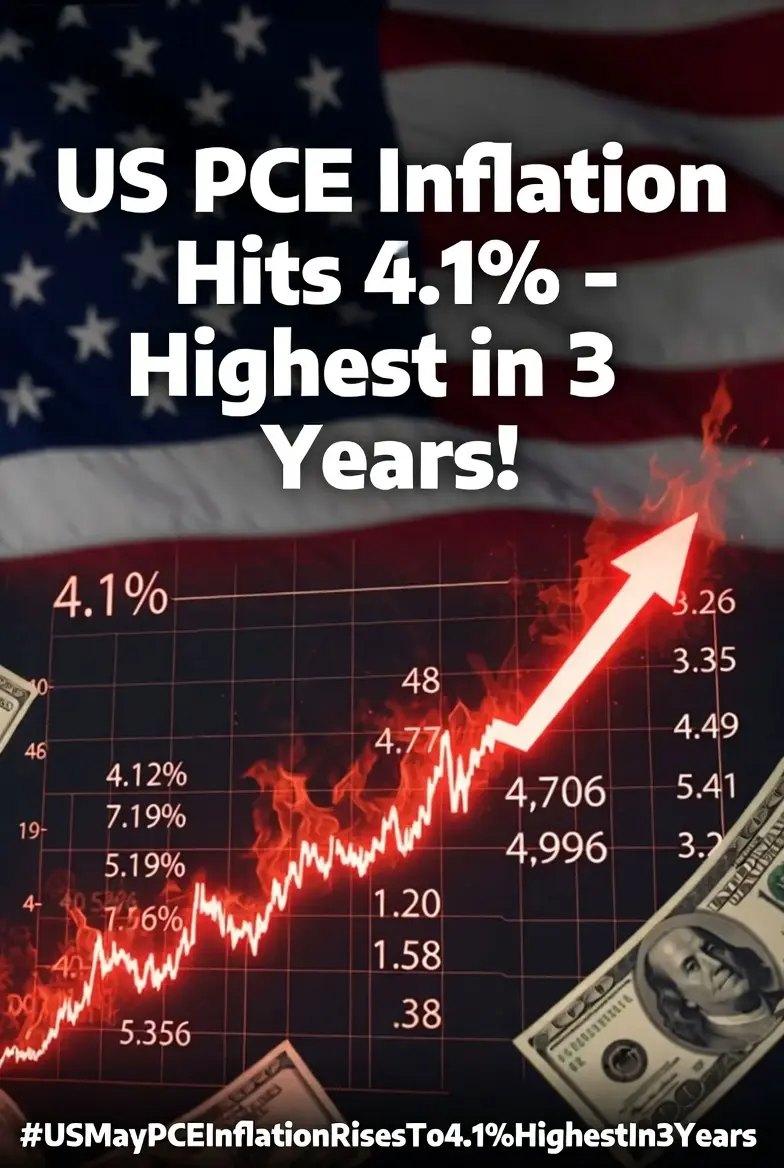
The United States Personal Consumption Expenditures (PCE) Price Index, the Federal Reserve's preferred inflation gauge, accelerated to 4.1% year-over-year in May 2026, rising from 3.8% in April and marking the highest inflation reading in more than three years. The stronger-than-expected report immediately changed market expectations for future monetary policy, as investors now anticipate interest rates remaining higher for longer. This shift has strengthened the U.S. dollar, pushed Treasury yields sharply higher, tightened global liquidity conditions, and triggered broad-based selling across cryptocurrencies, while defensive assets such as gold continued attracting capital.
Unlike previous inflation surprises, this report arrived when cryptocurrency markets were already experiencing weakening momentum, declining institutional demand, and persistent ETF outflows. As a result, the inflation data accelerated an already fragile market structure, increasing volatility and forcing traders to reassess both short-term positioning and long-term portfolio allocation.
Understanding the Inflation Data
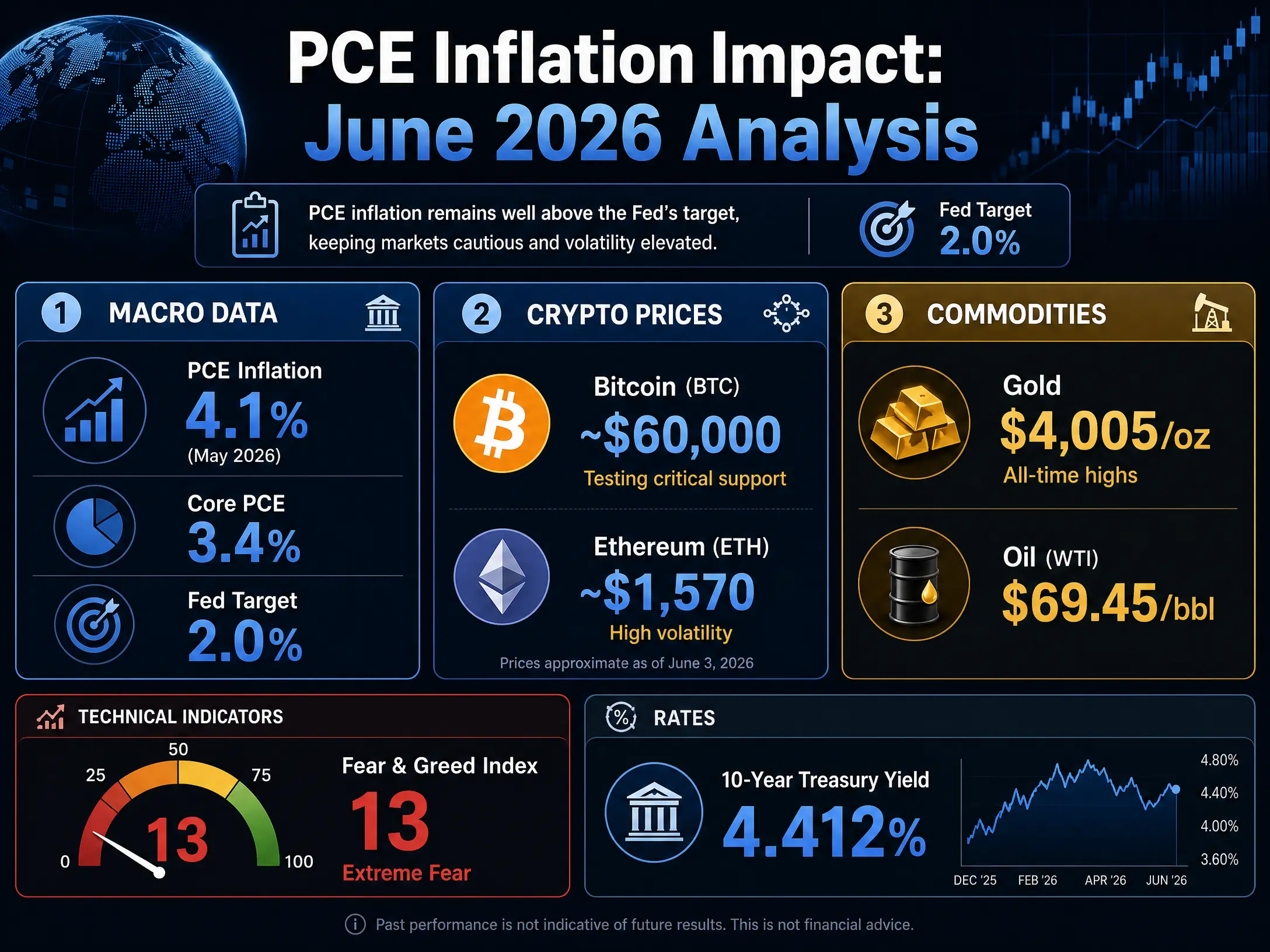
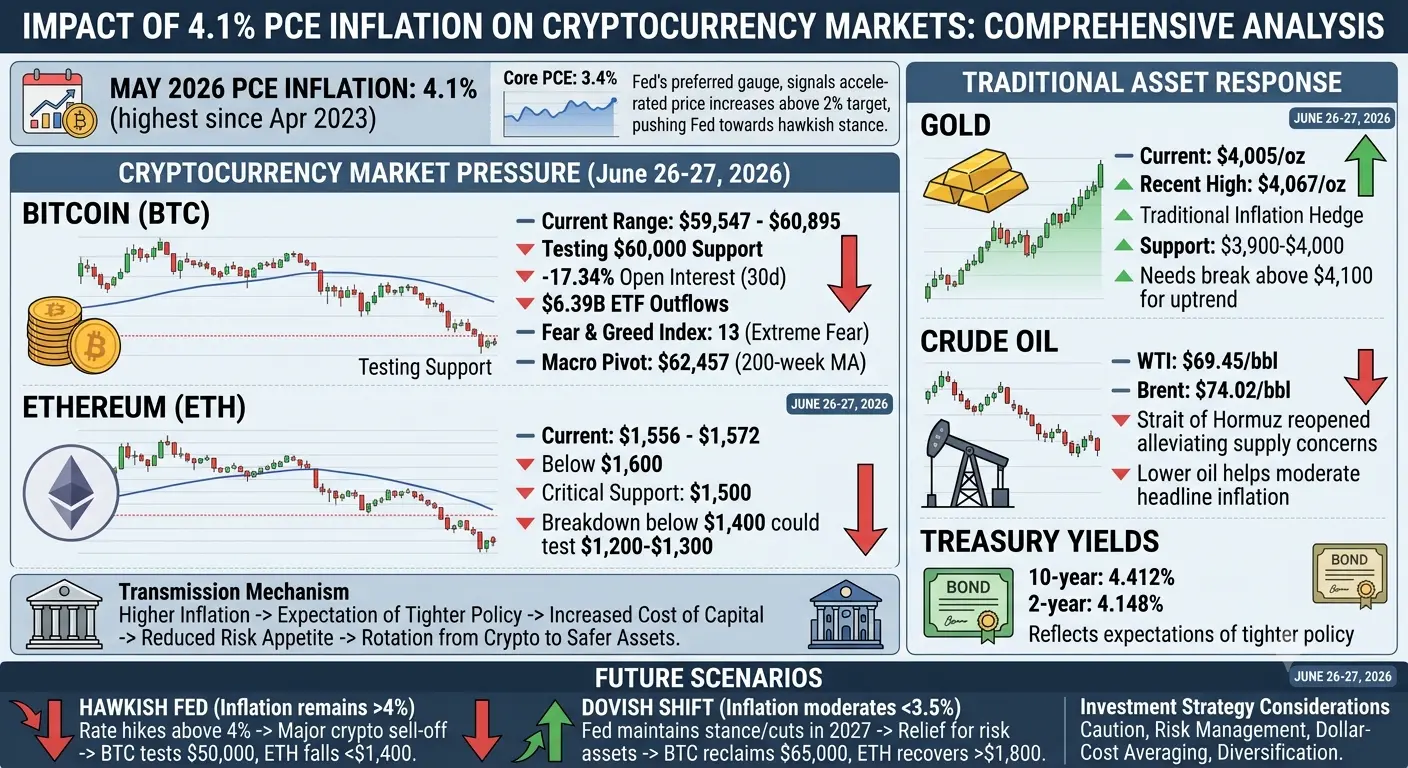
Headline PCE inflation increased to 4.1%, compared with 3.8% in April, while monthly inflation rose 0.3%. At the same time, Core PCE, which excludes food and energy prices and is closely monitored by Federal Reserve policymakers, climbed to 3.4% from 3.3%, representing its highest level since October 2023. These figures confirm that inflation remains significantly above the Federal Reserve's long-term 2% target, making immediate monetary easing increasingly unlikely.
For financial markets, persistent inflation is not simply an economic statistic—it directly influences borrowing costs, liquidity availability, investor confidence, and overall risk appetite.
Every additional month of elevated inflation increases the probability that interest rates will remain restrictive, limiting the flow of capital into speculative assets such as cryptocurrencies while improving the attractiveness of government bonds and other yield-generating investments.
Current Market Performance
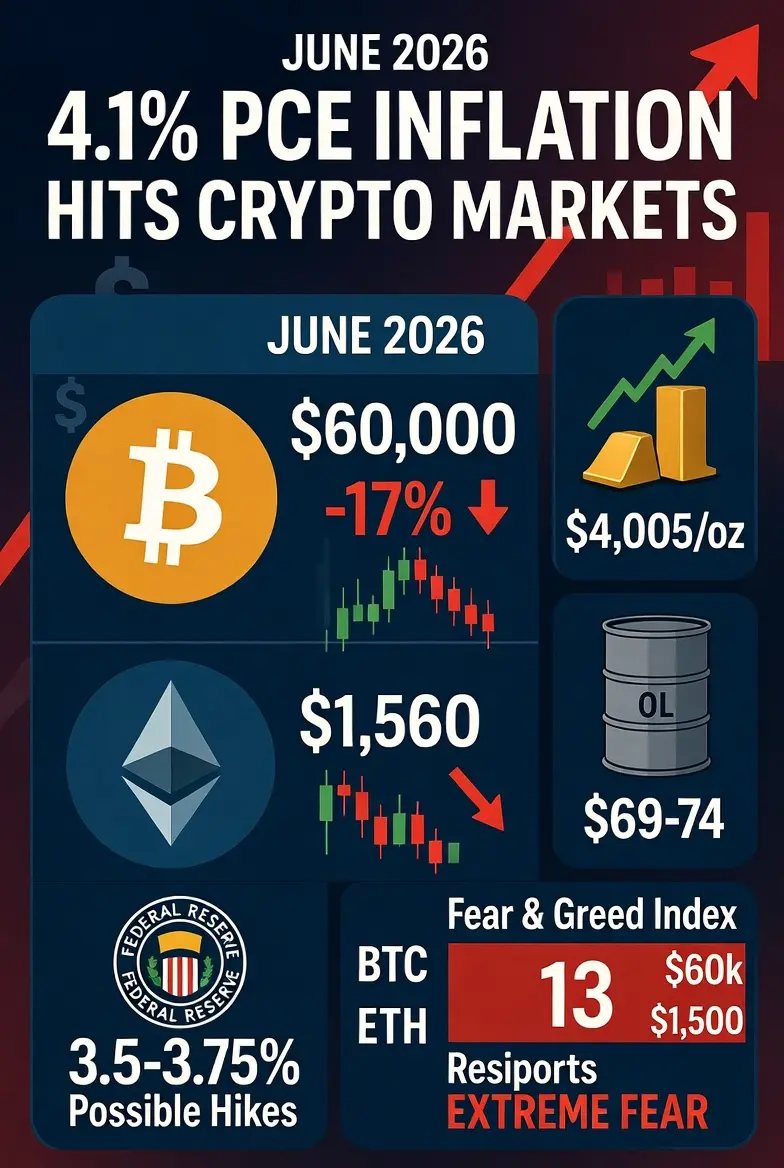
The inflation surprise produced an immediate reaction across global financial markets. Bitcoin traded between $59,547 and $60,895, recording a 24-hour decline of 2.8%, a 7-day loss of 8.4%, a 30-day decline of 14.7%, and a 90-day correction of 26.3%, leaving the world's largest cryptocurrency approximately 68% below its all-time high near $108,000. Ethereum underperformed even further, trading between $1,556 and $1,572, falling 4.1% in 24 hours, 12.6% over seven days, 21.3% during the last month, and 38.7% over the previous ninety days, remaining almost 92% below its historical peak of $4,878.
While cryptocurrencies weakened, Gold climbed to approximately $4,005 per ounce, after touching an intraday high of $4,067, gaining 0.9% in 24 hours, 2.4% in one week, 6.8% over thirty days, and 18.4% over ninety days, reflecting continued investor demand for traditional inflation hedges. Meanwhile, WTI crude oil traded near $69.45 per barrel and Brent crude near $74.02, both extending recent declines as easing geopolitical tensions reduced supply concerns. U.S. Treasury yields also moved sharply higher, with the 10-Year yield reaching 4.412%, up 11 basis points following the PCE release, while the 2-Year yield stood at 4.148%, reinforcing expectations of tighter financial conditions.
Liquidity, Trading Volume and Institutional Positioning
One of the most important developments following the inflation report was the significant deterioration in cryptocurrency market liquidity.
Bitcoin's 24-hour spot trading volume surged to approximately $48.7 billion, representing a 58% increase above its thirty-day average, while the seven-day average daily volume reached $41.2 billion, up 47%. However, despite stronger trading activity, Bitcoin futures open interest declined to $31.4 billion, falling 17.34% during the previous month, indicating that much of the increased volume resulted from liquidation and position reduction rather than fresh bullish capital entering the market.
Market liquidity also weakened considerably. Bid-ask spreads on major exchanges widened by 42% around the critical $60,000 price level, while buy-side market depth across the ten largest exchanges declined by 26% within 2% of spot price. This combination of higher trading volume and lower market depth suggests that relatively modest sell orders are now capable of producing significantly larger price movements, increasing the probability of sharp intraday volatility and flash crashes during periods of negative macroeconomic news.
Ethereum displayed even greater weakness.
Spot trading volume climbed to $28.9 billion, approximately 71% above average, while the seven-day average reached $24.6 billion, increasing 64%. Despite higher activity, Ethereum futures open interest fell to $14.8 billion, declining 19.7% over the last month, while long liquidations totaled approximately $1.12 billion during the previous seven days, representing nearly 78% of all cryptocurrency liquidations. Across the broader digital asset market, total 24-hour trading volume expanded to roughly $118 billion, increasing 52% after the PCE release, whereas the overall crypto market capitalization declined to approximately $2.18 trillion, falling 9.4% during the previous month.
Bitcoin dominance remained stable at 52.8%, indicating that investors continued rotating capital away from higher-risk altcoins toward relatively safer large-cap assets.
Institutional positioning also remained weak.
Bitcoin Spot ETFs recorded cumulative outflows of approximately $6.39 billion, with 26 of the previous 30 trading sessions showing net withdrawals, while Ethereum ETFs experienced nearly $412 million in outflows during the last fourteen days. Persistent ETF redemptions suggest that institutional investors remain cautious and continue reducing exposure until inflation shows a convincing downward trend.
Bitcoin and Ethereum Technical Outlook
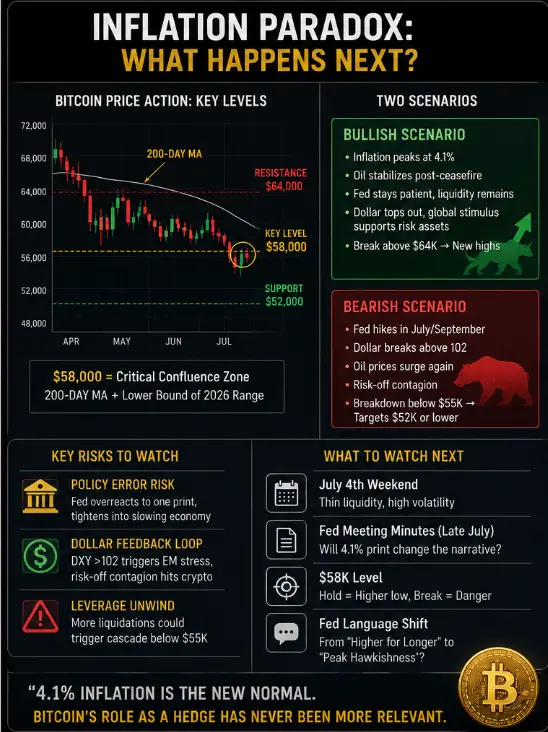
From a technical perspective, Bitcoin remains under heavy pressure near the psychologically important $60,000 level. Immediate support is located between $60,000 and $59,500, followed by stronger structural support between $57,000 and $58,000, while the broader long-term support zone extends between $50,000 and $55,000. On the upside, major resistance remains at $63,100, followed by $65,000, $67,200-$67,500, while the 200-week moving average currently stands near $62,457.
Momentum indicators continue favoring sellers, with the Daily RSI at 39, Weekly RSI at 34, and Monthly RSI at 41, while the MACD remains bearish across both daily and weekly timeframes. Retail positioning also shows approximately 70.5% of traders remaining long, historically acting as a contrarian bearish signal whenever excessive optimism persists during declining markets.
Ethereum continues exhibiting even higher volatility because of its greater sensitivity to risk sentiment. The $1,500 level represents the primary psychological and technical support, followed by additional support between $1,400 and $1,450, while a deeper correction could extend toward $1,200-$1,300. Resistance remains near $1,600, followed by $1,708 and $1,750, with Ethereum needing to reclaim and hold above $1,750 before a sustainable recovery can be considered technically credible.
Market Outlook and Investment Strategy
If inflation remains above 4% and upcoming economic reports continue surprising to the upside, the Federal Reserve may maintain restrictive monetary policy for longer than markets currently expect. Under this bearish scenario, Bitcoin could revisit the $50,000-$55,000 region, while Ethereum could decline toward $1,200-$1,400 as institutional investors continue reducing exposure and liquidity conditions remain weak. A more neutral outcome would likely keep Bitcoin trading between $55,000 and $65,000 and Ethereum between $1,400 and $1,800, allowing markets to consolidate while waiting for additional inflation data. A bullish recovery would require a significantly softer June PCE report, renewed ETF inflows, improving liquidity, and growing expectations that the Federal Reserve may eventually begin easing monetary policy, potentially allowing Bitcoin to recover above $67,000 while Ethereum advances toward $2,000.
For investors, disciplined risk management remains essential. Long-term participants may continue gradual Dollar-Cost Averaging while reducing position sizes until a confirmed market bottom develops. Short-term traders should prioritize high-liquidity support and resistance zones, avoid excessive leverage, and maintain strict stop-loss strategies because thinner liquidity can produce unusually sharp price swings. Maintaining portfolio diversification, including a 10-20% allocation to gold as an inflation hedge together with adequate cash reserves, may help reduce overall portfolio volatility during this uncertain macroeconomic environment.
The 4.1% PCE inflation reading has clearly reinforced the bearish short-term outlook for cryptocurrency markets. Rising trading volumes accompanied by declining futures open interest, persistent ETF outflows, weakening market depth, and reduced institutional participation collectively suggest that investors remain defensive despite periodic relief rallies. Although the long-term fundamentals supporting Bitcoin and Ethereum adoption remain intact, current price action continues to be driven primarily by macroeconomic conditions rather than blockchain-specific developments.
The next major catalyst will be the June 2026 PCE report, scheduled for release in late July. A meaningful decline below 3.8% could improve market confidence, weaken the U.S. dollar, reduce Treasury yields, and encourage renewed institutional participation. However, another elevated inflation reading would likely strengthen expectations for prolonged monetary tightening, intensify selling pressure across digital assets, and extend the current correction. Until inflation shows a sustained path toward the Federal Reserve's 2% objective, investors should prioritize capital preservation, disciplined portfolio management, and careful risk control while preparing for continued volatility across Bitcoin, Ethereum, gold, oil, and the broader global financial markets.@Gate_Square
The United States Personal Consumption Expenditures (PCE) Price Index, the Federal Reserve's preferred inflation gauge, accelerated to 4.1% year-over-year in May 2026, rising from 3.8% in April and marking the highest inflation reading in more than three years. The stronger-than-expected report immediately changed market expectations for future monetary policy, as investors now anticipate interest rates remaining higher for longer. This shift has strengthened the U.S. dollar, pushed Treasury yields sharply higher, tightened global liquidity conditions, and triggered broad-based selling across cryptocurrencies, while defensive assets such as gold continued attracting capital.
Unlike previous inflation surprises, this report arrived when cryptocurrency markets were already experiencing weakening momentum, declining institutional demand, and persistent ETF outflows. As a result, the inflation data accelerated an already fragile market structure, increasing volatility and forcing traders to reassess both short-term positioning and long-term portfolio allocation.
Understanding the Inflation Data
Headline PCE inflation increased to 4.1%, compared with 3.8% in April, while monthly inflation rose 0.3%. At the same time, Core PCE, which excludes food and energy prices and is closely monitored by Federal Reserve policymakers, climbed to 3.4% from 3.3%, representing its highest level since October 2023. These figures confirm that inflation remains significantly above the Federal Reserve's long-term 2% target, making immediate monetary easing increasingly unlikely.
For financial markets, persistent inflation is not simply an economic statistic—it directly influences borrowing costs, liquidity availability, investor confidence, and overall risk appetite.
Every additional month of elevated inflation increases the probability that interest rates will remain restrictive, limiting the flow of capital into speculative assets such as cryptocurrencies while improving the attractiveness of government bonds and other yield-generating investments.
Current Market Performance
The inflation surprise produced an immediate reaction across global financial markets. Bitcoin traded between $59,547 and $60,895, recording a 24-hour decline of 2.8%, a 7-day loss of 8.4%, a 30-day decline of 14.7%, and a 90-day correction of 26.3%, leaving the world's largest cryptocurrency approximately 68% below its all-time high near $108,000. Ethereum underperformed even further, trading between $1,556 and $1,572, falling 4.1% in 24 hours, 12.6% over seven days, 21.3% during the last month, and 38.7% over the previous ninety days, remaining almost 92% below its historical peak of $4,878.
While cryptocurrencies weakened, Gold climbed to approximately $4,005 per ounce, after touching an intraday high of $4,067, gaining 0.9% in 24 hours, 2.4% in one week, 6.8% over thirty days, and 18.4% over ninety days, reflecting continued investor demand for traditional inflation hedges. Meanwhile, WTI crude oil traded near $69.45 per barrel and Brent crude near $74.02, both extending recent declines as easing geopolitical tensions reduced supply concerns. U.S. Treasury yields also moved sharply higher, with the 10-Year yield reaching 4.412%, up 11 basis points following the PCE release, while the 2-Year yield stood at 4.148%, reinforcing expectations of tighter financial conditions.
Liquidity, Trading Volume and Institutional Positioning
One of the most important developments following the inflation report was the significant deterioration in cryptocurrency market liquidity.
Bitcoin's 24-hour spot trading volume surged to approximately $48.7 billion, representing a 58% increase above its thirty-day average, while the seven-day average daily volume reached $41.2 billion, up 47%. However, despite stronger trading activity, Bitcoin futures open interest declined to $31.4 billion, falling 17.34% during the previous month, indicating that much of the increased volume resulted from liquidation and position reduction rather than fresh bullish capital entering the market.
Market liquidity also weakened considerably. Bid-ask spreads on major exchanges widened by 42% around the critical $60,000 price level, while buy-side market depth across the ten largest exchanges declined by 26% within 2% of spot price. This combination of higher trading volume and lower market depth suggests that relatively modest sell orders are now capable of producing significantly larger price movements, increasing the probability of sharp intraday volatility and flash crashes during periods of negative macroeconomic news.
Ethereum displayed even greater weakness.
Spot trading volume climbed to $28.9 billion, approximately 71% above average, while the seven-day average reached $24.6 billion, increasing 64%. Despite higher activity, Ethereum futures open interest fell to $14.8 billion, declining 19.7% over the last month, while long liquidations totaled approximately $1.12 billion during the previous seven days, representing nearly 78% of all cryptocurrency liquidations. Across the broader digital asset market, total 24-hour trading volume expanded to roughly $118 billion, increasing 52% after the PCE release, whereas the overall crypto market capitalization declined to approximately $2.18 trillion, falling 9.4% during the previous month.
Bitcoin dominance remained stable at 52.8%, indicating that investors continued rotating capital away from higher-risk altcoins toward relatively safer large-cap assets.
Institutional positioning also remained weak.
Bitcoin Spot ETFs recorded cumulative outflows of approximately $6.39 billion, with 26 of the previous 30 trading sessions showing net withdrawals, while Ethereum ETFs experienced nearly $412 million in outflows during the last fourteen days. Persistent ETF redemptions suggest that institutional investors remain cautious and continue reducing exposure until inflation shows a convincing downward trend.
Bitcoin and Ethereum Technical Outlook
From a technical perspective, Bitcoin remains under heavy pressure near the psychologically important $60,000 level. Immediate support is located between $60,000 and $59,500, followed by stronger structural support between $57,000 and $58,000, while the broader long-term support zone extends between $50,000 and $55,000. On the upside, major resistance remains at $63,100, followed by $65,000, $67,200-$67,500, while the 200-week moving average currently stands near $62,457.
Momentum indicators continue favoring sellers, with the Daily RSI at 39, Weekly RSI at 34, and Monthly RSI at 41, while the MACD remains bearish across both daily and weekly timeframes. Retail positioning also shows approximately 70.5% of traders remaining long, historically acting as a contrarian bearish signal whenever excessive optimism persists during declining markets.
Ethereum continues exhibiting even higher volatility because of its greater sensitivity to risk sentiment. The $1,500 level represents the primary psychological and technical support, followed by additional support between $1,400 and $1,450, while a deeper correction could extend toward $1,200-$1,300. Resistance remains near $1,600, followed by $1,708 and $1,750, with Ethereum needing to reclaim and hold above $1,750 before a sustainable recovery can be considered technically credible.
Market Outlook and Investment Strategy
If inflation remains above 4% and upcoming economic reports continue surprising to the upside, the Federal Reserve may maintain restrictive monetary policy for longer than markets currently expect. Under this bearish scenario, Bitcoin could revisit the $50,000-$55,000 region, while Ethereum could decline toward $1,200-$1,400 as institutional investors continue reducing exposure and liquidity conditions remain weak. A more neutral outcome would likely keep Bitcoin trading between $55,000 and $65,000 and Ethereum between $1,400 and $1,800, allowing markets to consolidate while waiting for additional inflation data. A bullish recovery would require a significantly softer June PCE report, renewed ETF inflows, improving liquidity, and growing expectations that the Federal Reserve may eventually begin easing monetary policy, potentially allowing Bitcoin to recover above $67,000 while Ethereum advances toward $2,000.
For investors, disciplined risk management remains essential. Long-term participants may continue gradual Dollar-Cost Averaging while reducing position sizes until a confirmed market bottom develops. Short-term traders should prioritize high-liquidity support and resistance zones, avoid excessive leverage, and maintain strict stop-loss strategies because thinner liquidity can produce unusually sharp price swings. Maintaining portfolio diversification, including a 10-20% allocation to gold as an inflation hedge together with adequate cash reserves, may help reduce overall portfolio volatility during this uncertain macroeconomic environment.
The 4.1% PCE inflation reading has clearly reinforced the bearish short-term outlook for cryptocurrency markets. Rising trading volumes accompanied by declining futures open interest, persistent ETF outflows, weakening market depth, and reduced institutional participation collectively suggest that investors remain defensive despite periodic relief rallies. Although the long-term fundamentals supporting Bitcoin and Ethereum adoption remain intact, current price action continues to be driven primarily by macroeconomic conditions rather than blockchain-specific developments.
The next major catalyst will be the June 2026 PCE report, scheduled for release in late July. A meaningful decline below 3.8% could improve market confidence, weaken the U.S. dollar, reduce Treasury yields, and encourage renewed institutional participation. However, another elevated inflation reading would likely strengthen expectations for prolonged monetary tightening, intensify selling pressure across digital assets, and extend the current correction. Until inflation shows a sustained path toward the Federal Reserve's 2% objective, investors should prioritize capital preservation, disciplined portfolio management, and careful risk control while preparing for continued volatility across Bitcoin, Ethereum, gold, oil, and the broader global financial markets.@Gate_Square