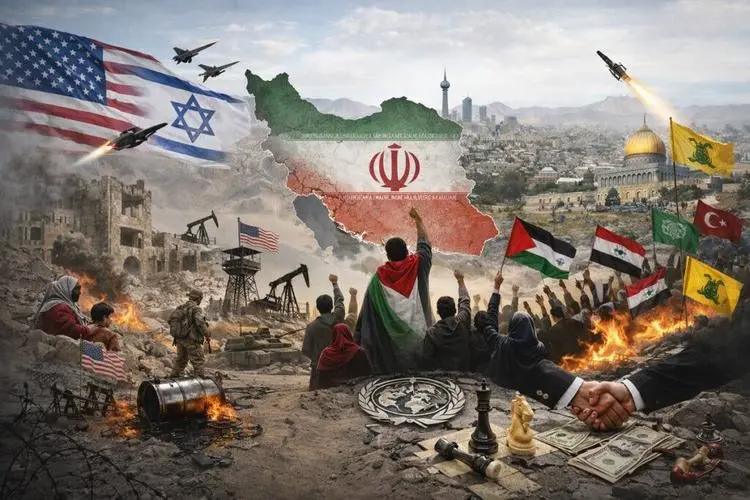
# IranUSConflictEscalates

84.75K

In the early hours of May 8 local time, the U.S. military violated the ceasefire agreement, launching airstrikes on Iran's coastal areas and oil tankers. The Iranian armed forces quickly counterattacked, using ballistic missiles, anti-ship cruise missiles, and drones to strike U.S. naval vessels east of the Strait of Hormuz. Iran's Revolutionary Guard claimed to have repelled three U.S. destroyers, inflicting "significant losses." Oil prices, which had plunged 7% earlier on ceasefire hopes, rebounded sharply, while U.S. stocks erased gains. Tensions at the Strait of Hormuz have reignited, fueling risk-off sentiment and near-term volatility for risk assets.

📢 Gate Square | 5/8 Hot Discussion: #美伊冲突再升级
The prospects for US-Iran talks have suddenly taken a major hit. On May 8, the U.S. Central Command confirmed that U.S. forces intercepted and retaliated against an Iranian attack in the Strait of Hormuz. Owing to this geopolitical conflict, U.S. stocks promptly dropped below their highs, BTC fell through the $80,000 level, and oil prices saw a sharp V-shaped reversal. With tonight’s non-farm payroll data about to be released, can the bulls regain their ground?
🎁 Predict the market trend and draw 5 lucky Koi fish winners to share a $1,000 positio
BTC-1.95%
View Original
post-image
  • Reward
  • 8
  • Repost
  • Share
Ruichen:
To The Moon 🌕
View More
#IranUSConflictEscalates 🌍⚠️
Global markets are entering a dangerous phase where geopolitics is starting to move faster than investor confidence. Every time tensions rise between Iran and the United States, financial markets immediately react because the risk is no longer regional — it becomes global. Oil prices spike, investors rush toward safe-haven assets, liquidity becomes unstable, and risk markets like crypto suddenly face intense volatility pressure.
What makes this situation critical is the speed at which fear spreads across interconnected markets. One military escalation, one strateg
BTC-1.95%
ETH-2.32%
LINK-1.73%
post-image
  • Reward
  • Comment
  • Repost
  • Share
#IranUSConflictEscalates
🚨 Iran-U.S. Conflict Escalates — What the Strait of Hormuz Crisis Means for Crypto and Global Markets
In the early hours of May 8th, geopolitical risk returned to the center of global financial markets with devastating force. U.S. military airstrikes on Iran's coastal areas and oil tankers shattered fragile ceasefire hopes, triggering an immediate Iranian counterattack involving ballistic missiles, anti-ship cruise missiles, and drones targeting U.S. naval vessels east of the Strait of Hormuz. Iran's Revolutionary Guard claimed to have repelled three U.S. destroyers
post-image
  • Reward
  • 2
  • Repost
  • Share
HighAmbition:
good 👍👍👍👍 good
View More
#IranUSConflictEscalates
#美伊冲突再升级 US-Iran Conflict Escalates Again
The current escalation between the United States and Iran should not be interpreted as a standalone geopolitical headline — it represents a multi-dimensional stress shock entering the global macro system, simultaneously affecting energy markets, inflation expectations, liquidity cycles, and risk asset behavior across the board.
What makes this phase structurally different from previous tensions is not simply military activity, but the speed of transmission from geopolitical shock → energy repricing → macro tightening → financi
post-image
[The user has shared his/her trading data. Go to the App to view more.]
  • Reward
  • Comment
  • Repost
  • Share
#IranUSConflictEscalates
Global financial markets are currently entering one of the most sensitive macro-driven phases of recent cycles as geopolitical tensions between Iran and the United States continue to escalate. This is not a normal news headline reaction anymore, and it is not a short-term speculative move either. What we are witnessing right now is a full-scale macro repricing environment where geopolitical uncertainty is directly influencing liquidity flows, inflation expectations, institutional positioning, and cross-asset volatility structures across the entire global financial sys
HighAmbition
#IranUSConflictEscalates
Global financial markets are currently entering one of the most sensitive macro-driven phases of recent cycles as geopolitical tensions between Iran and the United States continue to escalate. This is not a normal news headline reaction anymore, and it is not a short-term speculative move either. What we are witnessing right now is a full-scale macro repricing environment where geopolitical uncertainty is directly influencing liquidity flows, inflation expectations, institutional positioning, and cross-asset volatility structures across the entire global financial system.
At this moment, the market is clearly not behaving in a purely technical manner. Instead, price action across all major asset classes is being driven by fear premium, risk adjustment behavior, and capital rotation dynamics.
Current key asset prices:
Bitcoin (BTC): $79,800
Ethereum (ETH): $2,292
Gold (XAU/USD): $4,690
Crude Oil (XTI): $95.6
These prices are extremely important because they reflect a global transition phase where markets are no longer just following trend structures, but are actively reacting to macro risk probabilities and geopolitical stress factors.
1. GLOBAL GEOPOLITICAL CONTEXT — WHY THIS EVENT IS A MACRO MARKET CATALYST
The escalation between Iran and the United States carries significant weight in global financial systems because the Middle East region plays a critical role in global energy supply, maritime trade routes, and inflation stability. When tensions rise in this region, the entire global market ecosystem reacts immediately because even the possibility of disruption can impact supply chains, commodity pricing, and inflation expectations worldwide.
Markets are forward-discounting systems, which means they do not wait for actual events to occur. Instead, they begin pricing in potential outcomes based on probability shifts. As geopolitical risk increases, investors begin repositioning capital away from risk-sensitive assets and toward defensive or hedging instruments.
This is why we are currently seeing synchronized movement across multiple asset classes rather than isolated reactions.
2. CRUDE OIL (XTI $95.6) — THE MOST DIRECT GEOPOLITICAL TRADE IN THE MARKET
Crude oil is currently the most reactive and sensitive asset in this entire environment because it is directly connected to supply chain stability and global energy security.
At $95.6, oil is already trading with a geopolitical risk premium embedded in its price structure. The market is not only pricing current supply conditions but also future uncertainty regarding potential disruptions in the Middle East.
If geopolitical escalation continues, oil does not move slowly—it reacts aggressively due to speculative positioning and supply shock expectations. In such scenarios, oil can quickly expand toward $100, $105, and even $110 levels depending on the intensity of perceived risk.
This happens because: • Shipping route security concerns increase immediately
• Insurance costs for transportation rise
• Institutional hedging demand increases
• Inflation expectations rise globally
• Speculative futures positioning accelerates
Oil is essentially the first asset that reacts to geopolitical stress and often leads macro inflation narratives across the financial system.
3. GOLD (XAU $4,690) — SAFE HAVEN CAPITAL ACCUMULATION ZONE
Gold is currently functioning as the primary safe-haven asset in the global financial system. At $4,690, gold is already reflecting strong institutional demand driven by uncertainty, fear hedging, and long-term capital preservation strategies.
Unlike speculative assets, gold does not rely on growth expectations or leverage cycles. Instead, it benefits directly from instability, uncertainty, and inflation concerns.
In the current environment, gold demand is increasing because investors are prioritizing capital protection over capital growth. This is a classic behavior seen in geopolitical stress cycles.
If uncertainty continues or escalates further, gold has a clear structural pathway toward $4,750, $4,850, and potentially psychological levels near $5,000 in extended instability scenarios.
Gold’s strength in this environment comes from: • Central bank accumulation behavior
• Institutional hedge positioning
• Currency uncertainty hedging
• Long-term store of value demand
Gold is currently acting as the “stability anchor” of the entire macro system.
4. BITCOIN (BTC $79,800) — HIGH VOLATILITY HYBRID MACRO ASSET
Bitcoin is currently in a complex structural phase because it behaves as both a risk asset and a macro liquidity-sensitive asset.
At $79,800, BTC is not breaking its macro structure, but it is experiencing high volatility due to reduced liquidity stability and increased risk-off sentiment.
Current BTC behavior includes: • Increased intraday volatility
• Liquidity gaps between buyers and sellers
• Reduced leverage participation
• Faster reaction to macro headlines
Bitcoin is currently trapped between two opposing forces: On one side, it still holds long-term bullish structure.
On the other side, short-term macro fear is suppressing momentum.
Key BTC levels: Immediate support: $78,000 → $76,000
Immediate resistance: $82,500 → $85,000
If BTC holds above $78,000, the structure remains stable. However, if geopolitical pressure increases and liquidity weakens further, deeper retests can occur before stabilization.
Importantly, BTC is not in structural collapse—it is in a macro adjustment phase driven by external uncertainty.
5. ETHEREUM (ETH $2,292) — HIGH BETA VOLATILITY EXPANSION ASSET
Ethereum is currently showing more aggressive volatility behavior compared to Bitcoin due to its higher beta nature and deeper sensitivity to liquidity cycles.
At $2,292, ETH is under relatively higher pressure because altcoin liquidity tends to contract faster during risk-off environments.
Key ETH behavior: • Faster downside reactions than BTC
• Reduced speculative inflows
• Higher sensitivity to market sentiment shifts
Key ETH zones: Support: $2,200 → $2,100
Recovery: Dependent on BTC stabilization above $82K
ETH typically amplifies BTC movements, meaning if BTC stabilizes, ETH recovery can be faster, but if BTC weakens, ETH downside can accelerate.
6. US DOLLAR STRENGTH — GLOBAL LIQUIDITY CONTRACTION SIGNAL
During geopolitical stress phases, the US Dollar typically strengthens because global investors move toward the most liquid and stable currency available in the system.
Dollar strength creates indirect pressure on all risk assets because: • Global liquidity contracts
• Cross-border capital flows slow down
• Risk assets face reduced inflows
• Borrowing costs effectively increase
This is one of the hidden but most powerful macro drivers affecting Bitcoin and Ethereum right now.
7. GLOBAL EQUITIES — DEFENSIVE ROTATION PHASE
Stock markets are currently experiencing risk-off rotation behavior where investors reduce exposure to high-growth and high-volatility sectors.
Typical behavior includes: • Technology sector pressure
• Increased demand for defensive stocks
• Capital rotation into low-volatility sectors
• Reduced speculative positioning
Equities are essentially mirroring the same macro sentiment shift seen in crypto markets.
8. MARKET PSYCHOLOGY — FEAR-DRIVEN REPRICING CYCLE
Markets are currently not operating on pure technical structure. Instead, they are operating on emotional macro repricing dynamics.
Key psychological conditions: • Fear replacing greed
• Reduced confidence in breakouts
• News-driven volatility spikes
• Short-term panic reactions
• Uncertainty dominating decision-making
This type of environment creates unstable price behavior where traditional support/resistance levels can be temporarily broken due to emotional liquidity events.
9. CAPITAL FLOW ROTATION MAP — WHERE MONEY IS MOVING
Current global capital flow structure is clearly visible:
Risk assets (BTC, ETH, equities) → Outflow pressure
Gold → Strong accumulation inflows
Oil → Speculative geopolitical inflows
US Dollar → Strength accumulation phase
This rotation defines the entire macro environment more accurately than technical charts.
10. CROSS-ASSET COMPARISON — MARKET POWER STRUCTURE
Bitcoin ($79,800): High volatility, consolidation between $78K–$82K, macro-sensitive
Ethereum ($2,292): Higher volatility, weaker liquidity, faster downside reactions
Gold ($4,690): Strong safe-haven leader, stable accumulation, potential move toward $5K
Oil ($95.6): Most aggressive geopolitical asset, potential spike toward $100–$110
Each asset is currently responding differently based on its structural role in the macro system.
11. FINAL MARKET OUTLOOK — WHAT HAPPENS NEXT
The global financial system is currently in a geopolitical risk repricing cycle combined with a liquidity adjustment phase. Markets are not collapsing, but they are actively recalibrating risk exposure across all asset classes.
The next directional phase of the market will depend on two major conditions:
First, geopolitical clarity—either escalation intensifies or stabilizes, reducing uncertainty premium in global markets.
Second, liquidity conditions—whether capital begins returning to risk assets or continues rotating into defensive positioning.
Until these conditions stabilize, markets are expected to remain: • Highly volatile
• News-driven
• Emotionally reactive
• Liquidity-sensitive
• Structurally unstable in short-term behavior
Bitcoin and Ethereum are currently in a macro reset phase, gold is acting as the stability anchor, and oil is functioning as the primary geopolitical shock absorber of the global system.
Historically, phases like this often precede major structural opportunities once fear peaks, liquidity resets, and smart money begins re-accumulation in risk assets before the next expansion cycle begins.
repost-content-media
  • Reward
  • Comment
  • Repost
  • Share
📢 Gate Square | 5/8 Hot Discussion: #美伊冲突再升级
The prospects for US-Iran talks have suddenly taken a major hit. On May 8, the U.S. Central Command confirmed that U.S. forces intercepted and retaliated against an Iranian attack in the Strait of Hormuz. Owing to this geopolitical conflict, U.S. stocks promptly dropped below their highs, BTC fell through the $80,000 level, and oil prices saw a sharp V-shaped reversal. With tonight’s non-farm payroll data about to be released, can the bulls regain their ground?
🎁 Predict the market trend and draw 5 lucky Koi fish winners to share a $1,000 positio
BTC-1.95%
post-image
  • Reward
  • 2
  • Repost
  • Share
HighAmbition:
To The Moon 🌕
View More
#美伊冲突再升级 #Gate广场五月交易分享 US-Iran Conflict Escalates Again
On May 7th, three US destroyers (USS Trenton, USS Rafael Peralta, USS Mason) were attacked by multiple Iranian missiles, drones, and small boats while crossing the Strait of Hormuz. The US Central Command stated that no US ships were hit, and immediately launched targeted retaliatory strikes against Iranian missile launch sites, command and control centers, and intelligence surveillance nodes. Iran, on the other hand, claimed that the US first fired on an Iranian oil tanker, and that Iranian forces responded with ballistic missiles and an
Ryakpanda
#美伊冲突再升级 #Gate广场五月交易分享 US-Iran Conflict Escalates Again
On May 7th, three US destroyers (USS Trenton, USS Rafael Peralta, USS Mason) were attacked by multiple Iranian missiles, drones, and small boats while crossing the Strait of Hormuz. The US Central Command stated that no US ships were hit, and immediately launched targeted retaliatory strikes against Iranian missile launch sites, command and control centers, and intelligence surveillance nodes. Iran, on the other hand, claimed that the US first fired on an Iranian oil tanker, and that Iranian forces responded with ballistic missiles and anti-ship cruise missiles, claiming to have hit an "enemy destroyer." Iran's air defense forces also shot down two "hostile aircraft" over Abadan Port and Kish Island. Iran officially declared early on May 8th that US forces violated the ceasefire agreement.
Current market conditions (real-time on May 8th): BTC approximately $79,724 (24h -1.75%), ETH approximately $2,284 (-1.88%), SOL approximately $88.13 (-0.19%), XRP approximately $1.384 (-2.32%), DOGE approximately $0.106 (-4.07%). The market is digesting the impact of the crossfire in the strait, with a broad decline.
Impact transmission chain: three pathways acting simultaneously
1. Energy inflation → monetary tightening. The Strait of Hormuz carries about 20% of global oil and natural gas transportation. Since the conflict erupted, Brent crude oil surged to $114 per barrel, currently still fluctuating above $100. Citibank raised its Brent benchmark forecast by $15 to $110 and delayed the reopening expectation of the strait to the end of May. US inflation in March jumped to 3.3% (energy costs up 12.5% YoY), the 30-year US Treasury yield broke above 5%, approaching a twenty-year high, with market pricing a 37% chance of rate hikes this year. St. Louis Fed President James Bullard explicitly stated that inflation risks are skewed upward, and interest rates may need to stay high for a long time. The high-interest-rate environment directly suppresses risk asset valuations.
2. Geopolitical risk → safe-haven sell-off. Every escalation in conflict triggers rapid declines in crypto markets.
Typical pattern: BTC surged to $80,594 on May 4th (highest since January), but immediately fell back to around $79,000 after reports of Iranian missiles.
This cycle: BTC climbed from a low of about $60,000 at the start of the year to the $80,000 range over nearly four months, but each geopolitical shock can wipe out weeks of gains within hours. Altcoins like DOGE fell even more (-4.07% vs BTC -1.75%), showing clear risk asset divergence.
3. Supply chain disruptions → recession fears. Iran's attack on a UAE aluminum smelter disrupted nearly 10% of global aluminum supply; UN reports doubled transportation costs for aid supplies; delays at Omani ports disrupted delivery schedules. Citibank analysts bluntly said, "It's hard to predict whether Iran will reach an agreement; you know news-driven prices will fluctuate wildly."
Negotiation progress: light and shadow coexist
Despite the escalation in strait clashes, the negotiation window remains open. The US has submitted a one-page, 14-point memorandum of understanding to Iran, with core points including:
• Iran promises to suspend uranium enrichment (US demands 15-20 years, Iran may accept 5-10 years, a compromise around 12 years)
• US lifts some sanctions and releases billions of dollars of frozen Iranian funds
• Both sides lift restrictions on passage through the Strait of Hormuz and Iranian ports
• Establish a detailed 30-day negotiation framework
On June 6th, Trump suddenly paused the "Freedom of Navigation" escort operation, claiming "significant progress" in negotiations; Secretary of State Blinken announced the end of the "epic fury" military operations. But Trump also warned: if Iran does not accept the deal, "it will be bombed at higher intensity."
Key contradiction: Iran has also established the "Persian Gulf Strait Authority," attempting to charge a $1 per barrel "toll" for ships passing through (requiring payment in cryptocurrency), directly conflicting with US demands for unconditional open access to the strait.
Future trends: three scenarios and probability assessments
Scenario 1: Successful negotiations, conflict ends (probability: medium, about 35-40%)
If Iran accepts the memorandum framework within 48 hours and enters a 30-day formal negotiation period, the Strait of Hormuz gradually reopens, and oil prices could quickly fall below $90. Easing inflation pressures could open room for the Fed to cut rates, and BTC may break through the short-term resistance level of around $93,000, moving toward the $90,000-$100,000 range. Standard Chartered's 2026 year-end target is $100,000.
Signal indicators: Iran officially responds to the memorandum; actual passage volume in the strait recovers; Brent drops below $95.
Scenario 2: Negotiations break down, conflict escalates sharply again (probability: medium-low, about 20-25%)
If Iran rejects the memorandum or the toll demands from the Strait Authority cannot be reconciled, Trump has explicitly threatened "higher intensity bombing." Since the ceasefire, Iran has launched 9 attacks on commercial ships and over 10 on US forces (all below the threshold for resuming large-scale combat). The crossfire on May 7th shows the situation remains volatile. If full-scale military action resumes, oil prices could spike above $120, and BTC could retest support levels of $70,000 or even $65,000.
Signal indicators: Trump announces resumption of large-scale military operations; Iran launches large-scale attacks on ships in the strait; Brent surpasses $120.
Scenario 3: Low-intensity stalemate, market gradually desensitizes (highest probability, about 40%)
The most likely middle path: negotiations continue but progress is slow, sporadic clashes persist but below the threshold of full-scale war, with limited passage through the strait. Under this "low-intensity stalemate," market sensitivity to geopolitical risks will gradually diminish—CoinDesk has observed BTC beginning to "ignore" the negative impact of high interest rates, forming a clear upward channel (higher lows and higher highs). In April, BTC ETF inflows reached $2.44 billion (the strongest since October), with institutions continuing to buy during declines. BTC may oscillate in the $75,000-$85,000 range for several weeks, awaiting clear catalysts (negotiation outcomes or inflation data).
A noteworthy variable: Iran demands to pay tolls in BTC
Iran announced it will charge a $1 per barrel toll for oil tankers passing through the Strait of Hormuz, requiring payment in cryptocurrency. Bitwise Chief Investment Officer Matt Hougan believes this is a "watershed moment where Bitcoin's non-political currency theory shifts from fantasy to reality." If BTC assumes both store of value and international trade currency roles, long-term price potential could expand significantly. The London Crypto Club also states that "even if no agreement is reached ultimately, this is a major shift in BTC's Overton window." However, in the short term, this narrative is more conceptual than driven by actual demand—current strait traffic volume is very low, and the actual BTC payment volume is minimal.
Operational considerations
The current market is in a "high-risk observation window"—the crossfire in the strait on May 7th has significantly increased short-term risks, but the negotiation framework offers some hope for easing. BTC has retreated to around $79,700, neither panic nor confirmation zone.
• Short-term: extremely volatile, any geopolitical news could trigger 5-10% rapid swings. Position management is more important than directional judgment; avoid heavy bets on a single scenario.
• Medium-term: focus on support at $75,000 and resistance at $85,000. If negotiations make substantial progress, gradual deployment is safer than chasing the top; if conflict escalates again, wait for stabilization signals around $70,000-$75,000.
• Long-term: the narrative of Iran paying tolls in BTC has limited short-term impact but signifies a breakthrough in BTC's recognition as a "non-political currency." Institutions have continued buying during Q1 declines (ETF monthly inflow of $2.44 billion), and the long-term support logic remains unchanged.
• Altcoins: DOGE fell 4.07%, far more than BTC's -1.75%, indicating increased risk asset divergence. During rebounds, altcoins are more volatile (previously ZEC +24%, DOGS +26%), but also fall more sharply during downturns; choose based on risk appetite.
repost-content-media
  • Reward
  • 3
  • Repost
  • Share
Dubai_Prince:
2026 GOGOGO 👊
View More
#IranUSConflictEscalates
Global financial markets are currently entering one of the most sensitive macro-driven phases of recent cycles as geopolitical tensions between Iran and the United States continue to escalate. This is not a normal news headline reaction anymore, and it is not a short-term speculative move either. What we are witnessing right now is a full-scale macro repricing environment where geopolitical uncertainty is directly influencing liquidity flows, inflation expectations, institutional positioning, and cross-asset volatility structures across the entire global financial sys
HighAmbition
#IranUSConflictEscalates
Global financial markets are currently entering one of the most sensitive macro-driven phases of recent cycles as geopolitical tensions between Iran and the United States continue to escalate. This is not a normal news headline reaction anymore, and it is not a short-term speculative move either. What we are witnessing right now is a full-scale macro repricing environment where geopolitical uncertainty is directly influencing liquidity flows, inflation expectations, institutional positioning, and cross-asset volatility structures across the entire global financial system.
At this moment, the market is clearly not behaving in a purely technical manner. Instead, price action across all major asset classes is being driven by fear premium, risk adjustment behavior, and capital rotation dynamics.
Current key asset prices:
Bitcoin (BTC): $79,800
Ethereum (ETH): $2,292
Gold (XAU/USD): $4,690
Crude Oil (XTI): $95.6
These prices are extremely important because they reflect a global transition phase where markets are no longer just following trend structures, but are actively reacting to macro risk probabilities and geopolitical stress factors.
1. GLOBAL GEOPOLITICAL CONTEXT — WHY THIS EVENT IS A MACRO MARKET CATALYST
The escalation between Iran and the United States carries significant weight in global financial systems because the Middle East region plays a critical role in global energy supply, maritime trade routes, and inflation stability. When tensions rise in this region, the entire global market ecosystem reacts immediately because even the possibility of disruption can impact supply chains, commodity pricing, and inflation expectations worldwide.
Markets are forward-discounting systems, which means they do not wait for actual events to occur. Instead, they begin pricing in potential outcomes based on probability shifts. As geopolitical risk increases, investors begin repositioning capital away from risk-sensitive assets and toward defensive or hedging instruments.
This is why we are currently seeing synchronized movement across multiple asset classes rather than isolated reactions.
2. CRUDE OIL (XTI $95.6) — THE MOST DIRECT GEOPOLITICAL TRADE IN THE MARKET
Crude oil is currently the most reactive and sensitive asset in this entire environment because it is directly connected to supply chain stability and global energy security.
At $95.6, oil is already trading with a geopolitical risk premium embedded in its price structure. The market is not only pricing current supply conditions but also future uncertainty regarding potential disruptions in the Middle East.
If geopolitical escalation continues, oil does not move slowly—it reacts aggressively due to speculative positioning and supply shock expectations. In such scenarios, oil can quickly expand toward $100, $105, and even $110 levels depending on the intensity of perceived risk.
This happens because: • Shipping route security concerns increase immediately
• Insurance costs for transportation rise
• Institutional hedging demand increases
• Inflation expectations rise globally
• Speculative futures positioning accelerates
Oil is essentially the first asset that reacts to geopolitical stress and often leads macro inflation narratives across the financial system.
3. GOLD (XAU $4,690) — SAFE HAVEN CAPITAL ACCUMULATION ZONE
Gold is currently functioning as the primary safe-haven asset in the global financial system. At $4,690, gold is already reflecting strong institutional demand driven by uncertainty, fear hedging, and long-term capital preservation strategies.
Unlike speculative assets, gold does not rely on growth expectations or leverage cycles. Instead, it benefits directly from instability, uncertainty, and inflation concerns.
In the current environment, gold demand is increasing because investors are prioritizing capital protection over capital growth. This is a classic behavior seen in geopolitical stress cycles.
If uncertainty continues or escalates further, gold has a clear structural pathway toward $4,750, $4,850, and potentially psychological levels near $5,000 in extended instability scenarios.
Gold’s strength in this environment comes from: • Central bank accumulation behavior
• Institutional hedge positioning
• Currency uncertainty hedging
• Long-term store of value demand
Gold is currently acting as the “stability anchor” of the entire macro system.
4. BITCOIN (BTC $79,800) — HIGH VOLATILITY HYBRID MACRO ASSET
Bitcoin is currently in a complex structural phase because it behaves as both a risk asset and a macro liquidity-sensitive asset.
At $79,800, BTC is not breaking its macro structure, but it is experiencing high volatility due to reduced liquidity stability and increased risk-off sentiment.
Current BTC behavior includes: • Increased intraday volatility
• Liquidity gaps between buyers and sellers
• Reduced leverage participation
• Faster reaction to macro headlines
Bitcoin is currently trapped between two opposing forces: On one side, it still holds long-term bullish structure.
On the other side, short-term macro fear is suppressing momentum.
Key BTC levels: Immediate support: $78,000 → $76,000
Immediate resistance: $82,500 → $85,000
If BTC holds above $78,000, the structure remains stable. However, if geopolitical pressure increases and liquidity weakens further, deeper retests can occur before stabilization.
Importantly, BTC is not in structural collapse—it is in a macro adjustment phase driven by external uncertainty.
5. ETHEREUM (ETH $2,292) — HIGH BETA VOLATILITY EXPANSION ASSET
Ethereum is currently showing more aggressive volatility behavior compared to Bitcoin due to its higher beta nature and deeper sensitivity to liquidity cycles.
At $2,292, ETH is under relatively higher pressure because altcoin liquidity tends to contract faster during risk-off environments.
Key ETH behavior: • Faster downside reactions than BTC
• Reduced speculative inflows
• Higher sensitivity to market sentiment shifts
Key ETH zones: Support: $2,200 → $2,100
Recovery: Dependent on BTC stabilization above $82K
ETH typically amplifies BTC movements, meaning if BTC stabilizes, ETH recovery can be faster, but if BTC weakens, ETH downside can accelerate.
6. US DOLLAR STRENGTH — GLOBAL LIQUIDITY CONTRACTION SIGNAL
During geopolitical stress phases, the US Dollar typically strengthens because global investors move toward the most liquid and stable currency available in the system.
Dollar strength creates indirect pressure on all risk assets because: • Global liquidity contracts
• Cross-border capital flows slow down
• Risk assets face reduced inflows
• Borrowing costs effectively increase
This is one of the hidden but most powerful macro drivers affecting Bitcoin and Ethereum right now.
7. GLOBAL EQUITIES — DEFENSIVE ROTATION PHASE
Stock markets are currently experiencing risk-off rotation behavior where investors reduce exposure to high-growth and high-volatility sectors.
Typical behavior includes: • Technology sector pressure
• Increased demand for defensive stocks
• Capital rotation into low-volatility sectors
• Reduced speculative positioning
Equities are essentially mirroring the same macro sentiment shift seen in crypto markets.
8. MARKET PSYCHOLOGY — FEAR-DRIVEN REPRICING CYCLE
Markets are currently not operating on pure technical structure. Instead, they are operating on emotional macro repricing dynamics.
Key psychological conditions: • Fear replacing greed
• Reduced confidence in breakouts
• News-driven volatility spikes
• Short-term panic reactions
• Uncertainty dominating decision-making
This type of environment creates unstable price behavior where traditional support/resistance levels can be temporarily broken due to emotional liquidity events.
9. CAPITAL FLOW ROTATION MAP — WHERE MONEY IS MOVING
Current global capital flow structure is clearly visible:
Risk assets (BTC, ETH, equities) → Outflow pressure
Gold → Strong accumulation inflows
Oil → Speculative geopolitical inflows
US Dollar → Strength accumulation phase
This rotation defines the entire macro environment more accurately than technical charts.
10. CROSS-ASSET COMPARISON — MARKET POWER STRUCTURE
Bitcoin ($79,800): High volatility, consolidation between $78K–$82K, macro-sensitive
Ethereum ($2,292): Higher volatility, weaker liquidity, faster downside reactions
Gold ($4,690): Strong safe-haven leader, stable accumulation, potential move toward $5K
Oil ($95.6): Most aggressive geopolitical asset, potential spike toward $100–$110
Each asset is currently responding differently based on its structural role in the macro system.
11. FINAL MARKET OUTLOOK — WHAT HAPPENS NEXT
The global financial system is currently in a geopolitical risk repricing cycle combined with a liquidity adjustment phase. Markets are not collapsing, but they are actively recalibrating risk exposure across all asset classes.
The next directional phase of the market will depend on two major conditions:
First, geopolitical clarity—either escalation intensifies or stabilizes, reducing uncertainty premium in global markets.
Second, liquidity conditions—whether capital begins returning to risk assets or continues rotating into defensive positioning.
Until these conditions stabilize, markets are expected to remain: • Highly volatile
• News-driven
• Emotionally reactive
• Liquidity-sensitive
• Structurally unstable in short-term behavior
Bitcoin and Ethereum are currently in a macro reset phase, gold is acting as the stability anchor, and oil is functioning as the primary geopolitical shock absorber of the global system.
Historically, phases like this often precede major structural opportunities once fear peaks, liquidity resets, and smart money begins re-accumulation in risk assets before the next expansion cycle begins.
repost-content-media
  • Reward
  • Comment
  • Repost
  • Share
#IranUSConflictEscalates
Global financial markets are currently entering one of the most sensitive macro-driven phases of recent cycles as geopolitical tensions between Iran and the United States continue to escalate. This is not a normal news headline reaction anymore, and it is not a short-term speculative move either. What we are witnessing right now is a full-scale macro repricing environment where geopolitical uncertainty is directly influencing liquidity flows, inflation expectations, institutional positioning, and cross-asset volatility structures across the entire global financial sys
HighAmbition
#IranUSConflictEscalates
Global financial markets are currently entering one of the most sensitive macro-driven phases of recent cycles as geopolitical tensions between Iran and the United States continue to escalate. This is not a normal news headline reaction anymore, and it is not a short-term speculative move either. What we are witnessing right now is a full-scale macro repricing environment where geopolitical uncertainty is directly influencing liquidity flows, inflation expectations, institutional positioning, and cross-asset volatility structures across the entire global financial system.
At this moment, the market is clearly not behaving in a purely technical manner. Instead, price action across all major asset classes is being driven by fear premium, risk adjustment behavior, and capital rotation dynamics.
Current key asset prices:
Bitcoin (BTC): $79,800
Ethereum (ETH): $2,292
Gold (XAU/USD): $4,690
Crude Oil (XTI): $95.6
These prices are extremely important because they reflect a global transition phase where markets are no longer just following trend structures, but are actively reacting to macro risk probabilities and geopolitical stress factors.
1. GLOBAL GEOPOLITICAL CONTEXT — WHY THIS EVENT IS A MACRO MARKET CATALYST
The escalation between Iran and the United States carries significant weight in global financial systems because the Middle East region plays a critical role in global energy supply, maritime trade routes, and inflation stability. When tensions rise in this region, the entire global market ecosystem reacts immediately because even the possibility of disruption can impact supply chains, commodity pricing, and inflation expectations worldwide.
Markets are forward-discounting systems, which means they do not wait for actual events to occur. Instead, they begin pricing in potential outcomes based on probability shifts. As geopolitical risk increases, investors begin repositioning capital away from risk-sensitive assets and toward defensive or hedging instruments.
This is why we are currently seeing synchronized movement across multiple asset classes rather than isolated reactions.
2. CRUDE OIL (XTI $95.6) — THE MOST DIRECT GEOPOLITICAL TRADE IN THE MARKET
Crude oil is currently the most reactive and sensitive asset in this entire environment because it is directly connected to supply chain stability and global energy security.
At $95.6, oil is already trading with a geopolitical risk premium embedded in its price structure. The market is not only pricing current supply conditions but also future uncertainty regarding potential disruptions in the Middle East.
If geopolitical escalation continues, oil does not move slowly—it reacts aggressively due to speculative positioning and supply shock expectations. In such scenarios, oil can quickly expand toward $100, $105, and even $110 levels depending on the intensity of perceived risk.
This happens because: • Shipping route security concerns increase immediately
• Insurance costs for transportation rise
• Institutional hedging demand increases
• Inflation expectations rise globally
• Speculative futures positioning accelerates
Oil is essentially the first asset that reacts to geopolitical stress and often leads macro inflation narratives across the financial system.
3. GOLD (XAU $4,690) — SAFE HAVEN CAPITAL ACCUMULATION ZONE
Gold is currently functioning as the primary safe-haven asset in the global financial system. At $4,690, gold is already reflecting strong institutional demand driven by uncertainty, fear hedging, and long-term capital preservation strategies.
Unlike speculative assets, gold does not rely on growth expectations or leverage cycles. Instead, it benefits directly from instability, uncertainty, and inflation concerns.
In the current environment, gold demand is increasing because investors are prioritizing capital protection over capital growth. This is a classic behavior seen in geopolitical stress cycles.
If uncertainty continues or escalates further, gold has a clear structural pathway toward $4,750, $4,850, and potentially psychological levels near $5,000 in extended instability scenarios.
Gold’s strength in this environment comes from: • Central bank accumulation behavior
• Institutional hedge positioning
• Currency uncertainty hedging
• Long-term store of value demand
Gold is currently acting as the “stability anchor” of the entire macro system.
4. BITCOIN (BTC $79,800) — HIGH VOLATILITY HYBRID MACRO ASSET
Bitcoin is currently in a complex structural phase because it behaves as both a risk asset and a macro liquidity-sensitive asset.
At $79,800, BTC is not breaking its macro structure, but it is experiencing high volatility due to reduced liquidity stability and increased risk-off sentiment.
Current BTC behavior includes: • Increased intraday volatility
• Liquidity gaps between buyers and sellers
• Reduced leverage participation
• Faster reaction to macro headlines
Bitcoin is currently trapped between two opposing forces: On one side, it still holds long-term bullish structure.
On the other side, short-term macro fear is suppressing momentum.
Key BTC levels: Immediate support: $78,000 → $76,000
Immediate resistance: $82,500 → $85,000
If BTC holds above $78,000, the structure remains stable. However, if geopolitical pressure increases and liquidity weakens further, deeper retests can occur before stabilization.
Importantly, BTC is not in structural collapse—it is in a macro adjustment phase driven by external uncertainty.
5. ETHEREUM (ETH $2,292) — HIGH BETA VOLATILITY EXPANSION ASSET
Ethereum is currently showing more aggressive volatility behavior compared to Bitcoin due to its higher beta nature and deeper sensitivity to liquidity cycles.
At $2,292, ETH is under relatively higher pressure because altcoin liquidity tends to contract faster during risk-off environments.
Key ETH behavior: • Faster downside reactions than BTC
• Reduced speculative inflows
• Higher sensitivity to market sentiment shifts
Key ETH zones: Support: $2,200 → $2,100
Recovery: Dependent on BTC stabilization above $82K
ETH typically amplifies BTC movements, meaning if BTC stabilizes, ETH recovery can be faster, but if BTC weakens, ETH downside can accelerate.
6. US DOLLAR STRENGTH — GLOBAL LIQUIDITY CONTRACTION SIGNAL
During geopolitical stress phases, the US Dollar typically strengthens because global investors move toward the most liquid and stable currency available in the system.
Dollar strength creates indirect pressure on all risk assets because: • Global liquidity contracts
• Cross-border capital flows slow down
• Risk assets face reduced inflows
• Borrowing costs effectively increase
This is one of the hidden but most powerful macro drivers affecting Bitcoin and Ethereum right now.
7. GLOBAL EQUITIES — DEFENSIVE ROTATION PHASE
Stock markets are currently experiencing risk-off rotation behavior where investors reduce exposure to high-growth and high-volatility sectors.
Typical behavior includes: • Technology sector pressure
• Increased demand for defensive stocks
• Capital rotation into low-volatility sectors
• Reduced speculative positioning
Equities are essentially mirroring the same macro sentiment shift seen in crypto markets.
8. MARKET PSYCHOLOGY — FEAR-DRIVEN REPRICING CYCLE
Markets are currently not operating on pure technical structure. Instead, they are operating on emotional macro repricing dynamics.
Key psychological conditions: • Fear replacing greed
• Reduced confidence in breakouts
• News-driven volatility spikes
• Short-term panic reactions
• Uncertainty dominating decision-making
This type of environment creates unstable price behavior where traditional support/resistance levels can be temporarily broken due to emotional liquidity events.
9. CAPITAL FLOW ROTATION MAP — WHERE MONEY IS MOVING
Current global capital flow structure is clearly visible:
Risk assets (BTC, ETH, equities) → Outflow pressure
Gold → Strong accumulation inflows
Oil → Speculative geopolitical inflows
US Dollar → Strength accumulation phase
This rotation defines the entire macro environment more accurately than technical charts.
10. CROSS-ASSET COMPARISON — MARKET POWER STRUCTURE
Bitcoin ($79,800): High volatility, consolidation between $78K–$82K, macro-sensitive
Ethereum ($2,292): Higher volatility, weaker liquidity, faster downside reactions
Gold ($4,690): Strong safe-haven leader, stable accumulation, potential move toward $5K
Oil ($95.6): Most aggressive geopolitical asset, potential spike toward $100–$110
Each asset is currently responding differently based on its structural role in the macro system.
11. FINAL MARKET OUTLOOK — WHAT HAPPENS NEXT
The global financial system is currently in a geopolitical risk repricing cycle combined with a liquidity adjustment phase. Markets are not collapsing, but they are actively recalibrating risk exposure across all asset classes.
The next directional phase of the market will depend on two major conditions:
First, geopolitical clarity—either escalation intensifies or stabilizes, reducing uncertainty premium in global markets.
Second, liquidity conditions—whether capital begins returning to risk assets or continues rotating into defensive positioning.
Until these conditions stabilize, markets are expected to remain: • Highly volatile
• News-driven
• Emotionally reactive
• Liquidity-sensitive
• Structurally unstable in short-term behavior
Bitcoin and Ethereum are currently in a macro reset phase, gold is acting as the stability anchor, and oil is functioning as the primary geopolitical shock absorber of the global system.
Historically, phases like this often precede major structural opportunities once fear peaks, liquidity resets, and smart money begins re-accumulation in risk assets before the next expansion cycle begins.
repost-content-media
  • Reward
  • Comment
  • Repost
  • Share
#IranUSConflictEscalates
Global financial markets are currently entering one of the most sensitive macro-driven phases of recent cycles as geopolitical tensions between Iran and the United States continue to escalate. This is not a normal news headline reaction anymore, and it is not a short-term speculative move either. What we are witnessing right now is a full-scale macro repricing environment where geopolitical uncertainty is directly influencing liquidity flows, inflation expectations, institutional positioning, and cross-asset volatility structures across the entire global financial sys
HighAmbition
#IranUSConflictEscalates
Global financial markets are currently entering one of the most sensitive macro-driven phases of recent cycles as geopolitical tensions between Iran and the United States continue to escalate. This is not a normal news headline reaction anymore, and it is not a short-term speculative move either. What we are witnessing right now is a full-scale macro repricing environment where geopolitical uncertainty is directly influencing liquidity flows, inflation expectations, institutional positioning, and cross-asset volatility structures across the entire global financial system.
At this moment, the market is clearly not behaving in a purely technical manner. Instead, price action across all major asset classes is being driven by fear premium, risk adjustment behavior, and capital rotation dynamics.
Current key asset prices:
Bitcoin (BTC): $79,800
Ethereum (ETH): $2,292
Gold (XAU/USD): $4,690
Crude Oil (XTI): $95.6
These prices are extremely important because they reflect a global transition phase where markets are no longer just following trend structures, but are actively reacting to macro risk probabilities and geopolitical stress factors.
1. GLOBAL GEOPOLITICAL CONTEXT — WHY THIS EVENT IS A MACRO MARKET CATALYST
The escalation between Iran and the United States carries significant weight in global financial systems because the Middle East region plays a critical role in global energy supply, maritime trade routes, and inflation stability. When tensions rise in this region, the entire global market ecosystem reacts immediately because even the possibility of disruption can impact supply chains, commodity pricing, and inflation expectations worldwide.
Markets are forward-discounting systems, which means they do not wait for actual events to occur. Instead, they begin pricing in potential outcomes based on probability shifts. As geopolitical risk increases, investors begin repositioning capital away from risk-sensitive assets and toward defensive or hedging instruments.
This is why we are currently seeing synchronized movement across multiple asset classes rather than isolated reactions.
2. CRUDE OIL (XTI $95.6) — THE MOST DIRECT GEOPOLITICAL TRADE IN THE MARKET
Crude oil is currently the most reactive and sensitive asset in this entire environment because it is directly connected to supply chain stability and global energy security.
At $95.6, oil is already trading with a geopolitical risk premium embedded in its price structure. The market is not only pricing current supply conditions but also future uncertainty regarding potential disruptions in the Middle East.
If geopolitical escalation continues, oil does not move slowly—it reacts aggressively due to speculative positioning and supply shock expectations. In such scenarios, oil can quickly expand toward $100, $105, and even $110 levels depending on the intensity of perceived risk.
This happens because: • Shipping route security concerns increase immediately
• Insurance costs for transportation rise
• Institutional hedging demand increases
• Inflation expectations rise globally
• Speculative futures positioning accelerates
Oil is essentially the first asset that reacts to geopolitical stress and often leads macro inflation narratives across the financial system.
3. GOLD (XAU $4,690) — SAFE HAVEN CAPITAL ACCUMULATION ZONE
Gold is currently functioning as the primary safe-haven asset in the global financial system. At $4,690, gold is already reflecting strong institutional demand driven by uncertainty, fear hedging, and long-term capital preservation strategies.
Unlike speculative assets, gold does not rely on growth expectations or leverage cycles. Instead, it benefits directly from instability, uncertainty, and inflation concerns.
In the current environment, gold demand is increasing because investors are prioritizing capital protection over capital growth. This is a classic behavior seen in geopolitical stress cycles.
If uncertainty continues or escalates further, gold has a clear structural pathway toward $4,750, $4,850, and potentially psychological levels near $5,000 in extended instability scenarios.
Gold’s strength in this environment comes from: • Central bank accumulation behavior
• Institutional hedge positioning
• Currency uncertainty hedging
• Long-term store of value demand
Gold is currently acting as the “stability anchor” of the entire macro system.
4. BITCOIN (BTC $79,800) — HIGH VOLATILITY HYBRID MACRO ASSET
Bitcoin is currently in a complex structural phase because it behaves as both a risk asset and a macro liquidity-sensitive asset.
At $79,800, BTC is not breaking its macro structure, but it is experiencing high volatility due to reduced liquidity stability and increased risk-off sentiment.
Current BTC behavior includes: • Increased intraday volatility
• Liquidity gaps between buyers and sellers
• Reduced leverage participation
• Faster reaction to macro headlines
Bitcoin is currently trapped between two opposing forces: On one side, it still holds long-term bullish structure.
On the other side, short-term macro fear is suppressing momentum.
Key BTC levels: Immediate support: $78,000 → $76,000
Immediate resistance: $82,500 → $85,000
If BTC holds above $78,000, the structure remains stable. However, if geopolitical pressure increases and liquidity weakens further, deeper retests can occur before stabilization.
Importantly, BTC is not in structural collapse—it is in a macro adjustment phase driven by external uncertainty.
5. ETHEREUM (ETH $2,292) — HIGH BETA VOLATILITY EXPANSION ASSET
Ethereum is currently showing more aggressive volatility behavior compared to Bitcoin due to its higher beta nature and deeper sensitivity to liquidity cycles.
At $2,292, ETH is under relatively higher pressure because altcoin liquidity tends to contract faster during risk-off environments.
Key ETH behavior: • Faster downside reactions than BTC
• Reduced speculative inflows
• Higher sensitivity to market sentiment shifts
Key ETH zones: Support: $2,200 → $2,100
Recovery: Dependent on BTC stabilization above $82K
ETH typically amplifies BTC movements, meaning if BTC stabilizes, ETH recovery can be faster, but if BTC weakens, ETH downside can accelerate.
6. US DOLLAR STRENGTH — GLOBAL LIQUIDITY CONTRACTION SIGNAL
During geopolitical stress phases, the US Dollar typically strengthens because global investors move toward the most liquid and stable currency available in the system.
Dollar strength creates indirect pressure on all risk assets because: • Global liquidity contracts
• Cross-border capital flows slow down
• Risk assets face reduced inflows
• Borrowing costs effectively increase
This is one of the hidden but most powerful macro drivers affecting Bitcoin and Ethereum right now.
7. GLOBAL EQUITIES — DEFENSIVE ROTATION PHASE
Stock markets are currently experiencing risk-off rotation behavior where investors reduce exposure to high-growth and high-volatility sectors.
Typical behavior includes: • Technology sector pressure
• Increased demand for defensive stocks
• Capital rotation into low-volatility sectors
• Reduced speculative positioning
Equities are essentially mirroring the same macro sentiment shift seen in crypto markets.
8. MARKET PSYCHOLOGY — FEAR-DRIVEN REPRICING CYCLE
Markets are currently not operating on pure technical structure. Instead, they are operating on emotional macro repricing dynamics.
Key psychological conditions: • Fear replacing greed
• Reduced confidence in breakouts
• News-driven volatility spikes
• Short-term panic reactions
• Uncertainty dominating decision-making
This type of environment creates unstable price behavior where traditional support/resistance levels can be temporarily broken due to emotional liquidity events.
9. CAPITAL FLOW ROTATION MAP — WHERE MONEY IS MOVING
Current global capital flow structure is clearly visible:
Risk assets (BTC, ETH, equities) → Outflow pressure
Gold → Strong accumulation inflows
Oil → Speculative geopolitical inflows
US Dollar → Strength accumulation phase
This rotation defines the entire macro environment more accurately than technical charts.
10. CROSS-ASSET COMPARISON — MARKET POWER STRUCTURE
Bitcoin ($79,800): High volatility, consolidation between $78K–$82K, macro-sensitive
Ethereum ($2,292): Higher volatility, weaker liquidity, faster downside reactions
Gold ($4,690): Strong safe-haven leader, stable accumulation, potential move toward $5K
Oil ($95.6): Most aggressive geopolitical asset, potential spike toward $100–$110
Each asset is currently responding differently based on its structural role in the macro system.
11. FINAL MARKET OUTLOOK — WHAT HAPPENS NEXT
The global financial system is currently in a geopolitical risk repricing cycle combined with a liquidity adjustment phase. Markets are not collapsing, but they are actively recalibrating risk exposure across all asset classes.
The next directional phase of the market will depend on two major conditions:
First, geopolitical clarity—either escalation intensifies or stabilizes, reducing uncertainty premium in global markets.
Second, liquidity conditions—whether capital begins returning to risk assets or continues rotating into defensive positioning.
Until these conditions stabilize, markets are expected to remain: • Highly volatile
• News-driven
• Emotionally reactive
• Liquidity-sensitive
• Structurally unstable in short-term behavior
Bitcoin and Ethereum are currently in a macro reset phase, gold is acting as the stability anchor, and oil is functioning as the primary geopolitical shock absorber of the global system.
Historically, phases like this often precede major structural opportunities once fear peaks, liquidity resets, and smart money begins re-accumulation in risk assets before the next expansion cycle begins.
repost-content-media
  • Reward
  • Comment
  • Repost
  • Share
Load More