Why did Bitcoin rise today? The Middle East geopolitical crisis triggered a risk-off wave, with Iran unrest resulting in 500 deaths and threats to attack U.S. military bases. Gold opened higher on Monday at $4,545, and Bitcoin simultaneously rose to over $91,100. However, the outflow of $343.8 million from crypto ETFs on January 9 indicates institutional caution. Technically, a triangle has formed between $90,000 and $91,520, and the breakout direction will determine the short-term trend.
The Risk-Off Logic Behind the Simultaneous Surge of Gold and Bitcoin
The first reason for Bitcoin’s rise today is the risk-off asset correlation effect. On Monday during Asian market open, spot gold jumped sharply, opening gap up from the previous trading day’s $4,510/oz to $4,545/oz, a daily increase of $35. Such a gap is extremely rare in the gold market, usually only seen during major geopolitical risk events. Bitcoin nearly synchronized, quickly climbing from the weekend’s around $89,000 to above $91,100.
In traditional financial theory, gold is recognized as a safe-haven asset, while Bitcoin’s safe-haven status has long been debated. But this synchronized rally confirms a trend: some investors are increasingly viewing Bitcoin as “digital gold.” When geopolitical risks escalate, capital flows not only into traditional safe assets but also into cryptocurrencies. This linkage has appeared multiple times during the Russia-Ukraine conflict and Middle East tensions.
The synchronized rise of gold and Bitcoin reflects similar market psychology: concerns over fiat currency devaluation and demand for non-reclaimable assets. As war risks increase, investors begin to question the safety of government bonds and bank deposits, turning instead to physical gold and decentralized digital assets. Bitcoin’s 24-hour trading volume reached $12.18 billion, indicating that this risk-hedging demand involves substantial market depth rather than small-scale capital flows.
However, the sustainability of this risk-off logic is questionable. Gold has a millennia-long history as a safe-haven, but Bitcoin’s performance during extreme risk events remains unstable. During the early stages of the Russia-Ukraine conflict in 2022, Bitcoin briefly surged before quickly retreating. Therefore, while the current rise points to risk-hedging demand, whether this demand can translate into sustained buying remains to be seen with further data.
Iran Crisis Escalation and Trump Intervention Threats
The geopolitical background for Bitcoin’s rise today is extremely severe. Human rights organization HRANA reports verified deaths of 490 protesters and 48 security personnel, with over 10,600 arrests during two weeks of unrest. The protests erupted on December 28, initially responding to soaring prices, but later evolved into opposition against the clerical rulers in power since the 1979 Islamic Revolution.
Trump repeatedly threatened intervention if force was used against protesters. U.S. officials told Reuters on Sunday that Trump would meet with senior advisors on Tuesday to discuss options against Iran. The Wall Street Journal reports these options include military strikes, deploying covert cyber weapons, expanding sanctions, and providing online support to opposition forces.
Iranian Parliament Speaker and former Revolutionary Guard commander Ghalibaf warned Washington not to “misjudge,” explicitly stating: “Once an attack on Iran is launched, occupied territories (Israel) and all U.S. bases and ships will become legitimate targets for us.” Such direct threats against U.S. military forces are extremely rare in diplomatic language, indicating the situation is nearing a breakdown.
Triple Impact of Middle East Crisis on the Crypto Market
Surge in risk-hedging demand: War risks drive capital into gold, Bitcoin, and other non-reclaimable assets
Increased dollar volatility: Military conflict expectations impact the USD index, indirectly boosting cryptocurrencies
Oil price linkage: If Iran blocks the Strait of Hormuz, energy crisis will trigger inflation expectations
In June 2025, Israel and Iran fought a continuous 12-day war, with the U.S. briefly intervening by attacking Iranian nuclear facilities. Iran retaliated by firing missiles at U.S. airbases in Israel and Qatar. This recent conflict history makes market fears of new military confrontations not unfounded but based on real military capabilities and political will.
ETF Outflows and Contradictory Technical Signals
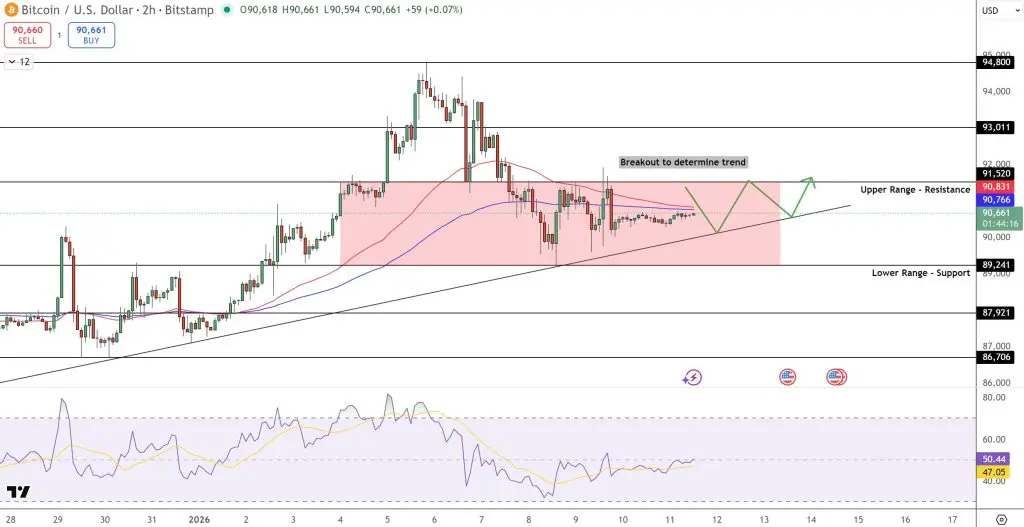
(Source: Trading View)
The explanation for Bitcoin’s rise today shows conflicting signals in capital flows. Despite the price rebounding to $91,100, the crypto ETF recorded a net outflow of $343.8 million on January 9, continuing the volatile trend since the start of the year. This divergence between price increase and capital outflows suggests that the rally is driven not by institutional buying but by short-term spot market risk-hedging demand.
Institutional caution is reflected in the Fear & Greed Index, which stands at 40, indicating a neutral sentiment rather than confidence. The Altcoin Seasonal Index is at 34/100, confirming that the current market remains dominated by Bitcoin rather than a broad risk-on cycle. Capital is maintaining a selective rather than speculative stance, and Bitcoin’s dominance remains solid. The total crypto market cap is close to $3.1 trillion, but daily trading volume has fallen to about $44.4 billion, indicating relatively low market participation.
On the technical side, Bitcoin’s price is forming a symmetrical triangle between support near $90,000 and resistance around $91,520. Smaller candles and neutral trend suggest traders are waiting for confirmation signals. The 50-day and 100-day moving averages are flattening, creating a squeeze effect, and RSI near 47 reflects a balanced rather than momentum-driven state.
If the closing price confirms above $91,520, it could trigger an upward trend toward $93,011, with $94,800 as the next major resistance. Conversely, failure to hold the support levels could weaken the structure, pushing the price down to $89,241 or even $87,921. The higher lows since late December remain intact, indicating bulls have not yet given up their defense.
Disclaimer: The information on this page may come from third parties and does not represent the views or opinions of Gate. The content displayed on this page is for reference only and does not constitute any financial, investment, or legal advice. Gate does not guarantee the accuracy or completeness of the information and shall not be liable for any losses arising from the use of this information. Virtual asset investments carry high risks and are subject to significant price volatility. You may lose all of your invested principal. Please fully understand the relevant risks and make prudent decisions based on your own financial situation and risk tolerance. For details, please refer to
Disclaimer.


