 :
:


#EthereumFoundationUnveilsItsStrawmap
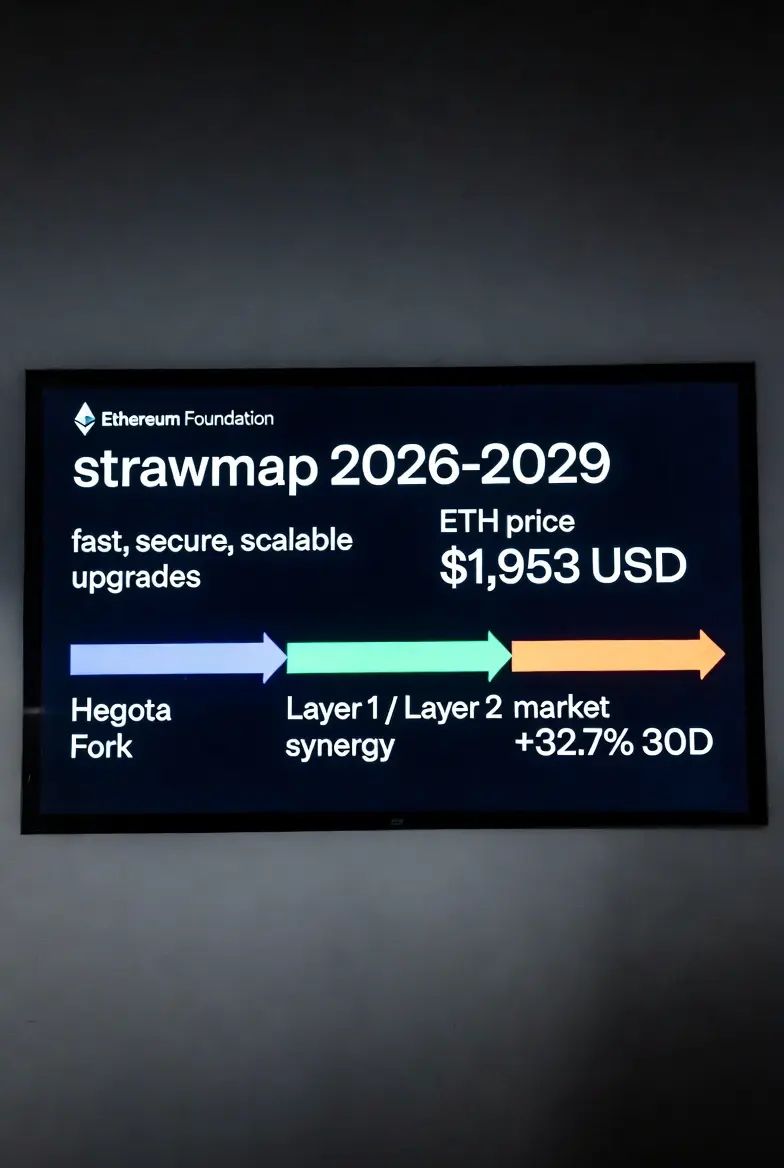
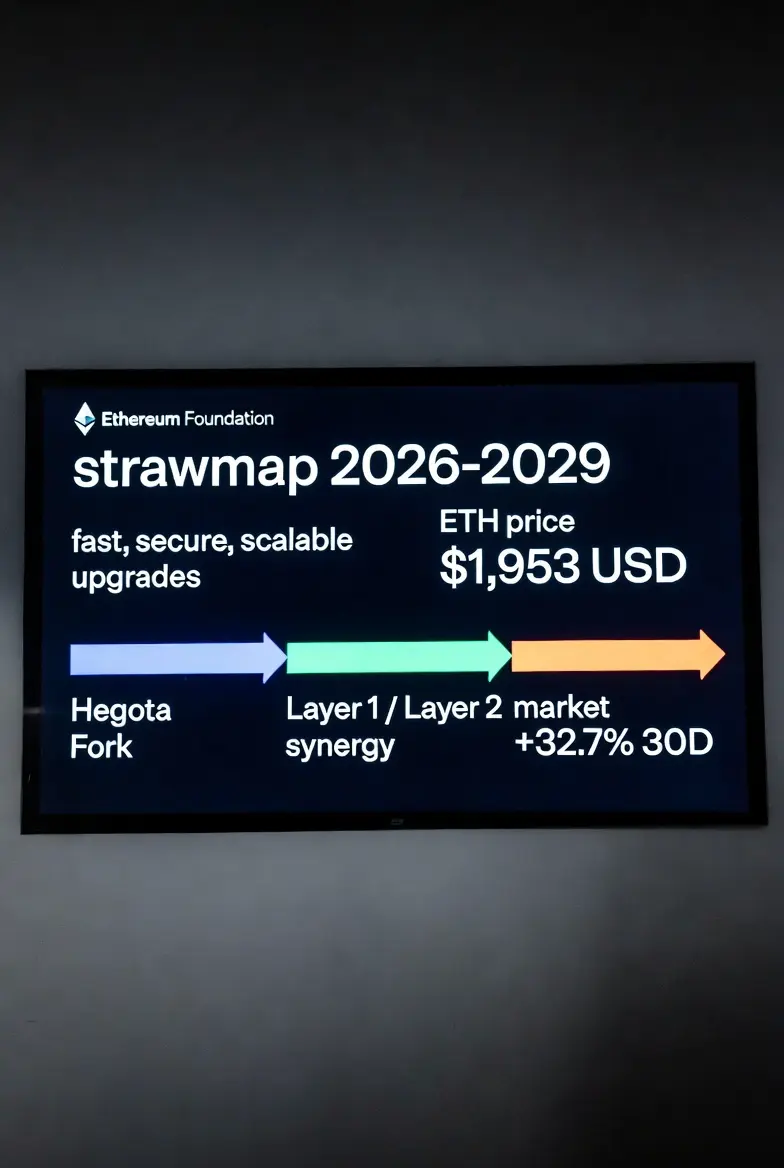
ETH price set to $1,953 USD.
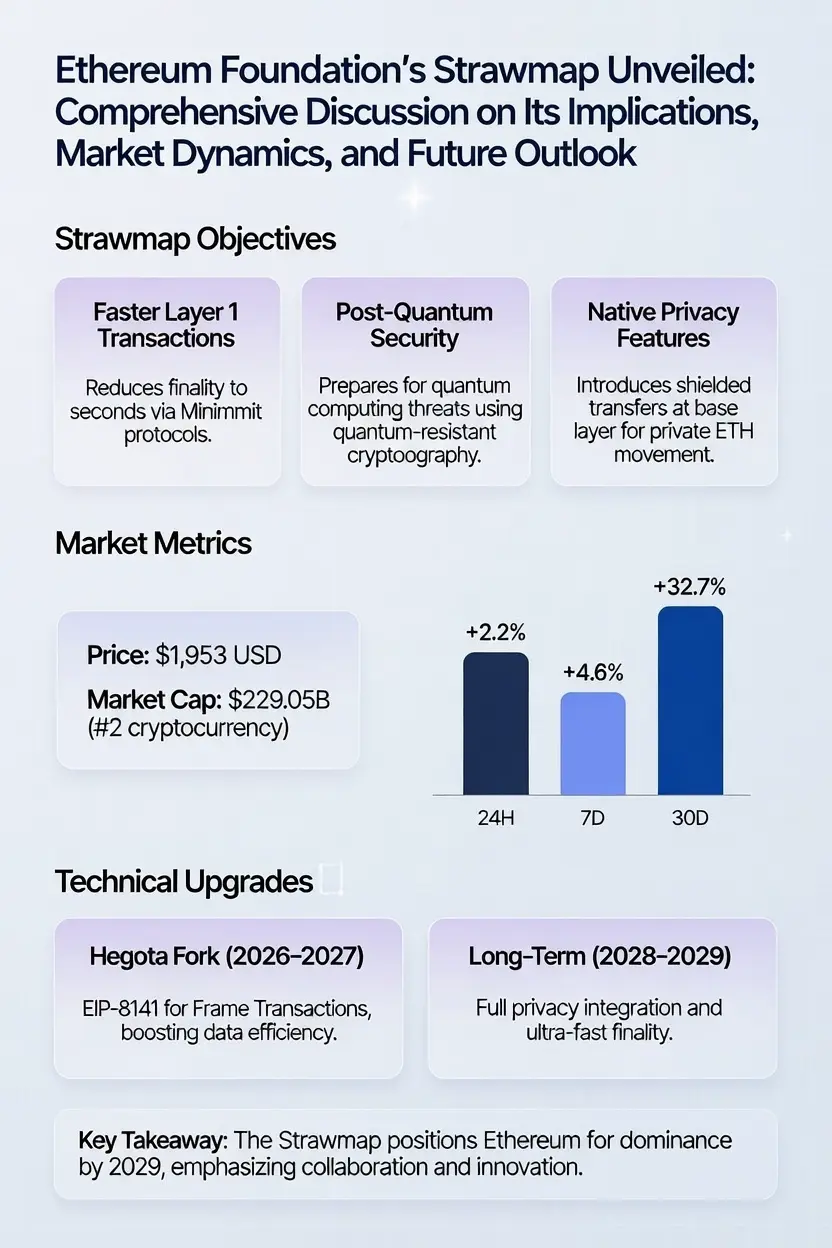
Ethereum Foundation's Strawmap Unveiled: Comprehensive Discussion on Its Implications, Market Dynamics, and Future Outlook
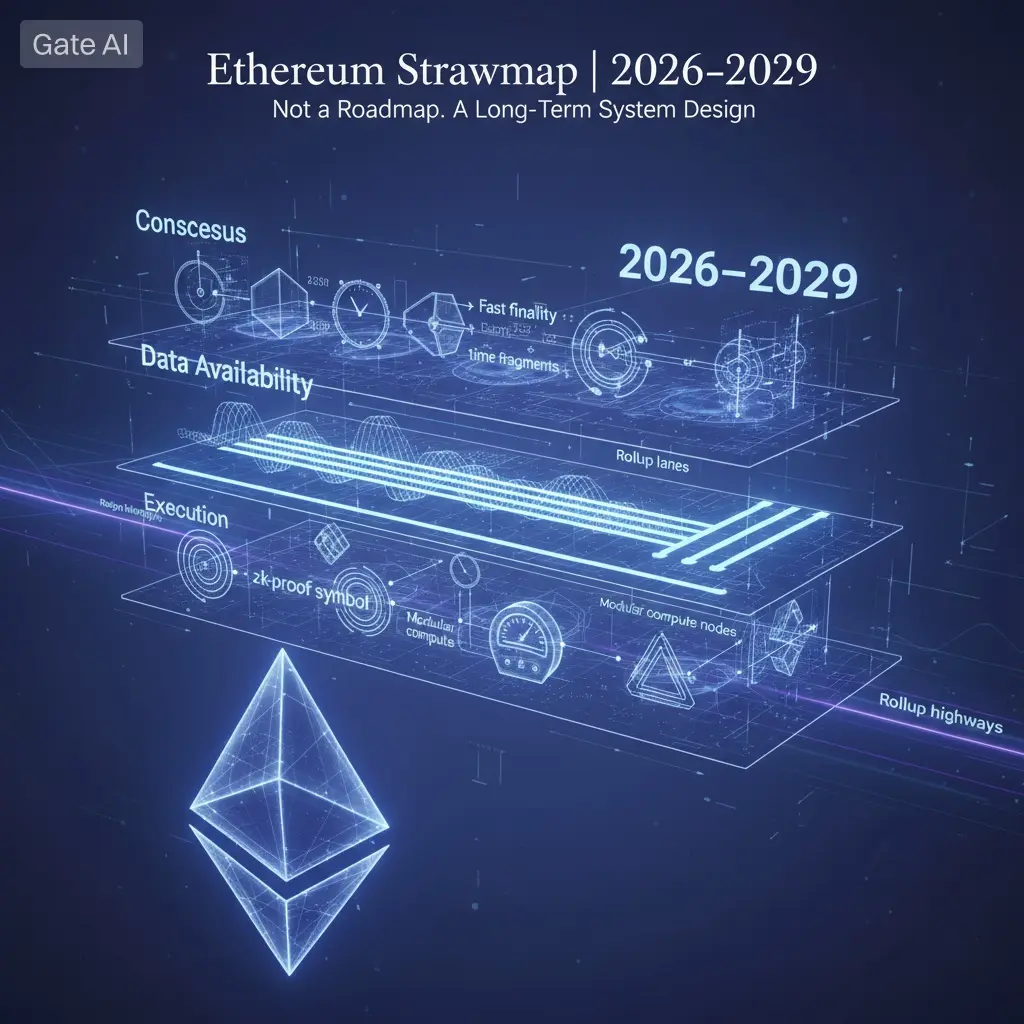
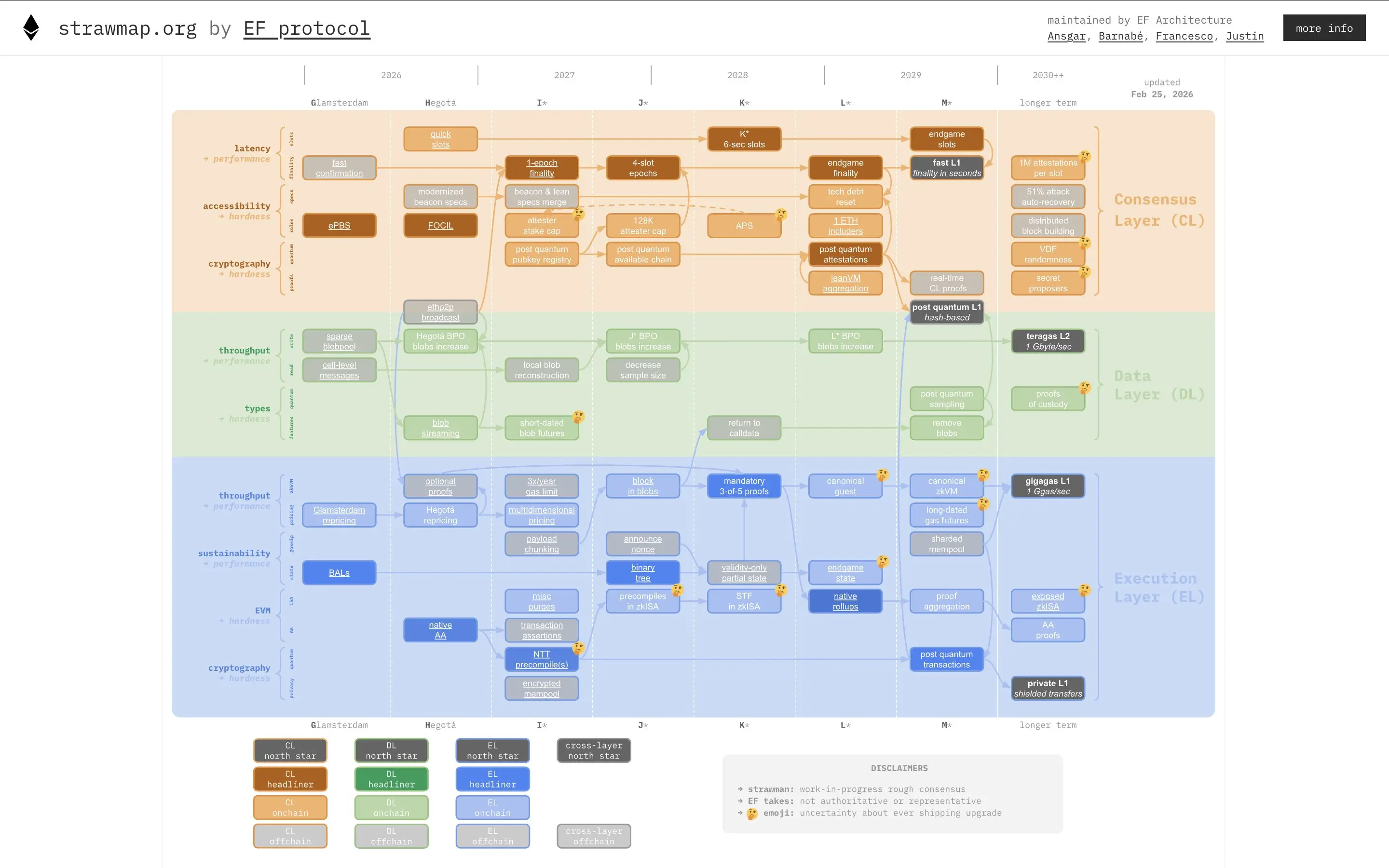
The Ethereum Foundation's unveiling of its "Strawmap" marks a pivotal moment in Ethereum's evolution. Acting as a draft roadmap through 2029, it outlines ambitious upgrades designed to transform Ethereum into a high-speed, secure, and scalable "internet of value." This discussion breaks down the Strawmap’s core elements, objectives, technical details, market impact, and long-term implications for users, developers, investors, and the broader crypto ecosystem.
1. Understanding the Strawmap: Definition and Origins
Definition & Concept:
The Strawmap is a preliminary proposal intended to spark discussion, combining "straw man" (a draft for critique) with "roadmap" (strategic plan). It reflects Ethereum’s collaborative ethos.
Etymology:
Straw man = tentative plan for refinement.
Roadmap = developmental path, flexible for community input.
Coined by Ethereum researchers like Justin Drake, emphasizing transparency over finality.
Announcement Details:
Released February 26, 2026 via Ethereum Foundation blogs and X (formerly Twitter).
Focused on Layer 1 upgrades, building on post-Merge achievements.
Proposes seven hard forks by 2029, roughly one per year, addressing scalability, privacy, and throughput.
Historical Context:
Ethereum launched in 2015, with major upgrades including The Merge (2022), Shanghai (2023), and Dencun (2024).
Strawmap responds to criticisms about slow scalability and privacy adoption, competing with chains like Solana or Aptos.
2. Key Objectives and "North Stars" of the Strawmap
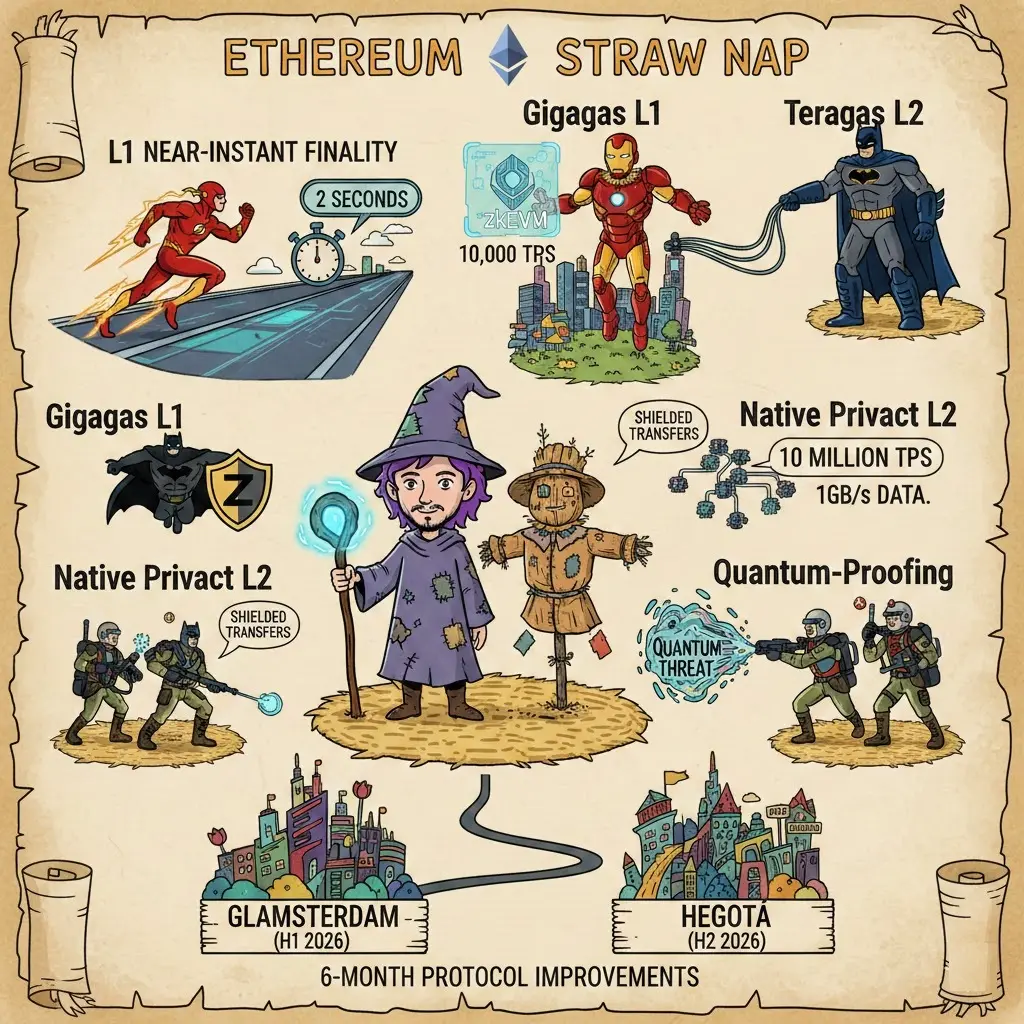
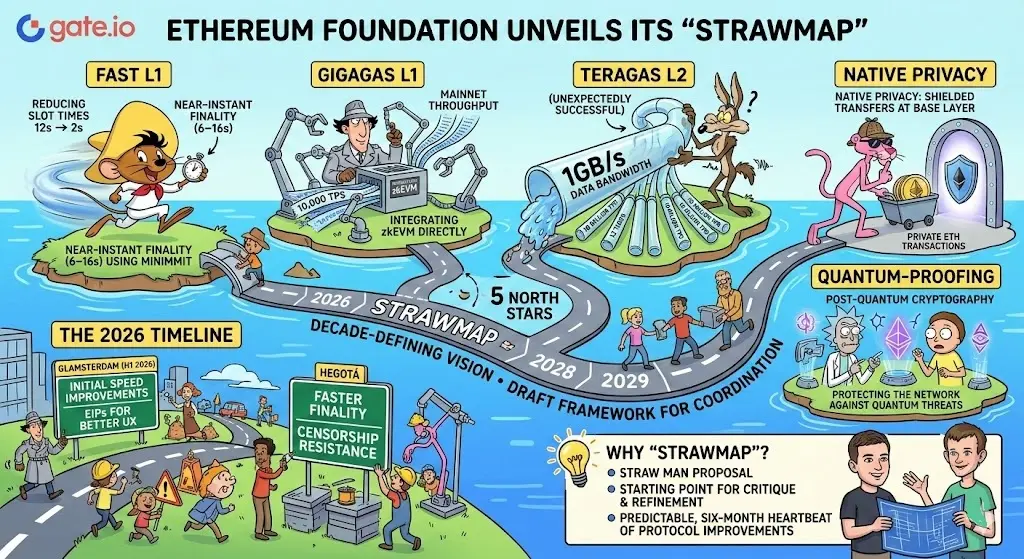
The Strawmap focuses on five strategic priorities to make Ethereum more efficient, secure, and user-friendly by 2029.
Faster Layer 1 Transactions:
Reduces finality from ~12 minutes to seconds via Minimmit protocols.
Enables real-time DeFi trades, gaming, and payments.
Higher Throughput & Scalability:
Targets millions of TPS with data availability sampling and sharding improvements.
Sub-goal: Integrate Frame Transactions (EIP-8141) in forks like Hegota.
Post-Quantum Security:
Prepares for quantum computing threats using quantum-resistant cryptography.
Ensures long-term network integrity.
Native Privacy Features:
Introduces shielded transfers at base layer for private ETH movement.
Enhances enterprise adoption and regulatory safety.
Harmonized Layer 1 & Layer 2 Scaling:
Aligns core protocol with rollups like Optimism and Arbitrum.
Creates unified ecosystem where Layer 2 handles most activity and Layer 1 ensures security.
3. Purpose and Strategic Intent
Transparency:
Shows internal deliberations early, fostering trust.
Community Feedback:
Invites developers, researchers, and users to critique via forums like Ethereum Magicians or GitHub.
Ecosystem Alignment:
Allows projects to plan around fork timelines and sustainability goals.
Risk Mitigation:
Being non-binding, forks can be modified based on real-world testing.
4. Technical Breakdown of Proposed Upgrades
Short-Term (2026–2027):
Hegota Fork: EIP-8141 for Frame Transactions, boosting data efficiency.
Focus: Scalability and bug fixes.
Mid-Term (2027–2028):
Quantum-resistant signatures and enhanced sharding.
Throughput handles peak loads without high gas fees.
Long-Term (2028–2029):
Full privacy integration and ultra-fast finality.
Goal: Ethereum as a high-speed internet of value.
Cross-Layer Integration:
Ensures compatibility with wallets (e.g., MetaMask) and Layer 2s.
Challenge: Complexity may cause temporary network disruptions if untested.
5. Implications for Stakeholders
Developers:
Align dApps with future features, build privacy-focused tools.
Challenge: Adapting code for new standards may increase costs.
Users & Investors:
Lower fees and faster transactions boost adoption and ETH value.
Risk: Market volatility if forks are delayed.
Broader Crypto Market:
Strengthens Ethereum vs competitors, enhances ESG appeal via low energy usage.
6. Market Analysis: Current Ethereum Metrics (Post-Strawmap)
(As of Feb 28, 2026, ~09:19 PM PKT, updated ETH price $1,953 USD)
Price: $1,953 USD
Stabilization after dips, recovered from $1,841 intra-day low.
Price Changes:
24H: +2.2%
7D: +4.6%
30D: +32.7%
1Y: +14.6%
ATH: ~$4,946.05 (down ~61.6%)
Trading Volume: $20.73B (24H)
Volume/Market Cap: ~9% – healthy, active trading.
Liquidations during dips: ~$272.7M.
Market Cap: $229.05B (#2 cryptocurrency)
Fully Diluted Valuation ≈ Market Cap (due to burn mechanisms).
Supply Metrics:
Circulating & Total Supply: 120,692,247 ETH
Burned >5M ETH since EIP-1559.
Liquidity:
Extremely high; traded on 11,000+ markets.
DeFi TVL ~$52B (Uniswap and other major pools).
Other Factors:
24H Range: $1,841 – $1,942
Correlation with BTC: ~0.8
Sentiment: Bullish long-term; analysts project $10,000+ by 2029 if forks succeed.
7. Potential Risks & Criticisms
Execution delays could erode confidence.
Community debates (privacy vs speed) may cause splits.
Regulatory scrutiny over privacy features.
Market volatility from short-term selloffs.
8. Key Takeaways & Future Outlook
The Strawmap positions Ethereum for dominance by 2029, emphasizing collaboration and innovation. Current metrics (+32.7% 30D growth) show resilience. Investors and developers should watch Hegota Fork and subsequent upgrades for adoption and valuation catalysts.
✅ Optimized Social Media Versions
200-character:
Ethereum's Strawmap 2026–2029 unveils fast, secure, scalable upgrades. ETH $1,953 USD, +32.7% 30D. Hegota & Layer 1/2 synergy aim for next-gen blockchain adoption and value growth.
100-character:
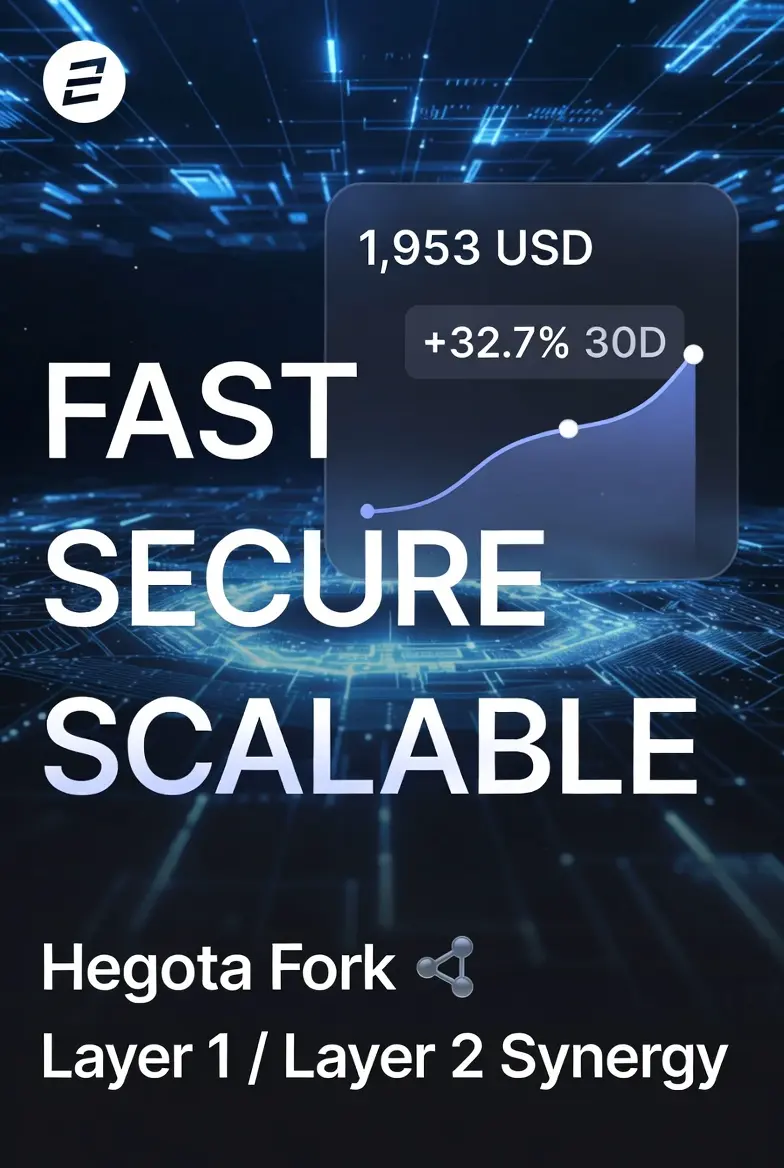
Ethereum Strawmap boosts speed, security & scalability. ETH $1,953 USD, +32.7% 30D growth.
ETH price set to $1,953 USD.
Ethereum Foundation's Strawmap Unveiled: Comprehensive Discussion on Its Implications, Market Dynamics, and Future Outlook
The Ethereum Foundation's unveiling of its "Strawmap" marks a pivotal moment in Ethereum's evolution. Acting as a draft roadmap through 2029, it outlines ambitious upgrades designed to transform Ethereum into a high-speed, secure, and scalable "internet of value." This discussion breaks down the Strawmap’s core elements, objectives, technical details, market impact, and long-term implications for users, developers, investors, and the broader crypto ecosystem.
1. Understanding the Strawmap: Definition and Origins
Definition & Concept:
The Strawmap is a preliminary proposal intended to spark discussion, combining "straw man" (a draft for critique) with "roadmap" (strategic plan). It reflects Ethereum’s collaborative ethos.
Etymology:
Straw man = tentative plan for refinement.
Roadmap = developmental path, flexible for community input.
Coined by Ethereum researchers like Justin Drake, emphasizing transparency over finality.
Announcement Details:
Released February 26, 2026 via Ethereum Foundation blogs and X (formerly Twitter).
Focused on Layer 1 upgrades, building on post-Merge achievements.
Proposes seven hard forks by 2029, roughly one per year, addressing scalability, privacy, and throughput.
Historical Context:
Ethereum launched in 2015, with major upgrades including The Merge (2022), Shanghai (2023), and Dencun (2024).
Strawmap responds to criticisms about slow scalability and privacy adoption, competing with chains like Solana or Aptos.
2. Key Objectives and "North Stars" of the Strawmap
The Strawmap focuses on five strategic priorities to make Ethereum more efficient, secure, and user-friendly by 2029.
Faster Layer 1 Transactions:
Reduces finality from ~12 minutes to seconds via Minimmit protocols.
Enables real-time DeFi trades, gaming, and payments.
Higher Throughput & Scalability:
Targets millions of TPS with data availability sampling and sharding improvements.
Sub-goal: Integrate Frame Transactions (EIP-8141) in forks like Hegota.
Post-Quantum Security:
Prepares for quantum computing threats using quantum-resistant cryptography.
Ensures long-term network integrity.
Native Privacy Features:
Introduces shielded transfers at base layer for private ETH movement.
Enhances enterprise adoption and regulatory safety.
Harmonized Layer 1 & Layer 2 Scaling:
Aligns core protocol with rollups like Optimism and Arbitrum.
Creates unified ecosystem where Layer 2 handles most activity and Layer 1 ensures security.
3. Purpose and Strategic Intent
Transparency:
Shows internal deliberations early, fostering trust.
Community Feedback:
Invites developers, researchers, and users to critique via forums like Ethereum Magicians or GitHub.
Ecosystem Alignment:
Allows projects to plan around fork timelines and sustainability goals.
Risk Mitigation:
Being non-binding, forks can be modified based on real-world testing.
4. Technical Breakdown of Proposed Upgrades
Short-Term (2026–2027):
Hegota Fork: EIP-8141 for Frame Transactions, boosting data efficiency.
Focus: Scalability and bug fixes.
Mid-Term (2027–2028):
Quantum-resistant signatures and enhanced sharding.
Throughput handles peak loads without high gas fees.
Long-Term (2028–2029):
Full privacy integration and ultra-fast finality.
Goal: Ethereum as a high-speed internet of value.
Cross-Layer Integration:
Ensures compatibility with wallets (e.g., MetaMask) and Layer 2s.
Challenge: Complexity may cause temporary network disruptions if untested.
5. Implications for Stakeholders
Developers:
Align dApps with future features, build privacy-focused tools.
Challenge: Adapting code for new standards may increase costs.
Users & Investors:
Lower fees and faster transactions boost adoption and ETH value.
Risk: Market volatility if forks are delayed.
Broader Crypto Market:
Strengthens Ethereum vs competitors, enhances ESG appeal via low energy usage.
6. Market Analysis: Current Ethereum Metrics (Post-Strawmap)
(As of Feb 28, 2026, ~09:19 PM PKT, updated ETH price $1,953 USD)
Price: $1,953 USD
Stabilization after dips, recovered from $1,841 intra-day low.
Price Changes:
24H: +2.2%
7D: +4.6%
30D: +32.7%
1Y: +14.6%
ATH: ~$4,946.05 (down ~61.6%)
Trading Volume: $20.73B (24H)
Volume/Market Cap: ~9% – healthy, active trading.
Liquidations during dips: ~$272.7M.
Market Cap: $229.05B (#2 cryptocurrency)
Fully Diluted Valuation ≈ Market Cap (due to burn mechanisms).
Supply Metrics:
Circulating & Total Supply: 120,692,247 ETH
Burned >5M ETH since EIP-1559.
Liquidity:
Extremely high; traded on 11,000+ markets.
DeFi TVL ~$52B (Uniswap and other major pools).
Other Factors:
24H Range: $1,841 – $1,942
Correlation with BTC: ~0.8
Sentiment: Bullish long-term; analysts project $10,000+ by 2029 if forks succeed.
7. Potential Risks & Criticisms
Execution delays could erode confidence.
Community debates (privacy vs speed) may cause splits.
Regulatory scrutiny over privacy features.
Market volatility from short-term selloffs.
8. Key Takeaways & Future Outlook
The Strawmap positions Ethereum for dominance by 2029, emphasizing collaboration and innovation. Current metrics (+32.7% 30D growth) show resilience. Investors and developers should watch Hegota Fork and subsequent upgrades for adoption and valuation catalysts.
✅ Optimized Social Media Versions
200-character:
Ethereum's Strawmap 2026–2029 unveils fast, secure, scalable upgrades. ETH $1,953 USD, +32.7% 30D. Hegota & Layer 1/2 synergy aim for next-gen blockchain adoption and value growth.
100-character:
Ethereum Strawmap boosts speed, security & scalability. ETH $1,953 USD, +32.7% 30D growth.