The U.S. stock market is one of the world’s largest and most liquid capital markets. From Apple and Microsoft to Nvidia and Amazon, many of the world’s leading companies choose to list on U.S. securities markets. For investors looking to participate in global economic growth and technological innovation, the U.S. stock market has long been viewed as an important part of international asset allocation. For that reason, opening a U.S. stock account is the first step for many investors entering the American capital market.
In addition to the traditional brokerage account opening model, the integration of digital asset platforms and traditional finance services is creating new ways to access the market. Whether investors participate through a traditional securities account or emerging digital asset accounts that support stock trading, understanding account opening requirements, account structures, and market rules is an important prerequisite for entering the U.S. stock market.
What Is U.S. Stock Account Opening?
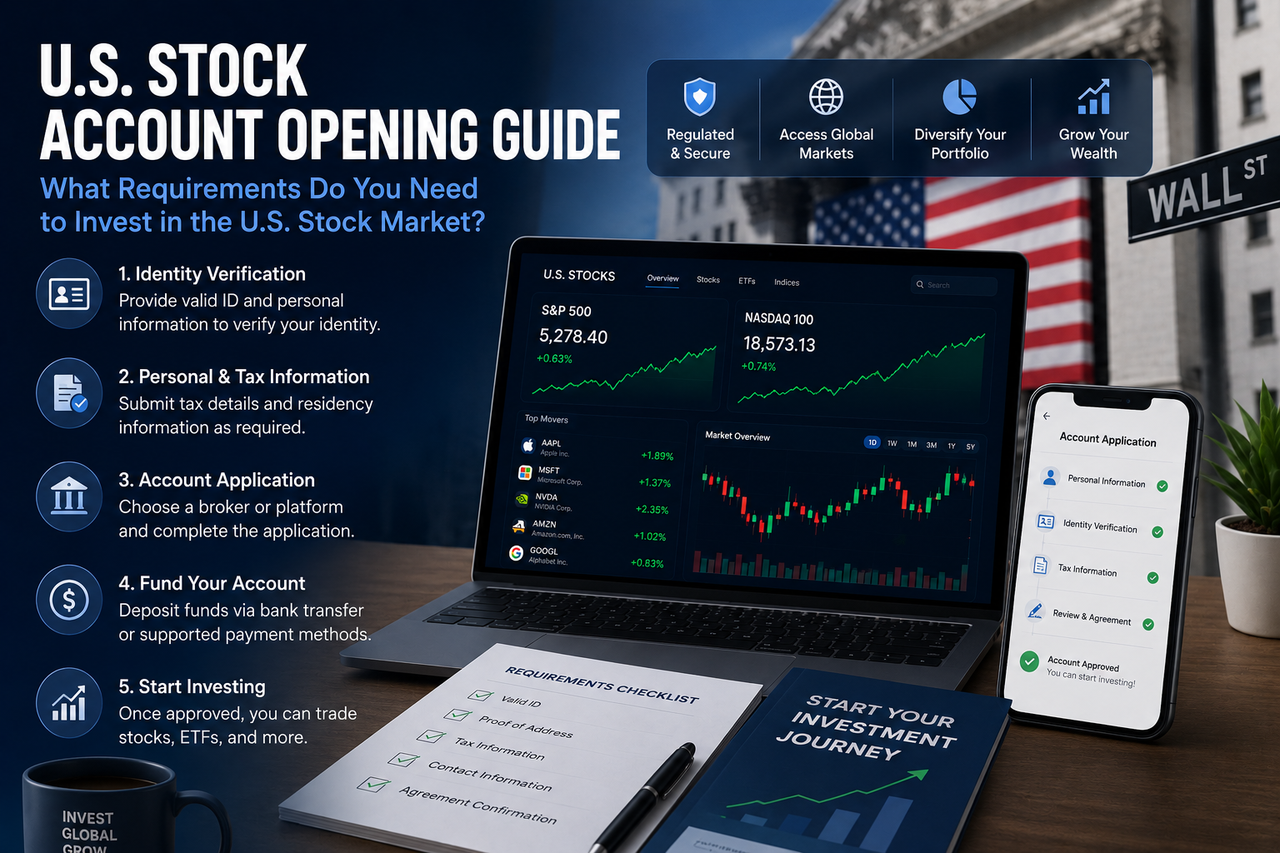
Opening a U.S. stock account refers to the process of setting up an account that allows investors to trade in U.S. securities markets and become eligible to buy and sell assets such as U.S. stocks and ETFs.
A stock account serves as an investor’s gateway into the U.S. capital market. Only after completing the account application, identity verification, and relevant review procedures can investors buy and sell stocks, manage positions, and allocate assets.
For international investors, opening a U.S. stock account is not just a technical process. It is also an important step in connecting with global capital markets.
What Is the Role of a Stock Account?
A stock account is used to record the securities assets held by investors and their trading activity.
Through a stock account, investors can buy and sell stocks, ETFs, and other securities products, while also viewing their holdings, transaction history, and changes in asset value.
Why Can’t Investors Trade U.S. Stocks Directly?
The U.S. securities market is subject to strict regulation, and all trades must be completed through qualified securities service providers.
As a result, investors must first complete the account opening process before they can gain access to the market.
What Basic Requirements Must Be Met to Participate in the U.S. Stock Market?
Different platforms and service providers may have different details, but most U.S. stock account opening processes require several basic conditions to be met.
Complete Identity Verification
Identity verification is one of the most important steps in the account opening process.
Platforms usually need to confirm the applicant’s true identity in order to meet compliance requirements such as anti money laundering (AML) and know your customer (KYC).
Meet Age Requirements
Most stock trading services require account applicants to meet the legal age requirement in their jurisdiction.
This is one of the basic requirements for participating in financial market trading.
Meet Regional and Compliance Requirements
Some services may restrict supported regions based on local laws and regulations.
Investors need to confirm whether the relevant stock trading service is available in their region.
Read and Confirm Risk Disclosures
Stock investing involves market risk, so the account opening process usually requires investors to read and confirm the relevant risk notices and service agreements.
What Documents Are Usually Needed to Open a U.S. Stock Account?
To complete identity verification and account review, investors usually need to prepare certain personal information and documents.
Identity Documents
Common documents include:
Specific requirements vary depending on the service provider.
During account opening, investors usually need to provide:
This information is used for account verification and future notifications.
Some U.S. securities services may require investors to complete tax related documents to confirm the account holder’s identity classification and tax status.
To protect account security, some platforms may also require security measures such as two factor authentication (2FA).
What Is the U.S. Stock Account Opening Process with a Traditional Brokerage?
Traditional brokerages are one of the most common ways for international investors to participate in the U.S. stock market.
Create a Securities Account
Investors first need to register a securities account and fill in basic personal information.
Submit Identity Verification Materials
Next, they upload identity documents as required and complete the review process.
Wait for Account Review
Once the review is approved, investors can obtain stock trading access.
Prepare Funds
Traditional brokerages usually require funds to be transferred through a bank account, with the U.S. dollar serving as the main trading currency.
Start Stock Trading
After the account and funds are ready, investors can begin trading stocks and ETFs.
How Can Digital Asset Users Participate in the U.S. Stock Market?
In recent years, the development of the digital asset industry has accelerated the convergence of TradFi and Crypto.
At this stage, cryptocurrency trading platforms such as Binance and Gate have begun offering stock trading services, allowing digital asset users to access the U.S. stock market through a unified account system. Under the Gate Stocks model, users can manage digital assets and stock assets on the same platform.

Use USDT as a Funding Gateway
Gate Stocks supports using stablecoins such as USDT to participate in stock investing. This model reduces the complexity of cross border fund conversion and management, while also improving capital efficiency.
Manage Multiple Asset Classes in One Place
Investors can not only hold stocks and ETFs, but also manage digital assets at the same time, enabling cross market asset allocation.
What Assets Can You Buy After Opening a U.S. Stock Account?
After opening an account, investors can access a wide range of U.S. market investment products.
U.S. Individual Stocks
Investors can buy shares of companies listed on U.S. stock exchanges. Common sectors include technology, finance, healthcare, energy, consumer services, and more.
ETFs
ETFs are among the most popular investment tools in the U.S. stock market. Investors can use ETFs to invest in the S&P 500 Index, the Nasdaq Index, the technology sector, high dividend segments, and global market themes.
Sector Themed Assets
The U.S. market offers abundant sector investment opportunities, covering areas such as artificial intelligence, new energy, semiconductors, and biotechnology.
What Is the Difference Between Opening a U.S. Stock Account and a Hong Kong Stock Account?
Although both involve securities market investing, there are certain differences in market structure and investment logic.
Different Market Sizes
The U.S. market has the world’s largest capital market and the largest number of listed companies.
The Hong Kong stock market connects China with international capital markets and has unique regional advantages.
Different Investment Targets
The U.S. market is known for global technology companies and innovative enterprises.
The Hong Kong stock market has many Chinese companies and regional industry leaders.
Different Product Systems
The U.S. market offers a richer range of ETFs, index funds, and sector themed investment products.
What Should Investors Pay Attention to After Opening a U.S. Stock Account?
Opening an account is only the first step into the market.
Trading Hours
Investors need to understand the regular trading session of the U.S. market, as well as pre market and after hours trading rules.
Corporate Earnings
Earnings reports are an important basis for assessing the operating condition of listed companies.
Macroeconomic Data
This includes Federal Reserve interest rate decisions, CPI inflation data, nonfarm payrolls, and other information that can affect market expectations and asset prices.
Risk Management
Whether investing in stocks or ETFs, investors should develop a reasonable asset allocation strategy based on their own risk tolerance.
As the market develops, investors now have different paths to participate.
Different Funding Gateways
Traditional brokerages usually rely on bank accounts and the U.S. dollar system.
Digital asset platforms may support stablecoins such as USDT as a funding gateway.
Different Account Structures
Under the traditional model, stock accounts and digital asset accounts are usually separate from each other.
Digital asset platforms, by contrast, place greater emphasis on a unified account management experience.
Different Investment Scope
In addition to stocks and ETFs, some digital asset platforms also support crypto assets and other digital financial products.
Why Are More Investors Paying Attention to U.S. Stock Account Opening?
The development of global capital markets has made the U.S. stock market an important investment target for international investors.
At the same time, the development of industries such as artificial intelligence, semiconductors, cloud computing, and new energy has further increased investor attention on the U.S. market.
As account opening processes and market access methods continue to improve, participating in the U.S. stock market is becoming more convenient.
Conclusion
Opening a U.S. stock account is an important foundational step for entering the U.S. securities market. Whether participating in stock investing through a traditional brokerage or a digital asset platform, investors usually need to complete identity verification, account application, and fund preparation. Once the account is opened, investors can access U.S. stocks, ETFs, and a variety of sector themed assets, gaining exposure to opportunities in global capital markets.
As TradFi and Crypto continue to converge, investors are gaining more ways to enter the U.S. stock market. From traditional securities accounts to using USDT for stock investing, diversified market access models are making global investing more open and efficient.
FAQs
What does opening a U.S. stock account mean?
Opening a U.S. stock account means setting up an account that allows investors to participate in U.S. securities market trading and become eligible to buy and sell assets such as U.S. stocks and ETFs.
What requirements are needed to open a U.S. stock account?
Investors usually need to complete identity verification, meet age requirements, comply with relevant regional rules, and agree to the applicable risk disclosures and service agreements.
What documents are needed to open a U.S. stock account?
Investors generally need identity documents, contact information, and certain tax related information. Specific requirements vary by platform.
Can overseas investors open U.S. stock accounts?
Many securities services support international investors participating in the U.S. stock market, but supported regions depend on the rules of each platform.
Can investors buy ETFs after opening a U.S. stock account?
Yes. ETFs are among the most common investment products in the U.S. market, and investors can usually trade them after opening an account.
Is the U.S. dollar required to open a U.S. stock account?
Traditional brokerages usually use the U.S. dollar as the trading currency, but some newer services support stablecoins such as USDT as a funding gateway.
Can USDT be used to participate in U.S. stock trading?
Some platforms that support stock trading allow users to use USDT to participate in U.S. stock and ETF investing.
How long does it take to start trading after opening a U.S. stock account?
The exact time depends on the platform’s review process. Once account review and fund preparation are complete, trading can usually begin.