Users are drawn to the ATH token because Aethir is not your typical blockchain project. Instead, it’s a DePIN network built around GPU computing, AI computation, cloud services, and node operations. The token’s role directly shapes how computing power is priced, how nodes generate revenue, and how the network sustains high service quality.
This topic typically covers the token’s characteristics, payment for compute, staking mechanisms, node incentives, governance features, and the structure of token distribution.
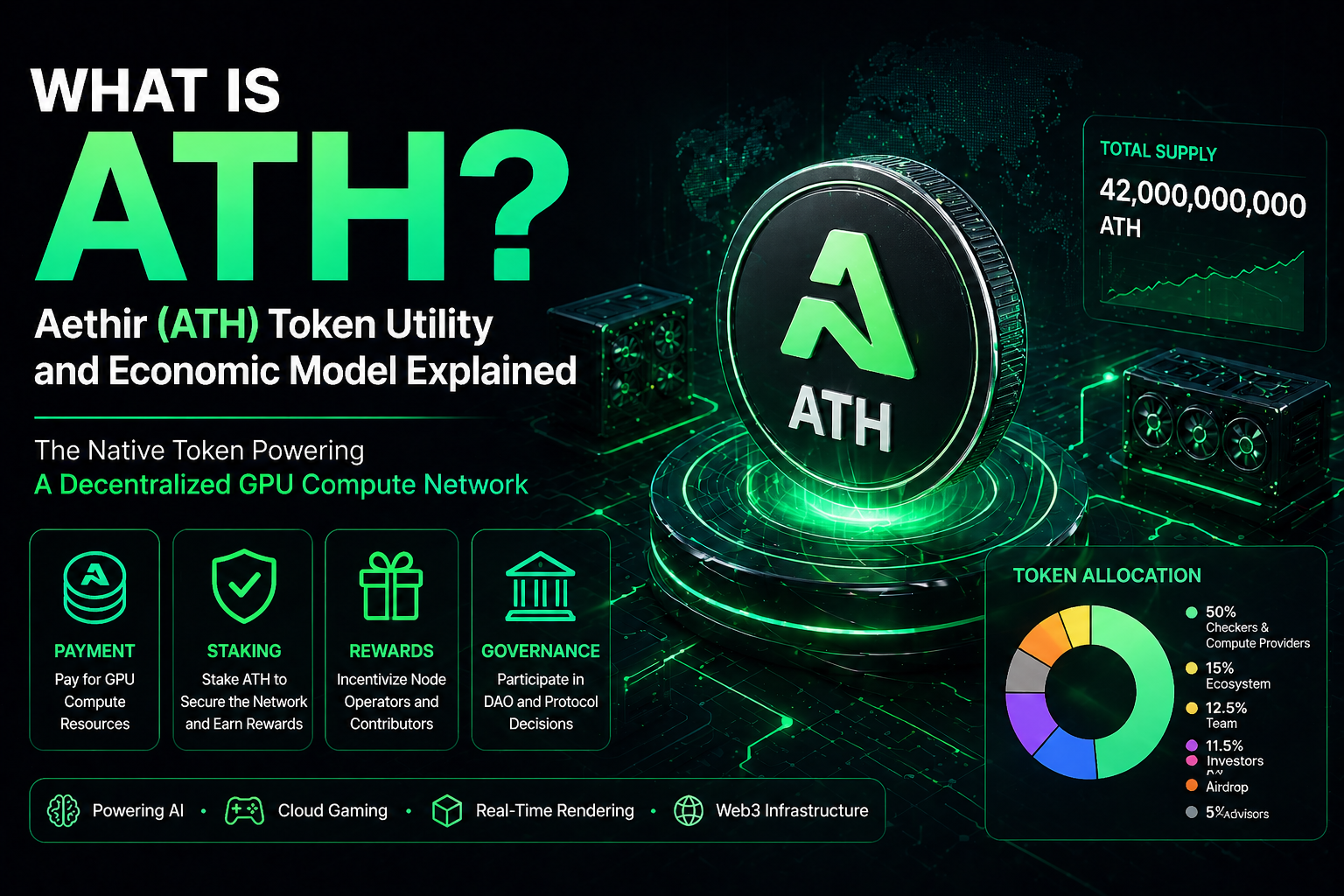
What Is the ATH Token
ATH serves as the native token for the Aethir network, enabling payments, incentives, governance, and staking across its decentralized GPU compute ecosystem.
According to Aethir’s official documentation, ATH supports not only transactions, but also governance, incentives, and platform growth. The official Token Overview states a total supply of 42,000,000,000 ATH.
ATH connects compute demanders, node operators, and the network protocol. Demanders use ATH to buy compute resources, nodes earn rewards for supplying GPU power or network services, and the protocol coordinates service quality and resource allocation via the token.
Crucially, ATH is more than just a payment asset—it is the central medium for compute transactions, node accountability, and ecosystem coordination within Aethir.
What Are ATH’s Core Functions
ATH’s core functions include compute payments, node staking, network rewards, and governance participation.
For payments, ATH is the Aethir ecosystem’s standard means of exchange: demanders buy compute resources with ATH, and node operators are compensated for their compute contributions. Per official documentation, ATH is suitable for AI, cloud computing, and virtualization business models.
| Function Type |
Specific Role |
Network Impact |
| Compute Payments |
Pay for GPU compute resources |
Supports supply-demand transactions |
| Node Staking |
Enforce node service quality |
Boosts network reliability |
| Node Rewards |
Incentivize compute providers |
Expands resource supply |
| Governance |
Enable community decision-making |
Strengthens decentralized coordination |
| Ecosystem Circulation |
Connect users and nodes |
Drives economic activity |
Together, these functions provide ATH’s foundation. Compute payments create real demand, staking enforces node accountability, rewards attract resource contributors, and governance empowers the community.
How ATH Circulates in the Compute Network
ATH’s movement within Aethir revolves around compute supply and task demand.
Typically, a demander submits a compute request through Aethir and pays with ATH. Node operators supply GPU resources and complete the task, receiving ATH as compensation. The protocol layer settles rewards based on task completion, service quality, and network rules.
This cycle involves three steps: the demander purchases compute services with ATH, the node delivers GPU resources and completes the job, and the system allocates rewards according to rules and contributions.
This structure turns distributed GPU resources into tradable network services, creating a unified economic system that matches compute supply with demand.
How ATH Is Used for Compute Payments and Staking
ATH’s payment function enables compute purchases, while its staking mechanism enforces node service quality.
Demanders buy processing power with ATH; nodes earn rewards for supplying resources. This framework gives GPU compute an economic structure that supports valuation, settlement, and allocation.
Aethir’s official documentation explains that ATH holders can stake tokens to participate in the network and earn rewards. Edge and IDC operators are required to stake ATH to contribute compute; staking also guarantees service quality—failure to meet standards can result in penalties.
Staking isn’t just about locking tokens—it’s a core part of network quality control. It ties node behavior to economic outcomes, motivating providers to deliver reliable service.
ATH’s Incentive and Governance Roles
ATH’s incentive system rewards compute contributors and network participants; its governance function supports protocol-level community coordination.
Nodes earn ATH by supplying compute, completing tasks, or providing network services. The official documentation notes that a significant portion of ATH is allocated for compute rewards, supporting node operators and reinforcing the value of ecosystem contributors.
Governance-wise, ATH is designed as a community participation tool. As Aethir transitions toward a DAO, ATH holders can propose, discuss, and vote on platform changes.
This design means ATH goes beyond compute transactions—it’s also integral to governance and ecosystem collaboration. Incentives determine resource supply; governance shapes protocol evolution.
How the ATH Economic Model Drives Network Growth
ATH’s economic model is defined by its total supply, allocation structure, and network usage demand.
Aethir’s official documentation sets ATH’s total supply at 42 billion. According to the official breakdown, 50% goes to Checkers and Compute Providers, 15% to the Ecosystem, 12.5% to the Team, 11.5% to Investors, 6% to Airdrops, and 5% to Advisors.
| Distribution Category |
Percentage |
| Checkers & Compute Providers |
50% |
| Ecosystem Development |
15% |
| Team |
12.50% |
| Investors |
11.50% |
| Airdrop |
6% |
| Advisors |
5% |
| Total |
100% |
Half the tokens are allocated to checkers and compute providers, emphasizing Aethir’s focus on infrastructure. Ecosystem allocations fund network expansion, while team and investor shares support project development.
This structure ties ATH’s value circulation directly to network participation. As GPU node supply, AI compute demand, and cloud service adoption grow, ATH’s utility becomes increasingly embedded in network operations.
Summary
ATH powers compute payments, staking, node incentives, and governance within the Aethir ecosystem. With a total supply of 42 billion and a distribution model centered on compute providers and checkers, ATH reflects Aethir’s emphasis on decentralized GPU infrastructure. The key to ATH isn’t just the token itself—it’s how it connects compute demand, node services, and network governance.
FAQ
What Is the Main Use of ATH
ATH is used to pay for GPU compute, participate in staking, reward node contributions, and support ecosystem governance within the Aethir network.
What Is ATH’s Total Supply
Per Aethir’s official Token Overview, ATH’s total supply is 42,000,000,000.
How Is ATH Distributed
ATH distribution: 50% to checkers and compute providers, 15% to ecosystem development, 12.5% to the team, 11.5% to investors, 6% to airdrops, and 5% to advisors.
How Is ATH Used for Compute Payments
Users purchase compute resources on Aethir with ATH; node operators are compensated for providing GPU power.
What Is the Purpose of Staking ATH
Staking ATH enables network participation and enforces service quality; certain node operators must stake ATH to supply compute.







