


Futures
Access hundreds of perpetual contracts
TradFi
Gold
One platform for global traditional assets
Options
Hot
Trade European-style vanilla options
Unified Account
Maximize your capital efficiency
Demo Trading
Futures Kickoff
Get prepared for your futures trading
Futures Events
Join events to earn rewards
Demo Trading
Use virtual funds to experience risk-free trading
Launch
CandyDrop
Collect candies to earn airdrops
Launchpool
Quick staking, earn potential new tokens
HODLer Airdrop
Hold GT and get massive airdrops for free
Launchpad
Be early to the next big token project
Alpha Points
Trade on-chain assets and earn airdrops
Futures Points
Earn futures points and claim airdrop rewards


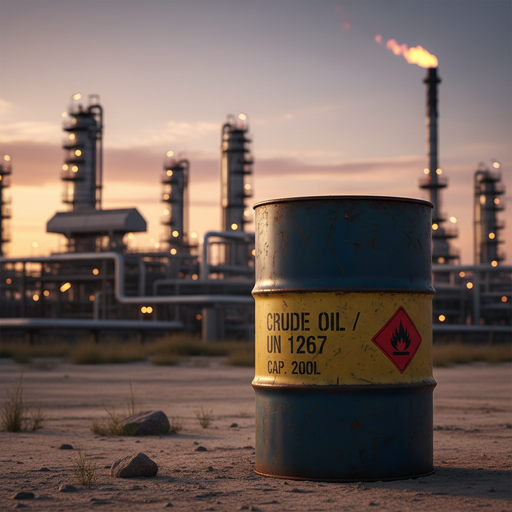
A real oil price shock! The Middle East crude oil "production halt wave" is about to arrive
The Middle East situation is pushing the global oil market toward a real supply crisis.
As commercial shipping through the Strait of Hormuz nears paralysis, crude oil exports from the Gulf region are increasingly obstructed, with inventories rapidly accumulating. Once tank and offshore oil tanker capacities are filled, some oil-producing countries will have to cut production—a regional “shutdown wave” triggered by logistical bottlenecks is approaching.
In a recent report on March 7, JPMorgan commodities analyst Natasha Kaneva estimated that the scale of supply disruptions in the Gulf could rise from the current approximately 1.5 million barrels per day to 3 million barrels per day by the weekend, over 4 million barrels per day by next weekend; if refined product storage tanks are exhausted, the shutdown scale could even approach 6 million barrels per day.
Against this backdrop, oil prices face a clear asymmetric risk structure:
Meanwhile, Goldman Sachs monitoring data shows that oil flow through the Strait of Hormuz has plummeted by about 90%. If the situation cannot be alleviated in the coming days, the bank believes the probability of oil prices breaking above $100 per barrel next week will significantly increase, and if the blockade persists throughout March, prices could challenge the historical highs of 2008 and 2022.
Strait of Hormuz: The Global Energy Artery Nearly Halted
On the seventh day of the conflict, commercial traffic through the Strait of Hormuz has nearly come to a standstill.
According to Goldman Sachs’ latest monitoring data from its commodities research team, almost all ships still passing through the strait are Iranian vessels. For Gulf countries relying on this route for oil exports, this means the most critical energy transportation channel is close to shutdown.
At the same time, Goldman estimates that oil flow through the Strait of Hormuz has plummeted by about 90%.
Based on the overall export capacity of the Persian Gulf, this change implies a potential supply shock of 17.1 million barrels per day—equivalent to 17 times the peak Russian production cuts in April 2022.
Inventories are rapidly accumulating.
JPMorgan statistics show that since the end of February, the Gulf region has accumulated about 76 million barrels of crude oil inventories:
This scale is equivalent to about 4.5 days of crude oil exports from the region, with inventory buildup mainly concentrated in Saudi Arabia.
Inventory pressures are gradually shifting the problem from transportation to production.
Limited alternative routes: pipelines have room, logistics are the bottleneck
Despite the disruption in Hormuz, Gulf countries are not without alternative routes.
JPMorgan data shows that Saudi Arabia and the UAE still have about 1.6 million barrels per day of spare pipeline export capacity unused.
Among them, Saudi Arabia has significantly increased the utilization of east-west pipelines, transporting crude to the Red Sea coast.
Currently:
This means the entire pipeline system currently transports about 3.8 million barrels per day, still below its rated capacity of 5 million barrels per day.
JPMorgan notes that this pipeline could theoretically be ramped up to 6.5 to 7 million barrels per day in the short term. But the real constraints are not in the pipelines but in port and shipping capacity:
These factors limit Saudi Arabia’s ability to quickly reallocate Gulf exports.
For the UAE, although Abu Dhabi’s oil pipeline can bypass Hormuz and retains about 400,000 barrels per day of spare capacity, exports from the Fujeirah port remain relatively stable and have not shown significant increases.
JPMorgan also warns that Houthi forces remain a key variable. If Iran expands blockades through regional proxies, the safety of the Red Sea route could also be affected.
Shutdown wave begins to spread
As inventories rapidly build up, some oil-producing countries have already begun to be forced to cut production.
JPMorgan reports that within just six days of the conflict, Iraq has cut about 1.5 million barrels per day of supply.
Kuwait’s pressure is also rising rapidly.
Due to tanks nearing capacity, Kuwait has reduced refinery operation rates by about 600,000 barrels per day, essentially shutting down all export-oriented refining and maintaining only the minimum level of domestic consumption.
According to JPMorgan’s estimates:
The bank expects UAE supply constraints signals could also begin to appear early next week.
Based on their scenario analysis, Gulf region supply disruptions could quickly expand:
Countries begin to prepare emergency measures
Faced with potential supply shocks, governments have started preparing contingency plans.
Japanese refineries are urging the government to consider releasing strategic petroleum reserves.
Thailand has activated its energy emergency plan and halted oil exports to secure domestic inventories.
The International Energy Agency (IEA) stated that if supply disruptions persist, it will prepare to coordinate a global strategic reserve release, but is currently monitoring whether the Hormuz blockade will evolve into a long-term situation.
The U.S. government has not yet planned to use strategic petroleum reserves.
The Trump administration is evaluating various response options, including:
This Tuesday, Trump announced that the U.S. will provide insurance guarantees and naval escort for oil tankers to help restore navigation through the Strait of Hormuz.
Meanwhile, the U.S. has temporarily eased sanctions on Russian oil exports to India, effective until April 4.
This adjustment has quickly changed market quotes.
Russian Urals crude arriving in India from March to early April is now quoted as a premium of $4 to $5 per barrel over Brent (CIF); in February, this crude was still sold at a $13 discount per barrel.
Oil prices face clear “asymmetric risk”
According to JPMorgan, even with the U.S. providing insurance guarantees and naval escorts, these measures alone are unlikely to quickly restore passage through the strait.
Until Iran’s interference capability is effectively suppressed, oil tanker navigation will still face high risks.
Therefore, the current oil market exhibits a clear asymmetric price structure:
This asymmetric risk is a core variable that the current global energy market must carefully evaluate.
Risk warning and disclaimer
Market risks are present; investments should be cautious. This article does not constitute personal investment advice and does not consider individual users’ specific investment goals, financial situations, or needs. Users should consider whether any opinions, views, or conclusions herein are suitable for their particular circumstances. Invest at your own risk.