Users are drawn to XLM’s utility because Stellar goes beyond a simple transfer network—it enables the issuance and exchange of stablecoins, fiat-backed assets, and various digital assets. To fully understand XLM’s functions, it’s essential to examine its roles in network operations, fee structure, asset conversion, and token supply.
This topic typically covers token characteristics, core functionalities, fee mechanisms, anti-abuse designs, ecosystem circulation models, and total supply distribution.
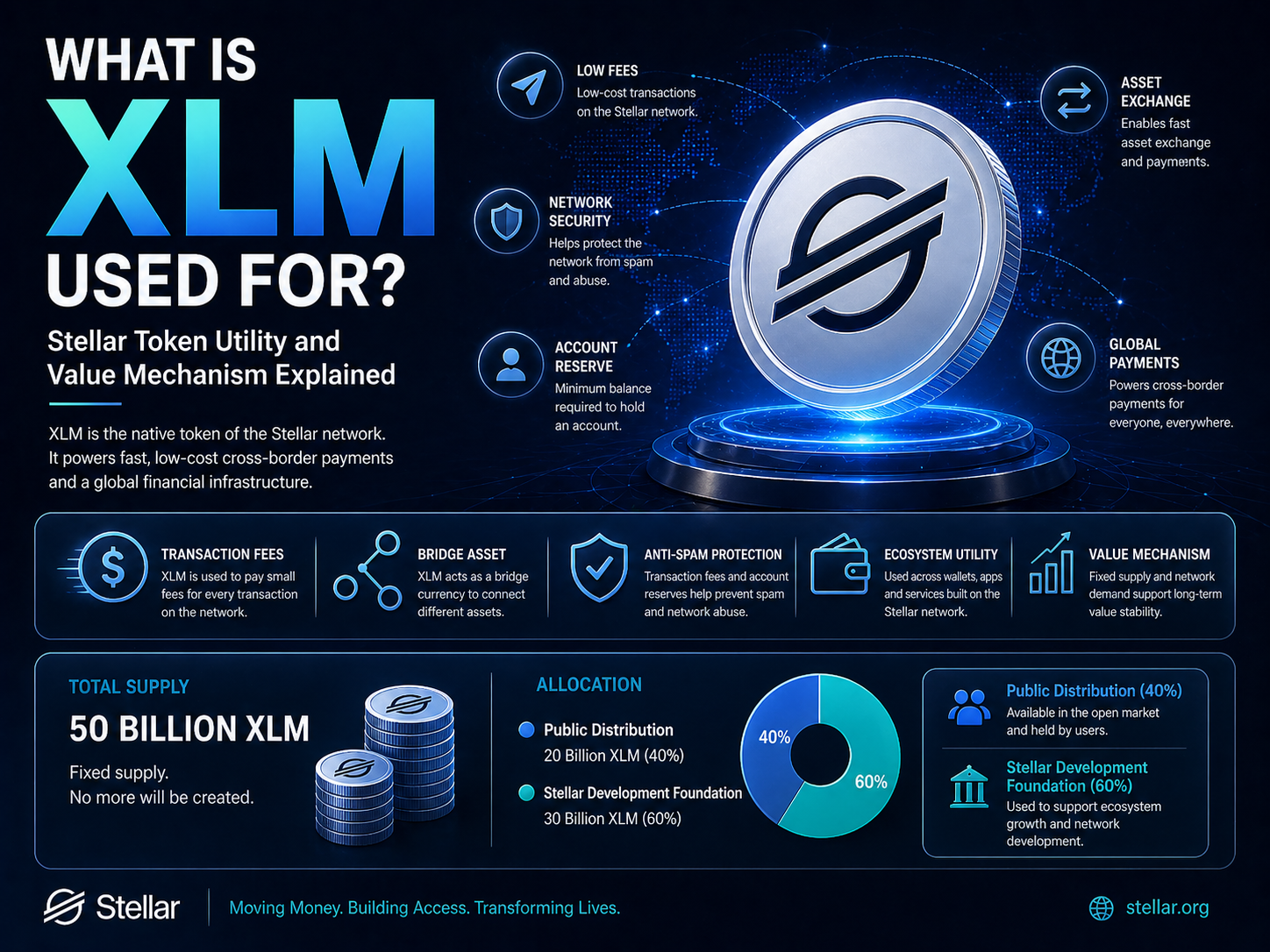
What Is the XLM Token?
XLM, also known as lumen, is the native asset of the Stellar blockchain. It primarily supports network transactions, account creation, and asset movement.
Unlike a simple payment token, XLM is embedded in Stellar’s core protocol. Users must maintain a certain XLM balance for account creation, transaction initiation, or holding other assets. Stellar’s official documentation notes that the network requires a small amount of XLM for transaction fees and enforces a minimum balance to prevent spam accounts and network abuse.
Functionally, XLM serves as a fundamental resource constraint. Every transaction incurs a small fee, and all accounts must maintain a minimum balance, ensuring network resources aren’t exploited at no cost.
As a result, XLM’s value lies not just in transferability, but in its integral link to Stellar’s operational framework.
What Are XLM’s Core Functions?
XLM’s primary functions include: transaction fees, account reserves, anti-abuse safeguards, and serving as a bridge asset.
Every transaction or operation on Stellar requires users to pay a nominal XLM fee. According to Stellar’s official documentation, the network’s inflation mechanism ended via a community vote in 2019, and the total supply was subsequently reduced—no new XLM will be created.
| Function Type |
Specific Role |
Network Impact |
| Transaction Fees |
Covers on-chain operational costs |
Prevents spam transactions |
| Account Reserve |
Satisfies minimum balance |
Reduces inactive accounts |
| Bridge Asset |
Enables asset conversions |
Improves payment efficiency |
| Ecosystem Flow |
Used for transfers, asset trading |
Connects users and applications |
| Value Constraint |
Fixed supply and fee consumption |
Influences long-term supply |
XLM maintains network stability through low-cost fees and minimum balance requirements, while its bridge asset feature enables seamless multi-asset payments.
Together, these functions position XLM as both a utility and infrastructure token within Stellar’s ecosystem.
XLM’s Role in Transactions and Fees
XLM is essential for paying transaction fees on Stellar.
Each Stellar transaction requires a base fee—typically very low—serving a governance purpose: it imposes a cost for every operation, discouraging malicious users from flooding the network with spam or abusing resources. Stellar identifies transaction fees as a key use case for XLM.
For users, this low-fee structure makes Stellar ideal for micropayments and cross-border transfers. Low costs enable frequent transactions without negatively impacting user experience.
From the network’s perspective, the fee is a protective layer rather than a barrier—so long as every operation incurs a cost, large-scale attacks and spam are naturally limited.
This design creates a balance between user experience and network security.
How XLM Secures the Network and Prevents Abuse
XLM safeguards the Stellar network through minimum account balances and transaction fee mechanisms.
Every Stellar account must hold a minimum amount of XLM to remain active. This requirement ensures that creating accounts and holding assets isn’t entirely free, reducing spam accounts, inactive relationships, and malicious use of resources.
Minimum balances and transaction fees together constrain network resources: fees restrict high-frequency spam, while minimum balances limit mass creation of invalid accounts. This combination maintains order while preserving low operational costs.
This approach is critical for open payment networks. Without basic resource costs, Stellar’s open asset issuance and multi-asset transactions could be overrun with invalid data.
Thus, XLM functions as both a payment instrument and a network security tool.
How XLM Circulates in the Stellar Ecosystem
XLM circulates throughout Stellar’s ecosystem by facilitating transfers, asset exchanges, account operations, and application interactions.
Users can transfer XLM directly, or use it as a bridge asset during conversions between different currencies. For example, if the sender and receiver use different assets, Stellar’s path payment mechanism can identify an optimal route, with XLM sometimes serving as the intermediary.
XLM’s circulation involves users, asset issuers, wallets, payment apps, and transaction scenarios. Users pay fees or transfer XLM, issuers deploy stablecoins or other assets, and applications build services for payments, remittances, and exchanges.
Importantly, XLM isn’t limited to single-token transactions—it’s embedded in Stellar’s multi-asset payment infrastructure.
As asset issuance and payment applications grow within Stellar, XLM’s demand for fees, reserves, and bridging will increase accordingly.
How XLM’s Value Mechanism Impacts Network Operations
XLM’s value mechanism is determined by its fixed supply, fee consumption, minimum balance requirements, and ecosystem usage.
Per Stellar’s official disclosures, the network formerly had an inflation mechanism, which the community voted to end in October 2019. In November 2019, the total supply was reduced. Currently, about 50 billion XLM exist—no additional XLM will be created.
Stellar notes that approximately 20 billion XLM circulate on the open market, with about 30 billion held by the Stellar Development Foundation (SDF) for network development and ecosystem growth. In 2019, SDF ended individual airdrops and partner giveaway programs, burning roughly 50 billion XLM from those allocations, and confirmed no further token burns are planned.
| Category |
Quantity/Proportion |
Description |
| Current Supply |
~50 billion XLM |
No further issuance |
| Public Market |
~20 billion XLM |
Held and traded by market participants |
| SDF Reserve |
~30 billion XLM |
For network and ecosystem development |
| Burned Portion |
~50 billion XLM |
From prior airdrop and allocation pools |
XLM’s value is not based on mining, but on fixed supply, network usage, and SDF’s ecosystem resource management. Fixed supply reduces uncertainty, while transaction fees and minimum balances ensure continual network demand for XLM.
This structure tightly links XLM’s value to Stellar’s network activity. As payments, asset issuances, and cross-border transactions increase, so does XLM’s importance in fees, anti-abuse, and ecosystem flow.
Summary
The XLM token plays multiple roles within Stellar: covering transaction fees, enforcing minimum balances, preventing abuse, enabling asset conversion, and supporting ecosystem flow. Its total supply is capped at approximately 50 billion, with no new issuance. Circulation is split between the public market and SDF reserves. Understanding XLM requires seeing beyond its use for transfers to its foundational role in Stellar’s accounts, fee structure, payments, and asset exchange systems.
FAQ
What is XLM primarily used for?
XLM primarily pays Stellar network fees, fulfills minimum account balance requirements, prevents spam, and acts as a bridge asset for exchanges.
What is XLM’s total supply?
About 50 billion XLM are in existence, with inflation ended—no additional XLM will be created.
How is XLM allocated?
Roughly 20 billion XLM circulate on the open market, while about 30 billion are held by the Stellar Development Foundation for network and ecosystem growth.
How does XLM prevent network abuse?
Stellar’s transaction fees and minimum account balance requirements add cost to network usage, making spam transactions, inactive accounts, and malicious resource occupation expensive.
What is the relationship between XLM and the Stellar network?
Stellar is a payment and asset issuance network, while XLM is its native token, used for fees, account reserves, asset conversion, and ecosystem operations.







