As concepts like AgentFi, DataFi, and AI Wallet continue to gain traction, on-chain intelligence is transitioning from a niche institutional tool into a foundational layer of the AI era.
This shift sets Wallitelli apart from traditional on-chain data platforms. Its core focus lies in AI-native Intelligence and Wallet-native Intelligence.
What is Wallitelli?
Wallitelli is an intelligence platform designed for on-chain wallets and AI Agents. It specializes in wallet risk analysis, asset behavior recognition, and on-chain risk monitoring. Unlike conventional blockchain explorers or data analytics tools, Wallitelli emphasizes "intelligent insight generation" rather than mere data presentation.
At its core, Wallitelli transforms scattered on-chain activity into structured, AI-readable information. For instance, if a single wallet engages with multiple DeFi protocols, faces potential liquidation risks, and interacts with high-risk addresses, the system consolidates these disparate data points into a unified risk profile.
This approach mirrors the "risk control layer" in traditional finance, but applied to on-chain wallets, protocols, and AI Agents. As automated trading and autonomous agents advance, on-chain systems increasingly require intelligent tools capable of real-time risk and behavior analysis.
How Does Wallitelli Work?
Wallitelli's operational framework comprises four stages: data collection, behavior analysis, risk modeling, and AI output.
First, the system gathers wallet activity, transaction records, liquidity shifts, and protocol interaction data from multiple blockchains and protocols. The AI model then performs pattern recognition on these behaviors.
For example, if a wallet suddenly increases leverage, transfers assets across chains repeatedly, or frequently enters high-risk protocols, the system may identify these behaviors as high-risk signals.
Upon analysis, Wallitelli generates a structured risk summary covering:
- Wallet risk level
- Multi-protocol risk exposure
- Potential liquidation risk
- Asset concentration
- Anomalous behavior signals
- DeFi yield risk
These insights are accessible to both human users and AI Agents or other automated systems.
What is the Role of the WALLI Token?
WALLI is the native functional token of the Wallitelli ecosystem, primarily used to unlock advanced analytics and ecosystem permissions.
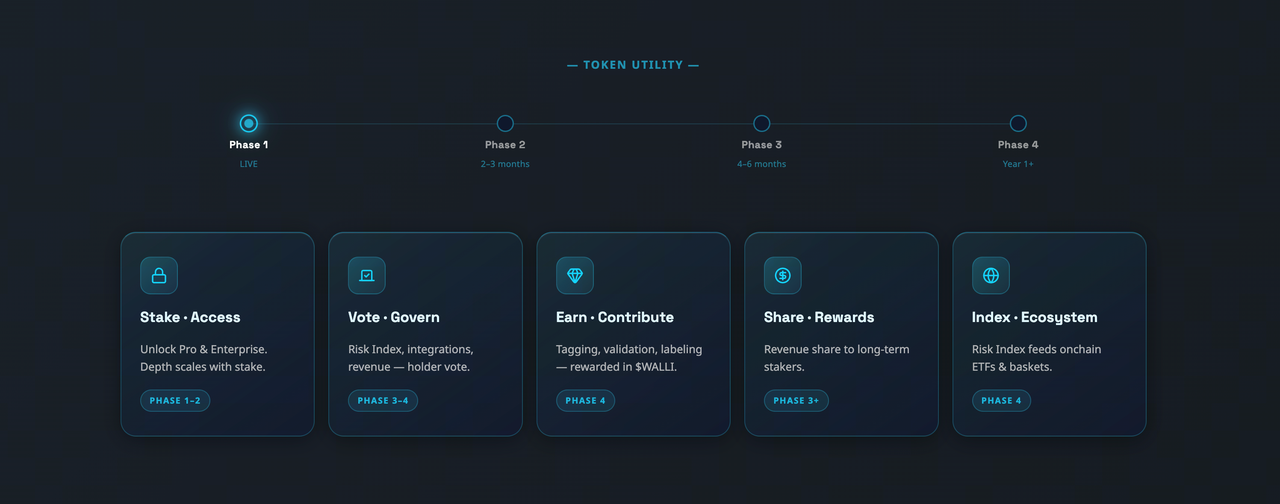
On many AI data platforms, value lies not in data alone but in access to high-quality intelligence. WALLI functions similarly as an "intelligence access layer."
Potential WALLI use cases include:
As the Agent Economy grows, AI Agents may become active users of WALLI. For example, an autonomous agent could use WALLI to access advanced risk models for automated decision-making.
Wallitelli is often compared to on-chain analytics platforms, but their focus areas differ.
Traditional platforms typically emphasize:
- Data visualization
- Wallet tracking
- On-chain labeling systems
- Transaction monitoring
- Address analysis
Wallitelli, in contrast, focuses on:
- AI-driven risk identification
- Behavioral pattern analysis
- Wallet-level intelligent profiling
- Agent-executable insights
- Automated risk output
This distinction positions Wallitelli as an "on-chain intelligence decision layer," rather than just another data tool.
In AI Agent applications, structured risk information is more valuable than static charts, as AI systems require executable logic, not just display-oriented data.
What Are Wallitelli's Use Cases?
Wallitelli's applications center on on-chain risk management and AI-powered automated finance.
In DeFi, users can leverage Wallitelli to analyze multi-protocol asset risk. For instance, a wallet exposed to multiple yield protocols can be assessed for risk concentration.
For DAO Treasury management, Wallitelli monitors asset distribution, stablecoin exposure, and fund flows.
For AI Agents, Wallitelli acts as a "risk perception module." Agents can call its risk summaries to decide whether to execute trades, adjust strategies, or exit protocols.
What Challenges Does Wallitelli Face?
On-chain intelligence systems face several hurdles.
First, on-chain data is highly complex, with varying data structures across protocols. Building a unified risk model remains a key challenge for AI-driven on-chain analysis.
Second, AI risk assessments are not infallible. Certain behaviors may be misclassified as risky, requiring continuous model refinement.
Additionally, AI Agents and automated finance are still nascent. The actual market demand for an Agentic Economy, along with regulatory and infrastructure maturity, remains uncertain.
Given the open nature of on-chain systems, any analysis tool is vulnerable to data pollution, spoofed behaviors, and model bias.
Summary
Wallitelli serves as on-chain intelligence infrastructure for the AI Agent era. By combining AI risk analysis, wallet behavior identification, and on-chain data modeling, it delivers actionable on-chain insights for both users and automated systems.
Compared to traditional analytics platforms, Wallitelli prioritizes AI-native and Agent-ready intelligence, enabling AI systems to directly interpret and act on on-chain risk information.
FAQs
How is Wallitelli different from traditional on-chain analytics platforms?
Wallitelli focuses on AI-driven risk identification, behavioral pattern analysis, and structured insight output. Traditional platforms typically emphasize data display, address tracking, and visual analytics.
What is the Onchain Intelligence Layer?
The Onchain Intelligence Layer converts complex on-chain data into structured risk information, behavioral analysis, and AI-executable decision signals.
Why do AI Agents need on-chain intelligence?
AI Agents must understand on-chain risk, asset exposure, and protocol status in real time. Raw on-chain data is rarely suitable for direct automated decision-making, making an intelligence layer essential for structured risk output.
What are Wallitelli's main applications?
Wallitelli supports wallet risk analysis, DAO Treasury management, DeFi risk monitoring, AI Agent risk control, and multi-protocol asset behavior analysis.
What is the Agentic Economy?
The Agentic Economy describes an economic system where AI Agents, autonomous systems, and automated digital entities participate as independent actors. Here, AI evolves from a supportive tool into an autonomous economic participant.