When discussing the role of the TAC token, the core questions usually focus on three areas: how it supports the TAC EVM execution layer, how it participates in validation and governance, and how its total supply, allocation, and release structure affect the network economy.
This topic can be understood through six areas: the gas mechanism, validator network, governance design, token allocation, ecosystem incentives, and supply and demand dynamics. Among them, gas payment and validator staking are the most central functions in the TAC token model.
What Is the TAC Token
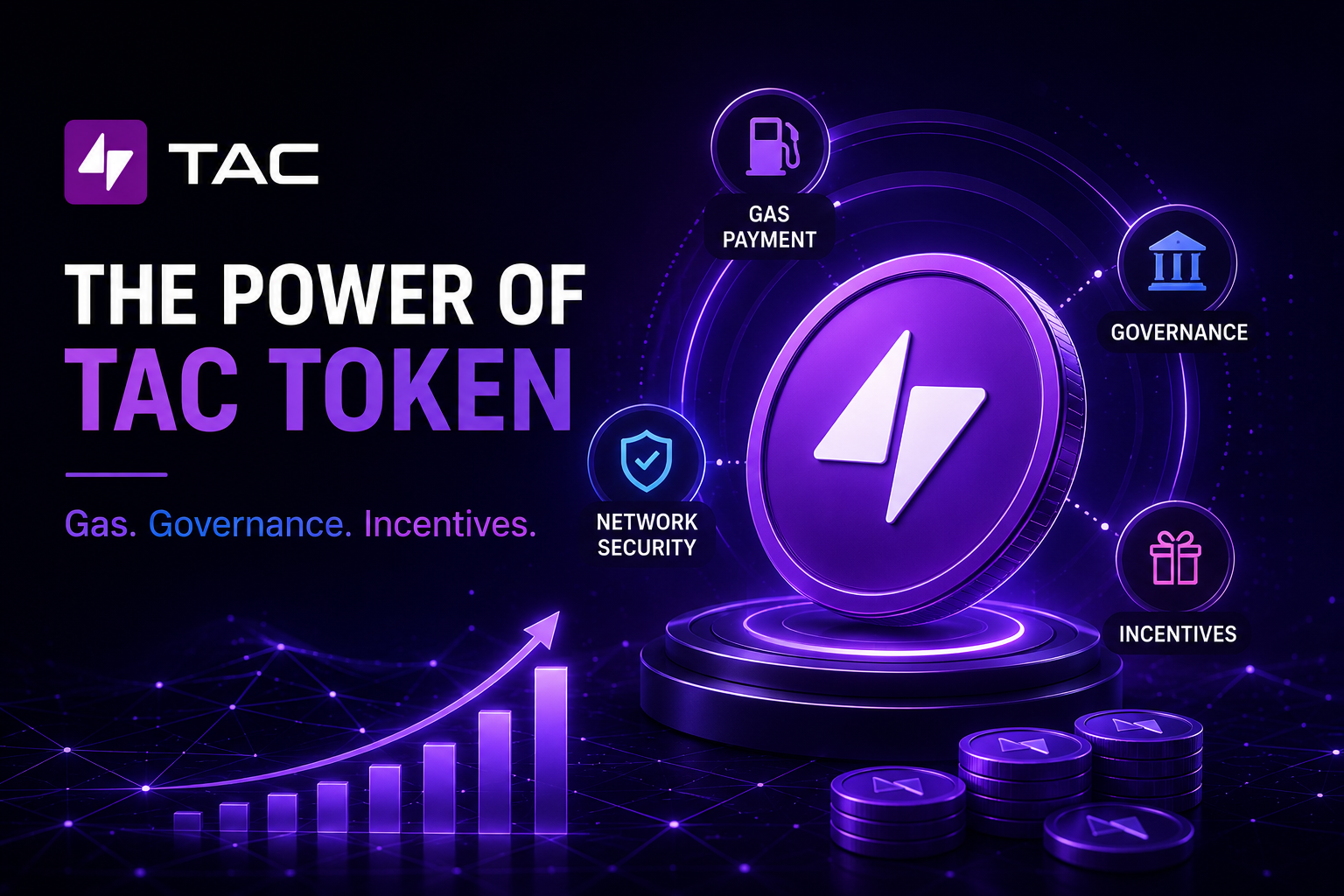
The TAC token provides the basic settlement function for the TAC EVM execution layer. It can be understood as the economic medium connecting Telegram users, TON assets, and EVM contract execution. Its core purpose is to allow cross-chain execution, gas payment, and network security to operate within the same token system.
Structurally, the TAC network connects the Telegram frontend, TON Adapter, Sequencer network, and EVM execution layer. First, users initiate an interaction through a Telegram Mini App or TON wallet. The system then converts the user request into an executable cross-chain message. Next, the TAC EVM layer executes the Solidity contract. Finally, gas, validation, and network resource consumption are all settled through the TAC token system.
The importance of this positioning is that TAC is not merely a payment asset for frontend users, but a functional token that supports the underlying execution environment. Users may interact through TON or a Telegram wallet at the experience layer, but TAC still serves as the gas and economic security asset within the EVM execution network.
How the TAC Gas Mechanism Works
The core purpose of the TAC gas mechanism is to provide fee settlement for contract execution on the TAC EVM Layer. In simple terms, whenever a Hybrid dApp executes a Solidity contract on the TAC EVM, a corresponding gas cost is required to pay for computation and network resources.
In practice, the user first initiates an action through a Telegram Mini App or TON wallet, such as a swap, lending transaction, or staking operation. The application then sends the request into TAC’s cross-chain execution flow. Next, the TAC EVM Layer executes the corresponding Solidity contract and generates a gas cost. Finally, that gas cost is settled through the TAC token system, supporting network execution and resource consumption.
The importance of this mechanism is that demand for the TAC token is directly connected to network usage. If Hybrid dApp call frequency increases, the number of EVM contract executions also rises, which may increase demand for gas payments. For the TAC ecosystem, the gas mechanism connects Telegram application usage, TON cross-chain interaction, and EVM execution activity within a single economic model.
The Role of the TAC Token in the Validator Network
The TAC token’s role in the validator network is mainly reflected in staking, delegation, and network security. Its core purpose is to use a DPoS mechanism that gives validators and delegators economic responsibility while allowing them to participate in network consensus.
Mechanically, validators first need to stake TAC tokens to qualify for network validation. Delegators can then delegate tokens to validators and participate indirectly in network security. Next, the validator network processes cross-chain messages, block production, and state updates. Finally, normal participants receive rewards, while improper or inactive behavior may face penalties.
The impact of this structure is that the TAC token is used not only for gas payments, but also to protect network operations. The more sufficiently validators are staked, the stronger the network’s economic security constraints become. For a cross-chain execution network, the stability of the validation mechanism is directly tied to message execution, state confirmation, and user asset security.
How TAC Governance Is Designed
TAC governance is built around protocol upgrades, ecosystem incentives, treasury resources, and network parameters. In practical terms, TAC token holders participate in network rules and resource allocation through governance.
In the governance process, the community or relevant participants first submit proposals around protocol development. Token holders then vote according to governance rules. Next, governance outcomes may affect ecosystem incentives, treasury usage, protocol parameters, or application support priorities. Ultimately, the governance mechanism connects token holding with network decision-making.
The importance of this design is that TAC’s ecosystem development depends not only on technical execution, but also on how resources are allocated. For the Telegram EVM ecosystem, governance can influence Hybrid dApp incentives, developer support, liquidity programs, and long-term ecosystem building. The quality of governance depends on participation, transparency, and proposal execution efficiency.
TAC Total Supply and Allocation Structure
TAC’s total token supply is generally reported as 10 billion. According to the official Tokenomics article, about 18% of tokens entered circulation at TGE, while roughly 80% remained locked or under foundation control and will enter circulation gradually according to the release schedule. The article also notes that the final community airdrop allocation was 1.42% of total supply.
In terms of allocation structure, the public tracking platform Dropstab lists TAC allocation categories including Early Contributors, Seed Initial, Foundation & Reserve, DAO Treasury, Growth, Pre-Mainnet Liquidity, Marketing & Rewards, Advisors, Liquidity Management, Validators, and Infrastructure Partnerships.
| Allocation Category |
Share |
| Early contributors |
22.10% |
| Seed round investment |
16.60% |
| Foundation and reserve |
14.80% |
| DAO treasury |
12% |
| Ecosystem growth |
10% |
| Pre-mainnet liquidity |
5.10% |
| Mid-term marketing and rewards |
4.60% |
| Launch marketing and rewards |
4.40% |
| Advisors |
3.40% |
| Liquidity management |
3% |
| Validators |
3% |
| Infrastructure partners |
1% |
This data shows that TAC’s allocation structure covers team contributions, early financing, foundation reserves, the DAO treasury, ecosystem growth, liquidity, and validator incentives. Its impact is that supply changes depend not only on total supply, but also on the release pace of different categories and whether network demand can absorb the newly circulating tokens.
How the TAC Token Model Affects Supply and Demand
The TAC token model affects supply and demand mainly through gas consumption, staking lockups, governance incentives, ecosystem growth, and release cycles. The key question is whether real network usage can offset the increase in supply caused by ongoing unlocks.
In its operating logic, Telegram users first create interaction demand through Hybrid dApps. The TAC EVM then executes Solidity contracts and generates gas usage. Next, validators and delegators participate in network security through staking, with some tokens moving out of circulation into a locked state. Finally, gas demand, staking scale, ecosystem incentives, and unlock schedules jointly affect effective supply and demand.
The key point in this structure is that demand for the TAC token does not come only from the trading market; it comes from real usage of the Telegram EVM execution layer. If DeFi, payments, games, or other Hybrid dApps gain broader use in Telegram-based scenarios, gas demand and ecosystem incentive use cases become clearer. If application calls are insufficient, unlock pressure and supply expansion may create challenges for the token economy.
Conclusion
The TAC token serves several functions in the TAC network, including gas payment, validator staking, governance participation, ecosystem incentives, and supply and demand coordination. Its economic logic revolves around Telegram users initiating interactions, TON Adapter processing cross-chain messages, the TAC EVM executing Solidity contracts, gas fees being settled, and the validator network providing security.
Overall, TAC’s token model is closely tied to Hybrid dApp usage, EVM contract execution frequency, validator staking scale, and the token release structure. Total supply and allocation define the supply framework, while gas, governance, and incentive mechanisms determine the token’s actual usage paths within the network.
FAQs
What Is the TAC Token Used For
The TAC token is mainly used for gas payments on the TAC EVM Layer, validator staking, governance participation, ecosystem incentives, and cross-chain execution settlement. It is the core functional asset of the TAC network.
How Does the TAC Gas Mechanism Work
After users initiate interactions through Telegram or the TON environment, the TAC EVM Layer executes Solidity contracts and generates gas costs. The related fees are settled through the TAC token system.
What Is the Total Supply of TAC
TAC’s total token supply is generally reported as 10 billion. According to the official Tokenomics article, about 18% entered circulation at TGE, while roughly 80% will gradually enter circulation according to lockup and release arrangements.
How Does the TAC Token Participate in the Validator Network
Validators need to stake TAC to participate in network validation, and delegators can also delegate tokens to validators. This mechanism uses economic constraints to maintain the security of cross-chain messages and EVM execution.
Does the TAC Token Model Affect Supply and Demand
Yes. TAC’s supply and demand dynamics are jointly affected by gas usage, staking lockups, ecosystem incentives, application call volume, and token release cycles. Among these, Hybrid dApp usage is a key variable.