The gaming industry has long relied on professional teams working together to develop products, with full projects typically requiring the combined efforts of planners, artists, programmers, testers, and operations staff. In the AI Gaming track, Portal positions itself as a creative infrastructure, using an AI Agent, a creator platform, and an ecosystem incentive system to connect developers, content creators, and players, making game production more automated and open.
Why Portal Was Built: Why Game Development Is Entering the AI Era
Game development has always been one of the most expensive areas in the digital content industry. From concept design to launch, development teams often spend massive amounts of time, labor, and capital. For indie developers, even great ideas can be hard to realize due to technical barriers.
Generative AI has changed this. Tools for text-to-code generation, AI-assisted art, automated testing, and content creation are growing more mature, allowing tasks that once required specialists to be done through natural language. Developers no longer need to build everything from scratch—they can use AI to quickly generate prototypes and refine them iteratively.
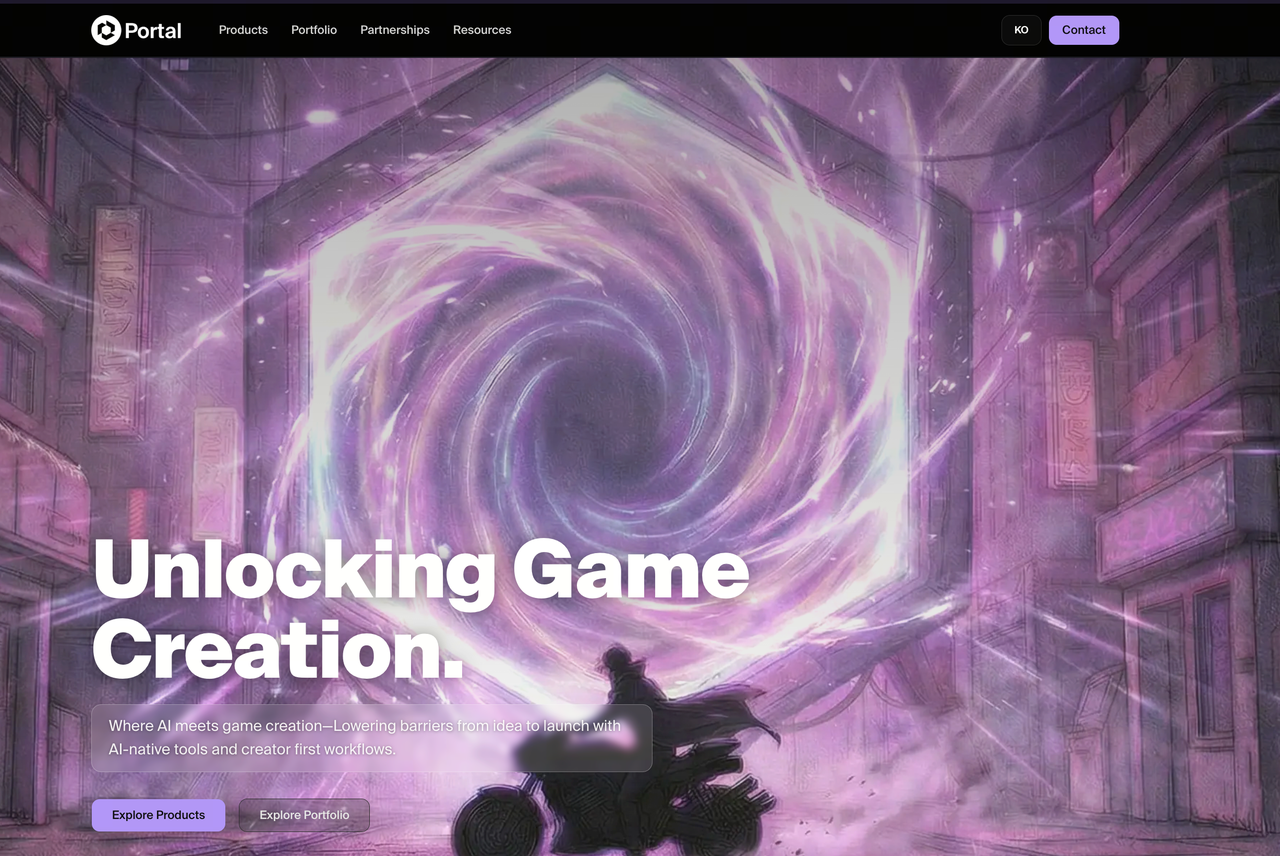
Against this backdrop, the Prompt-to-Game concept is gaining traction. Users can enter a description to generate game scenes, characters, and basic gameplay logic, shifting game development from "manual production" to "AI co-creation."
The key difference between an AI-native platform and traditional software is that AI isn't an add-on—it's a core part of the product architecture. Portal's design goal isn't to offer developers a single AI tool; it's to embed AI deeply into the game production pipeline.
Portal brings idea generation, asset creation, logic design, project management, and content testing together in one unified environment. Creators can go from concept to playable prototype without constantly switching tools. This model is similar to AI Coding Workspace in software development, but adapted for game creation.
With unified workflow management, Portal aims to shorten development cycles, boost content production efficiency, and lower the entry barrier for individual creators entering the gaming industry.
What Are Portal's Core Products?
Portal Studio
Portal Studio is the core creative environment in the Portal ecosystem, used to manage projects, coordinate AI tools, and organize development workflows. Creators can describe their needs in natural language, and the system automatically generates the corresponding content.
Portal Studio functions as an AI-driven development workbench, centralizing multiple creative stages into one interface for better collaboration.
GameGen
GameGen handles game content generation, including character design, scene creation, quest structures, and some gameplay logic. When creators input ideas, the system automatically builds a basic game framework.
GameGen's goal is to enable prompt-to-game functionality, allowing creators to quickly test ideas without first going through complex development.
GameRouter
GameRouter is Portal's AI agent orchestration layer. Different Agents take on design, modeling, programming, and testing tasks, working together within a unified framework.
Through task allocation and resource scheduling, multiple AI Agents can collaborate on complex development workflows rather than just performing single generation tasks.
GameHub
GameHub is the content display and distribution platform within the Portal ecosystem. Creators can publish their work, get community feedback, and communicate and collaborate with other developers.
GameHub also facilitates value flow in the creator economy, connecting content production with ecosystem incentives.
How Does Portal's AI Agent Workflow Work?
AI Agents are a major differentiator between Portal and traditional game development tools. Traditional AI tools typically only generate content, while AI Agents emphasize task execution and workflow coordination.
When a user inputs a game idea, the Design Agent first analyzes the requirements and creates a project framework. Then the Asset Generation Agent builds character models, map scenes, and visual assets, while the Logic Development Agent sets up gameplay rules and interaction systems.
After development is done, the Testing Agent automatically checks the game for potential issues. The collaborative work of multiple AI Agents lets Portal cover most development stages, from concept to prototype.
What Role Does the PORTAL Token Play in the Ecosystem?
PORTAL is the native token of the Portal ecosystem, used to connect platform features, creator incentives, and community governance. The token mechanism lets different participants share in the platform's value.
On the product side, PORTAL can be used to access advanced AI services, extra computing resources, and certain professional creation tools. For creators, PORTAL serves as a reward medium, encouraging content creation and community contributions.
Beyond utility and incentives, PORTAL also carries governance functions. Holders can join proposal discussions and some decision-making processes, helping shape the ecosystem's direction.
What Traditional Game Development Problems Does Portal Solve?
Traditional game development requires cross-disciplinary expertise, including programming, art design, project management, and quality testing. For individual developers, mastering all these skills is often extremely difficult.
Portal lowers some technical barriers through AI automation. Creators can generate content with natural language and use Agents to handle repetitive tasks in the development process.
Asset production efficiency is another area Portal focuses on optimizing. AI can quickly generate prototype assets and iterate on them, shortening development cycles and reducing trial-and-error costs.
The biggest difference between Portal and traditional game development platforms is the depth of AI involvement. Traditional tools mainly provide editors and engine capabilities, with game content still needing manual creation.
Portal integrates AI Agents into the production pipeline, allowing some design, development, and testing tasks to run automatically. Creators focus more on creative and decision-making roles rather than all technical implementation.
Additionally, Portal incorporates a Web3 creator economy model, creating a unified ecosystem for content creation, community collaboration, and value distribution. This model is distinctly different from traditional game development platforms.
Summary
As a game creation platform for the AI era, Portal reimagines traditional game development through AI Agents, prompt-to-game workflows, and a creator economy. Portal brings game design, asset generation, logic development, testing, and publishing into one unified environment, enabling more individual creators to participate in game production.
FAQs
What is Portal?
Portal is an AI-native game creation platform that uses AI Agents and automated workflows to help creators with game design, asset generation, testing, and publishing throughout the development process.
How is Portal different from traditional game engines?
Traditional game engines mainly provide development tools, while Portal emphasizes direct AI involvement in the development process. Portal's AI Agents can automatically handle some design, generation, and testing tasks, lowering the barrier to entry.
What is PORTAL Token used for?
PORTAL Token is used to access ecosystem services, get advanced features, participate in creator incentive programs, and support community governance. It is a key value medium in the Portal ecosystem.
Do I need programming skills for Portal?
One of Portal's design goals is to lower the programming barrier. Some features can be used through natural language prompts, but complex projects may still require some development knowledge and experience.
What is prompt-to-game?
Prompt-to-game is a development model that uses natural language to generate game content. Creators enter a text description, and the AI system produces corresponding game scenes, characters, and basic gameplay logic.
Is Portal an AI Gaming project?
Portal is generally categorized as an AI Gaming infrastructure project. Unlike traditional gaming projects, Portal focuses on AI creation tools and development workflows in the game production process, rather than a single game product itself.