As the blockchain industry moves beyond “crypto asset trading” into payments, on-chain finance, real-world asset (RWA) tokenization, and super app ecosystems, public blockchains that deliver high-performance trading, low-cost transfers, and scalable user access are increasingly in the spotlight.
Kaia is positioned as more than a conventional Layer 1 network—it’s designed as a gateway for users bridging Web2 and Web3, leveraging LINE Messenger, Mini DApps, and stablecoin infrastructure.
The Origin of Kaia: Why Did Klaytn and Finschia Merge?
Kaia’s creation is closely tied to the push by Asian internet companies to advance Web3 infrastructure. Klaytn was launched by Ground X, the blockchain division of South Korea’s internet giant Kakao, with a focus on enterprise blockchain, NFT, and DeFi ecosystems. Finschia originated from LINE’s blockchain strategy, targeting messaging app ecosystems and digital asset services.
As competition among Layer 1 public blockchains heats up, growing users and expanding developer communities within a single ecosystem has become increasingly challenging. The merger of Klaytn and Finschia is designed to combine both platforms’ user bases, developer tools, and traffic channels in Asia, creating a Web3 network that spans payments, social, and on-chain finance.
Kaia distinguishes itself from traditional “high-performance public blockchains.” Rather than focusing solely on TPS or on-chain throughput, Kaia prioritizes embedding Web3 services into internet products users already know—like messaging apps, digital payments, and Mini App ecosystems.
How Does Kaia’s Technical Architecture Work?
Kaia is EVM-compatible, supporting Solidity smart contracts and Ethereum development tools. This allows developers to migrate existing Ethereum applications to Kaia at low cost, using familiar tools like MetaMask, Remix, and Hardhat.
On the performance front, Kaia optimizes transaction confirmation speed and user experience. The network supports near real-time transaction confirmations and lowers the barrier to on-chain activity with reduced Gas costs. This makes it ideal for payments, micropayments, and high-frequency on-chain interactions.
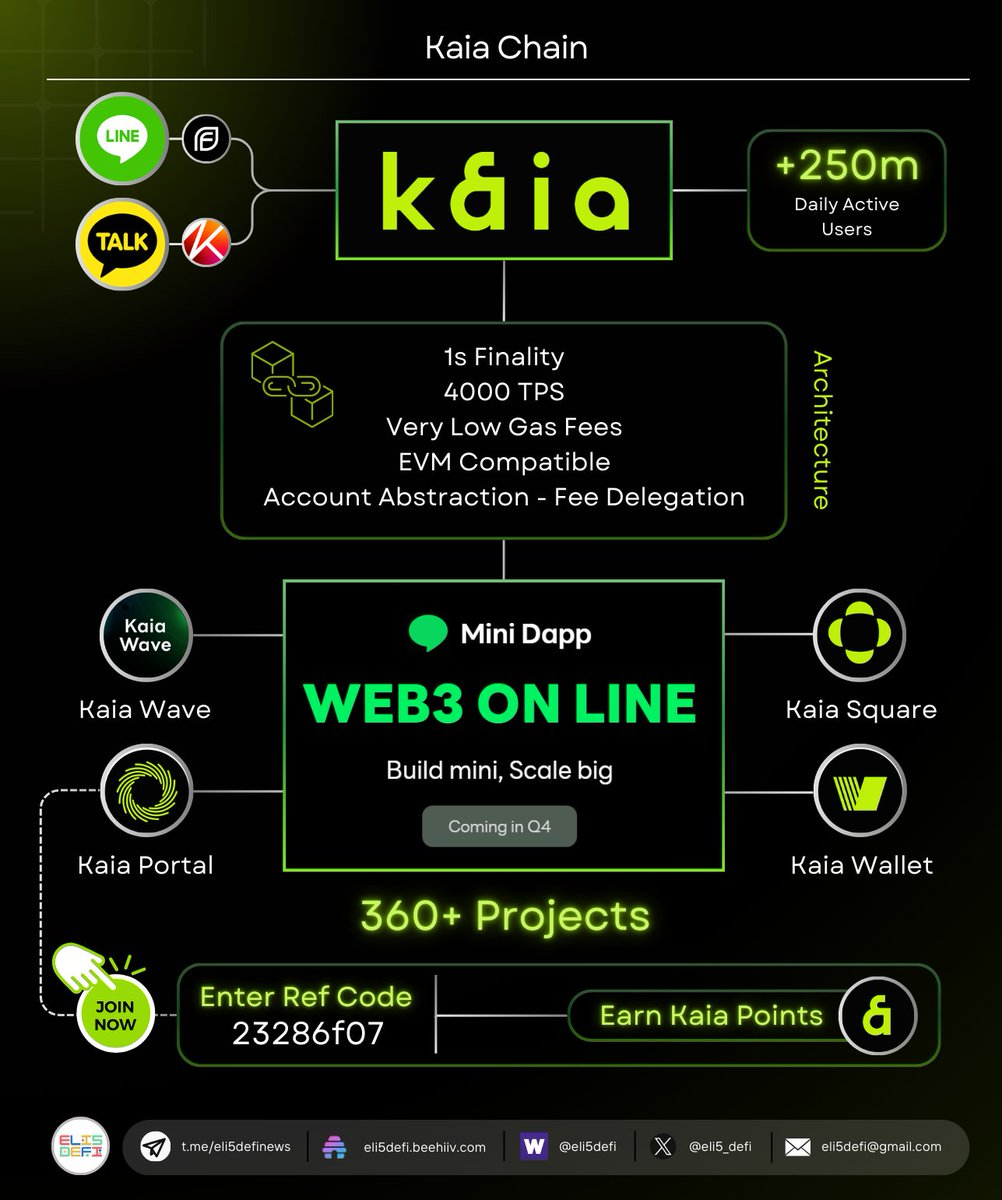
Kaia also introduces a Gas Fee Delegation mechanism. In conventional blockchains, users must hold native tokens to transact; Kaia, however, allows apps or service providers to pay Gas on behalf of users, simplifying the onboarding process for Web2 users new to blockchain.
This mechanism is integral to the Mini DApp strategy. Users accessing Web3 services through super apps like LINE can complete certain on-chain operations without needing to understand Wallets or Gas, significantly enhancing the user experience.
What Is the Utility of the KAIA Token?
KAIA is the native token of the Kaia network, used for on-chain transaction fees, network governance, and network security.
Technically, KAIA pays Gas Fees, enables smart contract execution, and supports on-chain transfers. Validators and network participants can also stake KAIA to help run the network and receive rewards.
With the launch of the Kaia network, legacy KLAY and FNSA tokens will be gradually converted to KAIA. This is not just a rebranding, but also a consolidation of Klaytn and Finschia’s governance and ecosystem.
Beyond network operations, KAIA is used for stablecoin payments, on-chain finance, and ecosystem incentives. Some Mini DApps, on-chain payment services, and DeFi protocols use KAIA for trading fee settlements or as an incentive medium.
Why Is Kaia Focused on Stablecoins and On-Chain Finance?
Stablecoins have become fundamental infrastructure in blockchain, with use cases expanding from trading to cross-border payments, settlement, on-chain yield markets, and RWA.
Kaia sees stablecoins as a key entry point for Web3 payments in Asia. Unlike traditional public blockchains centered on DeFi and on-chain trading, Kaia emphasizes the role of stablecoins in everyday payments and internet services—such as cross-border transfers, digital content consumption, and online settlements.
This strategy matches the unique characteristics of Asia’s internet market: high demand for cross-border payments and mature mobile payment and super app ecosystems. Kaia aims to integrate Web3 payment capabilities into existing internet products via low-cost on-chain settlement and stablecoin infrastructure.
What Does Integration of Kaia Mini DApp and LINE Mean?
Mini DApp is a core focus of the Kaia ecosystem, aiming to embed Web3 services into internet apps users already know—rather than forcing them into complex on-chain environments.
Traditional Web3 apps require users to install a Wallet, store a seed phrase, and learn blockchain operations—barriers that deter mainstream users. Mini DApps, by contrast, follow the familiar “mini program” model of Web2, allowing users to access on-chain services directly within messaging apps.
Kaia’s integration with LINE is a defining feature. LINE’s massive user base in Asia gives Kaia a powerful channel to bring digital payments, on-chain gaming, NFTs, and social applications to everyday users.
This model reflects a broader Web3 trend: blockchain infrastructure is shifting from “technology-first” to “user experience-first.” More projects are focused on reducing user friction, rather than showcasing complex on-chain features.
How Does Kaia Differ from Ethereum, TON, and Solana?
Kaia, Ethereum, TON, and Solana are all smart contract networks, but differ in ecosystem positioning and user growth strategies.
Ethereum is known for its decentralized ecosystem and developer community, serving as the backbone for DeFi and on-chain finance. Solana prioritizes high performance and low-cost transactions, while TON leverages Telegram’s social ecosystem to onboard Web3 users.
Kaia’s edge is its integration with Asian internet platforms. Its roadmap goes beyond DeFi and on-chain assets, focusing on bringing Web2 users into Web3 via LINE, Mini DApps, and stablecoin payments.
For developers, Kaia’s EVM compatibility lowers the barrier to migrate applications. For users, Gas Fee Delegation and super app integration optimize the on-chain experience.
What Are Kaia’s Strengths and Limitations?
Kaia’s main strengths are its resources and user entry points in the Asian internet ecosystem. Unlike many public blockchains reliant solely on crypto community growth, Kaia benefits from the user base of platforms like LINE and Kakao.
Its stablecoin and payments strategy aligns with blockchain’s current trajectory. As demand for on-chain finance and digital payments rises, networks that are low-cost, high-performance, and have internet access advantages will see broader adoption.
However, Kaia still faces stiff competition. Ethereum retains the largest developer community, Solana dominates the high-performance space, and TON is rapidly expanding in the super app segment.
The success of any Layer 1 public blockchain depends not just on technology, but also on sustained developer growth, user activity, and real on-chain demand. Kaia’s long-term competitiveness will hinge on its ecosystem expansion and real-world adoption.
Summary
Kaia is an EVM-compatible Layer 1 blockchain focused on the Asian market, integrating Klaytn and Finschia resources with an emphasis on stablecoin payments, on-chain finance, and the Mini DApp ecosystem.
Unlike many public blockchains that focus on on-chain performance, Kaia prioritizes onboarding Web2 users into Web3 and integrating blockchain services with internet platforms and super apps. Its collaboration with LINE, Gas Fee Delegation, and stablecoin strategy reflect a shift in Web3 infrastructure toward “low barriers” and “high availability.”
FAQs
What is the relationship between KAIA and KLAY?
KLAY, the native token of Klaytn, will be merged and converted to KAIA, along with FNSA, after the Kaia network launch.
Is Kaia compatible with Ethereum?
Kaia is EVM-compatible, allowing developers to deploy Solidity smart contracts and use Ethereum development tools.
What is the relationship between Kaia and LINE?
Kaia is deeply integrated with the LINE Web3 ecosystem, and its Mini DApps and some on-chain services are accessible via the LINE app.
What are the main use cases for Kaia?
Key use cases include stablecoin payments, DeFi, cross-border remittances, RWA, on-chain finance, and Mini DApps.
How does Kaia differ from TON?
TON relies on the Telegram ecosystem to expand Web3 users, while Kaia focuses on integrating with LINE and Asian internet platforms.
What is Kaia’s Gas Fee Delegation?
Gas Fee Delegation is Kaia’s Gas payment mechanism, allowing app developers to pay trading fees for users—lowering the barrier to Web3 adoption.







