As automotive electronics, industrial automation, 5G communications, and AI applications continue to evolve, the market is seeing sustained demand for stable, reliable chips with long-term supply assurance. Rather than competing in the race to develop the most advanced process nodes, GlobalFoundries (GFS) has chosen to focus on mature process technologies and specialty process platforms, gradually building a differentiated competitive edge.
What Is GlobalFoundries (GFS)?
Unlike chip design companies such as NVIDIA, AMD, and Qualcomm, GlobalFoundries does not design end-user chips. Instead, it specializes in turning customer-developed chip designs into mass-producible semiconductor products. As a result, GlobalFoundries operates under the classic Foundry (wafer foundry) business model.
Wafer foundries handle manufacturing within the semiconductor supply chain. After customers deliver chip design files to the foundry, the foundry uses advanced manufacturing equipment to complete wafer production. The wafers are then sent to assembly and testing companies for final processing, resulting in chips ready for use in automotive, communications, industrial systems, and consumer electronics.
As one of the world's leading foundry companies, GlobalFoundries has long served automotive electronics, industrial controls, communications networks, IoT, and defense sectors, providing customers with long-term production support through its global manufacturing network.
GlobalFoundries' Development History and Market Position
Founded in 2009, GlobalFoundries' growth is closely tied to the trend of specialization in the global semiconductor industry. The company was initially spun off from AMD's manufacturing division and subsequently built manufacturing bases across the U.S., Germany, Singapore, and other regions through continuous expansion and acquisitions. Compared with many emerging semiconductor companies, GlobalFoundries boasts a strong manufacturing foundation and industry accumulation.
During the industry's development, GlobalFoundries once participated in the advanced process race but later gradually adjusted its strategic direction, choosing to focus on mature process and specialty process markets. This shift allowed GlobalFoundries to avoid direct competition with TSMC and Samsung in the most advanced nodes and instead concentrate resources on markets with stable long-term demand.
Today, GlobalFoundries' market positioning is best described as a "specialty process foundry platform." Products such as automotive chips, RF chips, power management chips, and industrial control chips prioritize stability, reliability, and lifecycle management over extreme computing performance. These are precisely the markets GlobalFoundries serves.
How GlobalFoundries' Wafer Foundry Business Operates
The wafer foundry model is one of the most important business models in the modern semiconductor industry. Under the traditional vertically integrated model, companies had to handle both chip design and manufacturing. However, building advanced wafer fabs often requires tens of billions of dollars or more in capital expenditure. As manufacturing costs continue to rise, more companies are choosing to focus on design and outsource production to professional foundries.
GlobalFoundries' business process typically starts with customer requirements. After chip design companies complete their architecture design, they deliver the relevant design files to GlobalFoundries. GlobalFoundries then uses its manufacturing process platforms to complete wafer production, providing different process nodes and technical support based on customer needs.
This model enables customers to avoid building expensive fabrication facilities while leveraging GlobalFoundries' mature production capabilities to achieve rapid mass production. As a result, wafer foundries have become essential infrastructure in the modern semiconductor ecosystem.
GlobalFoundries' Role in the Global Semiconductor Supply Chain
The semiconductor supply chain can be broadly divided into design, manufacturing, packaging and testing, and end-use applications. Within this system, GlobalFoundries occupies the core position in manufacturing. Without wafer foundries, chip design companies cannot turn their designs into actual products; without stable manufacturing capabilities, automotive, industrial equipment, and communications networks would also struggle to secure a reliable long-term chip supply.
From an industry collaboration perspective, GlobalFoundries connects upstream equipment and material suppliers with downstream chip design companies, while also serving end markets such as automotive manufacturers, telecom operators, and industrial equipment firms.
This central position makes wafer foundry companies key nodes in the global semiconductor supply chain. In recent years, growing attention to global supply chain security has further elevated the importance of wafer manufacturing companies.
GlobalFoundries' Mature Process and Specialty Process Layout
Unlike companies chasing the most advanced process nodes, GlobalFoundries has long focused on mature process and specialty process platforms. Mature processes typically refer to manufacturing technologies that have achieved mass production, high stability, and long lifecycles. For automotive electronics, industrial controls, and IoT devices, long-term supply capability is often more important than extreme performance, so mature processes continue to enjoy robust demand.
Beyond mature processes, GlobalFoundries also focuses on developing process technologies for RF chips, power semiconductors, embedded memory, and automotive-grade chips. These specialty processes require long-term technical accumulation and have high industry barriers.
Compared with the fierce capital competition in the advanced process market, specialty processes emphasize manufacturing experience, reliability validation, and long-term customer relationships. Therefore, specialty process platforms have become one of GlobalFoundries' most critical competitive advantages.
How GlobalFoundries Serves the Automotive, Industrial, and Communications Markets
Automotive, industrial, and communications have become among GlobalFoundries' most important end markets. Unlike smartphone processors or high-performance AI chips, these markets have different chip demand characteristics, emphasizing long-term supply capability, reliability validation, and stable operational performance.
In automotive electronics, modern cars have become highly electronic products. From engine control systems to advanced driver-assistance systems (ADAS), in-vehicle communications, and battery management systems, a large number of semiconductor devices require long-term stable operation. Automotive chips typically require strict certification and maintain multi-year supply cycles, making mature processes often more advantageous than advanced ones.
The same applies to the industrial automation market. Factory equipment, robot controllers, power systems, and industrial sensors typically have long product lifecycles, so manufacturers are more concerned about stability and long-term maintenance. GlobalFoundries' mature process platforms can meet these needs.
In the communications field, GlobalFoundries has long focused on RF technology and communications chip manufacturing. 5G base stations, wireless network equipment, and IoT communication modules all require a large number of RF chips, and RF process technology is one of GlobalFoundries' key technical strengths.
What Are the Differences Between GlobalFoundries, TSMC, and UMC?
GlobalFoundries, TSMC, and UMC are all wafer foundry companies, but their development strategies differ significantly. TSMC has long focused on the advanced process market, maintaining industry leadership in 5nm, 3nm, and future nodes. Its customers mainly include high-performance chip design companies such as Apple, NVIDIA, and AMD, so its business benefits significantly from AI, high-performance computing, and smartphone markets.
UMC is similar to GlobalFoundries in focusing on the mature process market. However, UMC concentrates more on standard mature process foundry services, while GlobalFoundries further strengthens its layout in RF chips, automotive electronics, and specialty process platforms.
| Company |
Core Positioning |
Advantage Areas |
| TSMC |
Advanced process foundry |
AI, high-performance computing, smartphones |
| GlobalFoundries (GFS) |
Mature process and specialty process |
Automotive, industrial, communications |
| UMC |
Mature process foundry |
Consumer electronics and industrial applications |
From a business model perspective, TSMC relies more on its advanced process technology advantages, while GlobalFoundries depends on long-term customer relationships, supply chain stability, and specialty process barriers to build competitive advantages.
What Are the Main Application Scenarios for GlobalFoundries?
Although GlobalFoundries does not directly sell products to consumers, many people use devices supported by chips manufactured by GlobalFoundries every day. Automotive electronics is one of the most important application scenarios. Body control systems, powertrain systems, in-vehicle networks, and safety systems in modern cars all require a large number of chips, many of which are manufactured using mature processes.
Industrial automation equipment also widely uses chips manufactured by GlobalFoundries. Industrial controllers, sensors, robotic systems, and smart manufacturing equipment all require stable and reliable semiconductor components.
Communications networks are also an important market for GlobalFoundries. 5G infrastructure, wireless communication equipment, and IoT terminals require a large number of RF chips and connectivity chips, which are precisely the areas GlobalFoundries focuses on.
In addition, consumer electronics, power management systems, medical equipment, and defense industries also rely on mature process chips. Therefore, although GlobalFoundries does not manufacture end products, its manufacturing capabilities are deeply embedded in the modern digital economy.
How to Buy GFS (GlobalFoundries) Stock
GFS is listed and traded on the NASDAQ stock exchange in the U.S. and is one of the important publicly listed companies in the global semiconductor manufacturing industry. Traditionally, investors can buy GFS stock through securities accounts that support U.S. stock trading, thereby participating in the development opportunities of the global semiconductor supply chain and wafer foundry market. Because GlobalFoundries' business covers automotive electronics, industrial chips, communications infrastructure, and other areas, it is also considered an important company for observing the mature process market.
As digital assets and traditional financial markets gradually converge, more trading instruments linked to stock price fluctuations have emerged. For example, some platforms offer CFD products tied to stock prices, allowing users to participate in the market through price changes without directly holding the underlying stock.
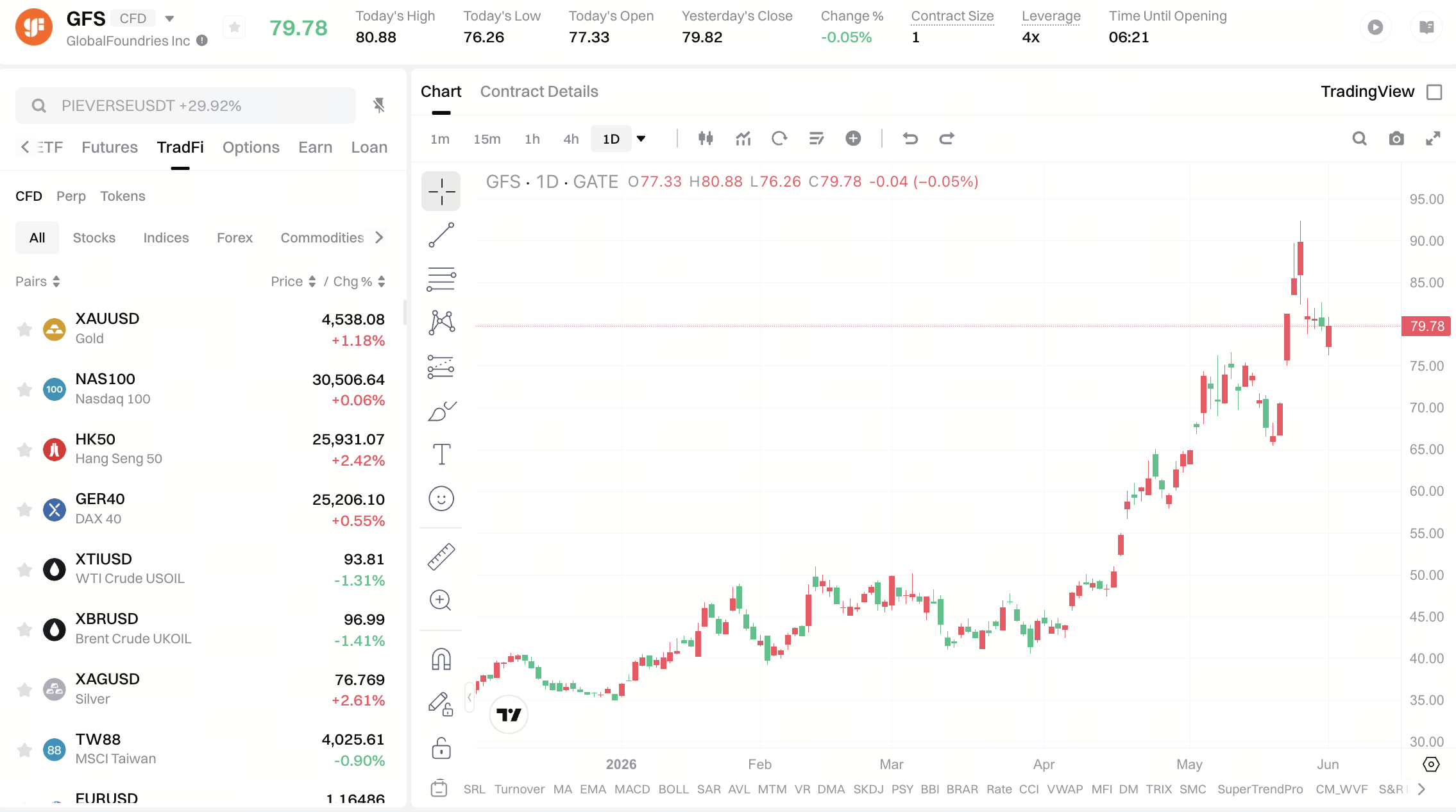
Taking Gate TradFi as an example, in addition to focusing on the digital asset market, users can also monitor stocks, ETFs, indices, and commodities within the same ecosystem. Some markets also offer Gate CFD products, enabling users to participate in price fluctuation trading of related assets through their digital asset accounts, thereby improving cross-market asset management efficiency.
Regardless of the method used to participate in the market, investors should fully understand the product structure, trading rules, liquidity conditions, and regulatory requirements of their jurisdiction.
GlobalFoundries' Advantages and Limitations
GlobalFoundries' biggest advantage comes from its differentiated market positioning. Compared with companies that need to continuously invest huge amounts of capital to compete in the advanced process market, GlobalFoundries chooses to focus on mature process and specialty process areas, thereby establishing clearer competitive barriers.
Automotive electronics, industrial controls, and communications infrastructure typically have long product lifecycles, so customers value supply stability and long-term cooperation. This market characteristic helps improve customer stickiness and enhance revenue predictability.
In addition, specialty process platforms such as RF chips, power management chips, and embedded memory also have high technical barriers, allowing GlobalFoundries to avoid direct competition with advanced process companies.
However, GlobalFoundries also faces certain challenges. Since the company does not participate in the most advanced process market, it is difficult for it to directly benefit from the growth dividends brought by high-performance AI chips and flagship smartphone chips. At the same time, competition in the mature process market remains intense, with UMC, SMIC, and other foundry companies actively expanding related capacity.
Therefore, GlobalFoundries' future development focus remains on continuously strengthening its specialty process capabilities and expanding its customer base in automotive, industrial, and communications markets to maintain its differentiated competitive advantage.
Summary
GlobalFoundries (GFS) is one of the world's leading wafer foundry companies, with its business model built on mature process and specialty process platforms. Unlike foundries focused on advanced process competition, GlobalFoundries primarily serves the automotive electronics, industrial automation, communications network, and IoT markets, building competitive advantages through stable supply capability and long-term customer cooperation. In the global semiconductor supply chain, GlobalFoundries is not only an important manufacturing node but also a key infrastructure company driving the digital development of automotive, industrial, and communications sectors.
FAQ
What company is GFS?
GFS is the stock ticker symbol for GlobalFoundries. GlobalFoundries is a world-leading wafer foundry company that primarily provides semiconductor manufacturing services to chip design companies.
What is the difference between GlobalFoundries and TSMC?
TSMC mainly focuses on the advanced process market, while GlobalFoundries focuses on mature process and specialty process areas, primarily serving the automotive, industrial, and communications markets.
Does GlobalFoundries design its own chips?
No. GlobalFoundries is a wafer foundry; its main business is manufacturing chips, not designing them.
Why does the automotive industry need GlobalFoundries' manufacturing capability?
Automotive chips typically require long-term supply and high reliability verification, so mature process platforms are more suitable for automotive industry needs than advanced processes.
Which industries does GlobalFoundries primarily serve?
GlobalFoundries primarily serves several industries including automotive electronics, industrial automation, communications networks, the Internet of Things, and consumer electronics.
What is GlobalFoundries' core competitive advantage?
GlobalFoundries' core competitive advantage comes from its mature process platforms, specialty process capabilities, and long-term stable customer cooperation relationships.