Ethereum originally operated under a PoW, or Proof of Work, mechanism, where miners competed with computing power to verify transactions and generate new blocks. As DeFi, NFTs, and on-chain applications grew rapidly, the Ethereum network gradually began facing issues such as high energy consumption, Gas Fee volatility, and limited scalability. Against this backdrop, Ethereum began moving toward a PoS, or Proof of Stake, consensus mechanism.
PoS has become an important consensus model for many mainstream blockchains today. For Ethereum, PoS is not just a technical upgrade. It is also closely tied to ETH issuance, network security, the validator economic model, and the future Layer 2 scaling roadmap.
What Is Ethereum PoS Consensus?
Ethereum PoS, or Proof of Stake, is a consensus mechanism that maintains blockchain security through ETH staking and validators. Unlike PoW, which relies on competition between mining machines, PoS uses economic incentives and staking to determine who is eligible to verify transactions and generate new blocks.
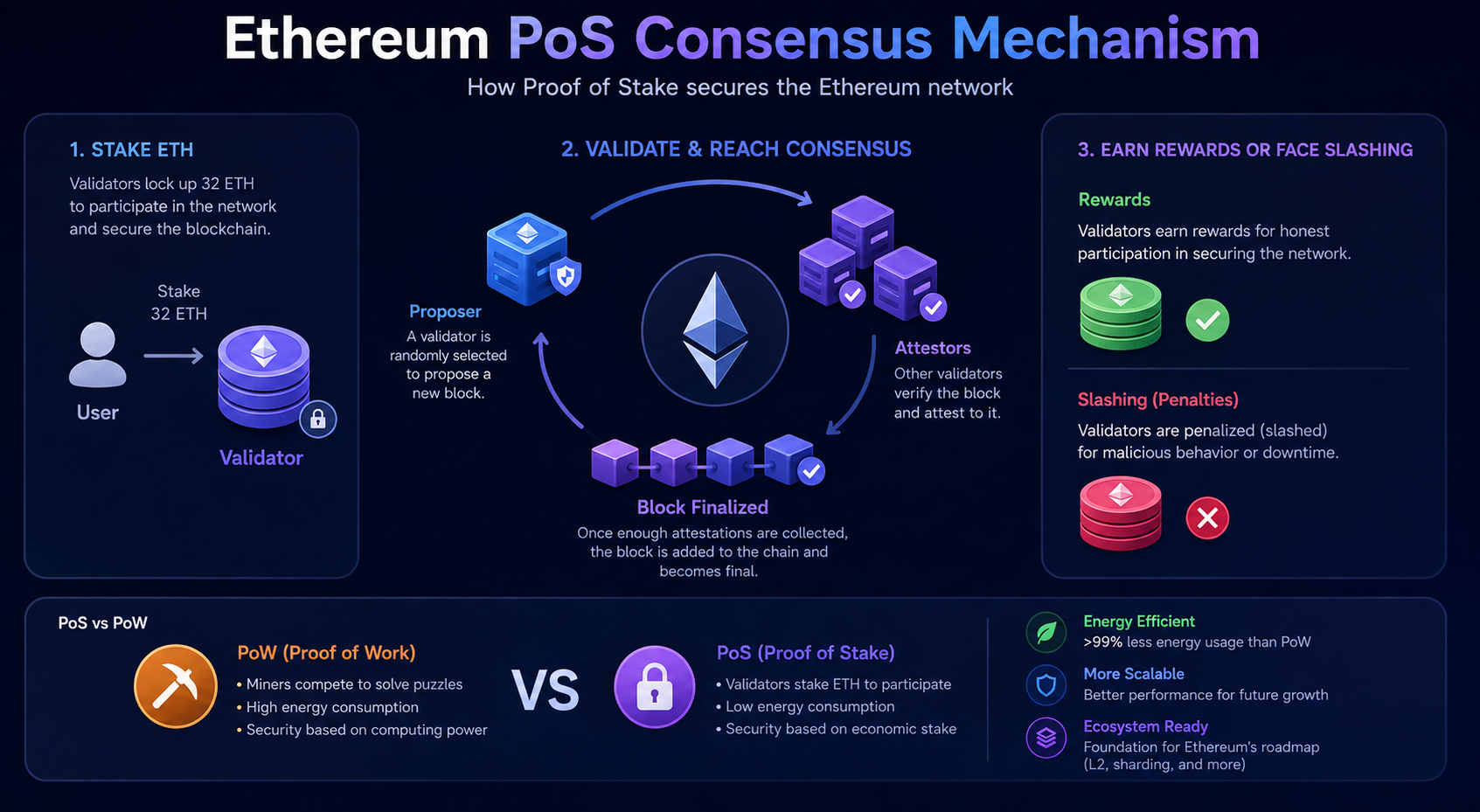
In a PoS system, validators must lock a certain amount of ETH as collateral. When the network needs to generate a new block, the system randomly selects a node from the validator set to propose the block and confirm transactions. Validators are rewarded for proper behavior, while malicious actions or prolonged offline periods may result in slashing.
One of Ethereum’s key goals in moving to PoS was to reduce the energy consumption required to operate the network. Compared with PoW, which depends on large amounts of hardware and electricity, PoS can maintain network security while greatly improving resource efficiency.
The Merge, completed in 2022, was the key milestone in Ethereum’s consensus transition. After the upgrade, the previously independent Beacon-chain merged with the Ethereum mainnet, and PoS officially became Ethereum’s main consensus layer.
How Does Ethereum PoS Work?
What Role Does the Beacon-chain Play in PoS?
The Beacon-chain is Ethereum PoS’s consensus layer. It coordinates validators, maintains network state, and confirms new blocks.
In Ethereum’s current architecture, the consensus layer and execution layer are separated. The execution layer handles smart contracts and user transactions, while the Beacon-chain is responsible for validating blocks, synchronizing validator status, and maintaining network finality.
The Beacon-chain first went live in 2020 and officially took over Ethereum’s consensus mechanism after The Merge.
How Do Validators Generate New Blocks?
In a PoS network, validators are responsible for generating new blocks and confirming transactions.
During each cycle, the system randomly selects one validator as the block proposer, responsible for packaging transactions and creating a new block. At the same time, other validators act as attestors, verifying and voting on the new block.
Only blocks that receive enough validator confirmations can be officially accepted by the network.
This mechanism avoids the continuous computing power competition seen among miners in PoW, allowing Ethereum to reach network consensus at a lower cost.
What Do Slot and Epoch Mean?
Ethereum PoS uses a fixed time structure to manage block production.
Each Slot in the network lasts about 12 seconds. In theory, one new block is produced in each Slot.
An Epoch consists of 32 Slots. Validators complete block validation and state synchronization within each Epoch.
When the network confirms after multiple Epochs that a block can no longer be reversed, that block has reached Finality. This means the transaction can no longer be easily rolled back.
What Happens After a User Sends a Transaction?
When a user sends a transaction on Ethereum, the transaction first enters the Mempool.
The block proposer then selects transactions from the pool and packages them into a new block. After the new block is broadcast, other validators verify and vote on it.
If the new block receives confirmation from the majority of validators, it is added to the blockchain and eventually reaches Finality.
Throughout this process, the PoS network confirms transactions through validator coordination, rather than relying on traditional miner based mining.
How Does ETH Staking Work?
Why Do Validators Need to Stake ETH?
ETH staking is the core foundation of PoS network security.
Validators need to lock ETH as economic collateral before they can participate in validating new blocks. If a validator attempts to attack the network or submit invalid data, its staked assets may be slashed.
This mechanism directly links the cost of attacking Ethereum to the value of ETH itself, creating an economic security model.
What Are the Requirements to Become a Validator?
At present, running an independent Ethereum validator requires staking 32 ETH.
In addition to the capital requirement, validators must also run an online node and maintain a stable long term connection to the network.
Some users also participate in ETH staking through liquid staking protocols or centralized platforms, which lowers the technical barrier to running an independent node.
Where Do ETH Staking Rewards Come From?
Validator rewards mainly come from the following sources:
-
Newly issued ETH rewards
-
Priority Fees paid by users
-
A portion of MEV, or Maximum Extractable Value, revenue
After participating in network validation, validators can earn returns based on their uptime and validation performance.
However, reward levels adjust as the overall amount of ETH staked across the network changes.
What Is Liquid Staking?
Liquid Staking is a mechanism that allows users to maintain asset liquidity while staking ETH.
After users deposit ETH into a protocol, they can receive corresponding liquid staking tokens, such as stETH. These tokens can continue to be used in DeFi applications, while the original ETH remains involved in PoS validation.
Liquid staking improves capital efficiency, but it may also introduce risks related to protocol centralization and smart contracts.
How Does PoS Keep the Ethereum Network Secure?
What Is the Slashing Mechanism?
Slashing is a mechanism used to punish malicious validators.
If a validator double signs, submits conflicting data, or attacks the network, part of its staked ETH may be forcibly deducted by the system.
In addition, validators that remain offline for long periods also face lighter penalties, encouraging nodes to stay continuously online.
PoS security comes from economic cost constraints.
To control the Ethereum network, an attacker would need to hold and stake a large amount of ETH, while malicious behavior could cause those assets to be slashed.
As ETH’s market value rises, the cost of attacking the network also increases.
This mechanism creates a direct link between network security and the economic value of ETH.
What Is Finality?
Finality refers to the point at which a transaction reaches an irreversible state on the blockchain.
In Ethereum PoS, once a block receives enough validator confirmations, its state is finalized.
Compared with some PoW networks, where chain rollback risks may persist for longer periods, PoS finality can improve transaction certainty more quickly.
Does PoS Have Centralization Risks?
Although PoS can support decentralization, validator concentration remains an important industry concern.
Large staking platforms, liquid staking protocols, and institutional nodes may hold a high proportion of staked ETH, potentially affecting network governance and the distribution of validation power.
For this reason, the Ethereum community has long paid close attention to validator distribution and protocol neutrality.
What Is the Difference Between Ethereum PoS and PoW?
What Is the Core Difference Between PoW and PoS?
PoW relies on computing power competition to maintain network security, while PoS relies on ETH staking and economic incentives.
In PoW, miners must continuously consume electricity to run mining machines. In PoS, validators obtain the right to participate in consensus by staking ETH.
How Do the Two Mechanisms Differ in Energy Consumption?
PoW networks usually require large amounts of electricity to support mining operations.
PoS no longer relies on large scale computing power competition, so energy consumption is significantly reduced.
After Ethereum transitioned to PoS, the overall energy consumption of the network dropped by more than 99%.
What Changed in ETH’s Issuance Mechanism?
After PoS went live, Ethereum’s new ETH issuance dropped significantly.
At the same time, the Base Fee burn mechanism introduced by EIP-1559 continues to reduce ETH’s circulating supply.
During certain periods, ETH may even enter a net deflationary state.
PoW vs PoS Comparison Table
| Dimension |
PoW |
PoS |
| Network Security |
Computing power competition |
ETH staking |
| Block Production |
Mining |
Validator proposal |
| Energy Consumption |
High |
Low |
| Participation Method |
Mining machines |
Staking ETH |
| Attack Cost |
Electricity and hardware |
Large amounts of ETH |
| Revenue Source |
Block rewards |
Staking rewards |
What Is the Relationship Between PoS and Layer 2 Scaling?
PoS improves Ethereum’s resource efficiency, but it does not directly solve every scalability issue.
Ethereum mainnet still has limited block space, which is why Layer 2 Rollups have become the main scaling solution today.
Layer 2 networks process large numbers of transactions off chain before submitting data to Ethereum mainnet. Ethereum PoS is then responsible for final security verification and data confirmation.
In the future, upgrade paths such as Danksharding and EIP-4844 will further strengthen the coordination between PoS and Layer 2.
Conclusion
Ethereum PoS consensus replaces the traditional PoW mining model with ETH staking and a validator network, allowing Ethereum to reduce energy consumption while establishing a new system for network security and economic incentives.
PoS has not only changed how new blocks are generated. It has also affected ETH issuance, the EIP-1559 burn mechanism, the Layer 2 scaling roadmap, and Ethereum’s long term development direction.
As the validator system, liquid staking, and scaling technologies continue to evolve, PoS has become one of the most important infrastructure foundations supporting today’s Ethereum ecosystem.
FAQs
How Much ETH Is Needed to Become an Ethereum Validator?
At present, 32 ETH must be staked to independently run an Ethereum validator node.
Why Did Ethereum Move from PoW to PoS?
The main reasons include reducing energy consumption, optimizing the economic model, and supporting future Layer 2 scaling and network upgrades.
Can Staked ETH Be Withdrawn?
Yes, but unstaking usually requires waiting for the validator exit process to complete.
Does PoS Reduce Ethereum Gas Fees?
PoS itself does not directly reduce Gas Fees. Fee optimization mainly depends on Layer 2 Rollup scaling solutions.
Is PoS More Environmentally Friendly Than PoW?
Compared with PoW, which depends on large numbers of mining machines, PoS consumes far less energy and is therefore generally considered more energy efficient.