As the artificial intelligence industry rapidly expands, high-performance computing resources like GPUs have become the backbone of AI model training and inference. However, building GPU clusters requires substantial upfront capital, and traditional financing methods are often slow and expensive, making it difficult to keep pace with the accelerating demand for AI infrastructure. This has made integrating GPU assets into on-chain financing systems a pivotal direction for the convergence of AI and DeFi.
USD.AI was created in response to this challenge, introducing a GPU-collateralized lending model. By converting AI computing assets into on-chain collateral, USD.AI provides financing solutions for AI infrastructure operators and channels loan returns directly into the DeFi ecosystem. This mechanism not only diversifies the sources of return for stablecoin protocols but also gives AI infrastructure assets, for the first time, credit-like financial properties—ushering in a new model for capital efficiency in the AI compute marketplace.
What Is the Core Operating Mechanism of USD.AI?
USD.AI’s core mechanism leverages AI compute hardware, such as GPUs, as collateral assets to provide loan financing for AI infrastructure operators, distributing returns to on-chain users via a stablecoin structure.
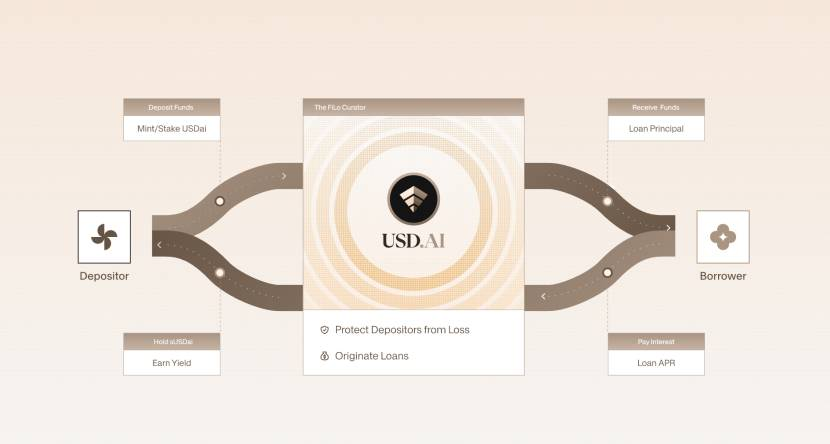
Within this system, when users deposit USDC or other stable assets, the protocol mints USDai as a stable circulating asset for use within the system. Simultaneously, the protocol allocates these funds to support GPU-collateralized lending, distributing the resulting loan interest to the yield-layer asset, sUSDai.
This process transforms stablecoins from a simple payment medium into a bridge connecting AI infrastructure financing with the on-chain yield market.
Why Can GPUs Serve as Collateral Assets?
GPUs are capable of generating sustained cash flow, which is the key reason they can serve as collateral assets.
AI companies require significant GPU resources for model training and inference, giving GPUs both substantial leasing value and financing value. For operators, GPUs are more than just hardware—they are productive assets capable of generating continuous revenue.
USD.AI brings this real-world cash flow on-chain, making GPUs analogous to income-generating assets in traditional finance and supporting a robust loan and return distribution mechanism.
What Roles Do USDai and sUSDai Play in the Lending Mechanism?
In the USD.AI architecture, USDai and sUSDai serve as the liquidity layer and yield layer, respectively.

USDai, as a stable asset, is primarily used for system-wide circulation and value anchoring, functioning as the medium of funds. sUSDai, in contrast, is designed to capture returns generated by underlying GPU-collateralized loans, with its value growth driven by the allocation of loan interest.
This dual-layer structure separates "stable value" from "yield generation," enabling the protocol to maintain stablecoin characteristics while offering users opportunities to earn returns.
How Does USD.AI Generate Returns Through GPU Lending?
The protocol’s returns are primarily derived from GPU-collateralized loan interest.
When AI infrastructure operators secure funding through GPU collateral, they pay financing costs as agreed, and this interest forms the main source of return for USD.AI. After deducting risk reserves and fees, the protocol distributes these returns to sUSDai holders.
Unlike traditional lending protocols, this model’s returns are driven not by on-chain leverage demand, but by real-world AI compute financing needs—making it more closely aligned with real-world asset yield structures.
What Are the Advantages of the GPU-Collateralized Lending Model?
The greatest advantage of the GPU-collateralized lending model is enhanced capital efficiency for AI infrastructure.
Traditional GPU deployment often relies on equity financing or long-term debt, whereas USD.AI offers a more flexible on-chain financing option, allowing operators to quickly access liquidity by pledging GPUs as collateral. At the same time, on-chain users can participate in the yield layer to earn cash flow returns from the AI infrastructure marketplace.
This model links AI infrastructure demand with DeFi capital supply, creating higher capital efficiency for both sides.
What Are the Risks of USD.AI’s GPU Lending Model?
While the GPU-collateralized lending model is innovative, it also carries several risks.
First, GPU assets are subject to depreciation risk, as hardware upgrades can rapidly erode their value. Second, fluctuations in AI compute demand may impact operators’ revenue and thus their ability to repay loans. Additionally, the valuation and liquidation of GPU collateral assets can be complex, increasing protocol risk during periods of high market volatility.
As a result, while GPU-collateralized lending improves capital efficiency, it also demands more comprehensive risk management mechanisms within the protocol.
Summary
At its core, USD.AI’s GPU-collateralized lending mechanism financializes AI compute assets. By combining a stablecoin layer with a yield layer, it brings real-world AI infrastructure financing returns into the DeFi marketplace. This model not only offers AI infrastructure operators new avenues for capital but also creates new sources of return for on-chain users. As demand for AI compute continues to surge, this “creditization of compute assets” may become a cornerstone of AI financial infrastructure.
FAQs
What is USD.AI’s GPU-collateralized lending mechanism?
It is a system that uses GPUs as collateral assets to provide loan financing for AI infrastructure operators, with loan returns distributed to on-chain users.
Where do USD.AI’s returns come from?
Primarily from GPU-collateralized loan interest, which represents the financing costs paid by AI infrastructure operators.
Why can GPUs be used as loan collateral?
Because GPUs can continuously generate leasing income and hashrate returns, they have robust cash flow support.
What is the difference between USDai and sUSDai?
USDai is a stable circulating asset, while sUSDai is a yield asset that captures returns generated from GPU loans.
What are the main risks of GPU-collateralized lending?
The main risks include GPU depreciation, volatility in AI compute demand, and the liquidation risk of collateral assets.







