Historically, most investors purchased real stocks and ETFs directly through traditional brokerages. But with crypto platforms expanding their TradFi offerings and global demand for US equities surging, more users are now turning to Stock CFDs, ETF CFDs, and on-chain asset structures.
Meanwhile, the rise of stablecoins and RWAs (Real World Assets) is reshaping how global assets are traded. Today, investors can not only buy Apple, NVIDIA, or S&P 500 ETFs through traditional brokerages, but also trade these assets using USDT on crypto platforms.
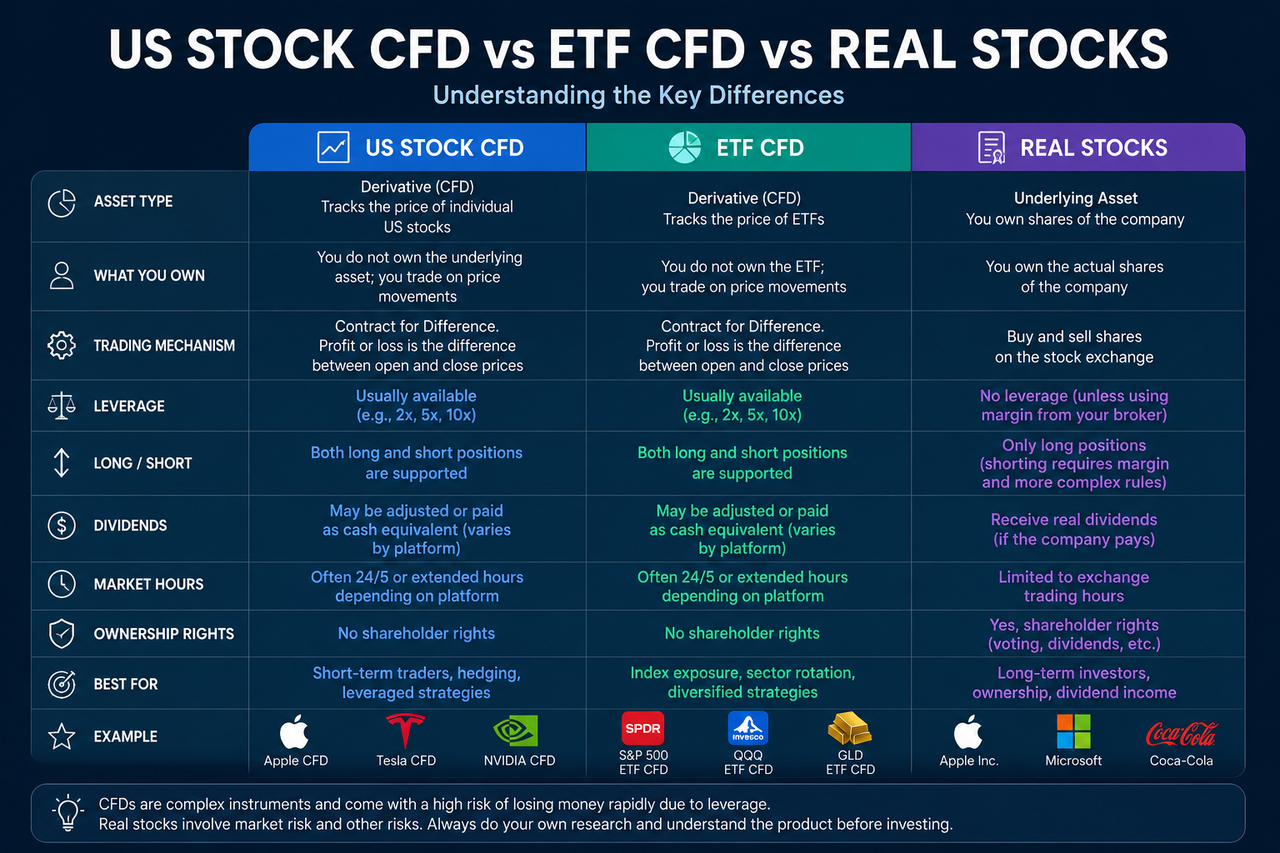
What Are Real Stocks?
Real stocks represent partial ownership in a listed company. For instance, buying Apple or Microsoft shares through a brokerage means you hold actual equity in those companies.
Key characteristics of real stocks:
- Shareholder rights
- Potential dividends
- Voting rights (in some markets)
- Suited for long-term holding
- Traded via traditional securities accounts
For long-term investors, real stocks serve as a classic asset allocation vehicle.
However, trading real stocks typically involves brokerage accounts, bank settlement, and exchange trading hours, which can create a higher barrier to cross-border investing.
What Are US Stock CFDs?
US Stock CFDs (Contracts for Difference) are derivatives that let you trade stock price movements without owning the underlying shares.
For example, you can trade CFDs on:
- Apple (AAPL)
- NVIDIA (NVDA)
- Tesla (TSLA)
- Amazon (AMZN)
In a CFD setup, you and the platform settle the price difference—not the stock itself. So stock CFDs are about price speculation, not equity ownership.
Because CFDs often support leverage and short selling, they appeal to short- to medium-term traders.
What Are ETF CFDs?
ETF CFDs work like stock CFDs, but the underlying assets are ETFs (Exchange-Traded Funds) instead of single stocks.
Examples of ETF CFDs:
- S&P 500 ETF
- Nasdaq ETF
- Gold ETF
- Energy ETF
The core idea is the same: trade price movements, not actual ETF shares.
Since ETFs are inherently diversified, ETF CFDs are commonly used for index trading and gaining macro market exposure.
What Are the Biggest Differences Between US Stock CFDs, ETF CFDs, and Real Stocks?
The key difference is asset ownership.
Real stocks give you actual ownership of a security, while CFDs are price derivatives.
This distinction affects:
- Shareholder rights
- Voting rights
- Dividend structure
- Leverage mechanics
- Risk profile
- Trading approach
Essentially, real stocks are about long-term ownership; CFDs are short-term price trading tools.
How Do ETF CFDs Differ From Stock CFDs?
Both are CFDs, but their different underlying assets lead to different use cases.
Stock CFDs track a single company’s price, so volatility is more concentrated. For example, NVIDIA or Tesla prices can swing on earnings, AI news, or sector developments.
ETF CFDs follow an index or portfolio. For instance, S&P 500 ETFs reflect the broader market, so volatility tends to be more diversified.
In short:
- Stock CFDs: focused on individual stocks
- ETF CFDs: aimed at broader market allocation
That’s why many traders use ETF CFDs for macro-level market exposure.
How Do Risks Differ Among US Stock CFDs, ETF CFDs, and Real Stocks?
Real stocks, stock CFDs, and ETF CFDs each have distinct risk structures.
Real stocks carry company-specific and market risks, but typically no forced leverage.
CFDs are different. Because many CFDs support leverage, market moves can amplify both gains and losses. Also, CFDs don’t represent actual ownership, so you miss out on traditional securities benefits.
ETF CFDs offer some diversification, but their leverage can still magnify risk.
So before trading, understanding the product structure is more critical than just watching prices.
Summary
US stock CFDs, ETF CFDs, and real stocks all provide exposure to US capital markets, but they differ fundamentally in ownership, trading mechanics, and risk.
Real stocks suit long-term holding and equity investment; stock CFDs emphasize price trading and leverage; ETF CFDs are ideal for index and macro market allocation.
FAQs
Are stock CFDs the same as real stocks?
No. Stock CFDs are price derivatives—you trade price fluctuations, not actual shares.
What's the difference between ETF CFDs and ETFs?
ETF CFDs are contracts for difference on ETF prices—they don't represent ownership in the ETF.
Why do crypto platforms offer CFDs more often?
Because CFDs integrate easily with existing crypto derivatives systems, and support stablecoin margin and leveraged trading.
Can I receive dividends with CFDs?
Some CFD products may offer price adjustments or simulated dividends, but these are not equivalent to real stock dividends.
Are real stocks definitely safer than CFDs?
Their risk profiles differ. Real stocks lack leverage risk, while CFDs—with leverage—carry higher volatility risk.
Why are ETF CFDs better for index trading?
Because ETFs represent a basket of assets, ETF CFDs are ideal for trading overall markets or industry trends.