As AI Agent evolves from a chat tool into a digital entity with autonomous capabilities, the AI infrastructure landscape is branching into distinct development pathways. Some projects focus on hashrate and models, while others target long-term collaboration and economic systems for agents.
Unibase and Virtuals represent two typical paths within AI Agent infrastructure: a decentralized Memory Layer and an AI Agent Marketplace.
Unibase vs. Virtuals: A Quick Overview
Unibase leans more toward the foundational infrastructure for AI Agents, with its core focus on long-term memory, state synchronization, and multi-agent collaboration.
In its architecture, Membase stores an agent’s long-term context and knowledge state. The AIP Protocol manages agent identity and communication, while Unibase DA provides data storage and state availability. This means Unibase prioritizes enabling AI to persist over time, continuously learn, and coordinate with other agents—rather than simply making agents easier to launch.
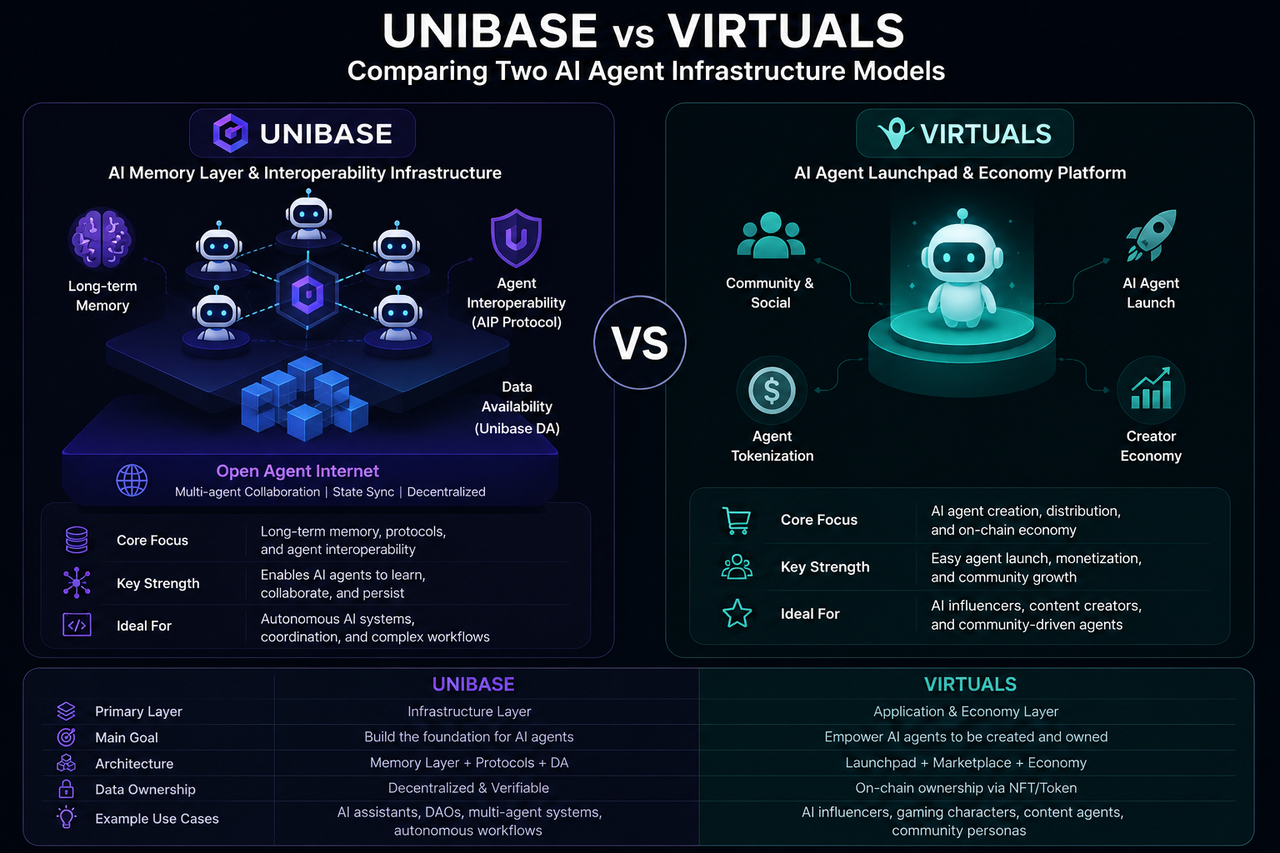
Virtuals, by contrast, revolves around AI Persona, social interaction, and an Agent Marketplace. Within its ecosystem, users create AI Agents and build communities, content, and on-chain economies around them. Some agents even carry their own tokens, social identities, and content operations.
AI Memory Layer vs. Agent Marketplace: Key Differences
One fundamental difference between Unibase and Virtuals lies in the layer of the AI infrastructure they occupy.
Unibase sits closer to the infrastructure layer, addressing the question: How can AI Agents run and collaborate long-term? Virtuals is more application- and marketplace-oriented, asking: How can AI Agents be created, operated, and distributed?
This distinction means that while both projects revolve around AI Agents, they solve different problems.
| Comparison |
Unibase |
Virtuals |
| Core Position |
AI Memory Layer |
AI Agent Marketplace |
| Main Focus |
Long-term memory & interoperability |
Agent launch & operations |
| Core Goal |
Long-term AI autonomy |
Agent monetization |
| Network Structure |
Open Agent Internet |
AI social ecosystem |
| Product Focus |
Infrastructure |
Applications & marketplace |
Long-Term Memory Mechanisms: How Do They Differ?
Long-term memory is a core capability for Unibase, while Virtuals does not primarily focus on it.
Unibase’s Membase allows AI Agents to retain task history, user preferences, and extended context. This enables agents to draw on past experience and accumulate state over time.
In contrast, Virtuals emphasizes AI persona and user interaction. Although some agents may have limited memory, a dedicated long-term memory layer is not part of its core infrastructure.
This distinction reflects a deeper conceptual difference: Unibase cares about whether AI can continuously grow, while Virtuals cares about whether AI can continuously operate.
| Memory Capability |
Unibase |
Virtuals |
| Long-term context |
Core feature |
Non-core |
| Multi-agent memory sharing |
Supported |
Limited |
| State synchronization |
Emphasized |
Primarily application-layer |
| Decentralized memory |
Core architecture |
Non-focus |
| Long-term learning |
Emphasized |
More social interaction |
Agent Communication & Collaboration: Structural Differences
Unibase’s AIP Protocol is built for Agent-to-Agent communication. In its design, different AI Agents can share state, sync memory, and exchange tasks—resembling an “AI network” focused on coordinating multiple autonomous agents.
Virtuals, on the other hand, emphasizes agent-user interactions: content generation, social distribution, and community management. Its focus is on the operational capability of an AI persona, not multi-agent collaboration.
Thus the network structures differ significantly: Unibase advocates an open agent protocol, while Virtuals builds an AI social ecosystem.
Economic Models: How Do They Compare?
Virtuals puts a strong emphasis on agent monetization and marketplace operations. In some designs, AI Agents can own communities, content ecosystems, and token structures—resembling an AI creator economy that lends itself to social virality.
By comparison, Unibase’s UB token supports protocol operations such as data storage, network governance, node incentives, and agent infrastructure coordination.
These economic differences mirror their product focus.
| Economic Model |
Unibase |
Virtuals |
| Primary Use |
Protocol operations |
Agent economic ecosystem |
| Product Focus |
Infrastructure governance |
Social & marketplace |
| Agent Tokenization |
Non-core |
Emphasized |
| Node Incentives |
Present |
Relatively few |
| Creator Economy |
Limited |
Core direction |
Application Scenarios: Where Each Excels
Unibase is better suited for use cases requiring long-term memory and multi-agent collaboration, such as autonomous AI assistants, AI workflow coordination, AI DAOs, and long-running state management—applications where agents must retain context and share state with others.
Virtuals is more appropriate for consumer-facing agent operations: AI social characters, AI content creators, and on-chain AI communities.
At the application level, Unibase functions as “AI network infrastructure,” while Virtuals acts as an “AI agent content and marketplace platform.”
The AI Agent Ecosystem: A Layered View
The AI crypto sector is still nascent, and many projects share the “AI Agent” narrative, which can lead to confusion. However, as AI infrastructure stratifies, differences between projects become clearer.
The AI Agent ecosystem can be roughly categorized as follows:
| AI Infrastructure Type |
Representative Direction |
| AI Compute |
Decentralized Hashrate |
| AI Data |
Data marketplace |
| AI Agent Framework |
Agent development framework |
| AI Memory Layer |
Long-term memory system |
| AI Agent Marketplace |
Agent launch & operations |
Unibase and Virtuals represent two distinct routes: AI Memory Layer and Agent Marketplace. As the AI Agent ecosystem expands, this layering is likely to become even more pronounced.
Summary
Both Unibase and Virtuals are important parts of the AI Agent ecosystem, but their core positions differ. Unibase focuses on long-term memory, state synchronization, and open protocols, aiming to build infrastructure for autonomous AI that grows over time. Virtuals, on the other hand, emphasizes agent issuance, social distribution, and economic operations, targeting the consumer side of AI Agents.
From an AI infrastructure perspective, they represent two divergent paths: a “Long-Term Memory Layer” and an “Agent Marketplace.”
FAQs
What is the biggest difference between Unibase and Virtuals?
Unibase focuses on long-term memory and interoperability infrastructure for AI Agents, while Virtuals focuses on agent issuance, social interaction, and monetization.
Is Unibase considered AI infrastructure?
Yes. Unibase operates as an AI Memory Layer and agent communication infrastructure.
What is Virtuals’ core direction?
Virtuals emphasizes an AI Agent Marketplace, AI personas, and an agent economy.
What is the AI Memory Layer?
It’s the infrastructure that provides AI Agents with long-term context and state management.
Does Unibase support multi-agent collaboration?
Yes. Its AIP Protocol enables agent-to-agent communication and state synchronization.
Are Virtuals and Unibase competitors?
They have some overlap, but are better understood as different layers and development directions within the broader AI Agent ecosystem.







