As crypto markets became more active and volatile, many traders began relying on indicators that respond faster to sudden price swings. Standard RSI remains widely used, but it can lag when momentum changes quickly. That is where Stochastic RSI Fast becomes useful.
Rather than measuring price strength directly, it measures the behavior of RSI itself. This extra layer makes it more reactive, which is why it is often used by traders watching intraday moves, breakouts, and short-lived momentum shifts. At the same time, its speed can create false signals when the market lacks direction.
What Stochastic RSI Fast Is
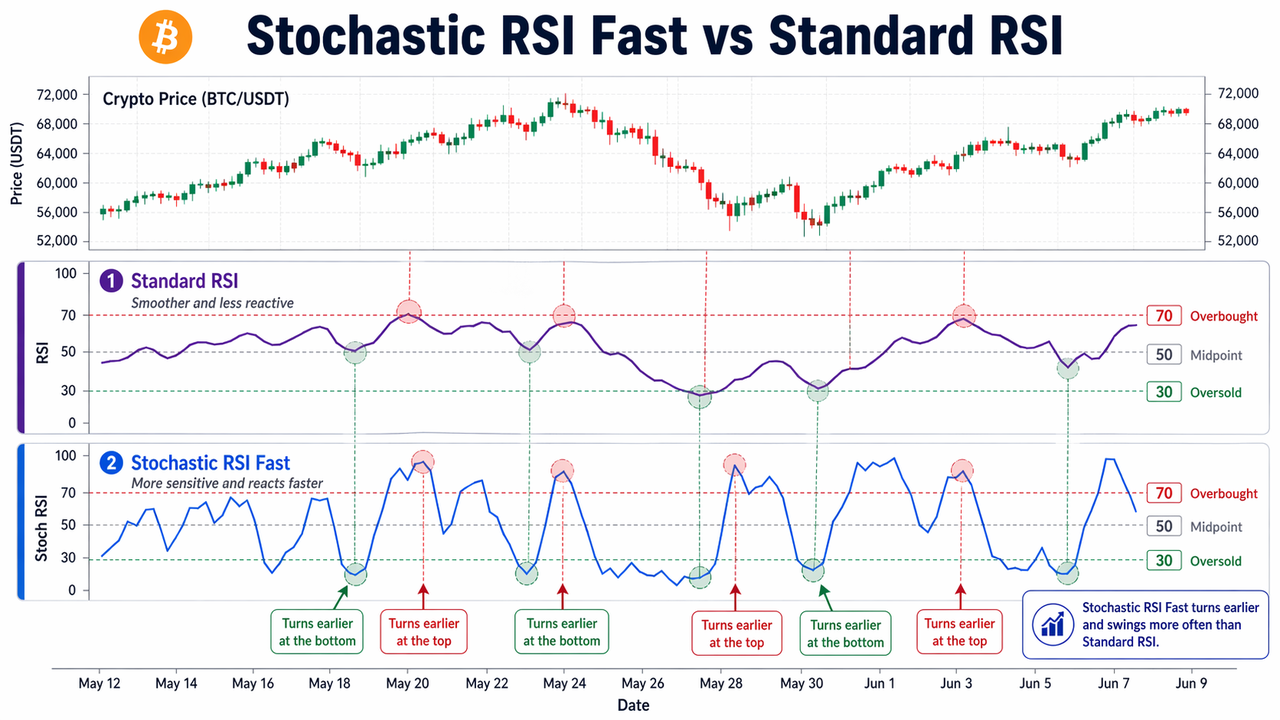
Stochastic RSI Fast measures where the current RSI sits within its recent range as a short-term momentum oscillator, which makes it more sensitive than standard RSI to recent market changes.
It belongs to the family of oscillators, which are indicators that move within a bounded scale and help traders judge momentum conditions such as overbought and oversold areas. While standard RSI tracks the speed and size of recent price changes, Stochastic RSI Fast tracks the position of RSI within its own recent range.
That distinction is important. Standard RSI asks whether price has recently moved up or down strongly. Stochastic RSI Fast asks whether RSI itself is currently elevated or depressed compared with its recent behavior. Because of that, it tends to swing more often and reach extremes more quickly.
In practical chart reading, traders usually use it to identify short-term momentum surges, possible exhaustion points, and early reversals. It is especially popular in crypto because digital asset markets often move sharply over short periods, creating conditions where a faster oscillator can be useful.
How It Is Derived From RSI
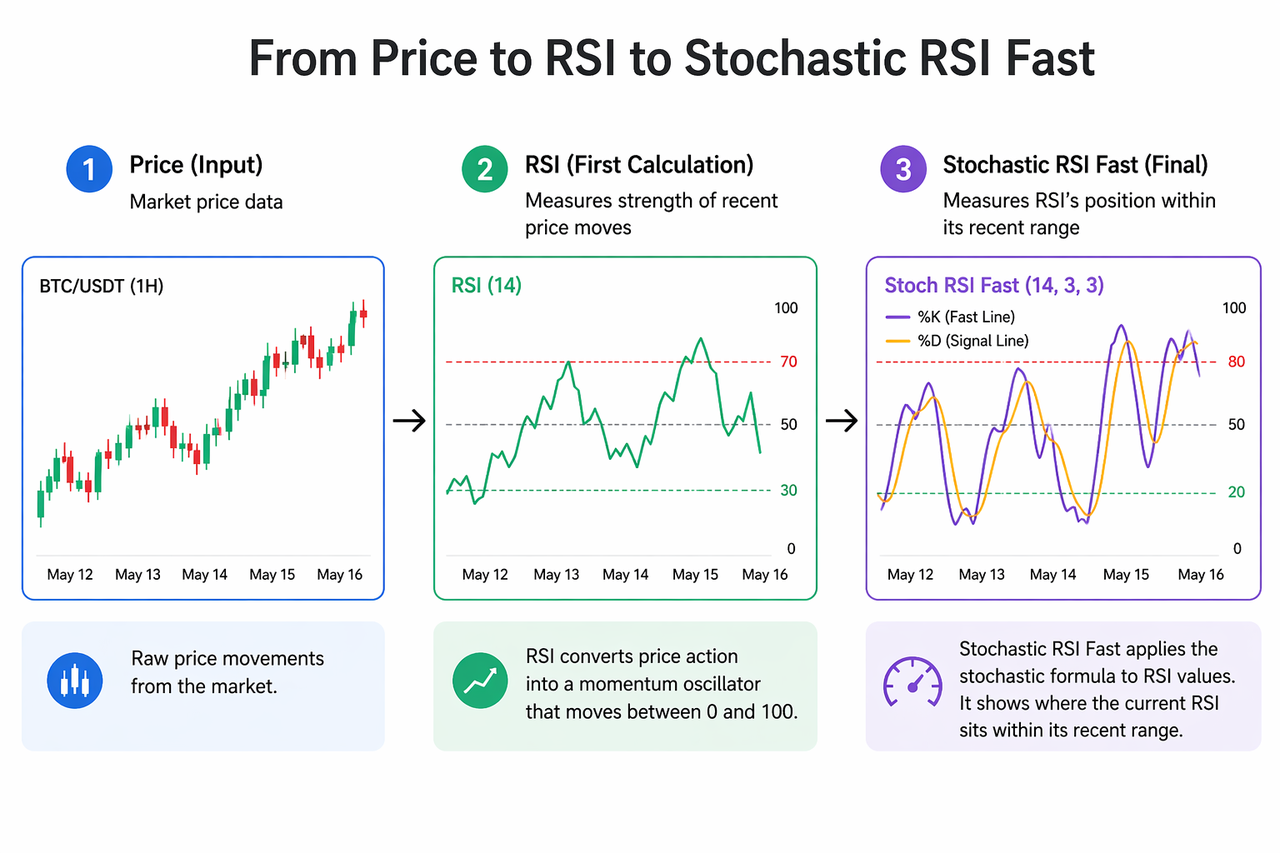
Stochastic RSI Fast is built from RSI, not from raw price.
The process is simple in concept. First, RSI is calculated over a chosen period. Then the current RSI value is compared with the highest and lowest RSI readings over another recent window. This creates a normalized momentum reading that usually moves between 0 and 1, or 0 and 100 depending on the charting platform.
That means Stochastic RSI Fast is a second-order indicator. Price data is used to calculate RSI, and RSI is then used to calculate Stochastic RSI. This is why the indicator often appears more active than standard RSI.
A simple way to think about the relationship is shown below.
| Indicator |
What it measures |
Input source |
Typical behavior |
| RSI |
Strength of recent price movement |
Price |
Smoother, less reactive |
| Stochastic RSI Fast |
Position of RSI within its recent range |
RSI |
Faster, more sensitive, more frequent swings |
Because it is derived from RSI, Stochastic RSI Fast does not replace RSI. Instead, it provides a more responsive view of short-term momentum conditions. Many traders use both together: RSI for broader momentum structure and Stochastic RSI Fast for timing and signal refinement.
Why It Is More Sensitive Than Standard RSI
Stochastic RSI Fast is more sensitive than standard RSI because it magnifies small changes in RSI.
When RSI begins to turn, even slightly, Stochastic RSI Fast can move sharply if that turn shifts RSI closer to one edge of its recent range. This makes the indicator respond earlier to momentum changes that standard RSI may still show only gradually.
That higher sensitivity has clear advantages. In a fast market, early momentum information can help traders notice a possible breakout, a fading move, or a short-term reversal before standard RSI fully reflects the shift. In crypto, where price often moves quickly between sessions and around news, that responsiveness can be attractive.
However, sensitivity also creates noise. In sideways or choppy markets, the indicator can jump from one extreme to the other without leading to a meaningful trend move. That is why faster does not always mean better. It means earlier, but sometimes less reliable.
For beginners, the main point is this: Stochastic RSI Fast is designed to react quickly, not to confirm long-term trend strength. It is better viewed as a short-term momentum lens than a full market judgment.
Reading Short-Term Momentum Signals
Traders usually read Stochastic RSI Fast through its movement into extreme zones and through turns in direction.
Common interpretations include:
-
Overbought zone: When the indicator moves high in its range, it may suggest momentum has become stretched upward in the short term.
-
Oversold zone: When it moves low in its range, it may suggest short-term downside momentum is stretched.
-
Crossovers: Some traders watch for the faster line crossing above or below a signal line to identify momentum shifts.
-
Centerline behavior: Movement back toward the middle can show momentum is normalizing after an extreme reading.
-
Divergence with price: If price makes a new high or low while the indicator weakens, momentum may be losing force.
These signals should not be read in isolation. An overbought reading does not always mean price will fall, and an oversold reading does not always mean price will rise. In strong trends, the indicator can remain extreme for longer than beginners expect.
A more practical approach is to combine the reading with trend and volume context. For example, an oversold signal during a strong uptrend may be more useful as a pullback clue than as a full reversal call. Likewise, an overbought signal in a downtrend may simply reflect a temporary bounce rather than the start of a larger recovery.
When It Works Best in Crypto Markets
Stochastic RSI Fast tends to work best when crypto markets are moving with clear short-term momentum.
It is often most useful in active environments such as intraday trends, breakout attempts, trend pullbacks, and strong reaction moves after important market events. In these settings, traders want an indicator that can react quickly enough to capture short-term changes in market pressure.
It can also be useful on lower time frames where standard RSI may appear too slow for very short-term execution decisions. Scalpers and active swing traders often prefer faster oscillators because the market structure they follow changes quickly.
Even so, the indicator performs best when it is aligned with broader context. It tends to be more informative when used alongside:
-
market trend direction
-
support and resistance zones
-
volume expansion or contraction
-
candle structure and volatility behavior
In crypto, this matters because price can move sharply for reasons that a single oscillator cannot explain. Liquidity shifts, sudden news, and leveraged positioning can all distort momentum readings. Stochastic RSI Fast can highlight a developing move, but context determines whether that move has meaningful follow-through.
Limitations of Stochastic RSI Fast
Stochastic RSI Fast is useful, but it has clear limitations.
The first is signal noise. Because it reacts quickly, it can produce repeated overbought and oversold readings during sideways conditions. This may lead traders to enter too early or trade too often.
The second is false reversal risk. A sharp turn in the indicator can look important, yet price may continue in the same direction if the broader trend is strong. In other words, momentum can pause without fully reversing.
The third is dependence on context. The indicator does not measure volume, market structure, liquidity, or external catalysts. It only reflects momentum behavior through RSI. That makes it informative, but incomplete.
The fourth is overconfidence from speed. Beginners sometimes assume a faster signal is more accurate. In practice, it is simply more responsive. The trade-off for responsiveness is a greater chance of misleading short-term swings.
For these reasons, Stochastic RSI Fast is better used as a timing aid rather than a standalone trading system. It can help frame short-term momentum, but it works best when combined with other evidence on the chart.
Conclusion
Stochastic RSI Fast is a short-term momentum oscillator built from RSI, designed to show where current RSI stands within its recent range. Its main strength is speed. Compared with standard RSI, it reacts faster to recent market changes and can highlight short-term momentum shifts earlier.
That speed makes it especially relevant in crypto, where price can accelerate quickly and traders often look for early signals. At the same time, the indicator is more prone to noise, especially in choppy conditions where momentum swings do not lead to lasting moves.
A useful way to understand Stochastic RSI Fast is to see it as a refinement tool. It does not replace trend analysis, volume study, or support and resistance. Instead, it adds a sharper view of short-term momentum behavior. Used carefully, it can help traders read timing more clearly. Used alone, it can create confusion.
FAQs
Is Stochastic RSI Fast the same as RSI?
No. RSI measures the strength of recent price movement, while Stochastic RSI Fast measures where RSI sits within its recent range. That makes Stochastic RSI Fast more reactive and often more volatile on a chart.
Why does Stochastic RSI Fast move more sharply than RSI?
It reacts to changes in RSI rather than directly to price. Because it tracks RSI relative to its recent highs and lows, even small changes can create larger swings in the indicator.
Does an overbought reading mean price will fall?
Not necessarily. In strong trends, overbought conditions can persist while price continues moving higher. The reading shows stretched short-term momentum, not an automatic reversal.
Is Stochastic RSI Fast useful for beginners?
Yes, but only if it is used with context. It can be easier to spot quick momentum shifts with this indicator, but beginners should avoid treating every signal as a trade on its own.
When is it less reliable?
It is often less reliable in sideways, low-conviction, or highly choppy markets. In those conditions, the indicator may swing frequently without producing a meaningful directional move.