As generative AI and AI Agents develop rapidly, more Web3 projects are beginning to explore decentralized AI infrastructure. Sahara AI and Bittensor are two of the most discussed AI blockchain projects today. Because both combine AI with blockchain, they are often compared with each other.
Although Sahara AI and Bittensor are both decentralized AI networks, their core goals, technical architectures, and ecosystem directions are not the same. Sahara AI focuses more on collaboration among AI data, models, and Agents, as well as revenue attribution. Bittensor is more concerned with competition in AI inference capabilities and incentives for high quality model outputs. From AI asset management to network incentive logic, the two projects actually represent different paths for AI infrastructure.
A Brief Introduction of Sahara AI and Bittensor, and a Comparison of Their Core Differences
As an AI native Layer1 blockchain platform, Sahara AI is mainly used for collaboration, authorization, and revenue distribution involving AI data, models, Agents, and AI services. Its core goal is to build an open AI collaboration economy, allowing AI data contributors, model developers, and AI service providers to earn transparent revenue through on-chain mechanisms.
The Sahara AI platform ecosystem centers on AI Marketplace, the Attribution System, and the AI Agent Economy, with stronger emphasis on AI asset ownership and transparency around AI data sources.
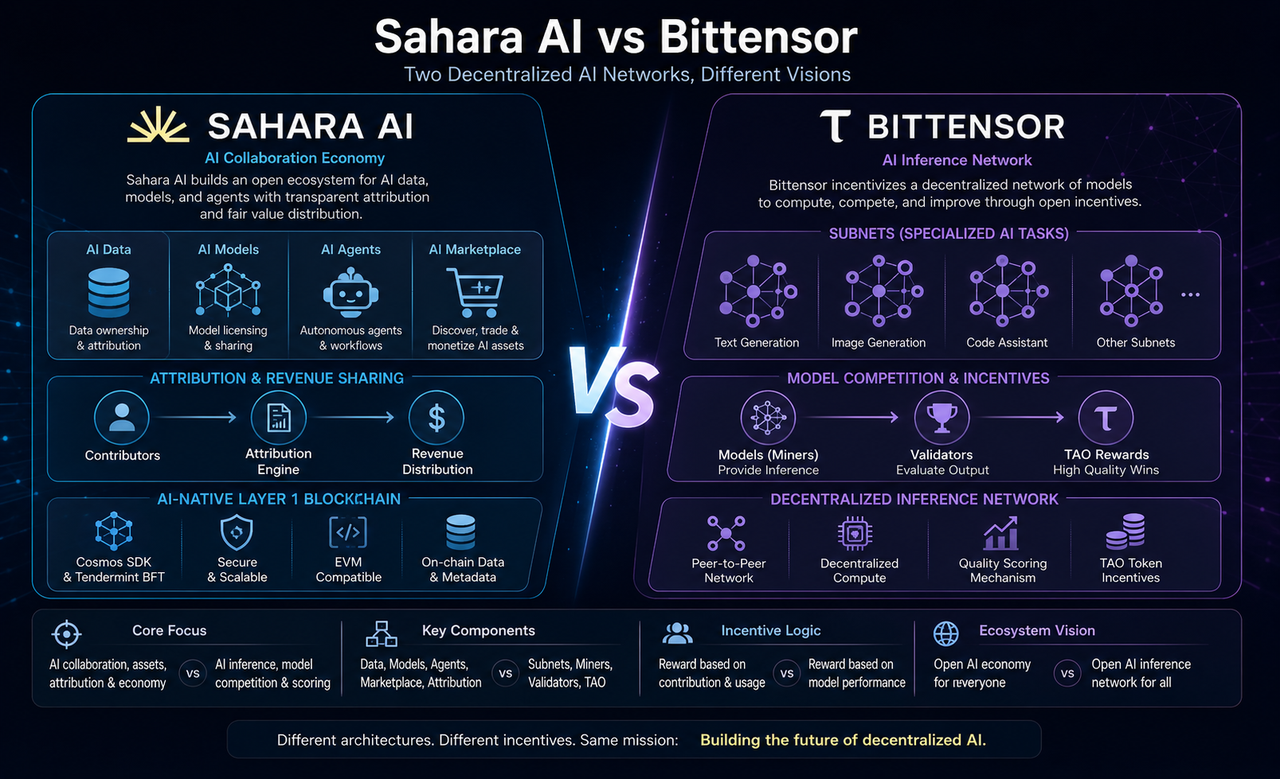
Bittensor, as a decentralized AI inference network, mainly aims to build an open AI model network through economic incentives. In the Bittensor network, different models participate in AI inference competition through Subnets, and the system distributes TAO rewards based on the quality of model outputs.
| Comparison Dimension |
Sahara AI |
Bittensor |
| Core Positioning |
AI collaboration economy |
AI inference network |
| Network Type |
AI Layer1 |
AI subnet protocol |
| Core Focus |
Collaboration among data, models, and Agents |
Competition in model outputs |
| Incentive Logic |
Revenue attribution and collaboration |
Rewards based on model quality |
| AI Marketplace |
Supported |
Not a core focus |
| Attribution System |
Core function |
Not a main focus |
| AI Agent Economy |
Supported |
Relatively weaker |
| Data Ownership |
Emphasized |
Less involved |
| Ecosystem Direction |
AI asset management |
AI model network |
For this reason, Bittensor is closer to an AI inference and model competition network than an AI data collaboration platform.
What Is the Main Difference Between Sahara AI and Bittensor’s Core Positioning?
The biggest difference between Sahara AI and Bittensor lies in how they understand “decentralized AI.”
Sahara AI focuses more on AI data sources, model authorization, revenue attribution, and Agent collaboration, with the goal of building a complete AI collaboration economy.
Bittensor, on the other hand, places greater emphasis on competition among AI model capabilities, using open Subnets and incentive mechanisms to improve the quality of AI outputs.
Simply put, Sahara AI is more like AI collaboration infrastructure, while Bittensor is more like an AI inference incentive network.
How Do Sahara AI and Bittensor Differ in Technical Architecture?
Sahara AI uses an AI native Layer1 architecture, built on Cosmos SDK and Tendermint BFT, while also supporting EVM compatibility. Its key features include on-chain ownership verification, off-chain AI execution, and an AI Marketplace collaboration system. Because AI inference and training require substantial computing power, Sahara AI uses a model of “on-chain management plus off-chain execution.”
By comparison, Bittensor focuses more on an AI inference network structure, operating mainly around Subnets, model nodes, and the TAO incentive system.
So from the perspective of underlying structure, Sahara AI leans toward an AI collaboration Layer1, while Bittensor leans more toward an AI inference protocol network.
How Do Sahara AI and Bittensor Differ in Their Incentive Mechanisms?
Incentive design is one of the areas where the two projects differ the most.
Sahara AI’s incentive logic mainly revolves around contributions to AI assets. For example, data contributors can earn revenue, model developers can earn licensing income, and Agent service providers can receive usage fees.
At its core, this is “revenue distribution for AI collaboration.”
Bittensor’s incentive mechanism, by contrast, is closer to an AI model competition system. Model nodes submit AI outputs, the network evaluates them based on output quality, and higher quality models can receive more TAO rewards.
Therefore, Bittensor places greater emphasis on model performance competition, while Sahara AI focuses more on the collaborative economy around AI data and models.
How Do Sahara AI and Bittensor Differ in AI Data and Model Management?
Sahara AI places more importance on tracking the sources of AI data and models.
Through its Attribution and Provenance systems, the platform records data sources, model contribution relationships, authorization rules, and revenue flows. This structure is better suited to AI data collaboration and AI assetization scenarios.
Bittensor, however, does not make data ownership its central goal. Its focus is on model inference capabilities and the expansion of model networks.
As a result, Sahara AI emphasizes AI data asset management, while Bittensor emphasizes competition in AI model capabilities.
How Do Sahara AI and Bittensor Differ in AI Agents and Ecosystem Direction?
AI Agents are an important part of the Sahara AI ecosystem.
Sahara AI aims to build an Agent Economy, allowing AI Agents to call models, use data, execute AI workflows, and earn on-chain revenue. Its goal is to create a collaborative network for AI services.
By comparison, Bittensor focuses more on the AI model network itself, rather than an Agent collaboration economy.
Therefore, Sahara AI leans more toward AI application collaboration, while Bittensor leans more toward the expansion of AI model networks.
How Do Sahara AI and Bittensor Differ in Application Scenarios?
Sahara AI is better suited to scenarios such as AI data collaboration, AI Marketplace operations, AI revenue attribution, and enterprise AI collaboration.
Because its core lies in AI asset management and authorization systems, it is more suitable for building an open AI service ecosystem.
Bittensor is better suited to AI inference networks, model competition mechanisms, and open AI model ecosystems.
In this sense, the two represent different directions within AI infrastructure, rather than being completely direct competitors.
Conclusion
Sahara AI and Bittensor are both decentralized AI infrastructure projects, but their development directions are not the same.
Sahara AI places greater emphasis on a collaborative system for AI data, models, and Agents, building an AI collaboration economy through Attribution, AI Marketplace, and revenue distribution mechanisms. Bittensor, by contrast, focuses more on AI model inference networks, using Subnets and incentive mechanisms to promote competition in AI model capabilities.
FAQs
What Is a Bittensor Subnet?
A Subnet is a subnet structure within the Bittensor network, used to organize different AI models and inference tasks.
Does Sahara AI Support an AI Marketplace?
Yes. AI Marketplace is one of the core ecosystem modules of Sahara AI.
Do Sahara AI and Bittensor Both Use Token Incentives?
Yes. Sahara AI uses the SAHARA token, while Bittensor uses the TAO token.
Are Sahara AI and Bittensor Competitors?
There is some overlap between the two, but their ecosystem directions are different. They are more likely to represent different development paths within decentralized AI infrastructure.







