Stage 2:
As the Ethereum restaking market accelerates, the industry's focus has shifted from simple yield generation toward protocol security, capital efficiency, and infrastructure scalability. While traditional liquid staking improved asset utilization, the restaking era demands a delicate balance among yield, liquidity, and security—now the defining challenge of the next competitive wave. Puffer's native liquid restaking architecture emerged directly in response to this need.
Viewed through the lens of DeFi and on-chain infrastructure trends, Puffer's technical system is far more than a yield optimization solution—it is a modular expansion framework built around Ethereum's security layer. By deeply integrating staking, restaking, validator security, Rollups, and transaction pre-confirmation, Puffer is attempting to expand ETH from a single yield asset into a composable, scalable, multi-layered productive resource.
Puffer’s Core Technical Architecture
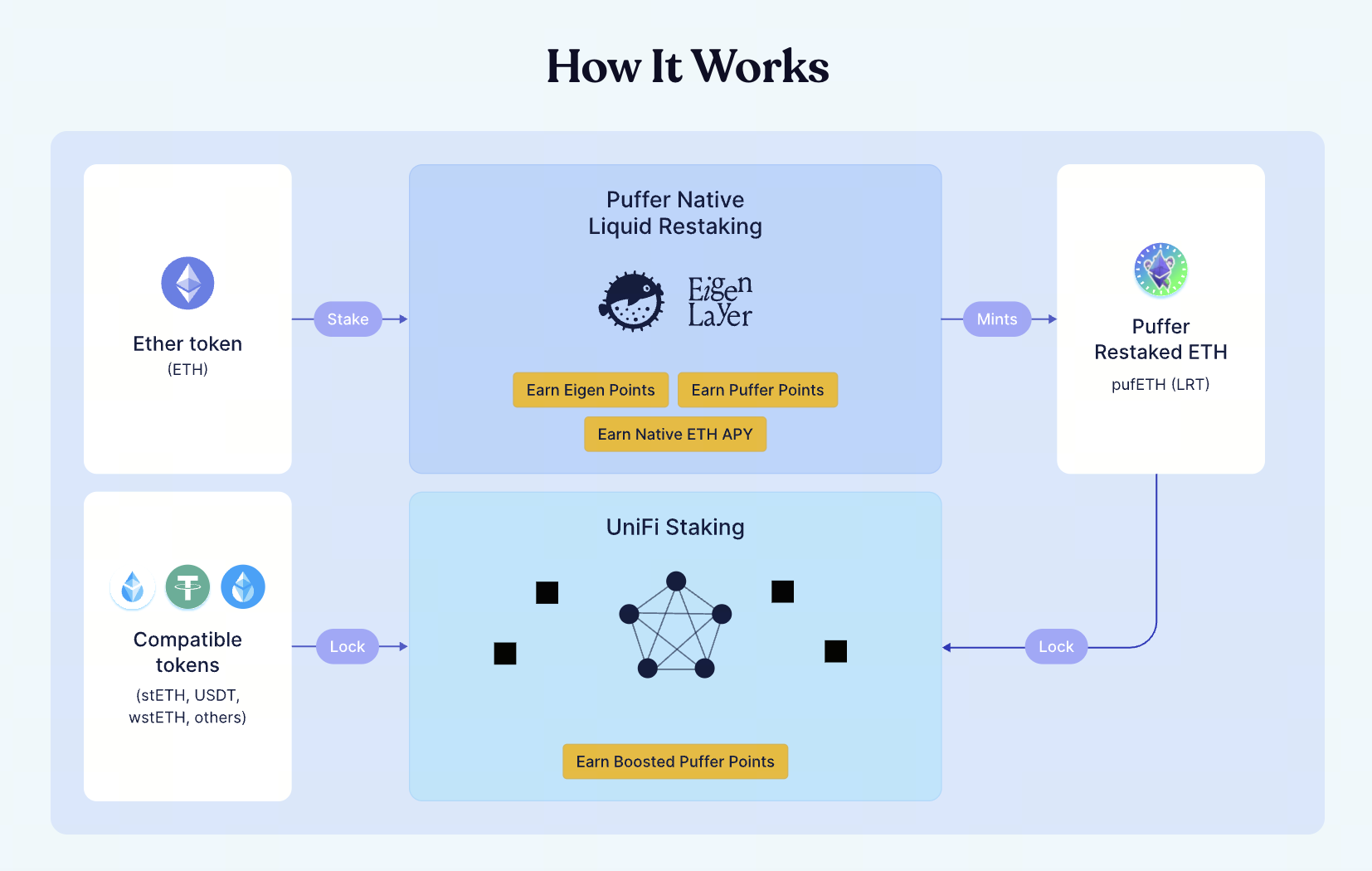
Puffer's architecture is anchored in Ethereum native staking, augmented with restaking, a dedicated security module, and Layer 2 extension capabilities. Rather than simply layering liquid staking on top of restaking, the system attempts to create a complete closed loop—from asset deposit to yield distribution.
When users deposit ETH, they receive an equivalent amount of pufETH. pufETH represents both the user's staking rights on Ethereum and the ability to participate in restaking networks for additional yield. Under the hood, Puffer's validator node system operates the validators, while Secure-Signer protects validator keys to minimize slashing risk.
At a higher level, Puffer leverages UniFi Rollup and Preconfirmation technology to extend restaking security to Layer 2. This allows ETH to generate value beyond the mainnet, participating in a much wider on-chain ecosystem.
The Puffer technical stack is composed of several core modules:
- ETH native staking and validator node system
- pufETH liquid yield-bearing token
- Restaking Module
- Secure-Signer node security module
- UniFi Rollup and Preconfirmation extension layer
These modules work in concert to realize Puffer's native liquid restaking architecture.
Understanding Native Liquid Restaking (nLRP)
Native Liquid Restaking is Puffer's foundational technical concept.
Traditional liquid staking works by users depositing ETH into a protocol and receiving a liquid token (e.g., stETH) for use across DeFi. Restaking then expands ETH's utility: users not only collect native staking rewards but also lend their security to other on-chain services, earning additional returns.
What sets Puffer's nLRP apart is the word "native." The protocol does not complete staking first and then re-wrap the resulting token. Instead, it integrates staking, liquidity, and restaking directly at the protocol layer. This eliminates unnecessary intermediary steps, boosts capital efficiency, and reduces system complexity.
For users, deposited ETH remains liquid while simultaneously unlocking multiple yield streams—precisely why Puffer is called a native liquid restaking protocol.
How pufETH Captures Both Staking and Restaking Returns
pufETH is the central asset in Puffer's ecosystem. When a user deposits ETH, the protocol mints a corresponding amount of pufETH as proof of entitlement. Unlike traditional liquid staking tokens, pufETH accesses both Ethereum native staking rewards and restaking network returns—a single ETH position yields two distinct income layers.
The first layer comes from Ethereum validators: block rewards and staking rewards form the base of Puffer's yield system.
The second layer originates from the restaking network. Through the AVS (Actively Validated Services) mechanism, ETH provides security support for data availability networks, oracle systems, Rollups, and other infrastructure, generating additional returns.
This dual-yield model dramatically improves ETH capital efficiency. And because pufETH retains full liquidity, users can trade, lend, or provide liquidity in DeFi, enabling compounding returns over time.
How Secure-Signer Mitigates Slashing Risk
Security has always been one of the most critical concerns in the restaking space. On Ethereum, validators risk slashing for double-signing, extended downtime, or malicious behavior. Restaking magnifies that responsibility and risk. Puffer addresses this with Secure-Signer.
Secure-Signer is a dedicated signing module that isolates the validator signing process from the general server environment, protecting validator keys within a Trusted Execution Environment (TEE).
This design delivers several key benefits:
- Prevents private key exposure
- Lowers the probability of double-signing
- Reduces asset loss in the event of a node compromise
- Enhances overall validator operational stability
By placing critical signing logic in a hardened environment, Secure-Signer ensures that even if a server is breached, the validator key remains inaccessible.
For a restaking protocol, this security layer effectively reduces slashing risk and strengthens the entire network's safety posture.
How Validators and the Restaking Module Work Together
Puffer's validator system is composed of two integrated components: the Validator and the Restaking Module.
The Validator handles block validation on the Ethereum mainnet, providing base security and earning staking rewards.
The Restaking Module extends the validator's security to additional AVS services.
This means a single validator can simultaneously secure the Ethereum network while also supporting other on-chain infrastructure. For example, a validator might concurrently perform:
- Ethereum block validation
- Rollup data verification
- Decentralized oracle security
- Preconfirmation services
- Other AVS network validation tasks
This shared security model is a major driver of restaking's rapid growth. Through modular design, Puffer can continuously onboard new AVS services, expanding yield sources over time.
How Puffer Powers UniFi Rollup and Preconfirmation
Ethereum Layer 2 networks have grown rapidly, but transaction confirmation speed remains a friction point for users. Puffer's UniFi Rollup tackles this directly. UniFi is a Rollup network built on a restaking security model, designed to achieve faster confirmations and lower latency. To further enhance user experience, Puffer introduces Preconfirmation.
Traditional Rollups require waiting for block confirmations. Preconfirmation delivers transaction results to users ahead of the official batch.
This mechanism brings several advantages:
- Faster transaction response
- Lower latency
- Smoother on-chain application interactions
- Infrastructure support for high-frequency trading and DeFi
As UniFi integrates with the restaking network, Puffer evolves from a simple yield protocol into a comprehensive Ethereum scaling infrastructure.
How Puffer Differs from Traditional Liquid Staking Protocols
On the surface, both Puffer and traditional liquid staking protocols let users deposit ETH and receive a liquid asset. But their technical objectives diverge sharply. Traditional liquid staking prioritizes liquidity—users receive a liquid token to deploy across DeFi. Puffer's aim is to keep ETH liquid while unlocking restaking opportunities for additional yield.
In security, traditional protocols often rely on external node operators. Puffer uses Secure-Signer to provide stronger validator protection and reduce slashing risk. Ecologically, Puffer goes beyond yield products to deploy UniFi Rollup, Preconfirmation, and AVS networks, striving to build a holistic yield and infrastructure ecosystem. Technically, Puffer is best understood as an Ethereum yield infrastructure built for the restaking era—not merely an upgraded liquid staking protocol.
Puffer's Future Technical Direction
As the restaking market matures, Puffer's technical roadmap continues to expand. The protocol will likely broaden AVS network coverage, enabling more infrastructure to tap into restaking security. As more on-chain services adopt shared security, Puffer's yield sources and ecosystem influence should grow accordingly.
UniFi Rollup and Preconfirmation will remain key development priorities. Optimizing transaction confirmation speed and Layer 2 user experience will help Puffer build a more robust Ethereum scaling ecosystem.
Security technologies like Secure-Signer will also see continuous upgrades. As the restaking market scales, node security becomes even more critical, and the security module could become a durable competitive moat for Puffer.
Longer term, Puffer is working to transform ETH from a single staking asset into a core on-chain resource that combines yield, security, and infrastructure value—a vision that may define the next chapter of Ethereum's yield ecosystem.
Summary
Puffer is an Ethereum yield infrastructure protocol built around Native Liquid Restaking. Through pufETH, Secure-Signer, the Restaking Module, and UniFi Rollup, it achieves deep integration of ETH native staking, restaking, security, and Layer 2 scalability.
As the Ethereum restaking market evolves, user expectations around yield efficiency, liquidity, and security continue to rise. Puffer's native liquid restaking architecture not only improves ETH capital utilization but also introduces richer yield scenarios and expansion capabilities to the Ethereum ecosystem. In the future restaking landscape, architectural completeness, security mechanisms, and infrastructure scalability will likely be the key determinants of Puffer's long-term value.







