In traditional stablecoin models, reserve interest is typically retained by the issuer, leaving payment platforms, exchanges, and other distribution-driving institutions with little opportunity for proportional returns. Open Standard clearly identifies network partners as the beneficiaries: approved enterprises are measured by their Hold, Mint, and Accept contributions, sharing in reserve returns and participating in partner board governance. Understanding who receives yield, how distribution is triggered, and the boundaries for token holders is essential to evaluating the differences between Open USD (OUSD) and USDC, USDT stablecoin economics.
Who Benefits from Traditional Stablecoin Yields?
USD-backed stablecoin reserves are held as cash and equivalents at regulated banks, with account interest serving as the primary reserve yield. Traditionally, this yield is retained by the issuer for operations, compliance, and profit distribution; third-party platforms that drive adoption typically do not receive reserve interest directly.
| Participant |
Traditional Model |
Open Standard Partner |
| Issuer/Operator |
Retains most reserve yield |
Only charges a small management fee |
| Adoption Platform |
Generally does not receive reserve interest directly |
Shares reserve returns |
| Regular On-Chain Holder |
Does not receive reserve interest directly |
Does not receive reserve interest directly |
The table above highlights the core differences between the two models. Open Standard directs "nearly all reserve economics" to network partners, retaining only a small management fee to cover technical and compliance operations.
What Is Earn by Default?
Earn by default is one of OUSD’s three core principles: Partners receive all earnings from reserves, less a small management fee. Reserve yields flow to ecosystem partners by default, eliminating the need for case-by-case negotiation. "Default" refers to protocol-level design—enterprises joining the network and assuming Hold, Mint, or Accept roles participate in distribution according to transparent rules.
The small management fee supports Open Standard’s technology, compliance, and operations; the remaining reserve economics are shared among partners. This principle complements Build for scale (zero mint/redeem fees): Earn by default addresses yield allocation, while Build for scale reduces transaction costs. Together, they incentivize partners to expand holding, minting, and acceptance.
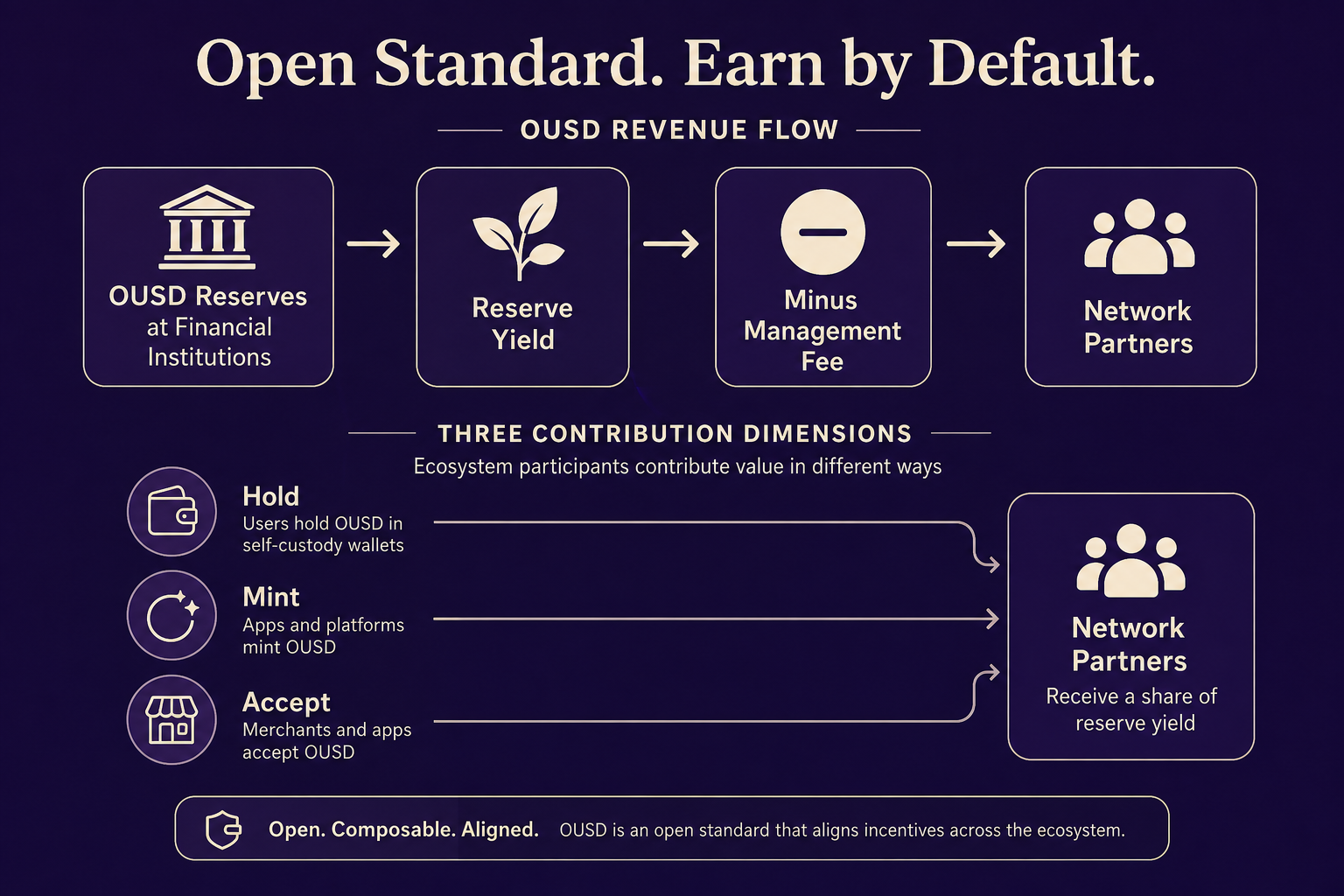 Figure 1. Earn by default reserve yield flow: reserve returns are distributed to Hold, Mint, and Accept partners after deducting a small management fee.
What Are the Rules and Triggers for Yield Distribution?
The distribution process is: reserve returns → deduct management fee → allocate to partners based on contribution metrics. Contributions are measured across three dimensions: Hold, Mint, and Accept.
Hold: Distribution at the base layer based on OUSD balances held within the platform.
Mint: Incentives for authorized minted increments, working in tandem with the OUSD mint and redeem process and its zero-fee model.
Accept: Traffic-layer incentives based on inbound OUSD volume.
| Contribution Metric |
Measurement Target |
Distribution Logic |
| Hold |
OUSD platform balance |
Distribution at base layer by holding size |
| Mint |
Authorized minted increment |
Incentive share by increment |
| Accept |
Inbound OUSD volume |
Traffic incentives by inflow size |
Partners can combine multiple roles to stack returns from different paths. Distribution is linked to compliance approval, balance/traffic reporting, and role registration; on-chain addresses not approved as network partners are excluded from reserve returns. Specific ratios and settlement cycles are governed by network protocol and partner agreements.
How Does Partner Admission and Contribution Measurement Work?
To join Open Standard, OUSD must be adopted as a core trading asset. Partners must pass compliance review, KYC/AML, and role declaration for Hold/Mint/Accept, gaining access to technical documentation, integration support, and usage-based yield distribution. Over 140 founding partners span payments, finance, technology, and blockchain; additional enterprises can apply by role.
Contribution measurement relies on reporting and verification: Hold checks balance size and duration, Mint tracks minted increments, Accept counts inbound flow. The enterprise Open USD integration path covers evaluation, documentation, and role registration. The partner board makes collective decisions on fee rates, expansion rules, and yield formulas.
How Does This Compare to GDN Hold/Mint/Accept?
Open Standard’s Earn by default is structurally similar to the Global Dollar Network (GDN) partner model: both direct reserve returns to network partners, but differ in governance and fee structure.
Similarities: Both use Hold, Mint, and Accept to measure contributions; regular on-chain holders do not receive reserve interest; partners must pass compliance review and register their roles.
Differences: GDN issues USDG through Paxos, allowing partners to receive up to 100% of reserve returns; Open Standard manages OUSD, distributing yield after a small management fee, with governance led by the partner board. OUSD features zero mint/redeem fees; GDN fees are set by Paxos and its protocol.
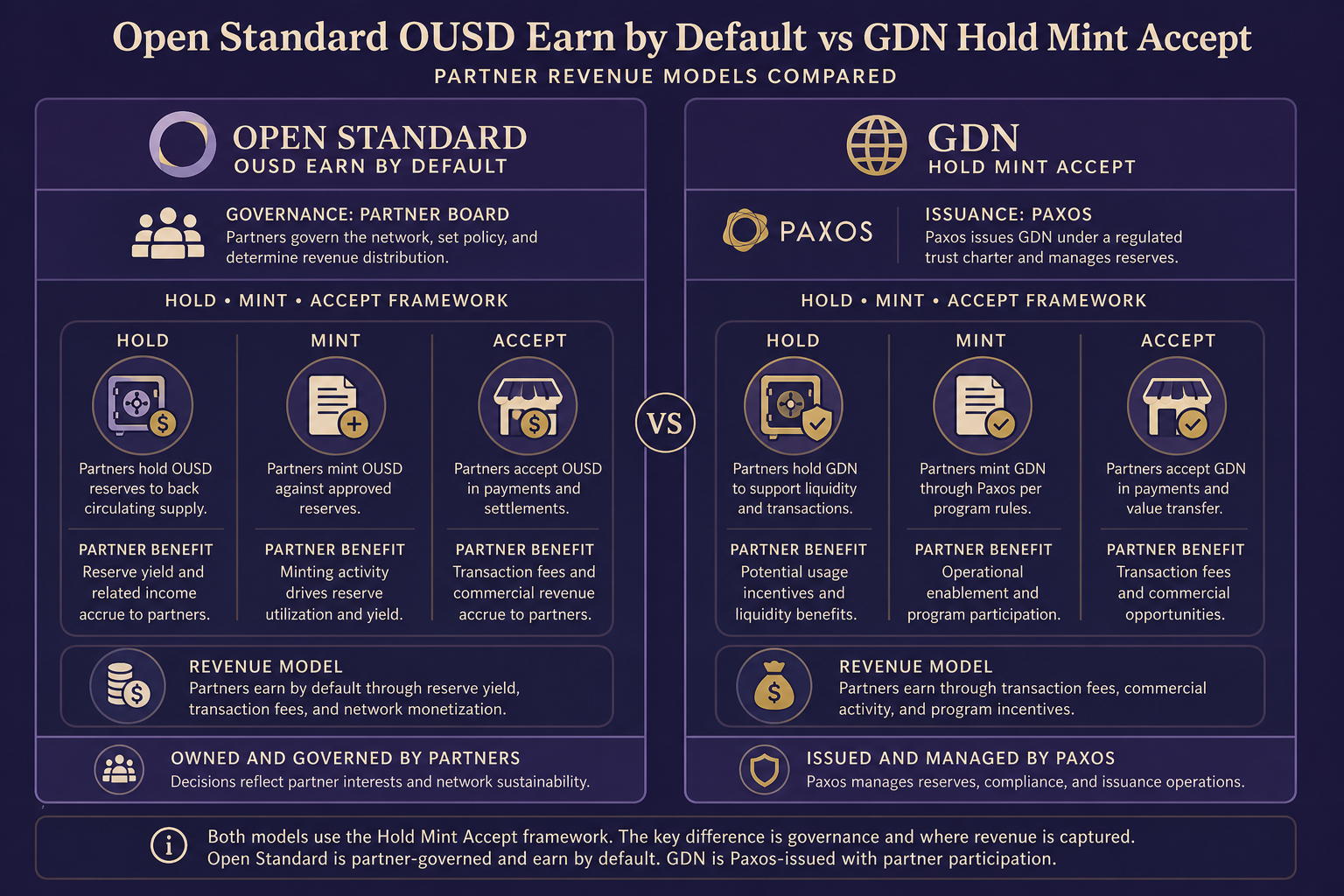 Figure 2. Comparison of Open USD Earn by default and GDN Hold/Mint/Accept partner revenue models.
| Comparison Metric |
Open USD |
GDN (USDG) |
| Governance Body |
Open Standard Partner Board |
GDN + Paxos |
| Yield Recipient |
Partners (less small management fee) |
Partners (up to 100%) |
| Fee Structure |
Zero mint/redeem fees |
Set by Paxos protocol |
| Contribution Metrics |
Hold, Mint, Accept |
Hold, Mint, Accept |
The OUSD vs USDG (GDN) comparison provides a full reference. Choosing a network requires independent evaluation of business needs, compliance jurisdiction, and role positioning.
Can Regular Token Holders Benefit from Reserve Returns?
Under Open Standard, regular on-chain holders do not receive reserve interest directly. Distribution is limited to approved network partners and is not automatically paid to any holding address. End-users’ core rights are the 1:1 peg, redemption, and on-chain transfer convenience—not reserve yield sharing.
Some partners may pass Hold role returns to users as account rewards or product incentives, but this is at the partner’s discretion and not protocol-mandated. It’s important to distinguish between “holding OUSD directly on-chain” and “holding on a partner platform”—on-chain self-custody only guarantees redemption rights; yield eligibility depends on the specific platform’s terms.
Summary
Earn by default allocates OUSD reserve returns to network partners after a small management fee, with contributions measured by Hold, Mint, and Accept—ensuring institutions driving adoption receive proportional returns. Regular on-chain holders do not receive reserve interest directly. While the model is similar to GDN, there are differences in governance, fee structure, and network scale.
FAQ
What Does “Default” Mean in Earn by Default?
“Default” means reserve returns flow to network partners at the protocol level, without case-by-case negotiation. Qualified enterprises in Hold, Mint, and Accept roles participate in distribution according to public rules; Open Standard only deducts a small management fee for operations.
How Are Reserve Returns Distributed Among Partners?
Returns are measured by Hold (balance held), Mint (minted increment), and Accept (inbound volume). Partners can combine multiple roles for greater returns; specific ratios and settlement cycles are set by network protocol and partner agreements.
Can Regular Users Holding OUSD Receive Reserve Interest?
Regular on-chain holders do not receive reserve interest directly. Some partners may pass on returns via products, but this is not required by protocol and depends on the platform’s terms.
What Are the Requirements to Join Open Standard?
Partners must adopt OUSD as a core trading asset, complete compliance review, KYC/AML, and role declaration, and gain access to technical documentation, integration support, and yield distribution, as well as participate in partner board governance.
What Are the Main Differences Between Open USD and GDN Partner Yield Mechanisms?
Both use Hold, Mint, and Accept, and regular holders do not receive interest directly. The main differences are in governance, fee structure (OUSD has zero mint/redeem fees), and partner network scale (140+ vs. seven founding partners).
What Is the Small Management Fee Used For?
It covers Open Standard’s technical infrastructure, compliance operations, and daily management. Reserve economics after deduction are shared by network partners.