Zero-knowledge proofs were originally used mainly for privacy protection. But as the need for blockchain scaling has continued to grow, zk technology has gradually become an important part of Layer 2 and modular blockchain architectures. In recent years, concepts such as zkRollups, zkVMs, and verifiable computation have developed quickly, moving zk technology beyond transaction privacy and into high-performance computing, AI inference, on-chain finance, and other areas.
In today’s zk sector, zkSync and Nexus represent two different development paths. zkSync places more emphasis on Ethereum scaling and EVM-compatible ecosystems, while Nexus focuses on verifiable computation and proving networks, aiming to support more complex on-chain computing scenarios through zkVM and a modular architecture. Understanding the differences between the two helps clarify where zk technology may be headed next.
A Brief Overview of Nexus and zkSync
Nexus is a Layer 1 network built around verifiable computation. Its core goal is to enable large-scale verifiable computation through zkVM, a modular proving network, and a distributed verification architecture.
Compared with traditional public blockchains, which focus more on transaction throughput, Nexus places greater emphasis on “how to verify complex computation.” Its architecture centers on zkVM, proof generation, and a proving network, mainly targeting Verifiable Finance, Verifiable AI, and high-frequency on-chain computation.
zkSync is a zkRollup network built on Ethereum. Its main goal is to improve Ethereum’s transaction throughput and reduce gas costs.
How Do Nexus and zkSync Differ in Core Positioning?
Although Nexus and zkSync both use zk proofs, they are not solving the same problem.
zkSync focuses on “scaling Ethereum.” It mainly addresses Ethereum’s high gas costs and limited transaction speed, so its core logic is that of a Layer 2 Rollup.
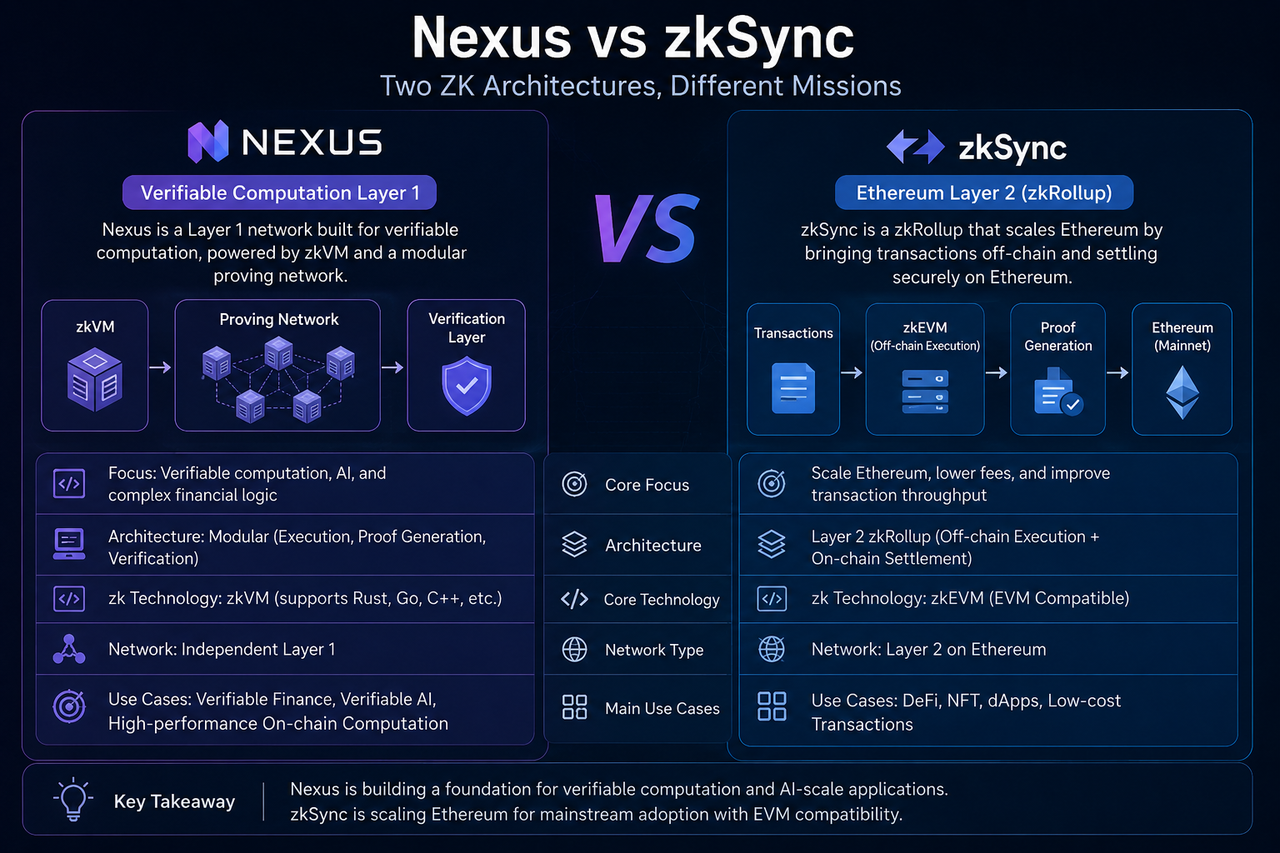
Nexus, on the other hand, focuses on “verifying complex computation.” It is more concerned with how AI inference, automated programs, and complex financial logic can be verified at lower cost.
In other words, zkSync leans more toward transaction scaling infrastructure, while Nexus leans more toward verifiable computation infrastructure. This difference shapes their architecture, development direction, and ecosystem positioning.
How Do the Architectures of Nexus and zkSync Differ?
zkSync uses a typical zkRollup architecture. Transactions are first executed on the Layer 2 network, and then state updates are submitted to Ethereum through zk proofs.
The core advantage of this model is that it inherits Ethereum’s security while increasing throughput.
Nexus uses a more modular structure. Its network separates execution, proving, and verification into different layers, and uses a proving network to complete proof generation.
In essence:
Although both rely on zk proofs, their system design goals are entirely different.
How Is Nexus zkVM Different From zkSync zkEVM?
One of zkSync’s core technologies is zkEVM, which is designed to be compatible with the Ethereum virtual machine ecosystem. Developers can continue using Solidity and existing EVM toolchains.
Nexus zkVM, by contrast, places more emphasis on general-purpose computation. It supports traditional development languages such as Rust, Go, and C++, and is focused on verifying complex programs.
zkEVM prioritizes compatibility, while zkVM focuses more on verifiable computation.
This difference means:
-
zkEVM is better suited to traditional DeFi and migration of EVM applications
-
zkVM is better suited to AI, complex financial logic, and automated programs
As demand for on-chain computation grows, zkVM is seen as a potential foundation for the next generation of trusted computing environments.
How Do Nexus and zkSync Differ in Application Scenarios?
zkSync’s main applications center on DeFi, NFTs, Ethereum dApp scaling, low-cost transactions, and EVM ecosystem migration. Its core goal is to make Ethereum applications cheaper to run.
By contrast, Nexus focuses more on Verifiable Finance, Verifiable AI, proving networks, high-performance on-chain computation, and AI inference verification. This means Nexus is better suited to scenarios that require complex computation and proof generation, not just ordinary transaction scaling.
zkSync’s scaling focus is transaction throughput and gas optimization. Its performance improvements mainly come from the Rollup aggregation mechanism.
Nexus focuses more on proving efficiency and parallel verification capability. Through its distributed proving network, it can assign proving tasks to different nodes, improving its ability to process complex computation.
The two follow different scaling logic:
| Comparison Dimension |
Nexus |
zkSync |
| Core Positioning |
Verifiable computation |
Ethereum Layer 2 |
| Network Type |
Layer 1 |
zkRollup |
| Core Technology |
zkVM + proving network |
zkEVM |
| Main Goal |
Verify complex computation |
Increase transaction throughput |
| Development Languages |
Rust / Go / C++ |
Solidity |
| AI Scenario Support |
Stronger |
Limited |
| Ethereum Dependency |
Relatively independent |
Highly dependent |
Over the long term, the two may not be direct competitors. Instead, they may represent different extensions of zk technology.
What Challenges Do Nexus and zkSync Face?
Although zk technology is developing quickly, both projects face different challenges.
zkSync needs to continue addressing zkEVM compatibility, Rollup costs, and its dependence on the Ethereum network.
Nexus faces issues such as high proving costs, an early-stage developer ecosystem, and a Verifiable AI market that has not yet fully matured.
In addition, competition in the zk sector is intense. Starknet, Scroll, Polygon zkEVM, and several modular projects are all advancing different technical paths.
Which zk architecture gains broader adoption will depend on the development of developer ecosystems, hardware capabilities, and real application demand.
Conclusion
Although Nexus and zkSync are both built on zero-knowledge proof technology, their core goals are clearly different.
zkSync places more emphasis on Ethereum Layer 2 scaling, using zkRollup and zkEVM to improve transaction efficiency and reduce gas costs. Nexus, by contrast, focuses more on verifiable computation, aiming to use zkVM and a proving network to support AI, Verifiable Finance, and verification of complex on-chain logic.
From a long-term development perspective, zk technology is gradually evolving from a simple scaling tool into trusted computing infrastructure. zkSync and Nexus represent two different directions within that broader trend.
FAQs
What Is the Biggest Difference Between Nexus and zkSync?
zkSync is mainly an Ethereum zkRollup scaling solution, while Nexus focuses more on verifiable computation and proving infrastructure.
Why Does Nexus Use zkVM?
Nexus uses zkVM to generate zk proofs, allowing complex computation results to be verified without requiring every node to rerun the program.
What Is the Difference Between zkEVM and zkVM?
zkEVM places more emphasis on compatibility with the Ethereum ecosystem, while zkVM places more emphasis on general-purpose verifiable computation.
What Is zkSync Mainly Used For?
zkSync is mainly used for Ethereum scaling, reducing gas costs, and supporting low-cost on-chain transactions.
Are Nexus and zkSync Competitors?
Both belong to the zk sector, but they solve different problems, so they are closer to different technical paths.







