On-chain lending protocols are among the most critical financial infrastructure in the DeFi ecosystem. They allow users to obtain liquidity by collateralizing digital assets without relying on banks or centralized institutions. In the Ethereum DeFi ecosystem, Aave has long been one of the most representative on-chain money market protocols. Meanwhile, as Kaspa begins expanding its Layer2 and smart contract capabilities, Kaskad has emerged as a key lending protocol within Kaspa DeFi.
While both Kaskad and Aave employ an over-collateralized lending model, the differences run far deeper than simply "deploying on different networks." From underlying architecture and risk control to governance logic and AI-native DeFi direction, the two protocols represent lending systems at different stages and with distinct goals.
Kaskad vs. Aave: Key Differences at a Glance
As a decentralized lending protocol operating on Igra Layer2 within the Kaspa ecosystem, Kaskad enables users to lend out other assets by collateralizing digital assets while maintaining exposure to their original holdings. Its architecture is built around Kaspa's high-speed blockDAG network and aims to integrate AI Agents with automated financial systems.
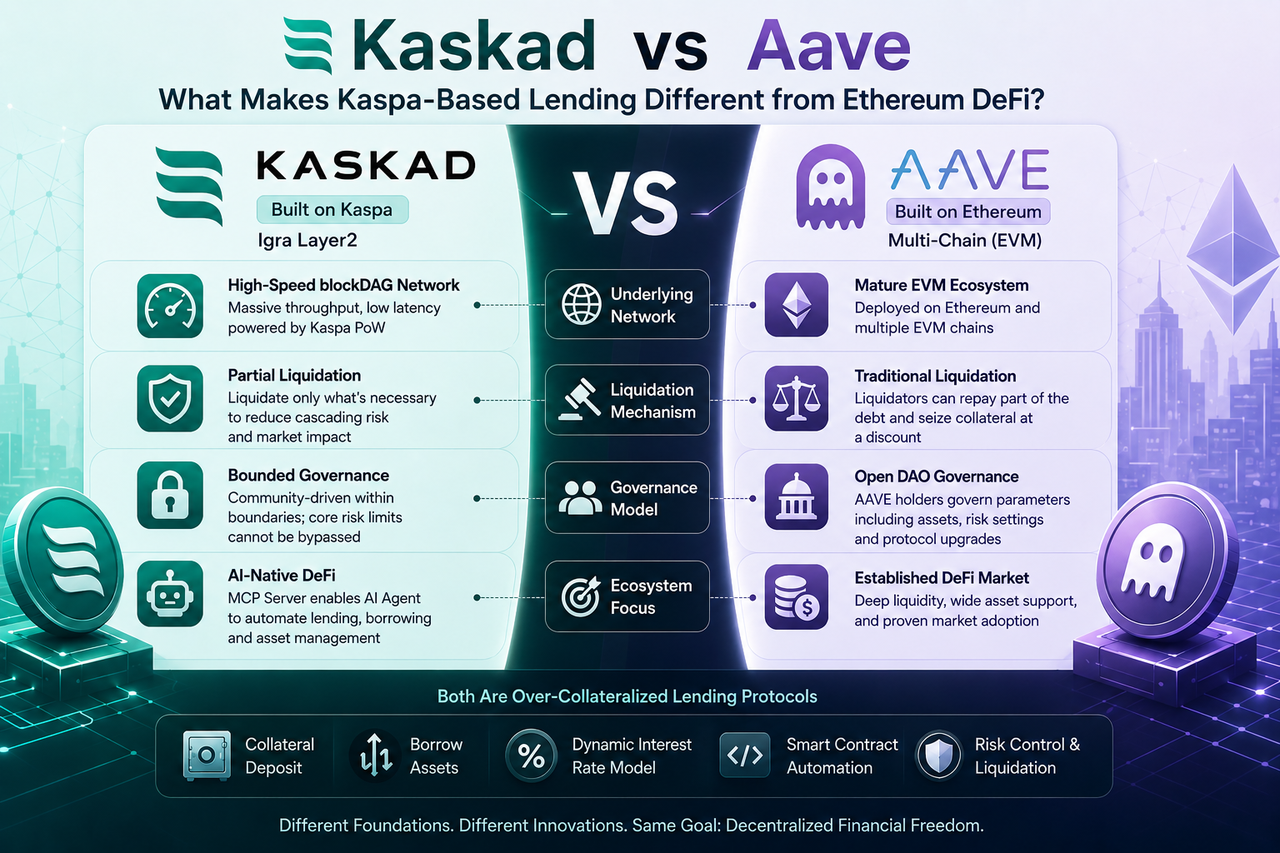
One of the most established lending protocols in the Ethereum DeFi ecosystem, Aave is currently deployed on multiple EVM networks, including Ethereum, Arbitrum, Optimism, and Polygon.
Aave's core model is also over-collateralized lending. Users deposit assets and can then borrow other digital assets, while the protocol uses a dynamic interest rate model to automatically balance market supply and demand.
| Dimension |
Kaskad |
Aave |
| Underlying Ecosystem |
Kaspa + Igra Layer2 |
Ethereum + EVM |
| Network Structure |
blockDAG |
Traditional Blockchain |
| Lending Model |
Over-Collateralization |
Over-Collateralization |
| Liquidation Mechanism |
Partial Liquidation |
Standard Liquidation |
| Governance Model |
Bounded Governance |
DAO Governance |
| AI Agent Interface |
MCP Server |
No Native Support |
| Market Maturity |
Early Ecosystem |
Mature Market |
| Liquidity Depth |
Relatively Low |
High |
| Core Focus |
AI-native DeFi |
Multi-Chain Liquidity Market |
How Are Kaskad and Aave's Lending Mechanisms Similar?
At their core, both Kaskad and Aave are typical on-chain money market protocols.
Both use an over-collateralization mechanism: users must first provide collateral worth more than the loan amount before they can borrow other assets. The protocols then automatically adjust borrowing rates based on market utilization rate through a dynamic interest rate model.
Additionally, both rely on smart contracts to automatically handle:
- Asset deposits
- Loan settlements
- Interest rate calculations
- Liquidation logic
- Risk control
This design allows the lending market to function continuously without needing a centralized intermediary.
How Does Kaskad's Partial Liquidation Differ from Aave's?
The liquidation mechanism is one of the key distinctions.
Aave uses a more traditional on-chain liquidation approach. When a user's Health Factor falls below the safety threshold, liquidators can repay a portion of the debt and receive collateral assets at a discount.
In contrast, Kaskad emphasizes a Partial Liquidation mechanism.
The core idea:
The protocol liquidates only the "necessary portion" of a position, rather than selling off a large amount of the user's collateral assets at once.
This mechanism aims to:
- Reduce cascading liquidations during high volatility
- Minimize sudden sell pressure in the market
- Limit one-time losses for users
- Improve overall protocol stability
For new ecosystems still developing liquidity depth, such a risk buffer is especially valuable.
Comparing Kaskad and Aave's Liquidation Mechanisms
Liquidation is a major differentiator between the two.
Aave primarily uses a standard liquidation model. When a user's Health Factor drops below the threshold, liquidators can repay part of the debt and receive discounted collateral.
Kaskad, however, focuses on a Partial Liquidation mechanism.
| Dimension |
Kaskad |
Aave |
| Liquidation Model |
Partial Liquidation |
Standard On-Chain Liquidation |
| Liquidation Goal |
Prioritize restoring position safety |
Quickly reduce protocol bad debt |
| User Impact |
Lower single loss per event |
Potentially larger-scale liquidation |
| Market Impact |
Reduces risk of cascading sell-offs |
More reliant on market liquidity |
| Target Ecosystem |
Emerging high-speed PoW DeFi |
Mature EVM DeFi |
How Do the Governance Models of Kaskad and Aave Differ?
Aave uses a traditional DAO governance structure, where AAVE holders can participate in protocol parameter governance, including asset listings, interest rate adjustments, and risk management rules.
Kaskad introduces the concept of "Bounded Governance."
The key difference:
Even though the community can participate in governance, the protocol's critical risk boundaries cannot be arbitrarily altered.
For example:
- The LTV for high-risk assets cannot be increased indefinitely
- Core liquidation logic cannot be bypassed
- Key security modules cannot be disabled
This design aims to strike a balance between decentralization and protocol safety.
In contrast, Aave promotes open DAO governance, while Kaskad emphasizes strict security boundaries.
Which Lending Protocol Is Right for Different Users?
There is no absolute "better" choice between Kaskad and Aave.
For users seeking mature liquidity, broad asset support, and a stable market environment, Aave aligns with the traditional mainstream DeFi landscape.
For those interested in the Kaspa ecosystem, high-speed PoW networks, AI-native DeFi, new financial infrastructure, and Layer2 innovation, Kaskad offers a more exploratory and growth-oriented experience.
The two protocols represent on-chain financial systems at different stages of evolution.
Conclusion
Both Kaskad and Aave use an over-collateralized lending model, but they differ significantly in underlying architecture, risk control, governance logic, and ecosystem focus.
Aave represents the mature Ethereum DeFi lending market, while Kaskad emphasizes Kaspa blockDAG, high-speed PoW networks, and AI-native DeFi infrastructure.
FAQs
What is the biggest difference between Kaskad and Aave?
The biggest difference lies in the underlying ecosystem and protocol direction. Aave is part of the mature Ethereum DeFi lending market, while Kaskad is centered on Kaspa blockDAG and AI-native DeFi.
Did Kaskad reference Aave's architecture?
Yes. Kaskad's overall lending model and money market logic are similar to Aave's, but it has been optimized specifically for the Kaspa ecosystem.
What is Partial Liquidation?
Partial Liquidation means the protocol liquidates only part of a position rather than closing it out entirely, reducing the risk of cascading liquidations in the market.
Why does Kaskad support AI Agents?
Kaskad provides an MCP Server that allows AI Agents to automatically execute lending and asset management operations.