Real world assets, or RWAs, are becoming an important growth area for the blockchain industry. By tokenizing traditional financial assets and bringing them into onchain markets, RWAs provide DeFi with more stable sources of yield while also opening new liquidity channels for traditional capital.
In this sector, KAIO, Ondo, and Centrifuge are three representative protocols. Although all of them aim to bring assets onchain, they differ significantly in underlying design, target users, and practical application. Understanding these differences helps build a clearer framework for evaluating the sector.
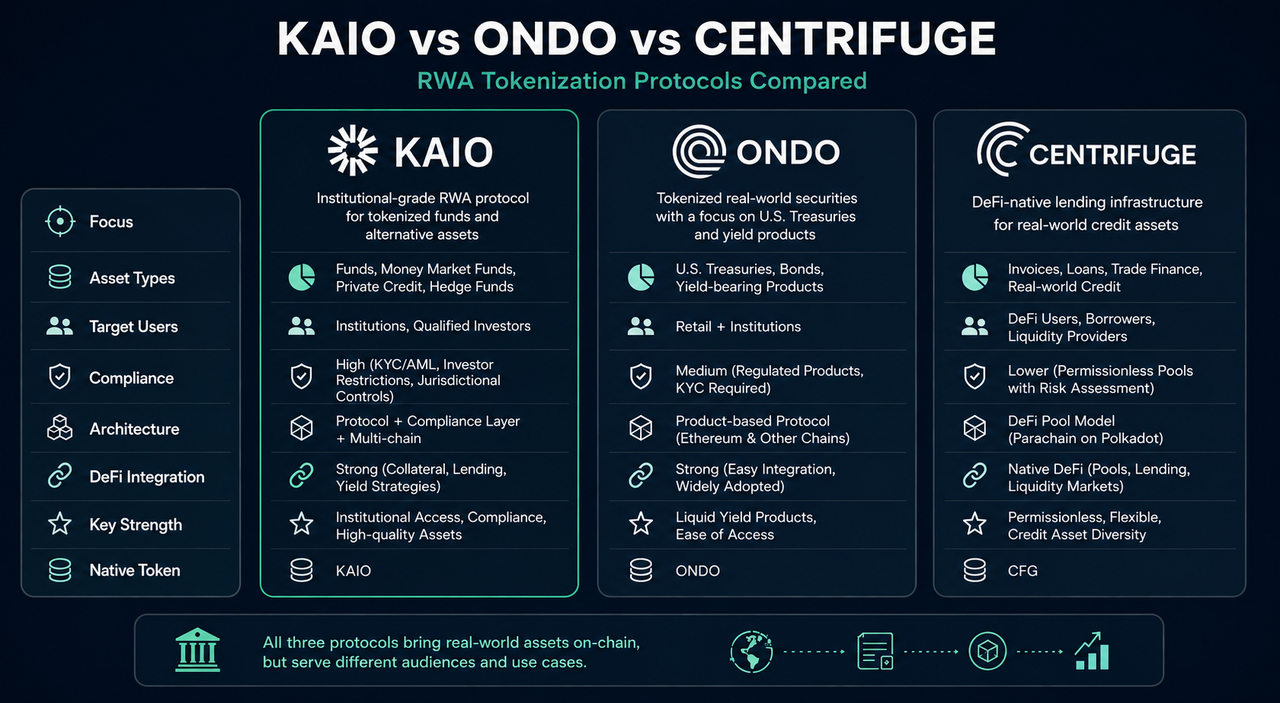
Introduction to KAIO, Ondo, and Centrifuge, and a Comparison of Their Core Differences
As an institution focused RWA tokenization protocol, KAIO uses smart contracts and compliance mechanisms to convert traditional fund assets into onchain tokens and support their use in DeFi. Its defining feature is its emphasis on compliance and institutional participation, allowing traditional financial assets to enter the blockchain ecosystem while meeting regulatory requirements.
Ondo is a protocol focused on tokenizing traditional low risk assets, such as U.S. Treasuries. Its main products are usually yield bearing tokens that represent real world fixed income assets. These assets tend to have lower volatility and are open to a broader user base. Ondo’s design leans more toward bringing standardized financial products onchain, with an emphasis on accessibility and stable yield.
Centrifuge is a protocol that brings real world credit assets, such as invoices and loans, into DeFi. Its core mechanism is to package different types of debt assets through asset pools, allowing users to participate in financing or provide liquidity.
Compared with KAIO and Ondo, Centrifuge is more DeFi native in structure, with a stronger emphasis on openness and decentralization.
| Dimension |
KAIO |
Ondo |
Centrifuge |
| Target Users |
Institutions |
Hybrid, institutions + retail |
DeFi Users |
| Compliance Level |
High |
Medium |
Relatively Low |
| Asset Types |
Funds, Private Assets |
Treasuries, Yield Assets |
Credit Assets |
| Architecture Model |
Protocol + Compliance Module |
Product Based Protocol |
DeFi Pool Model |
| Degree of Decentralization |
Relatively Low |
Medium |
Relatively High |
| DeFi Integration |
Strong, under compliance conditions |
Strong |
Native Integration |
KAIO vs Ondo vs Centrifuge: Compliance Mechanisms Compared
In the RWA field, compliance is one of the core points of difference.
KAIO uses a strict compliance framework, including identity verification and investor restrictions, and is mainly designed for institutional users.
Ondo also has certain compliance mechanisms, but some of its products allow broader user participation.
Centrifuge is relatively more open, with lower compliance requirements and a structure closer to the traditional DeFi model.
These differences determine the user groups and application scenarios of the three protocols.
KAIO vs Ondo vs Centrifuge: Asset Types Compared
The three protocols differ clearly in the types of assets they focus on.
KAIO mainly focuses on fund based assets, such as money market funds and private credit.
Ondo primarily focuses on standardized assets, such as low risk financial instruments including Treasuries.
Centrifuge covers a wider range of credit assets, including corporate loans and accounts receivable.
The differences in asset types directly affect their risk structures and return profiles.
KAIO vs Ondo vs Centrifuge: User Groups Compared
KAIO’s main users are institutional investors or qualified investors, and its products usually have higher access requirements.
Ondo targets a broader range of users, including crypto market participants seeking stable yield.
Centrifuge is more oriented toward DeFi users and liquidity providers, with an emphasis on open participation.
This difference reflects the distinct market positioning strategies of the three protocols.
KAIO vs Ondo vs Centrifuge: DeFi Integration Capabilities Compared
In terms of DeFi integration, the three protocols each have their own characteristics.
KAIO emphasizes the compliant use of institutional assets in DeFi, where its assets can serve as collateral or yield sources.
Ondo tokens are usually easier to integrate into existing DeFi protocols and can be used in stable yield strategies.
Centrifuge itself is part of the DeFi credit system, with its asset pools directly participating in lending and financing activities.
This difference reflects their different positions between “financial infrastructure” and “DeFi native protocol.”
How to Understand the Positioning Differences Between KAIO, Ondo, and Centrifuge
KAIO is more like a bridge connecting traditional financial institutions with blockchain, emphasizing asset quality and compliance.
Ondo provides standardized onchain yield products, allowing users to access a yield experience similar to traditional finance more easily.
Centrifuge is closer to a DeFi native credit market, emphasizing openness and asset diversity.
Overall, the three represent different paths in the development of RWAs:
-
Institution driven, KAIO
-
Product driven, Ondo
-
DeFi driven, Centrifuge
Conclusion
Although KAIO, Ondo, and Centrifuge all belong to the RWA sector, they differ clearly in compliance, asset structure, and user positioning.
KAIO emphasizes institutional grade compliance and high quality assets, Ondo focuses on standardized yield products, while Centrifuge centers on an open onchain credit market. Understanding these differences helps build a clear and reusable framework for navigating the complex RWA ecosystem.
FAQs
What Is the Biggest Difference Between KAIO, Ondo, and Centrifuge?
Their core differences lie in compliance level, asset types, and target users: KAIO is designed for institutions, Ondo offers standardized assets, and Centrifuge focuses more on DeFi credit.
Which Protocol Is More Decentralized?
Centrifuge is relatively more decentralized, while KAIO relies more heavily on compliance mechanisms.
Which Type of Asset Has Lower Risk?
In general, Treasury based assets offered by Ondo tend to have lower risk, while Centrifuge’s credit assets carry relatively higher risk.
Is KAIO Suitable for Regular Users?
KAIO is more focused on institutions or qualified investors, and some products may not be available to regular users.
What Is the Future Direction of RWA Protocols?
RWA protocols may develop toward stronger compliance, deeper DeFi integration, and a wider range of asset types.







