NFTs (non-fungible tokens), as a key application of blockchain technology, are widely used in digital art, gaming assets, identity credentials, and more. Their defining feature is that each token is unique and cannot be replaced. In practice, NFTs are not static assets, they need to be transferred and managed across different wallets, platforms, and even blockchains.
As multi-chain ecosystems and NFT markets continue to grow, NFT transfers have become a fundamental operation for asset management, trading, and display. Understanding the underlying mechanisms, fee structures, and security logic of NFT transfers helps reduce operational risks and builds a clearer understanding of digital asset ownership.
Basic Principles of NFT Transfers
At its core, an NFT transfer is an update of ownership records on blockchain. Each NFT is defined by a smart contract and identified by a unique Token ID.
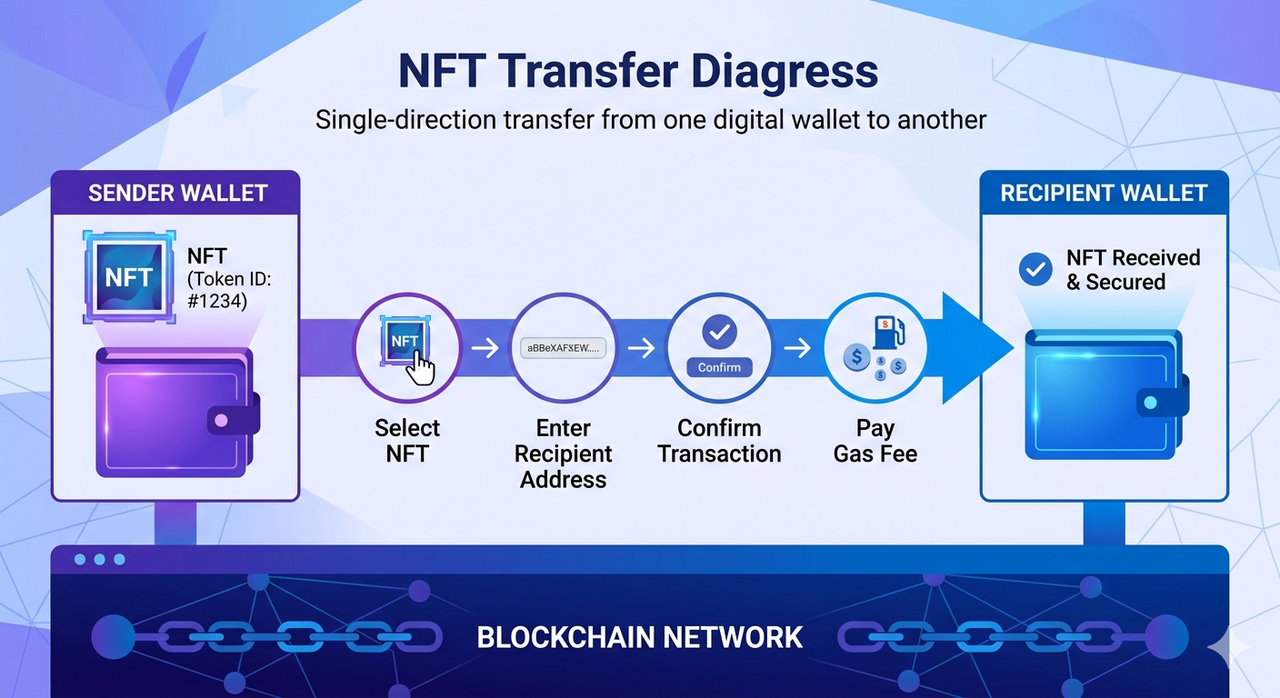
When a user initiates a transfer, they are essentially calling functions such as transferFrom or safeTransferFrom within the smart contract. This updates the owner address of the NFT from the sender to the recipient. The blockchain network validates and records this process, and once completed, the new ownership is immutable.
This means the NFT itself does not physically “move”, rather, its ownership record is reassigned on-chain.
Main Methods of NFT Transfers
NFT transfers can typically be carried out in several ways:
First, through a wallet transfer. Users can directly select an NFT in a Web3 wallet and send it to a target address. This is the most direct method and is suitable for users familiar with blockchain operations.
Second, via NFT marketplace platforms. Users can initiate transfers from an asset page within the platform. This approach usually provides a more intuitive interface and helpful prompts.
Third, through smart contract interaction. This involves directly calling contract functions to execute a transfer, which is more common among developers or advanced users.
While these methods differ in user experience and flexibility, they share the same underlying logic.
Standard NFT Transfer Process (Step-by-Step)
NFT transfers generally follow a standardized workflow.
First, the user accesses their Web3 wallet or NFT platform and locates the target NFT.
Next, they select the “Send” or “Transfer” option and enter the recipient’s wallet address. This step is critical because blockchain transactions are irreversible, and an incorrect address will result in permanent asset loss.
Then, the system prompts the user to confirm transaction details, including NFT information and estimated fees. Once confirmed, the transaction is submitted to the blockchain network.
Finally, after network validation and block confirmation, ownership of the NFT is successfully transferred. Users can check the transaction status via a blockchain explorer.
The core of this process can be summarized as: address verification, transaction signing, and on-chain validation.
Different platforms offer varying NFT transfer experiences.
Wallet-based tools typically provide a more direct transfer path and emphasize full user control over private keys. However, they may present a higher learning curve for beginners.
NFT marketplace platforms simplify the process with graphical interfaces, often including built-in transfer options, fee estimates, and error alerts.
Additionally, there is a distinction between custodial platforms and non-custodial wallets. In custodial setups, the platform manages the assets, while in non-custodial wallets, users retain full control of their private keys.
These differences mainly affect user experience and the distribution of security responsibility, rather than the underlying technical logic.
NFT Transfer Fees and Influencing Factors
NFT transfers typically require payment of blockchain network fees, known as gas fees.
These fees compensate miners or validators for processing and recording transactions. The cost depends on several factors, including network congestion, transaction complexity, and the specific blockchain used.
On heavily congested networks, gas fees can increase significantly, while on more scalable networks or layer-2 solutions, fees are generally lower.
In addition, batch transfer features can reduce the average cost per NFT when transferring multiple assets at once.
Therefore, NFT transfer costs are dynamic and must be understood within the context of current network conditions.
How to Evaluate the Security of NFT Transfers
The security of NFT transfers largely depends on risk control during the operation process.
First is address verification. Since blockchain transactions are irreversible, ensuring the accuracy of the recipient address is the most basic and critical security measure.
Second is the protection of private keys and recovery phrases. Ownership of NFTs is entirely controlled by private keys, and any compromise can lead to unauthorized transfers.
Users must also remain cautious of phishing websites and fraudulent platforms, which often mimic legitimate interfaces to trick users into signing malicious transactions.
Hardware wallets, which store private keys offline, can help reduce exposure to online attacks.
Overall, the security of NFT transfers depends heavily on user behavior and risk awareness.
How Cross-Chain NFT Transfers Work
With the rise of multi-chain ecosystems, NFTs are no longer confined to a single blockchain, making cross-chain transfers increasingly important.
Cross-chain transfers are typically achieved through bridging mechanisms. The core logic is to lock the original NFT on the source chain while minting a corresponding mapped asset on the target chain.
When the process is reversed, the mapped asset is burned, and the original NFT is unlocked and returned to circulation.
This process involves compatibility between different blockchain standards and introduces additional risks related to bridge protocols.
As a result, cross-chain NFT transfers are more complex than single-chain operations and require a deeper understanding of both mechanisms and potential risks.
Optimization and Emerging Trends in NFT Transfers
To lower the barrier to entry, NFT transfer experiences are continuously improving.
For example, domain name systems, such as human-readable addresses, can replace complex wallet strings and reduce input errors.
Batch transfer functionality allows users to send multiple NFTs in a single transaction, improving efficiency.
At the same time, gas fee estimation tools help users choose optimal transaction timing.
With the development of layer-2 networks and sidechains, both the cost and speed of NFT transfers are improving, making them more accessible to a broader audience.
Conclusion
NFT transfers are a fundamental operation in digital asset management. At their core, they involve updating ownership on the blockchain through smart contracts. The process includes selecting assets, entering addresses, confirming transactions, and on-chain validation.
In practice, users must consider fee structures, security risks, and platform differences, while also understanding advanced mechanisms such as cross-chain transfers. As technology evolves, NFT transfers are moving toward greater efficiency, lower costs, and a more user-friendly experience.
FAQs
Do NFT transfers require fees?
Yes. NFT transfers require payment of blockchain gas fees to process and record transactions.
Can an NFT be recovered if sent to the wrong address?
In most cases, no. Blockchain transactions are irreversible, so address accuracy is critical.
Can NFTs be transferred directly across different blockchains?
No. Cross-chain transfers require bridge mechanisms to create mapped assets.
How long does an NFT transfer take?
It depends on the blockchain’s confirmation speed, typically ranging from a few seconds to several minutes.
Can multiple NFTs be transferred at once?
Some platforms support batch transfers, allowing multiple NFTs to be processed in a single transaction.
No. NFTs can be transferred directly peer-to-peer using a Web3 wallet, without relying on a marketplace.