Arrow Finance (ARROW) is a native overcollateralized CDP protocol on Robinhood Chain, supporting stablecoins, liquid staking tokens, leading cryptocurrencies, and on-chain tokenized equities. It is entirely separate from Arrow Markets on Avalanche; always verify the protocol entry point and contract identity before proceeding.
Opening a position triggers a consistent set of on-chain state changes: collateral is locked, a debt position is established, and aUSD is minted and recorded at face value. Price fluctuations, fee accrual, and redemption pressure all impact the health factor, creating a cyclical debt lifecycle defined by "open position—maintain—repay."
What should you prepare before opening a position?
Four prerequisites must be met before opening a position: a wallet compatible with Robinhood Chain, an approved collateral balance, native tokens for gas fees, and a clear understanding of the target collateral's LTV and liquidation thresholds.
| Preparation Item |
Target Status |
Self-Check Points |
| Wallet |
Can sign and switch to Robinhood Chain |
Are the network and Chain ID correct? |
| Collateral |
Hold protocol-approved assets |
Is the asset type listed in governance onboarding? |
| Gas Funds |
Sufficient native tokens for transactions |
Is there a gas buffer for multiple operations? |
| Parameter Awareness |
Know the maximum LTV and liquidation threshold for the target asset |
Does the target LTV provide a safety margin? |
All four requirements must be met concurrently. The collateral LTV parameters detail the maximum LTV, liquidation thresholds, and debt caps for each asset; set a conservative target LTV before opening a position. For tokenized stock collateral, pay attention to trading hours: the protocol may pause borrowing or widen liquidation buffers around market closure, so avoid opening positions during NAV oracle freeze windows.
How do you choose collateral and target LTV?
Vaults use a "single collateral, single debt" model: each Vault holds one collateral asset and one aUSD debt. Selecting collateral is a balance between capital efficiency, volatility, and oracle constraints.
| Collateral Type |
Representative Assets |
Maximum LTV (approx.) |
Selection Considerations |
| Stablecoin |
USDC, sUSDe |
90% / 85% |
Highest capital efficiency, lowest volatility |
| Liquid Staking |
wstETH, weETH |
72% |
Retains staking yield, consider depeg risk |
| Mainstream Crypto |
WETH, WBTC |
75% / 70% |
Deep liquidity, moderate volatility |
| Primary Tokenized Stocks |
Large-cap index stocks |
55% |
Subject to trading hours and NAV oracle constraints |
| Secondary Tokenized Stocks |
Small-cap stocks |
40% |
Lower liquidity, more conservative parameters |
LTVs above are governance reference ranges; actual values are set by on-chain parameters. When setting your target LTV, leave a buffer below the maximum: USDC's maximum LTV is about 90%, but opening a position at 60%–75% allows room for price declines and stability fee accrual.
What happens when you deposit collateral and mint aUSD?
Each deposit and mint triggers the same system process: the user approves and transfers collateral to the Vault contract → the protocol calculates the maximum debt based on oracle valuation → the user specifies the mint amount (within LTV limits) → the system mints aUSD and records it as debt.
Steps: select collateral in [Vault Manager] → enter deposit amount → set target LTV or mint amount → confirm transaction. After on-chain confirmation, collateral is locked in the Vault, aUSD is sent to your wallet, and debt is tracked as ERC-20, transferable until repaid. The system updates collateral balance, debt principal, and accrued stability fee; oracle prices determine current LTV and health factor.
aUSD is fully overcollateralized by Vault assets and can be redeemed at face value for underlying assets via Redemption Router. The aUSD peg and redemption routing explains how redemption pressure impacts high-risk Vaults, forming a closed loop with debt creation.
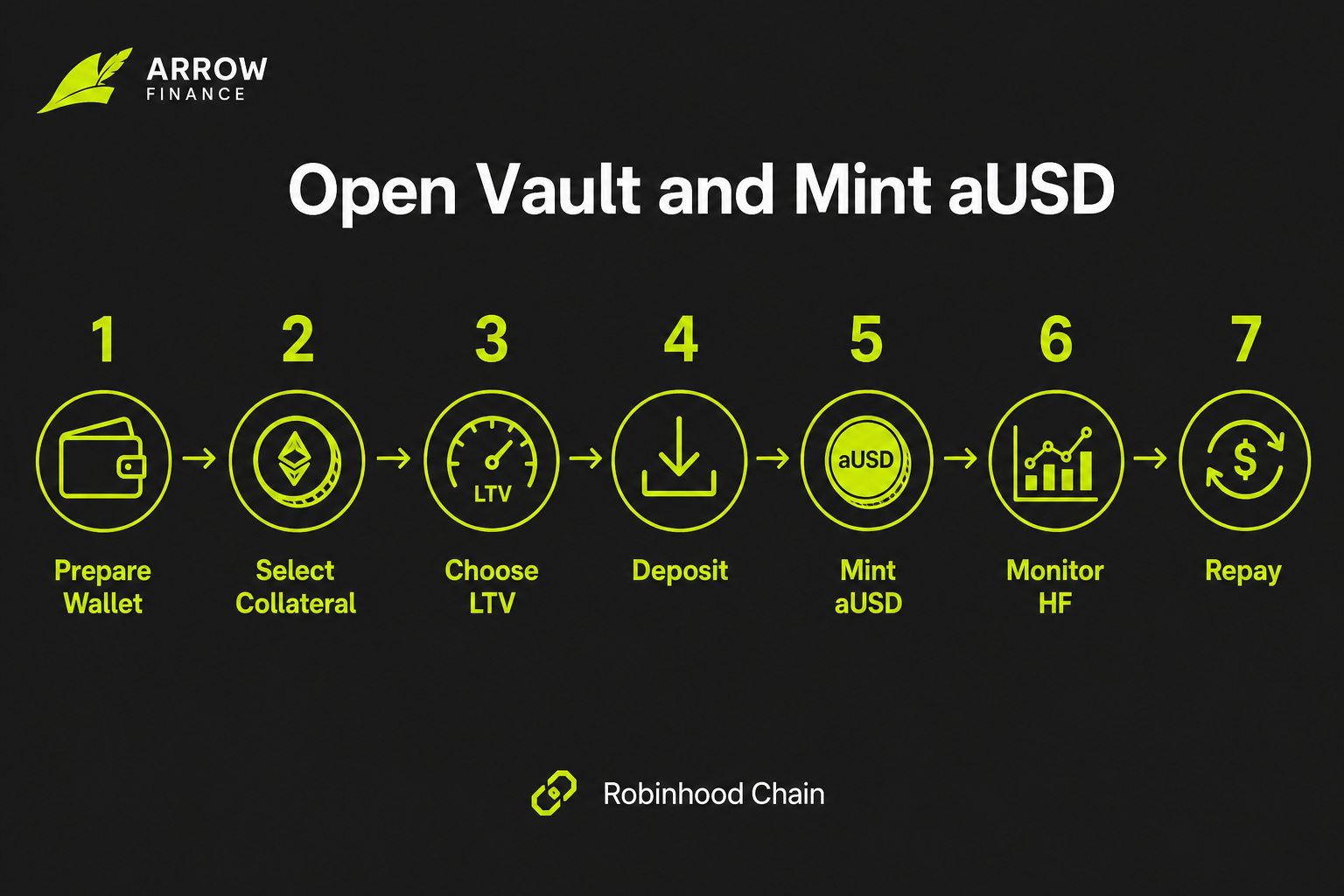 Figure 1. Arrow Finance's seven-step process for opening a Vault and minting aUSD: from asset preparation and LTV selection, to deposit, minting, monitoring, and repayment.
How do you monitor the Vault health factor?
The health factor measures the safety margin of collateral value relative to debt; above 1 is safe, at or below 1 the Vault becomes eligible for liquidation. Continuous monitoring is essential, as price changes, stability fee accrual, and oracle updates can shift the health factor without further user action.
Common triggers for health factor decline include: collateral price drops, debt growth from ongoing stability fee accrual, oracle value reductions, and additional minting without increasing collateral. For tokenized stock Vaults, NAV gaps after market reopening can cause significant health factor changes in a single update. If the health factor drops below 1, the Stability Pool burns the corresponding aUSD debt and acquires collateral at a discount, with a liquidation penalty of approximately 10%–13%. If pool capacity is insufficient, redistribution reallocates debt and collateral to other Vaults.
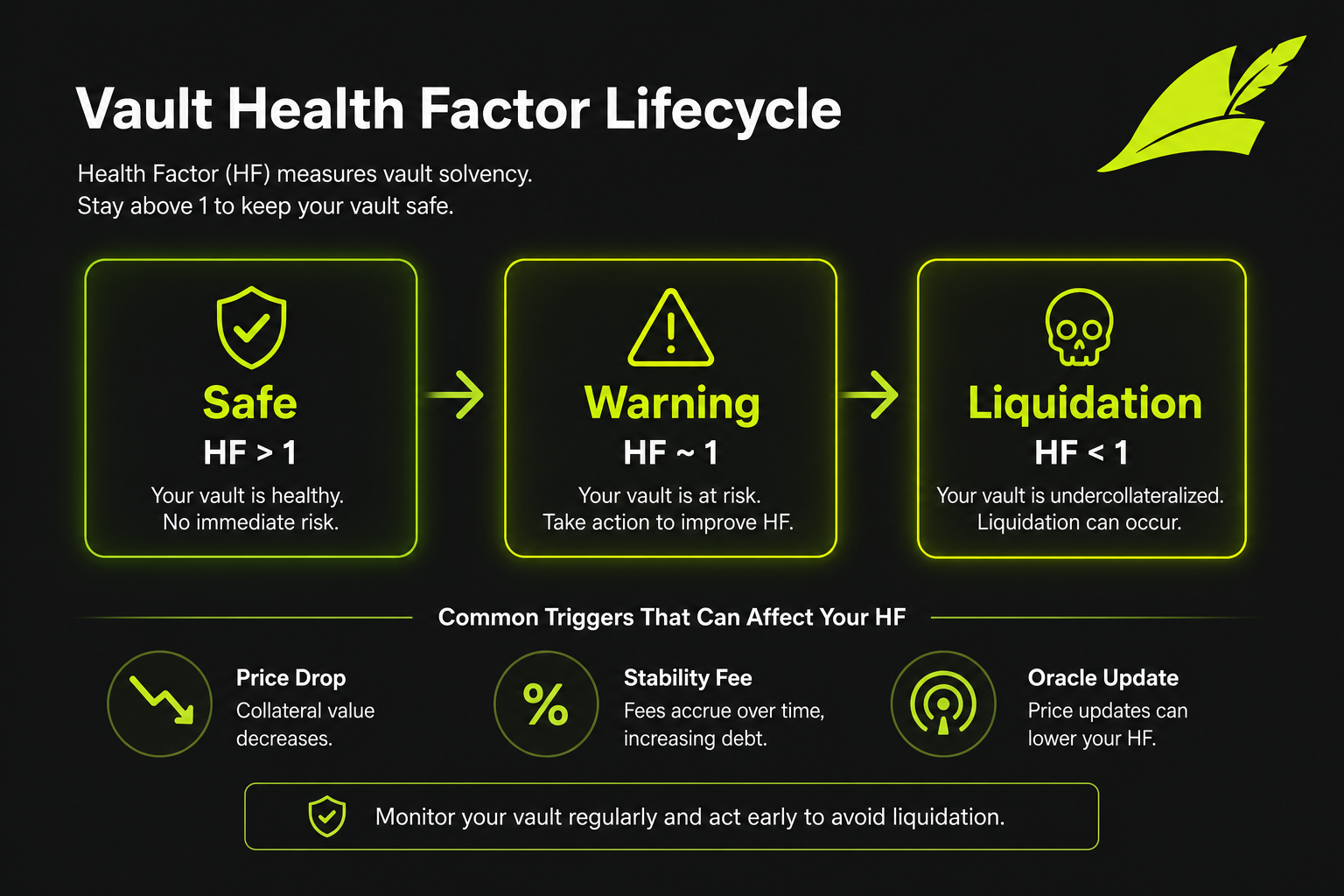 Figure 2. Vault health factor lifecycle: safe, warning, and liquidation stages, with price and fee triggers.
How do you repay and release collateral?
Repayment and collateral release reverse the opening process: the user returns aUSD to the Vault (covering principal and accrued stability fee) → debt balance is zeroed or reduced → collateral is unlocked and transferred back to the wallet. Partial repayment lowers LTV and raises the health factor without requiring full settlement.
Repayment scenarios include: no longer needing debt liquidity, health factor approaching the warning zone, or planning to switch collateral types (current Vault must be repaid before opening a new one). After on-chain confirmation, aUSD is burned, the stability fee moves to the Surplus Buffer; only with full debt repayment is all collateral released.
What fees must be checked during opening and maintenance?
Arrow Finance debt maintenance involves three main fee types—all affecting net cost and long-term health factor.
| Fee Type |
Rate Range |
Charging Method |
Flow Direction |
| Stability Fee |
0.5%–4% APR |
Continuous interest on debt |
Surplus Buffer |
| Liquidation Penalty |
10%–13% |
Triggered at health factor < 1 |
Liquidators and reserves |
| Redemption Fee |
0.25%–2% |
Redeeming aUSD via Router |
Adjusts redemption pressure |
The stability fee accrues over time, increasing debt and health factor pressure during long-term maintenance. Liquidation penalties apply only if a position is liquidated; redemption fees are relevant for aUSD holders, but opening users mainly focus on the first two. Fee parameters are set by ARROW governance; repayment must cover principal plus accrued stability fee up to the moment of repayment.
What risks exist in opening and minting debt?
Price declines are the most direct risk: collateral value falls while debt remains unchanged or grows with fees, causing the health factor to quickly drop below 1. Tokenized stocks also face risks from price gaps during market closure and NAV oracle delays; the protocol may pause borrowing or widen buffers around closure, but cannot eliminate reopening gap risks.
Oracle reliance is a structural risk: crypto assets use Chainlink price feeds, tokenized stocks depend on dedicated NAV oracles. Smart contract vulnerabilities, counterfeit protocols, and erroneous contract interactions are operational risks—always verify through official channels. High-LTV positions face shorter liquidation distances; a single Vault cannot mix collateral types, and large-scale minting may hit protocol-level debt caps.
Summary
Opening a Vault and minting aUSD on Arrow Finance follows a repeatable five-step loop: prepare wallet and approve collateral → select target LTV by asset type → deposit to trigger on-chain debt minting → monitor health factor and stability fee during maintenance → release collateral after repayment. Vaults use a single collateral, single debt structure; health factor above 1 is safe, below 1 triggers Stability Pool liquidation.
FAQ
How do I open a position and borrow aUSD on Arrow Finance?
Connect your wallet on Robinhood Chain, select approved collateral and deposit into the Vault, set the mint amount within the LTV cap, and confirm the transaction. After on-chain confirmation, aUSD is sent to your wallet and collateral is locked in the Vault. Monitor the health factor during maintenance; after repaying debt plus stability fee, collateral can be released.
What is aUSD? How is it minted?
aUSD is a USD-denominated debt token overcollateralized by Vault assets, tracked as ERC-20, and redeemable at face value for underlying collateral via Redemption Router. Minting steps: deposit a single approved collateral → open a Vault → mint aUSD within the LTV cap.
What happens if the Vault health factor falls below 1?
If the health factor drops below 1, the Vault is eligible for liquidation. The Stability Pool burns the corresponding aUSD debt and acquires collateral at a discount, incurring a liquidation penalty of approximately 10%–13%. If pool capacity is insufficient, redistribution reallocates debt and collateral to other Vaults.
How should LTV be set when opening a position?
Set the target LTV below the maximum for the collateral, leaving a buffer for price volatility and stability fee accrual. For stablecoins, use 15–30 percentage points below the maximum LTV; for tokenized stocks, apply a more conservative level, with caps determined by on-chain governance.
What fees must be paid when repaying?
Repayment must cover aUSD principal plus accrued stability fee up to the moment of repayment (about 0.5%–4% APR). Full repayment releases collateral; partial repayment lowers LTV and improves health factor, with remaining debt continuing to accrue interest.
How does tokenized stock collateral differ from crypto asset positions?
Tokenized stocks have lower maximum LTVs (about 55% for primary, 40% for secondary) and may pause borrowing around market closure. Oracles use NAV synchronization and may freeze prices during closure. Crypto assets and stablecoins rely on Chainlink price feeds, have no market closure logic, and generally offer higher parameters.