In the past, global asset allocation was usually a high barrier financial activity. Users who wanted to invest in US stocks, ETFs, gold, or overseas bonds often needed an overseas brokerage account, an international bank card, and a complicated cross-border funding process. For users in many regions, account opening, deposits, and currency exchange all involved considerable friction.
At the same time, the digital asset market is evolving rapidly. With the growth of stablecoins, RWAs, and asset tokenization, crypto platforms are no longer only places to trade BTC and ETH. They are gradually becoming a new gateway connecting global financial markets. Today, some platforms already allow users to use USDT directly to participate in traditional asset trading, including US stocks, ETFs, gold, and crude oil.
At present, most crypto platforms provide exposure to traditional financial assets mainly through CFDs(contracts for difference), tokenized stocks, and RWA products.
Among these, CFDs are one of the most common structures today. Users can trade price movements without actually holding the underlying stocks or commodities. For example, they can use stock CFDs to trade the price trends of Apple, Nvidia, Tesla, or Nasdaq ETFs.
Another model attracting growing attention is tokenized assets. Some platforms map real world stocks, gold, or bonds into on-chain tokens, enabling more flexible global circulation.
As the RWA market expands, more traditional assets are beginning to move on-chain, including:
| Asset Type |
Common On-Chain Form |
| US stocks |
Tokenized Stocks |
| ETFs |
ETF CFD / Tokenized ETF |
| Gold |
Tokenized Gold |
| US Treasuries |
Tokenized Treasuries |
| Crude oil |
Commodity CFD |
This means crypto platforms are gradually forming an on-chain global asset market.
Why Are Stablecoins Suitable for Global Asset Allocation?
The core advantage of stablecoins lies in their global and digital nature.
Traditional cross-border finance relies on banking networks and local currency settlement, while stablecoins such as USDT can move around the clock on blockchain networks. Compared with traditional cross-border transfers, stablecoins usually offer:
-
Faster settlement efficiency
-
Lower cross-border friction
-
Higher global liquidity
-
Stronger on-chain compatibility
As a result, more users are beginning to view stablecoins as a kind of “digital dollar” for global asset allocation.
In practice, users can first hold USDT, then switch into stock CFDs, ETF products, or on-chain gold assets through a crypto platform, completing cross-market allocation in one place.
At present, some crypto platforms already support price trading for a range of traditional financial assets.
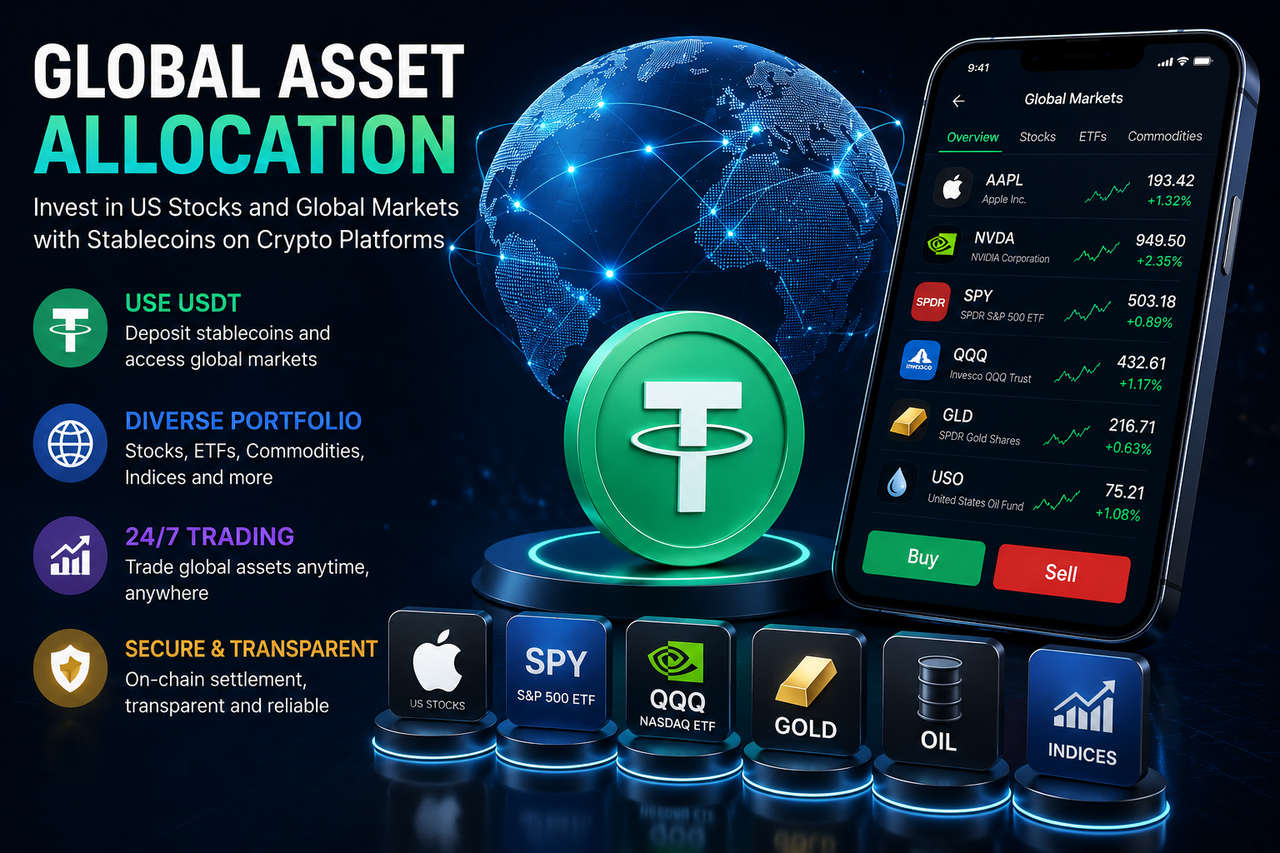
In the stock market, users can usually access:
For ETFs and indices, available products may include:
In addition, gold, crude oil, and some forex products are also beginning to enter crypto platforms through CFD or RWA structures.
This trend shows that global asset markets are gradually becoming more digital and more on-chain.
Although both can provide exposure to global markets, their underlying structures are clearly different.
Traditional brokerages mainly operate around real securities accounts, where users typically hold stocks and fund shares directly. Crypto platforms, by contrast, more often provide price exposure through CFDs or tokenized assets.
The core differences include:
| Comparison Dimension |
Crypto Platforms |
Traditional Brokerages |
| Settlement method |
Stablecoins |
Bank accounts |
| Trading hours |
Some support 24/7 |
Limited by exchange hours |
| Asset structure |
CFD / RWA |
Real securities |
| Global liquidity |
Relatively high |
More regionally segmented |
| Leverage support |
More common |
Relatively limited |
Therefore, crypto platforms place greater emphasis on global liquidity and asset digitization, while traditional brokerages remain closer to the conventional securities system.
Although crypto platforms lower the barrier to cross-border investing, related risks still exist.
First, many stock and ETF products may use CFD or tokenized structures rather than representing real securities holdings. Users need to understand whether they are trading a price derivative or a mapping of real world assets.
Second, regulatory rules for RWAs, stablecoins, and on-chain securities differ across jurisdictions, so platform compliance structures may vary.
In addition, stablecoins themselves may face liquidity, custody, and regulatory change risks. Leveraged trading may further amplify market volatility.
Therefore, before participating in global asset allocation, it remains important to understand the product structure and risk mechanisms.
Conclusion
Crypto platforms are gradually expanding from digital currency exchanges into gateways for global asset trading. Through stablecoins, CFDs, RWAs, and tokenized stock structures, users can now access US stocks, ETFs, gold, crude oil, and other traditional financial assets on the same platform.
FAQs
Can You Invest in US Stocks Directly with USDT?
Some crypto platforms support using USDT to trade US stock related products, but in many cases these are stock CFDs or tokenized stocks, not necessarily real stock holdings.
Not necessarily. Many platforms offer CFDs or on-chain mapped assets, so users need to review the specific product structure and compliance disclosures.
Why Are Stablecoins Suitable for Global Asset Allocation?
Because stablecoins offer global liquidity, around the clock settlement, and low friction transfers, they can improve capital movement efficiency across markets.
What Is RWA?
RWA, or real world assets, refers to the tokenization of real world assets, including stocks, bonds, gold, real estate, and funds.
The main risks include leverage risk, stablecoin risk, regulatory risk, and product structure risk. The asset types and compliance mechanisms offered by different platforms may also vary.







