Open-source software underpins much of today’s internet infrastructure, yet for years, there has been little direct link between developer contributions and financial returns. Many critical projects enjoy widespread adoption but rely on a handful of maintainers to devote time and resources to updates, security patches, and version management. Creating a more sustainable incentive model has long been a central challenge for the open-source ecosystem.
Tea Protocol is a key Web3 initiative focused on incentivizing open-source software. By leveraging Proof of Contribution, the teaRank reputation system, and on-chain rewards, Tea aims to build an economic model that measures the real-world value of open-source projects.
How Does Tea Protocol's Reward Mechanism Work?
Tea Protocol's reward mechanism is built on the principle that "incentive distribution must reflect value contribution." Rather than simply rewarding based on the number of code commits, the protocol seeks to assess a project's actual impact across the entire open-source ecosystem.
Tea constructs a project valuation framework by analyzing software dependency relationships, project activity levels, and historical contribution data. Rewards ultimately flow to projects and contributors that are heavily depended upon, consistently maintained, and deliver significant ecosystem value.
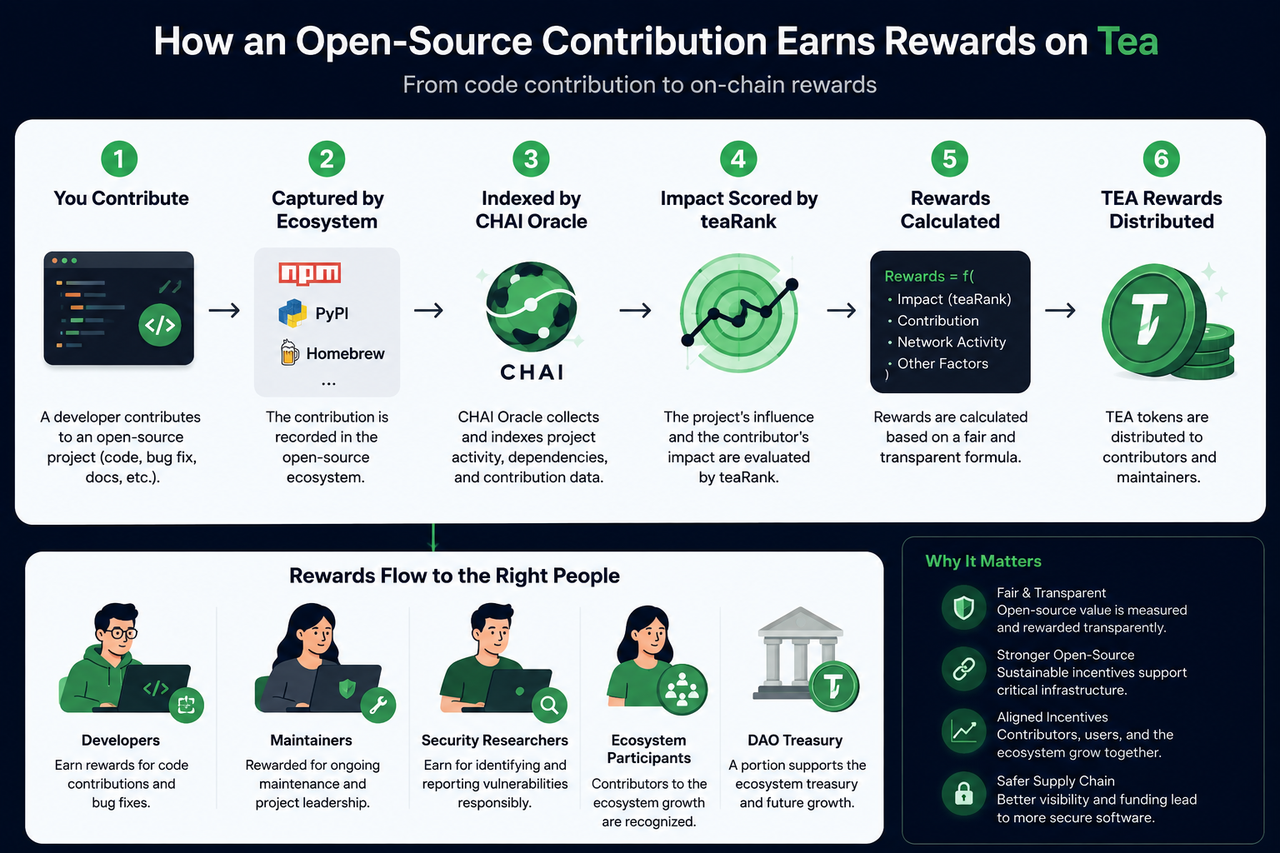
What Happens After a Developer Submits Code?
When a developer contributes code to an open-source project, the contribution is first recorded in the relevant software repository and version history.
Tea Protocol does not directly manage code repositories; instead, it tracks and analyzes project activity by tapping into data sources across the mainstream open-source ecosystem. Code updates, vulnerability fixes, version releases, and sustained maintenance efforts can all factor into the contribution evaluation.
Contributions are not instantly converted into rewards. The process involves data collection, project analysis, and reputation assessment before any activity enters the incentive pipeline.
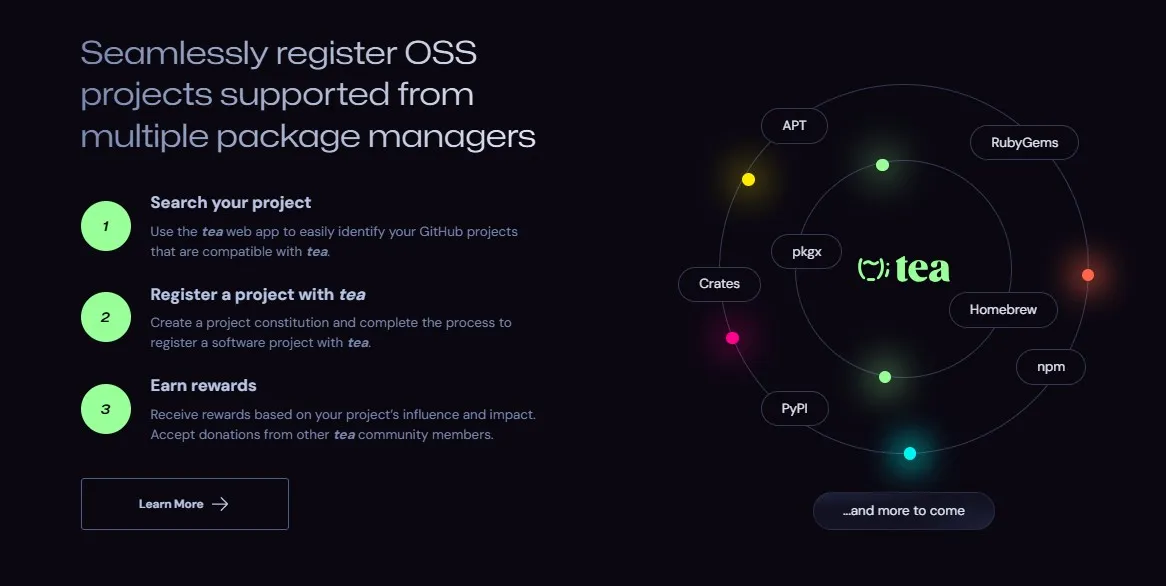
How Are Projects Collected and Analyzed by CHAI?
CHAI (Contribution History and Attribution Infrastructure) is Tea Protocol's core data layer.
CHAI aggregates historical records, dependency relationships, and contribution activities from open-source projects to build a comprehensive software supply chain graph. The system identifies connections between projects and tracks how widely a given software package is actually used across the ecosystem.
For instance, a seemingly modest library—if depended upon by thousands of projects—can wield influence far beyond what its surface metrics suggest. CHAI's role is to uncover these hidden infrastructure projects embedded in the software supply chain.
By continuously refreshing data, CHAI lays the groundwork for subsequent teaRank calculations.
How Is teaRank Updated?
teaRank is Tea Protocol's reputation system for measuring project influence and ecosystem value.
Its calculation considers not only a project's own activity but also its position within the dependency network. Projects with a high number of dependents receive greater weight.
When a project releases a new version, gains more dependents, or receives ongoing community maintenance, its teaRank may increase. Conversely, if a project lacks regular maintenance or its ecosystem influence wanes, its score may be adjusted downward.
This dynamic update mechanism ensures that rewards more accurately reflect a project's true value in the open-source ecosystem.
How Are Rewards Calculated?
Tea Protocol's reward distribution revolves around project influence and contribution value.
First, CHAI gathers project and developer data. teaRank then evaluates each project's importance based on the software dependency network. The protocol calculates reward weight by combining project reputation, historical contribution records, and ecosystem participation.
Because rewards come from a protocol-level incentive system, calculation is not a one-time event but an ongoing, dynamic process. As a project's influence changes, its future reward share may adjust accordingly.
This approach aims to move beyond simple code-count-based rewards and instead emphasize the long-term ecosystem value of contributions.
How Are TEA Tokens Distributed?
TEA is the native token of the Tea Protocol network and the primary vehicle for ecosystem rewards.
Rewards are allocated proportionally based on the weight of projects and contributors within the protocol. Maintainers, developers, and other participants can earn incentives through their contributions.
Beyond contributions, TEA also serves governance and staking functions. Token holders can participate in protocol governance, and certain network participation mechanisms may require staking.
Thus, TEA is more than a reward token—it is a key component connecting governance, incentives, and ecosystem collaboration.
Traditional open-source funding relies heavily on donation platforms, corporate sponsorships, or foundation grants.
In those models, project revenue often depends on community visibility or external funding sources, which may not accurately reflect a project's actual value in the software supply chain.
Tea Protocol emphasizes data-driven valuation. Whether a project receives rewards hinges not only on attention but also on its dependency footprint, maintenance track record, and ecosystem contributions.
Over the long term, Tea aims to create a mechanism that automatically identifies critical infrastructure and provides ongoing incentives—rather than relying on ad‑hoc funding.
Summary
Through CHAI as its data infrastructure, teaRank as its reputation system, and Proof of Contribution, Tea Protocol has built a reward pipeline tailored to the open-source software ecosystem. When developers maintain projects, submit code, or fix vulnerabilities, these actions are logged and influence the project's overall value assessment.
Compared to traditional sponsorship models, Tea prioritizes the real ecosystem value that projects generate—not just donations or popularity. By mapping software supply chain relationships onto an on-chain incentive system, Tea Protocol charts a new path toward sustainable open-source development.
FAQs
Does Tea Protocol distribute rewards based on the number of code commits?
No. Tea Protocol focuses on a project's actual value to the entire open-source ecosystem. Code commits are only one part of the contribution picture. Project influence, maintenance activity, and dependency relationships also affect reward allocation.
What role does CHAI play in Tea Protocol?
CHAI is Tea Protocol's data infrastructure. It collects project histories, dependency relationships, and contribution activities to build a software supply chain graph, providing the foundational data for reputation scoring and reward calculations.
What's the difference between teaRank and GitHub Stars?
GitHub Stars primarily reflect community popularity, while teaRank measures a project's actual impact across the software ecosystem. A widely depended-upon project may have a high teaRank even if its public attention is low.
Do developers get rewards immediately after submitting code?
No. Contributions must go through recording, analysis, and evaluation stages. Rewards are distributed based on a project's long-term value and ecosystem influence—not issued instantaneously.
Is TEA Token only used to reward developers?
No. TEA also powers governance, ecosystem incentives, and staking. Developer rewards are just one of its use cases.