Sahara AI Marketplace is one of the core modules in the Sahara AI ecosystem. It is mainly used for sharing and trading AI data, models, inference services, and AI Agents. As generative AI develops rapidly, the AI industry’s demand for high quality data, model collaboration, and AI service calls continues to grow. At the same time, the limitations of traditional AI platforms in data ownership and revenue distribution are becoming increasingly clear.
In today’s AI industry, most data and model resources are still controlled by centralized platforms. Developers and data contributors usually find it difficult to track how AI assets are actually used. Sahara AI Marketplace attempts to use blockchain mechanisms to build a more open AI collaboration environment, allowing AI data, models, and Agents to be licensed, called, and monetized like digital assets.
What Is the Core Positioning of Sahara AI Marketplace?
Sahara AI Marketplace is positioned as an AI asset collaboration platform. Here, AI assets include not only AI models, but also datasets, inference services, Agents, workflows, and AI APIs.
Compared with traditional AI platforms, Sahara AI Marketplace places greater emphasis on verifiable AI asset origins and transparent revenue distribution. The platform records contribution relationships for AI data and models through on-chain mechanisms, making the use of AI resources traceable.
This design means AI data and models are no longer just internal resources locked inside closed platforms. Instead, they become digital assets that can be licensed, called, and shared within an open ecosystem.
From the perspective of ecosystem roles, the Marketplace usually includes four types of participants: data contributors, model developers, AI service providers, and AI service users. Different participants can collaborate and exchange value around AI resources through a unified market.
How Are AI Data and Models Uploaded?
In Sahara AI Marketplace, developers or data providers can upload AI datasets, models, or AI services, and set the corresponding licensing rules.
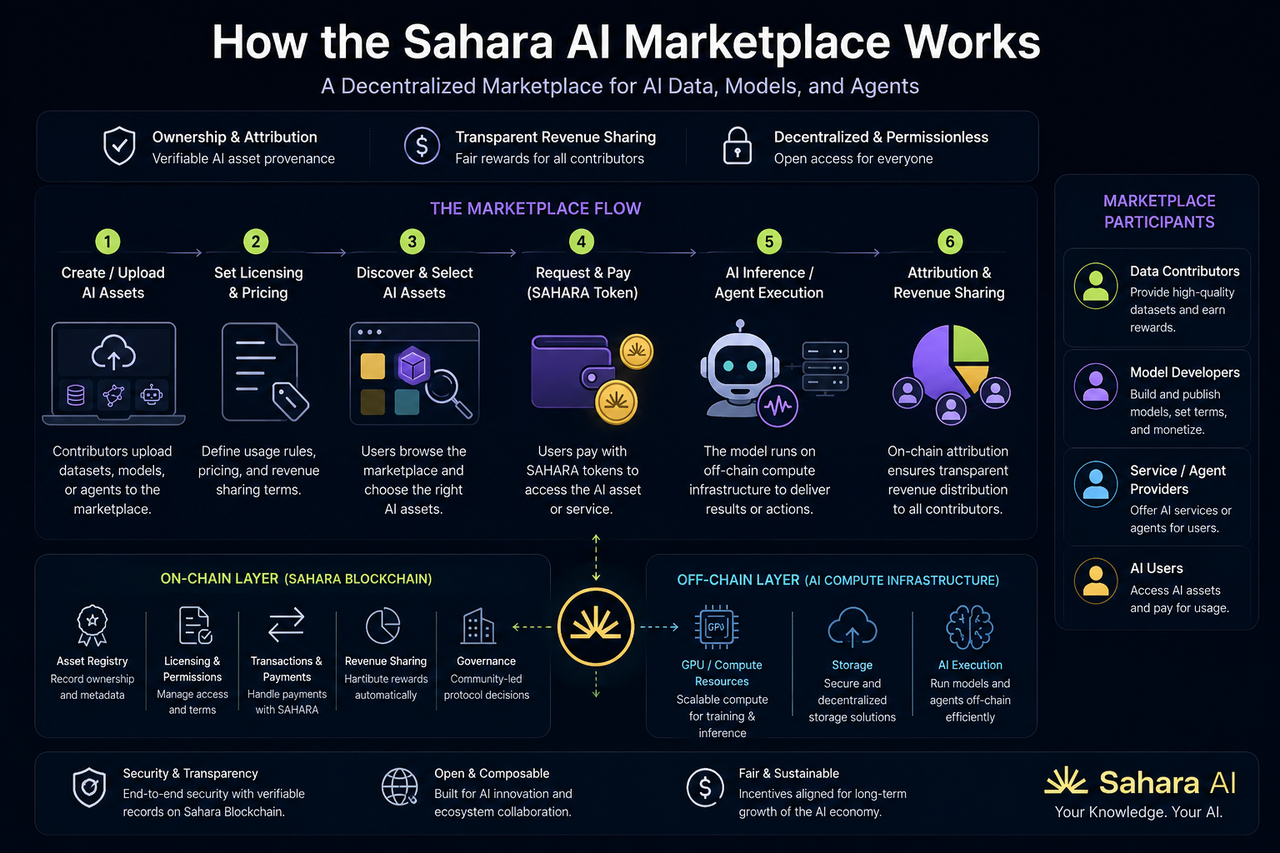
For example, a developer may upload a trained AI model and specify whether commercial use is allowed, whether fees are charged per call, and whether secondary training is permitted.
At the same time, data contributors can also upload data resources and record data sources and contribution relationships through on-chain mechanisms.
Unlike traditional AI platforms, which directly host resources, Sahara AI pays more attention to the attribution and licensing logic of AI assets. Therefore, after a resource is uploaded, the system usually generates a corresponding asset record for later authorization and revenue distribution.
This process is also a foundational part of the Sahara AI Attribution System.
How Does Sahara AI Marketplace Handle Licensing?
The licensing mechanism is one of the core functions of Sahara AI Marketplace.
On traditional AI platforms, the usage rules for models and data are usually controlled by the platform itself. Sahara AI Marketplace, by contrast, allows AI asset owners to set their own licensing conditions.
For example, developers can choose from different models such as pay per call, subscription based licensing, commercial use licensing, or restrictions on specific use cases.
When a user calls an AI service, the system automatically verifies the licensing relationship based on preset rules and records the call activity.
This mechanism can improve transparency in AI asset transactions while reducing centralized platform control over AI resources.
How Do AI Inference Services Run?
AI model training and inference usually require significant GPU computing power, so Sahara AI Marketplace does not execute AI computations directly on-chain.
Instead, the platform uses an “on-chain records plus off-chain execution” model. The blockchain is mainly responsible for recording AI asset ownership, licensing relationships, service call records, and revenue settlement logic, while the actual AI inference is completed by the off-chain computation layer.
For example, when a user calls a certain AI model, the system first verifies authorization and payment status. Then off-chain nodes execute model inference, and the call record is synchronized back to the blockchain.
This structure improves AI service efficiency while avoiding the pressure that complex AI computation would place on blockchain performance.
How Does Sahara AI Marketplace Distribute Revenue?
Revenue distribution is one of the key differences between Sahara AI Marketplace and traditional AI platforms.
On centralized AI platforms, data contributors usually cannot confirm whether their data has been used, and they often find it difficult to share in the resulting revenue. Sahara AI aims to build a more transparent AI revenue system through its Attribution mechanism.
When an AI service is called, the system records which data was used, which models were called, which Agents participated in the task, and who provided the service.
The system then automatically distributes revenue according to preset rules.
For example, an AI model may have been trained on multiple datasets. The Marketplace can distribute part of the revenue to the corresponding data providers based on their contribution relationships.
This model gradually gives AI data, models, and services the characteristics of “sustainable revenue generating assets.”
How Do AI Agents Collaborate in the Marketplace?
AI Agents are an important part of Sahara AI Marketplace.
An AI Agent can be understood as an AI program capable of completing tasks autonomously. It can not only call models, but also access data, execute workflows, and collaborate with other Agents.
In Sahara AI Marketplace, an Agent can be regarded as a callable AI service. For example, an Agent may be responsible for automatically analyzing data, calling multiple AI models, generating content, or executing an AI workflow.
When a user calls an Agent, the system automatically handles the related model calls and revenue settlement.
As AI Agents gradually become an important direction in the AI industry, the Marketplace is also evolving from a simple data market into a collaborative AI service network.
The biggest difference between Sahara AI Marketplace and traditional AI platforms lies in AI asset ownership and revenue mechanisms.
Traditional AI platforms usually operate in a closed model. The platform controls models, data, and revenue distribution rules, while users find it difficult to trace the sources of AI data.
By comparison, Sahara AI Marketplace places greater emphasis on open collaboration and transparent attribution.
| Comparison Dimension |
Sahara AI Marketplace |
Traditional AI Platform |
| Data Ownership |
Traceable on-chain |
Centrally controlled by the platform |
| Revenue Distribution |
Automatically distributed on-chain |
Platform led |
| AI Asset Licensing |
Set independently by users |
Managed uniformly by the platform |
| Agent Collaboration |
Supports open collaboration |
Mostly closed systems |
| Transparency |
Verifiable |
Relatively low |
This structure also makes Sahara AI closer to decentralized AI infrastructure, rather than just an AI service platform.
What Are the Potential Use Cases of Sahara AI Marketplace?
As AI and Web3 continue to converge, the application scenarios for Sahara AI Marketplace are expanding.
In the AI data field, developers can obtain training data and labeling services through the Marketplace. In the AI model field, model developers can upload AI APIs or inference services and earn revenue.
At the same time, AI Agents can also use the Marketplace to call models, execute automated tasks, and participate in the AI collaboration economy.
Beyond individual developers, enterprises may also use this type of platform to build open AI workflows, such as content generation, AI data analysis, and automated AI services.
Conclusion
As the core collaboration layer in the Sahara AI ecosystem, Sahara AI Marketplace is used for the licensing, trading, and revenue distribution of AI data, models, inference services, and AI Agents.
Through the Attribution System, on-chain licensing mechanisms, and off-chain AI execution architecture, the platform enables traceable collaboration and transparent revenue settlement for AI assets.
FAQs
What AI Assets Does Sahara AI Marketplace Support?
The platform supports multiple types of AI assets, including AI datasets, models, inference services, AI APIs, and AI Agents.
How Does Sahara AI Marketplace Distribute Revenue?
The system records contribution relationships for AI data and models through the on-chain Attribution mechanism and automatically completes revenue settlement.
Why Does Sahara AI Marketplace Use Off-Chain AI Execution?
Because AI inference and model training require substantial computing power, off-chain execution improves efficiency and reduces blockchain costs.
Can AI Agents Run in the Marketplace?
Yes. AI Agents can call models, execute tasks, and participate in revenue distribution within the Marketplace.
The core difference lies in AI data ownership, transparent licensing, and on-chain revenue distribution mechanisms.







