As the DeFi derivatives market continues to expand, trading models that rely solely on automated market makers, or AMMs, are beginning to face challenges in performance and liquidity efficiency. This is especially true in high-frequency trading, deep order management, and large leveraged trading scenarios, where more protocols are exploring order book architectures and hybrid trading models.
The perpetual contract market places high demands on low latency, real-time liquidation, and risk control, so order matching and settlement mechanisms often determine a platform’s overall performance. The architecture of Pacifica affects not only trading speed, but also liquidity depth, capital efficiency, and the user’s risk management experience.
What Are Off-Chain Matching and On-Chain Settlement
Off-Chain Matching means that user orders are not matched directly on the blockchain. Instead, order logic is first processed by an off-chain matching engine, including price matching, order sequencing, and trade confirmation.
On-Chain Settlement is responsible for the final asset transfers, position updates, and margin status synchronization. Trade results are submitted to the blockchain network, where the on-chain system completes final confirmation.
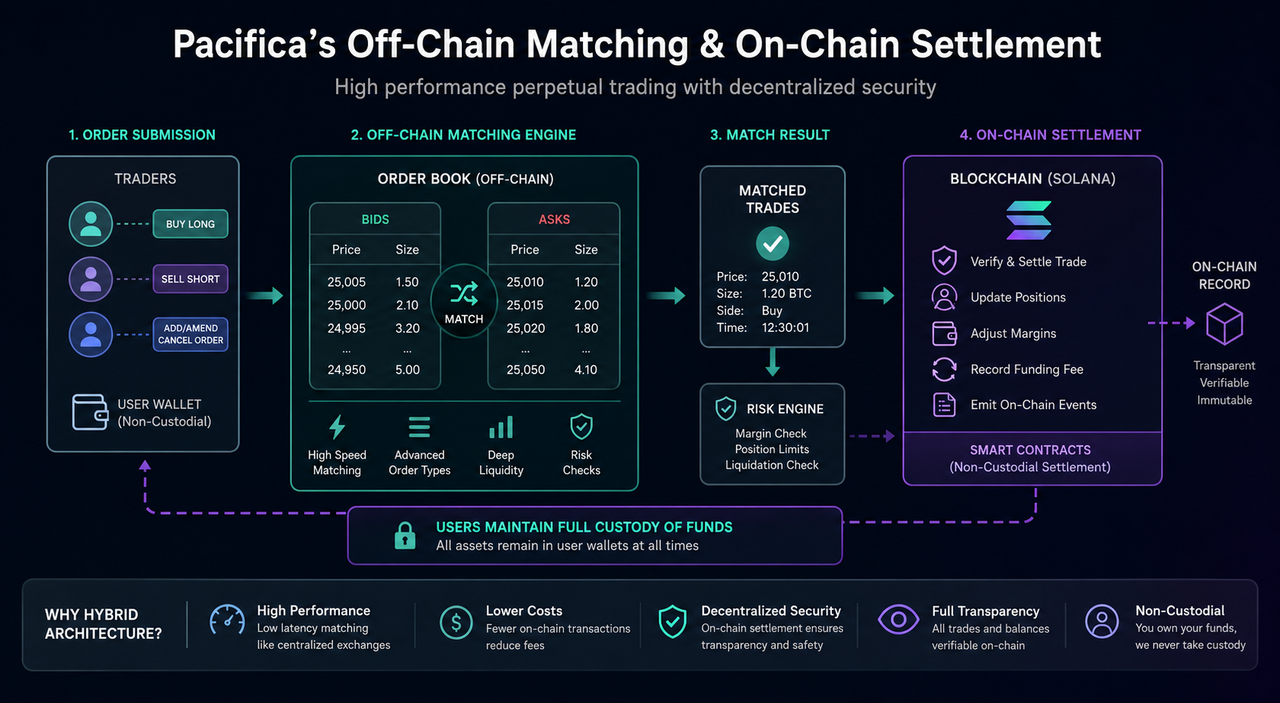
This architecture is essentially a Hybrid DEX model. Its core goal is to improve transaction processing efficiency without completely sacrificing decentralization.
Compared with a fully on-chain order book system, off-chain matching can reduce the computational burden on the blockchain and ease network congestion. Compared with centralized exchanges, on-chain settlement helps preserve fund transparency and user asset self-custody.
How Pacifica’s Order Matching Process Works
In Pacifica, users first connect their wallets to the platform and submit buy or sell orders.
After an order enters the off-chain matching engine, the system sorts orders according to price priority and time priority. The matching engine scans the order book in real time to find counterparties that meet the required conditions.
When the prices of buy and sell orders match successfully, the system generates the trade result and sends the relevant data to the on-chain settlement module.
Because the matching process mainly takes place off-chain, Pacifica can support faster order updates and lower latency. This is especially important for perpetual contract markets, where high-leverage trading is usually more sensitive to price movement and execution speed.
Off-chain matching can also reduce Gas costs. Users do not need to pay on-chain fees for every order modification or cancellation, which improves the overall trading experience.

What Role Does On-Chain Settlement Play in Pacifica
Although order matching happens off-chain, actual asset changes still require on-chain confirmation.
Pacifica’s on-chain settlement system is mainly responsible for several core functions:
-
Updating user position status
-
Adjusting margin balances
-
Recording completed orders
-
Executing funding rate settlement
-
Triggering liquidation and risk control logic
This design ensures that all final trading states can be publicly verified. Users can view position changes and asset flows through blockchain explorers, improving system transparency.
On-chain settlement is also an important part of the non-custodial trading model. User assets are not fully handed over to centralized servers. Instead, they are managed through smart contracts and on-chain accounts.
How Is Pacifica Different From AMM Perpetual DEXs
Traditional AMM perpetual DEXs usually rely on liquidity pool pricing. When users trade, they are essentially exchanging assets with a liquidity pool.
Although this model simplifies market structure, it also has some limitations:
-
Large trades are prone to slippage
-
Liquidity utilization is relatively low
-
Prices may deviate from external markets
-
High-frequency trading experience is limited
Pacifica is closer to an order book trading system. Its price formation mainly depends on market order matching rather than a single liquidity pool algorithm.
Order book architecture is generally better suited to professional trading markets because it can provide more granular price levels and more efficient liquidity management.
However, Hybrid DEXs also face new challenges, such as matching engine reliability, system synchronization speed, and data consistency between off-chain and on-chain components.
On-chain trading systems have long faced a core issue: performance and decentralization often involve trade-offs.
Fully on-chain execution can provide greater transparency, but it is easily constrained by blockchain throughput. Fully centralized systems offer higher performance, but tend to be weaker in user asset security and transparency.
The hybrid architecture used by Pacifica is, in essence, an attempt to find a balance between the two.
By moving high-frequency order processing off-chain, the platform can improve trading performance. By keeping asset settlement and position state records on-chain, it can maintain a certain degree of verifiability and non-custodial security.
Pacifica’s Future Trading Infrastructure Direction
Beyond its current Hybrid DEX architecture, Pacifica also plans to expand unified margin systems, multi-asset collateral, and on-chain lending capabilities.
Unified Margin will allow users to share funds across multiple markets, improving overall capital efficiency.
The platform is also paying attention to the development of real-world asset, or RWA, derivatives markets, with the goal of supporting more on-chain financial products in the future.
Conclusion
Pacifica’s off-chain matching and on-chain settlement mechanism is one of the important technical paths for today’s high-performance DeFi derivatives platforms.
By completing order matching off-chain while preserving on-chain asset settlement and risk control logic, Pacifica can balance trading performance, fund transparency, and non-custodial security to a meaningful extent.
FAQs
What Is Off-Chain Matching?
Off-chain matching means the order matching process is not executed directly on the blockchain, but is instead completed by an off-chain matching engine for price matching and order processing.
Why Does Pacifica Use Off-Chain Matching?
Off-chain matching can reduce trading latency, improve order processing speed, and lower on-chain Gas costs, making it better suited to high-frequency perpetual contract trading.
Are Pacifica Trades Eventually Recorded On-Chain?
Yes. After an order is executed, final asset settlement, position updates, and margin status are synchronized to the on-chain system.
Is Pacifica a Fully Decentralized Exchange?
Pacifica is a Hybrid DEX, meaning a hybrid decentralized trading platform that combines off-chain matching with on-chain settlement.
How Is Pacifica Different From AMM DEXs?
AMM DEXs mainly rely on liquidity pool pricing, while Pacifica is closer to an order book trading model, where market prices are formed through order matching.







