Users who search for the IBC cross-chain trading process of Osmosis are usually trying to understand how it differs from an ordinary cross-chain bridge. This is especially relevant in the Cosmos ecosystem, where assets are often distributed across different application chains. Users need Osmosis to complete interchain asset swaps, liquidity trading, and multichain asset management.
This topic usually involves three layers: how IBC transfers cross-chain assets, how Osmosis connects Cosmos ecosystem chains, and how Swap routing affects trading results.
What Is the IBC Cross-Chain Mechanism
The core of the IBC cross-chain mechanism is to allow different blockchains to securely transfer data and assets between one another. It is not simply an asset custody bridge, but an interchain communication protocol designed for the Cosmos ecosystem.
IBC can be understood as a standardized communication method for multiple independent blockchains. Chains that support IBC can complete interchain asset transfers, message delivery, and state verification without relying on a centralized custodian.
First, a user initiates a cross-chain asset transfer on the source chain. The source chain then locks or records the state of the corresponding asset. Next, the IBC protocol sends the relevant data to the destination chain through an interchain channel. Finally, the destination chain generates or receives the corresponding asset representation based on the verification result.
The importance of this mechanism lies in the fact that chains in the Cosmos ecosystem do not share the same execution environment. Instead, the ecosystem is made up of many application chains. IBC allows these chains to remain independent while still enabling assets and information to move between them.
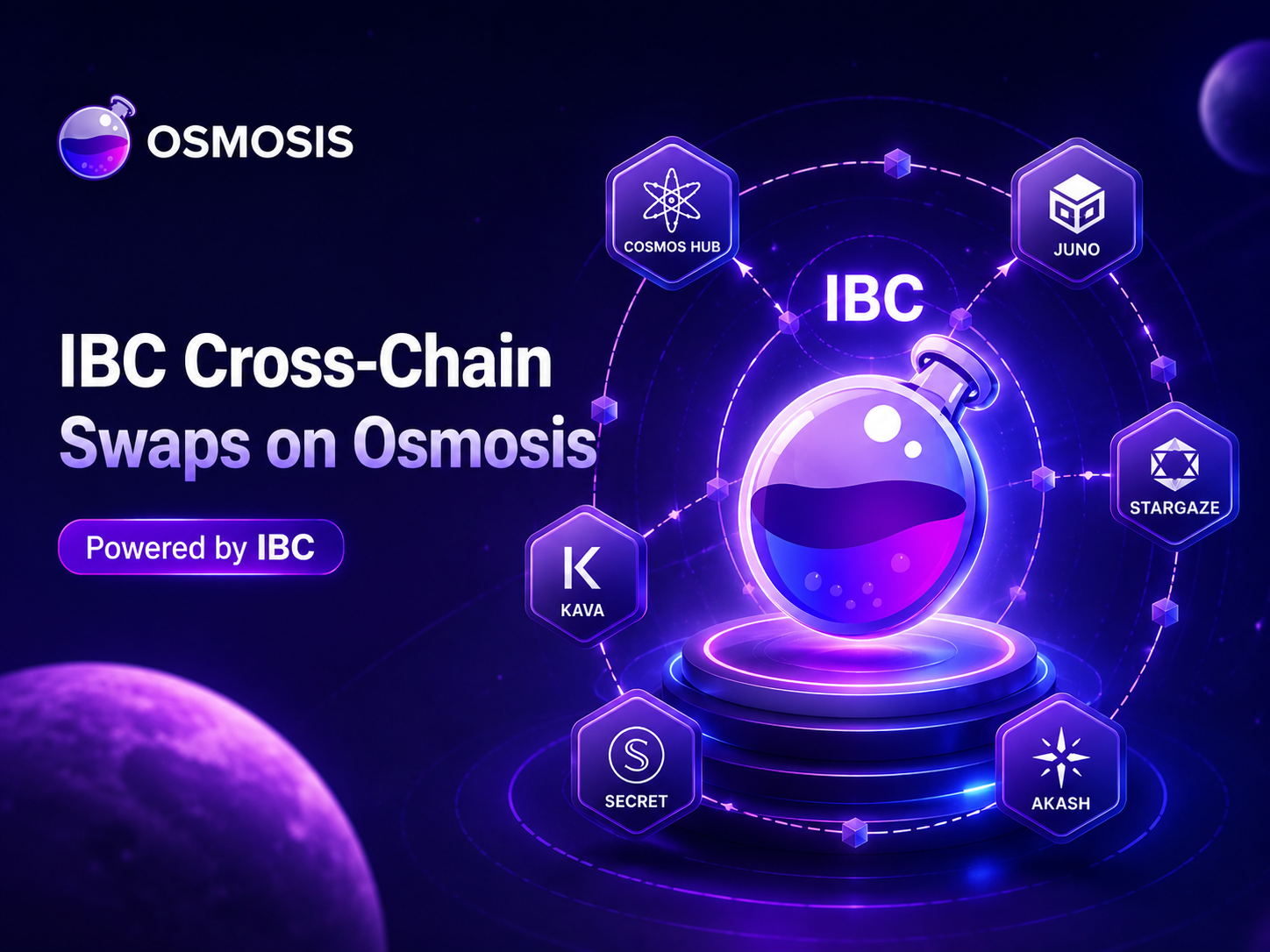
For Osmosis, IBC is the infrastructure behind its cross-chain Swaps. Without IBC, it would be difficult for Osmosis to serve as a cross-chain liquidity hub within the Cosmos ecosystem.
How Osmosis Connects Cosmos Ecosystem Chains
The key to how Osmosis connects Cosmos ecosystem chains lies in the fact that it is built on the Cosmos SDK and natively supports IBC communication. It is not a DEX deployed on a single smart contract platform, but an application chain designed for cross-chain trading.
Structurally, the Cosmos ecosystem consists of multiple independent chains, each of which may have different assets, applications, and validator systems. Osmosis uses IBC to connect with these chains, allowing assets to enter Osmosis liquidity pools and participate in trading.
First, a user holds assets on a chain within the Cosmos ecosystem. The user then transfers those assets into Osmosis through IBC. Next, Osmosis identifies the asset and allows it to enter the corresponding trading pool. Finally, the user can complete a Swap, provide liquidity, or carry out other DeFi operations on Osmosis.
This mechanism means that Osmosis’s trading capacity is not limited to its own native assets. It can become a trading hub for multichain Cosmos assets, bringing liquidity from different application chains into the same AMM environment.
Compared with a single-chain DEX, Osmosis is more like a cross-chain liquidity layer within the Cosmos ecosystem.
How Users Complete Cross-Chain Swaps Through Osmosis
When users complete cross-chain Swaps through Osmosis, the core process can be divided into four parts: asset entry, path matching, trade execution, and asset return. What the user sees is a single exchange operation, while the system handles interchain asset transfer and AMM trading behind the scenes.
First, the user transfers the source-chain asset into Osmosis through IBC. The user action is to select the asset and target network, while the system action is to complete asset transfer and state confirmation through the IBC channel.
The user then selects the target asset they want to receive on Osmosis. Based on liquidity pool conditions, the system determines whether the trade can be completed directly or whether it needs to be routed through an intermediate asset.
Next, the user confirms the Swap. The system executes the trade in the corresponding liquidity pool and calculates the output asset amount, fees, and slippage according to AMM rules.
Finally, the user can choose to keep the swapped asset on Osmosis or transfer it back to the target chain through IBC.
| Process Stage |
User Action |
System Action |
| Asset entry |
Select source-chain asset |
Receive asset through IBC |
| Path matching |
Select target asset |
Match liquidity pools |
| Swap execution |
Confirm transaction |
Swap according to AMM rules |
| Asset return |
Select target chain |
Transfer asset out through IBC |
This process shows that an Osmosis cross-chain Swap is not a single bridging action. It is a combination of IBC transfer and AMM trading.
How Osmosis Handles Interchain Asset Flows
The core of how Osmosis handles interchain asset flows is connecting IBC assets to AMM liquidity pools. After assets enter Osmosis, they participate in trading as IBC assets and form trading pairs with other Cosmos ecosystem assets.
By relying on the IBC asset flow mechanism, Osmosis allows assets from different chains to enter the same trading environment. This means users do not need to look for separate markets on each chain. Instead, they can access more concentrated cross-chain liquidity through Osmosis.
First, the user initiates an IBC transfer from the source chain. Osmosis then receives and identifies the asset. Next, the asset can enter the corresponding liquidity pool and participate in a Swap. Finally, the asset received after the trade can remain on Osmosis or be transferred again through IBC to another chain.
The importance of this structure is that it combines cross-chain asset movement with DeFi trading. Traditional cross-chain bridges often only handle asset transfers, while Osmosis also provides trading, liquidity, and routing capabilities.
However, interchain asset flows can also be affected by IBC channel status, the operating condition of the destination chain, and the range of supported assets. As a result, the cross-chain trading experience depends not only on Osmosis, but also on the stability of the relevant Cosmos chains.
How Routing Mechanisms Affect Trading Paths
The routing mechanism determines whether a user’s Swap can be completed directly and whether the trade needs to pass through an intermediate asset. For Osmosis, routing is an important part of the cross-chain trading experience.
The key point is that there may not always be enough direct liquidity between different assets. If two assets do not have a highly liquid trading pool between them, the system may use another asset as an intermediate path to complete the exchange.
First, the user selects the source asset and target asset. The system then checks whether a direct trading pool exists. Next, if the direct pool does not have enough liquidity, the system looks for a more suitable intermediate path. Finally, the trade is executed according to the matched path, which affects the final amount of assets the user receives.
For example, some trades may use OSMO or a stable asset as an intermediate route. This can improve tradability, but it may also increase the number of trading steps, fees, and slippage.
The importance of routing lies in its direct impact on trading costs, execution efficiency, and price performance. For users, the quote they see is not just the price of a single pool. It is the result of a combined calculation involving path, liquidity, and fees.
How Osmosis Cross-Chain Trading Differs from Traditional Bridging
The biggest difference between Osmosis cross-chain trading and traditional bridging is that Osmosis handles not only asset transfer, but also trade execution and liquidity matching.
Traditional bridging usually focuses on moving assets from one chain to another. After completing the bridge, users still need to find a DEX on the destination chain to trade. Osmosis combines IBC transfer, AMM trading, and liquidity routing within the same cross-chain trading environment.
First, in traditional bridging, users need to choose a bridge protocol and wait for assets to arrive on the destination chain. On Osmosis, users can first transfer IBC assets into the platform and then complete a Swap directly in AMM pools.
Traditional bridging also usually does not handle trading prices or liquidity. Osmosis, by contrast, uses liquidity pools and routing mechanisms to execute trades.
In addition, traditional bridging relies more heavily on the bridge’s custody or validation structure, while IBC places greater emphasis on interchain communication standards within the Cosmos ecosystem.
Ultimately, what users complete on Osmosis is not just a cross-chain transfer, but a cross-chain trade.
| Dimension |
Osmosis IBC Swap |
Traditional Bridging |
| Core goal |
Cross-chain trading |
Asset transfer |
| Underlying mechanism |
IBC communication |
Bridging protocol |
| Trade execution |
AMM liquidity pools |
Usually does not handle trading |
| Routing capability |
Supports path matching |
Usually weaker |
| Use case |
Cosmos ecosystem trading |
Cross-chain asset migration |
This difference shows that Osmosis is better suited to scenarios that require trading and liquidity integration, while traditional bridging is more focused on simple cross-chain asset transfers.
What Risks Can IBC Transactions Face
Although IBC transactions reduce cross-chain friction within the Cosmos ecosystem, that does not mean they are risk free. Users still need to understand potential issues involving interchain communication, liquidity, and trade execution.
Structurally, IBC transactions involve the source chain, destination chain, channel status, validation mechanisms, and Osmosis liquidity pools. If any one of these components encounters an issue, the trading experience may be affected.
First, when users initiate an IBC transfer, the source chain and destination chain need to be operating normally. The cross-chain channel must then transmit data reliably. After the asset enters Osmosis, it is also affected by liquidity pool depth, slippage, and routing path. In the end, the amount of assets the user receives may differ from expectations.
Common risks include channel delays, on-chain congestion, insufficient liquidity, wider slippage, and abnormal destination-chain conditions.
This is especially important for cross-chain Swaps. Users face not only the risk of a single transfer, but also AMM trading risk and path execution risk.
Therefore, although Osmosis’s IBC transactions offer stronger Cosmos-native interoperability, they still need to be understood in relation to trading fees, liquidity depth, and interchain status.
Summary
Osmosis connects Cosmos ecosystem chains through the IBC protocol and completes cross-chain Swaps in AMM liquidity pools. Its core process includes asset transfer in, path matching, Swap execution, and asset transfer out.
Compared with traditional bridging, Osmosis cross-chain trading is not only asset transfer. It combines IBC communication, liquidity pools, and routing mechanisms within the same trading environment.
This model makes Osmosis a cross-chain liquidity hub in the Cosmos ecosystem, but users still need to pay attention to risks such as IBC channels, on-chain status, liquidity depth, and trading slippage.
FAQs
What Is the IBC Cross-Chain Mechanism?
IBC is an interchain communication protocol in the Cosmos ecosystem. It is used to transfer assets and data between different blockchains, allowing independent chains to interoperate.
How Does Osmosis Complete Cross-Chain Swaps?
Users first transfer assets into Osmosis through IBC, then complete a Swap in AMM liquidity pools, and finally can transfer the target asset out to other Cosmos chains.
How Is Osmosis Different from an Ordinary Cross-Chain Bridge?
An ordinary cross-chain bridge mainly handles asset transfer, while Osmosis combines IBC, AMMs, and routing mechanisms to process both cross-chain asset flows and trade execution.
What Does Osmosis’s Routing Mechanism Do?
The routing mechanism matches trading paths based on liquidity pool conditions. It determines whether a trade can be completed directly or needs to pass through an intermediate asset.
What Risks Are Involved in IBC Cross-Chain Trading?
IBC cross-chain trading may face risks such as channel delays, on-chain congestion, insufficient liquidity, wider slippage, and abnormal destination-chain conditions.