In the traditional internet, the TCP/IP protocol solved the problem of information exchange between disparate networks. In the blockchain space, however, the industry faces a critical challenge: how to enable assets, NFTs, identity data, and smart contract information to flow across chains. Openverse aims to solve this by establishing a unified value transmission layer through an open cross-chain protocol, allowing different blockchains to achieve true interoperability.
Understanding Openverse's cross-chain mechanism is key to appreciating the role Layer 0 networks will play in the future multi-chain ecosystem and the direction in which the value internet infrastructure is evolving.
Problems Openverse Solves
The project posits that while the internet solved information transmission, blockchain is now solving value transmission. As digital currencies, NFTs, on-chain identities, and real-world assets are increasingly tokenized, a foundational network that can connect all blockchains is needed to enable these values to move freely.
Openverse therefore does not focus on building a single public chain. Instead, it aims to serve as the base layer that connects different blockchain ecosystems. By providing a unified protocol, assets, identities, and data on different chains can interoperate, significantly reducing the cost of cross-chain collaboration.
This positioning places Openverse closer to the infrastructure layer of the value internet, rather than operating as a single application chain or smart contract platform.
Why Layer 0 Networks Matter
As the blockchain industry has matured, numerous public chains have developed their own independent ecosystems—Bitcoin, Ethereum, Solana, BNB Chain, and many others.
Each of these networks uses different consensus mechanisms, account models, and asset standards, creating inherent isolation. Users who want to transfer assets or share data across multiple chains typically rely on third-party bridge services or centralized intermediaries.
This reliance leads to liquidity fragmentation, higher cross-chain costs, and security risks.
The core goal of Layer 0 is to establish a unified connection layer between different Layer 1 networks. If Layer 1 networks are like individual countries, then Layer 0 is the global transportation network connecting them. It does not handle the execution of specific applications; rather, it facilitates value transmission and communication across chains.
For the future multi-chain world, the cross-chain capability provided by Layer 0 could prove as fundamental as TCP/IP was for the internet.
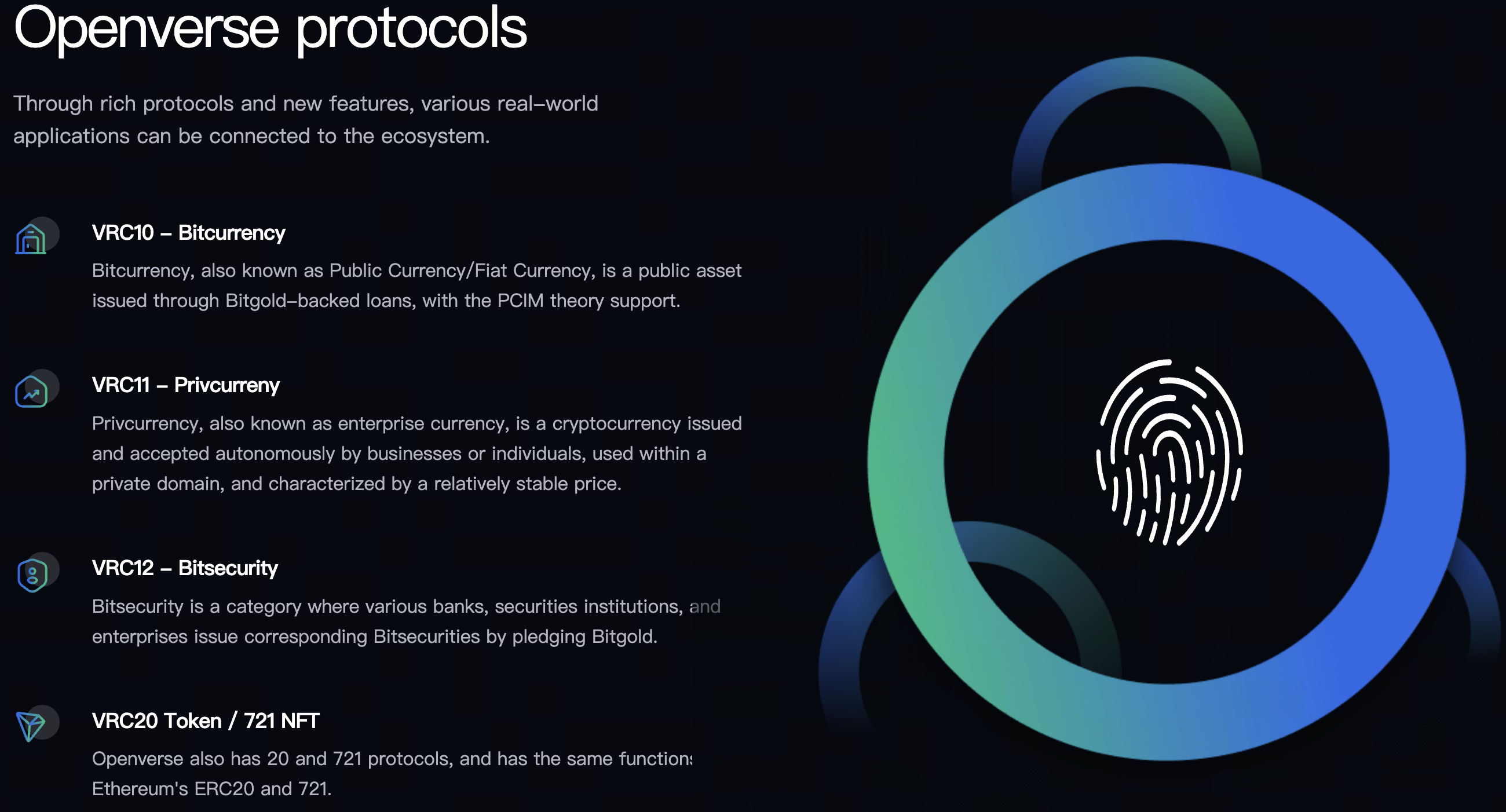
Source: openverse.network
Openverse's Cross-Chain Protocol Architecture
Openverse's core concept is a Fully Open Protocol Cross-Chain architecture. Traditional cross-chain bridges typically rely on centralized custody or isolated bridge networks. When assets move from Chain A to Chain B, they depend on bridge nodes to lock the original asset and issue a representation on the target chain.
Openverse, by contrast, embeds cross-chain capabilities directly into the network protocol layer, removing the need for separate bridging services.
In this architecture, Openverse establishes a unified communication standard that allows different blockchains to recognize each other's data structures and state changes. No matter which chain an asset originates from, it can be verified and transferred using a standardized protocol.
This approach reduces integration costs between blockchains while improving the system's openness and scalability.
How Tokens and NFTs Cross Chains
Openverse supports cross-chain circulation for digital assets across different blockchains. For standard tokens, the goal is to maintain consistent total supply and ownership status. When a user transfers an asset from Chain A to Chain B, the system must ensure the asset is not duplicated across chains. The process therefore involves three steps: asset locking, state verification, and target chain mapping.
| Cross-Chain Phase |
Primary Function |
| Asset Locking |
Prevents dual circulation |
| State Verification |
Confirms the validity of the cross-chain request |
| Target Chain Mapping |
Generates corresponding assets on the destination chain |
For NFTs, in addition to transferring ownership, metadata, copyright information, and identity attributes must also be synchronized. Because each NFT is a unique digital asset, cross-chain transfers must preserve its uniqueness and integrity. Openverse's architecture is designed to allow both tokens and NFTs to flow simultaneously, enabling assets to be used and traded across different ecosystems.
How the Messaging Mechanism Works
Asset cross-chain is only one part of interoperability. An even more critical component is cross-chain messaging, which allows smart contracts on different blockchains to communicate directly. For example, an application deployed on Chain A could send instructions to Chain B and trigger specific actions there.
This capability is essential for building cross-chain DeFi protocols, cross-chain DAOs, and on-chain identity systems.
In Openverse's architecture, messaging goes beyond simple data transmission. It also verifies the data's source and execution status. The network uses validator nodes to confirm the authenticity of messages and then synchronizes the validated results to the destination chain.
Cross-chain messaging elevates the relationship between blockchains from simple asset transfers to application-level collaboration, pushing the multi-chain ecosystem toward a unified network.
How Network Security Is Guaranteed
Security is one of the greatest challenges facing cross-chain systems. In recent years, several high-profile cross-chain bridge attacks have demonstrated that these protocols are among the riskiest components in the blockchain ecosystem. If the verification mechanism is compromised, attackers could forge assets or tamper with cross-chain data.
To mitigate these risks, Openverse employs a security architecture that combines DPoS (Delegated Proof of Stake) and PoH (Proof of History).
DPoS establishes a network of validator nodes. By requiring validators to stake tokens, it raises the cost of carrying out an attack. PoH provides a trusted, verifiable chronological order of events, helping the network confirm the sequence of cross-chain transactions.
| Security Component |
Function |
| DPoS |
Node validation and consensus |
| Staking |
Economic security guarantee |
| Validator Network |
Cross-chain data validation |
| PoH |
Timestamp and event ordering |
This design creates a unified validation layer that allows cross-chain assets, NFTs, and messages to be transmitted in a trusted environment.
As the ecosystem grows and the number of validator nodes increases, the overall security of the network improves accordingly.
Summary
Openverse uses a Layer 0 architecture to build a cross-chain infrastructure for the value internet. Its goal is to connect assets, identities, and data systems across different blockchains.
Its core mechanisms include an open cross-chain protocol, token and NFT cross-chain capabilities, a cross-chain messaging system, and a security model based on DPoS and PoH. Unlike simple asset bridge solutions, Openverse focuses on creating a unified value transmission network that enables true interoperability between blockchains.
As multi-chain ecosystems continue to expand, cross-chain interoperability is becoming a critical piece of blockchain infrastructure. Layer 0 networks may well become the foundational architecture of the future value internet.
FAQ
Is Openverse a Layer 0 or Layer 1 network?
Openverse is positioned as a Layer 0 network. It serves primarily to connect different blockchains and provide cross-chain interoperability, rather than running its own application ecosystem.
How does Openverse achieve cross-chain?
Openverse uses an open, protocol-based cross-chain architecture to transmit and verify tokens, NFTs, and messages across different blockchains.
Does Openverse support NFT cross-chain?
Yes. One of Openverse's core design goals is to allow NFTs and their associated metadata to circulate freely across a multi-chain ecosystem.
What is the difference between cross-chain messaging and asset cross-chain?
Asset cross-chain transfers tokens or NFTs, while cross-chain messaging enables smart contracts and applications on different blockchains to communicate and coordinate with each other.
How does Openverse ensure cross-chain security?
Openverse combines DPoS, PoH, a validator node network, and a staking mechanism to validate cross-chain data and enhance overall network security.







