As the blockchain industry evolves from a single-chain to a multi-chain era, data, assets, and applications across different networks have become increasingly fragmented. Ecosystems like Ethereum, Arbitrum, Avalanche, Cosmos, and Solana each operate with their own independent liquidity and Smart Contract environments, but direct interaction between these chains is rarely feasible.
Early cross-chain bridges were primarily used for asset transfers—for instance, moving tokens from Ethereum to another chain. However, as the complexity of Web3 applications continues to grow, simply supporting token transfers no longer meets developer demands. More cross-chain applications now require "inter-chain Smart Contract communication," such as cross-chain DeFi, inter-chain governance, cross-chain gaming, and chain abstraction Wallets.
Against this backdrop, cross-chain message protocols have become a critical component of Web3 infrastructure. The market needs more than just "cross-chain bridges"; it needs a communication layer that enables blockchains to directly exchange information and execute logic.
What Is General Message Passing (GMP)?
General Message Passing (GMP) is a cross-chain message communication mechanism provided by Axelar that facilitates Smart Contract calls between different blockchains.
Traditional cross-chain bridges typically only handle asset locking and mapping—users lock tokens on the source chain, and corresponding assets are minted on the destination chain. GMP, however, can transmit not only tokens but also "execution instructions."
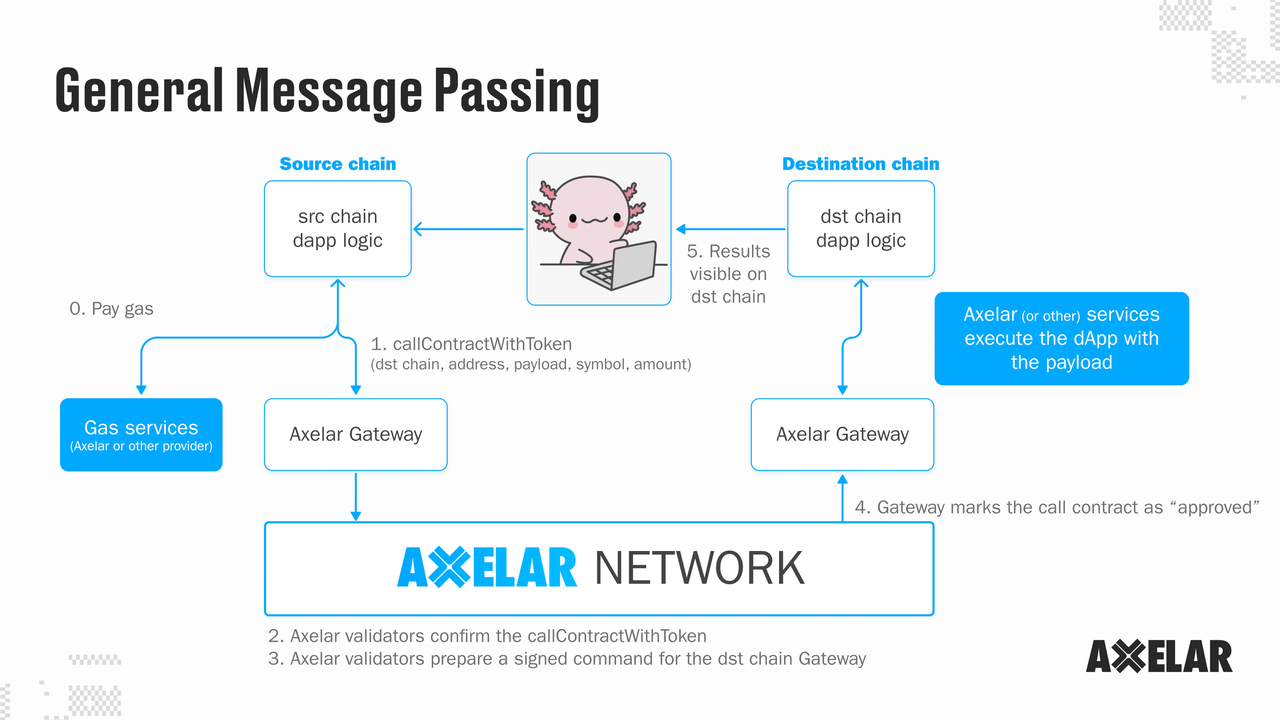
With GMP, developers can send function call requests across chains, enabling the destination chain's Smart Contract to automatically execute the corresponding logic. This means blockchains are no longer limited to asset flow relationships but can establish true inter-chain application interactions.
From an architectural standpoint, GMP functions like a cross-chain API system, allowing different blockchains to communicate with each other as seamlessly as internet services.
How Is GMP Different from Traditional Cross-Chain Bridges?
The key difference between GMP and traditional cross-chain bridges lies in their focus: GMP is not about asset transfer but about executing cross-chain logic.
Traditional cross-chain bridges typically follow a "lock assets — verify event — mint assets on destination chain" model, with the primary goal of token liquidity migration. In complex application scenarios, however, developers often need to call functions across chains, synchronize state, and automatically execute trading logic.
GMP, on the other hand, allows developers to send cross-chain messages directly. For example, a DeFi application could trigger lending logic on the source chain and automatically complete a swap or liquidation on the destination chain.
As a result, GMP is considered a foundational capability for chain abstraction and cross-chain applications.
How Is a GMP Message Initiated?
A GMP communication typically starts with an operation initiated by a user or application on the source chain.
The developer calls the Axelar Gateway contract on the source chain and submits a cross-chain message. This message usually includes the destination chain, the target contract address, the function to execute, and related parameters.
Once the transaction is confirmed, the Gateway logs the event and broadcasts it to the Axelar Validator network.
From the user's perspective, this process looks like a regular on-chain transaction, but under the hood, the cross-chain communication flow has already begun.
How Do Axelar Validators Confirm Cross-Chain Messages?
Axelar uses an independent Proof-of-Stake (PoS) Validator network to secure cross-chain operations.
When an event is emitted from the source chain Gateway, Axelar Validators monitor the corresponding chain's state changes and verify the authenticity of the message. After multiple Validators reach consensus, the network generates a signature.
This process is similar to transaction confirmation in blockchain networks, but instead of a regular transfer, it validates a cross-chain messaging event.
Because Validators must stake AXL tokens, malicious behavior is penalized through slashing. This mechanism enhances the security of cross-chain communication.
How Is a GMP Message Executed on the Destination Chain?
Once the Validator network reaches consensus, Axelar sends a verified cross-chain execution request to the Gateway on the destination chain.
Upon receiving the message, the destination chain Gateway calls the target Smart Contract and executes the specified function. For example, a cross-chain DeFi application can automatically complete swaps, lending, or liquidity operations.
This process is handled entirely by the Smart Contract on the destination chain, requiring no manual action from the user.
From an architectural perspective, GMP effectively enables "Chain A to call a Smart Contract on Chain B"—a capability that traditional bridging solutions struggle to deliver.
How Are Gas and Fees Generated for GMP?
Since GMP execution involves multiple chains, the fee structure is relatively complex.
Users typically need to pay for source chain Gas, cross-chain verification fees, and destination chain execution fees. Axelar provides a Gas Service to centrally manage destination chain execution costs.
Developers can prepay for destination chain Gas, eliminating the need for users to hold Gas tokens on multiple blockchains.
This mechanism is particularly important for the chain abstraction experience, as it reduces the operational overhead of multi-chain interactions.
What Challenges Does GMP Face?
While GMP offers enhanced cross-chain capabilities, cross-chain communication still presents certain complexities.
First, confirmation times vary between blockchains, making cross-chain execution generally slower than single-chain transactions. Second, the security model in a multi-chain environment is more complex, making cross-chain protocols a prime target for attackers.
Additionally, as the number of supported chains increases, verification and maintenance costs rise. Striking a balance between security, efficiency, and decentralization remains a challenge for all cross-chain protocols.
Conclusion
Axelar's General Message Passing (GMP) is a cross-chain messaging mechanism that enables Smart Contract calls and state synchronization between different blockchains.
Unlike traditional cross-chain bridges, which focus primarily on asset transfers, GMP emphasizes "cross-chain logic execution," allowing developers to build composable cross-chain applications across multiple blockchains.
A GMP message typically goes through several steps: initiation on the source chain, validation by Validators, Axelar consensus, and execution on the destination chain, with security maintained by a decentralized Validator network.
FAQs
What is the difference between GMP and ordinary cross-chain bridges?
Ordinary cross-chain bridges focus on asset transfers, while GMP emphasizes cross-chain messages and function execution.
Does GMP support cross-chain Smart Contract calls?
Yes. Developers can use GMP to directly call Smart Contract functions across different blockchains.
How does Axelar verify cross-chain messages?
Axelar uses a PoS Validator network to monitor source chain events and confirms message authenticity through a consensus mechanism.
Can GMP only be used for EVM chains?
No. Axelar supports multiple ecosystems, including EVM chains and selected Cosmos ecosystem chains.
Why is GMP related to chain abstraction?
GMP abstracts away the underlying complexity of cross-chain interactions, allowing users to complete actions without needing to know which blockchain they are on. This makes it a key infrastructure for chain abstraction.
Who pays the fees for GMP?
Typically, the user or the application pays, covering source chain Gas, cross-chain verification fees, and destination chain execution fees.
Does GMP have security risks?
Like all cross-chain protocols, GMP must address security challenges in a multi-chain environment. Its verification mechanism and network security design are therefore critical.







