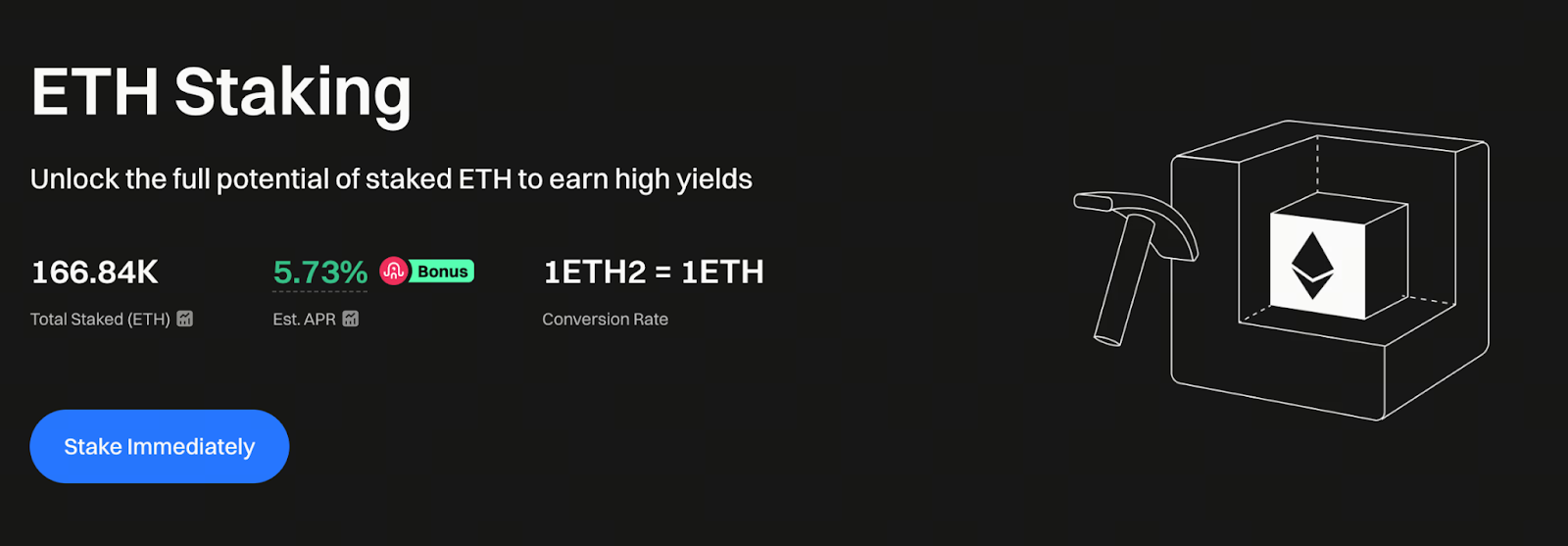
Gate ETH Staking: Earn Up to 5.73% Annual Yield

Beginner
Quick Reads
Last Updated 2026-03-29 03:31:57
Reading Time: 1m
This version of the staking plan strongly emphasizes accessibility and flexibility. The minimum entry requirement is exceptionally low—staking starts at just 0.00000001 ETH. Participants can join with ease. There are no lock-up periods, so users can redeem their assets at any time, ensuring maximum liquidity and financial agility.

Key Advantages of ETH On-Chain Staking

As a foundational asset among public blockchains, Ethereum staking continues to be a major focus for investors. Responding to market demand, Gate has introduced optimized enhancements. According to the latest data, users can earn up to 5.73% annualized yield, plus additional IKA token rewards. ETH staking now offers more than just reliable passive income—users enjoy increased flexibility and potential for long-term growth.

Accessible, Low-Barrier Participation for Everyone

This staking program is designed for maximum accessibility and adaptability:

  • Ultra-low minimum: Start staking with as little as 0.00000001 ETH.
  • No lock-up requirements: Withdraw assets at any time, maintaining liquidity.
  • Daily reward payout: Rewards are credited swiftly, reducing wait times.

Whether you are new to crypto or a seasoned ETH investor, you’re free to participate according to your own investment strategy.

Tiered Yield Structure

The upgraded offering adopts a tiered rewards framework to encourage broader participation:

  • Base annual yield: 2.73%
  • 0 – 700 ETH: 3.23% (+0.5% bonus yield)
  • 700 – 1000 ETH: 5.73% (+3% bonus yield)

Additionally, stakers qualify for extra IKA token incentives. Because the reward pool is limited, early adopters have the opportunity to secure more attractive reward terms.

Users can participate in Gate’s ETH staking to begin their on-chain yield journey: https://www.gate.com/staking/ETH?ch=ann46659

Automated Reward Distribution

Gate’s staking service features fully automated calculation and payout protocols:

  • Rewards are calculated daily and distributed the next day, ensuring transparent and prompt payouts.
  • IKA rewards are automatically credited—no manual actions required.
  • APR is updated in real time, dynamically reflecting market conditions and total staked amounts.

This streamlined system minimizes complexity, letting users focus on their investment strategy.

How to Join ETH Staking

  • Web: Navigate to “Earn” → “On-Chain Earn,” search for ETH, and stake.
  • App: Go to “Earn” → “On-Chain Earn,” search for ETH, and stake.

Security and Risk Controls

Before launch, Gate carried out rigorous protocol security and risk assessments, and selected multiple high-quality PoS projects to diversify exposure. Nevertheless, users should carefully evaluate investment risk based on their own tolerance. ETH staking may be unavailable in certain jurisdictions, including the U.K., due to local regulations. Please review the official User Agreement for details.

User Agreement: https://www.gate.com/legal/user-agreement

Summary

Gate’s enhanced ETH on-chain staking solution, as of publication, delivers up to 5.73% annualized return. With a low entry threshold, no lock-up period, tiered rewards, and IKA incentives, it offers users a flexible, high-potential investment alternative. For long-term Ethereum believers, it’s an ideal gateway to passive income and sustained portfolio growth.

Author: Allen
Disclaimer
* The information is not intended to be and does not constitute financial advice or any other recommendation of any sort offered or endorsed by Gate.
* This article may not be reproduced, transmitted or copied without referencing Gate. Contravention is an infringement of Copyright Act and may be subject to legal action.

Related Articles

AI-Native Settlement Layers: How United Stables Is Building the Next Financial Rail
Beginner

AI-Native Settlement Layers: How United Stables Is Building the Next Financial Rail

Stablecoins were originally designed as dollar substitutes within exchanges, primarily used for asset pricing and trade settlement. As on-chain financial ecosystems have matured, their role has expanded beyond simple payments to include collateral assets, cross-chain liquidity mediums, and unified settlement units. In particular, as AI systems and automated agents begin to participate directly in economic activity, demand has risen sharply for programmable value units capable of instant settlement. This shift is pushing stablecoins toward the role of foundational financial infrastructure.
2026-03-25 03:16:17
The ve(3,3) Flywheel Explained: How AERO Tokenomics Powers Aerodrome’s DeFi Economy
Beginner

The ve(3,3) Flywheel Explained: How AERO Tokenomics Powers Aerodrome’s DeFi Economy

In the competition for DeFi liquidity, high-inflation mining alone is no longer enough to build lasting advantages. Aerodrome applies the ve(3,3) economic model to redesign token emissions, voting mechanisms, and revenue distribution, creating a liquidity flywheel centered on governance and cash flow. This article examines AERO tokenomics, the veAERO locking mechanism, and protocol revenue models to explain how Aerodrome builds a sustainable DeFi economic system.
2026-03-25 06:41:58
Aerodrome Tokenomics: How ve(3,3) Powers Base's Most Profitable DEX
Beginner

Aerodrome Tokenomics: How ve(3,3) Powers Base's Most Profitable DEX

AERO is the native token of Aerodrome Finance, a core decentralized exchange and liquidity protocol in the Base ecosystem. It is primarily used for liquidity incentives and ecosystem operations. veAERO is a governance NFT that users receive by locking AERO, representing both voting power and the right to share protocol revenue. Through a dual track structure of AERO as a utility token and veAERO as a governance credential, Aerodrome separates liquidity usage value from long term governance power, allowing participants to act as liquidity providers, governance decision makers, and revenue sharers within the same system.
2026-03-25 06:40:31
DePIN Identity Network and Real World Applications: How Humanity Protocol Brings on-chain Identity Into the Physical World
Beginner

DePIN Identity Network and Real World Applications: How Humanity Protocol Brings on-chain Identity Into the Physical World

Most Web3 identity systems remain confined to on-chain environments and struggle to achieve meaningful adoption in real world settings. Through a DePIN architecture and physical verification hardware, Humanity Protocol aims to bring decentralized identity into access control systems, hospitality, public services, and offline events, allowing on-chain identity to function not just as a digital credential, but as foundational infrastructure for real world access.
2026-03-25 07:40:53
How is the price of PAXG determined? Pegging mechanism, trading depth, and influencing factors
Beginner

How is the price of PAXG determined? Pegging mechanism, trading depth, and influencing factors

PAXG (Pax Gold) is a tokenized asset backed by physical gold reserves, launched by fintech firm Paxos and issued as an ERC-20 token on the Ethereum blockchain. The core concept is to digitally represent real-world gold assets, allowing investors to hold and trade gold via the blockchain network. Because each PAXG token corresponds to a specific quantity of physical gold, its price is theoretically expected to closely track the global gold market.
2026-03-24 19:11:40
How Does PAXG Work? In-Depth Overview of the Physical Gold Tokenization Mechanism
Beginner

How Does PAXG Work? In-Depth Overview of the Physical Gold Tokenization Mechanism

PAXG (Pax Gold) is a tokenized asset backed by physical gold, issued by the fintech company Paxos and traded on the Ethereum blockchain as an ERC-20 token. The core concept is to tokenize physical gold on-chain, with each PAXG token representing ownership of a certain amount of gold. This structure enables investors to hold and trade gold in the form of a digital asset.
2026-03-24 19:12:51