“Recognizing crypto as a financial asset or financial product” means lawmakers or supervisors formally place bitcoin and similar digital assets in categories with investment-tool logic—not payment-only management.
There is no single global crypto statute. Jurisdictions split rules through specialized financial-instruments statutes, securities case law, or multi-category crypto ordinances. For investors and institutions, checking “how the local system labels the asset” is the first step toward understanding product compliance boundaries.
What Does Financial-Asset / Financial-Product Recognition Mean?
In regulatory language, recognition usually has three layers: legal texts bring specified digital assets or crypto trading into financial-market oversight; issuers, venues, or intermediaries face capital-market style disclosure and investor-protection duties; and funds, ETFs, or other collective vehicles may—where conditions allow—hold digital assets as underlyings.
Recognition is not “every token is a security.” Securities analysis emphasizes investment contracts, expectation of profits, and common enterprise. Financial-instruments law is a broader category in some civil-law systems covering securities and other supervised trading tools. Payment tokens, utility tokens, and stablecoins may sit in different sub-classes—or under multiple lines at once.
How Does Japan Bring Crypto Under Financial-Instruments Law?
Japan is shifting crypto from a Payment Services Act payment-tool posture toward Financial Instruments and Exchange Act (FIEA) financial-product supervision. After the shift, crypto trading, issuance, and intermediation use capital-market style tools: disclosure, insider-trading rules, stricter penalties for unregistered operators, and a category basis for spot crypto ETFs and similar products.
Japan’s FSA details duties for exchanges, issuers, and investors in implementing rules. FIEA classification is a category change—not automatic ETF approval. Financial product vs payment method contrasts Japan’s PSA and FIEA roles.
How Do the United States and the EU Define Crypto Assets?
The United States has no single “crypto act.” The SEC and CFTC divide oversight under securities law, commodities law, and case law. The SEC treats tokens that fit investment-contract features as securities; bitcoin is often discussed as a commodity or commodities-law asset in enforcement and public statements; ETF approvals follow fund and securities review at the SEC.
The EU’s Markets in Crypto-Assets Regulation (MiCA) supplies a unified classification: asset-referenced tokens (ART), e-money tokens (EMT), and other crypto-assets face different issuance and disclosure rules; some security tokens may still fall under MiFID. MiCA does not call every token a “financial asset”; it uses categories spanning payment, stable, and general crypto scenes.
| Jurisdiction |
Main tools |
Classification approach |
Link to ETFs/funds |
| Japan |
FIEA + PSA split |
Crypto under financial-instruments law |
Category basis for spot crypto ETFs; products need separate approval |
| United States |
Securities/commodities laws; SEC/CFTC |
Securities case law + commodities oversight |
SEC has approved spot bitcoin and ether ETFs |
| European Union |
MiCA + MiFID |
Multi-category crypto ordinance |
National ETP/ETN structures vary |
| United Kingdom |
FCA powers + financial promotions |
Activity- and function-based rules |
Regulated crypto ETN and related paths |
| Singapore |
MAS Payment Services Act + SFA |
Digital payment tokens vs capital-market products |
Capital-market products can enter regulated fund structures |
| South Korea |
Virtual Asset User Protection Act and related rules |
Dedicated virtual-asset law + further classification debate |
ETF paths still depend on further legislation and approval |
U.S. and EU paths differ sharply: enforcement-and-case-law identification versus ordinance categories. Cross-border activity should check both service-provider and investor-residence rules; one country’s recognition does not auto-apply elsewhere.
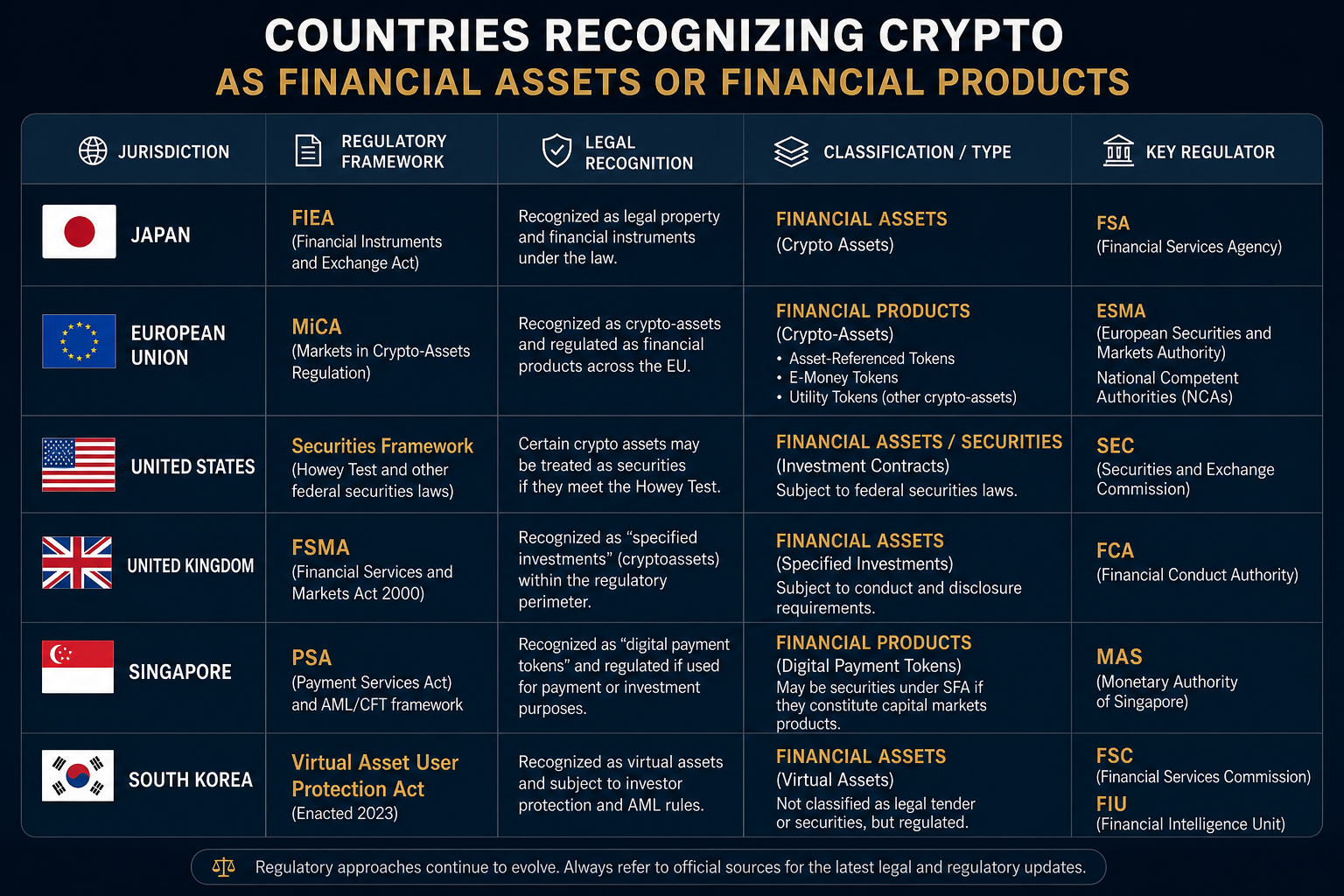 Figure 1. How major jurisdictions place crypto under financial-asset or financial-product frameworks.
How Do the UK, Singapore, and South Korea Classify Crypto?
The UK FCA separates tokens with securities, e-money, or specified-investment features and oversees consumer crypto promotions. Singapore’s MAS distinguishes digital payment tokens from capital-market products: securities-like activity under the Securities and Futures Act; exchange/transfer activity mainly licensed under the Payment Services Act. South Korea’s Virtual Asset User Protection Act covers trading and custody while further financial classification and ETF linkage continue to evolve—follow enacted texts and FSC implementing rules.
What Does Recognition Change for Investors?
Recognition typically affects three areas: stronger venue compliance expectations, fuller product disclosure, and possible movement of tax/account rules toward capital-gains structures. Transparency can improve; price volatility, liquidity shocks, and cross-border conflicts remain.
Countries with approved crypto ETFs shows which markets go further—approving tradable crypto ETF products—and why a legal framework is not the same as a listed fund.
How Should Investors Verify Classification by Country?
For cross-border holding or trading, use this public-information sequence:
| Step |
What to verify |
| 1. Service-provider supervisor |
Which regulator oversees the venue/custodian/issuer and under which license |
| 2. Official legal class |
Financial-instruments, securities, payment, or dedicated crypto law |
| 3. Token type |
Payment, security, utility, or stablecoin rules may differ |
| 4. Product documents |
Prospectus, risk disclosure, custody agreements |
| 5. Tax treatment |
Whether capital gains, ordinary income, or withholding rules change with class |
| 6. Framework vs product |
Legal recognition ≠ approved ETF or fund |
The sequence builds a checklist; it does not rank national regimes or imply that one class is “better” for investors.
Summary
Major markets use different drafting techniques to place crypto under financial-asset or financial-product oversight: Japan’s FIEA path, the U.S. SEC/CFTC and securities case-law approach, EU MiCA categories, and UK/Singapore/Korea local splits. Recognition affects venue duties, disclosure, tax design, and ETF legal pathways—but “recognized as a financial asset” is not “every crypto product is approved” or “global rules are unified.” In cross-border settings, verify service-provider rules, token type, and product documents together.
FAQ
Which countries treat crypto as a financial asset?
Japan supervises crypto under FIEA financial-instruments rules; the United States, the EU, the UK, Singapore, and South Korea also impose finance-market style duties on all or some digital assets via securities law, MiCA, FCA rules, MAS frameworks, or dedicated virtual-asset statutes. Scope and drafting differ.
What changes when crypto is recognized as a financial asset?
Changes often appear in venue compliance, issuer disclosure, insider-trading rules, suitability management, and a legal basis for funds/ETFs to hold digital assets. Exact duties follow local statutes and guidance.
Is financial-asset recognition the same as securities recognition?
Not entirely. Securities tests emphasize investment contracts and profit expectations; financial assets/products are broader categories in some systems. Whether a token is a security still depends on local standards.
Has South Korea listed crypto as a national asset?
South Korea has debated clearer financial classification—and related “national asset” language in public discussion—but enacted wording, timing, and scope must be checked against passed statutes and FSC implementing rules. Separate debate from effective law.
Does MiCA label every token a financial asset?
No. MiCA classifies ART, EMT, and other crypto-assets and preserves links to existing securities rules. Tokens that meet securities definitions may still fall under MiFID-style instruments rather than only MiCA’s general crypto clauses.
Does financial-asset recognition mean you can buy a crypto ETF?
Not automatically. Recognition supplies a category basis for fund holdings; ETF listing still needs management, custody, exchange approval, and product disclosure. Countries with approved crypto ETFs lists markets with approved fund products versus markets that only adjusted the legal frame.