Real-world assets (RWA) are gaining traction, and U.S. Treasury bonds have quickly become one of the most sought-after on-chain assets. With low credit risk, high liquidity, and stable yields, more and more financial institutions are tokenizing them, bringing traditional fixed-income products into the blockchain ecosystem and offering new capital management tools for institutional and digital asset investors.
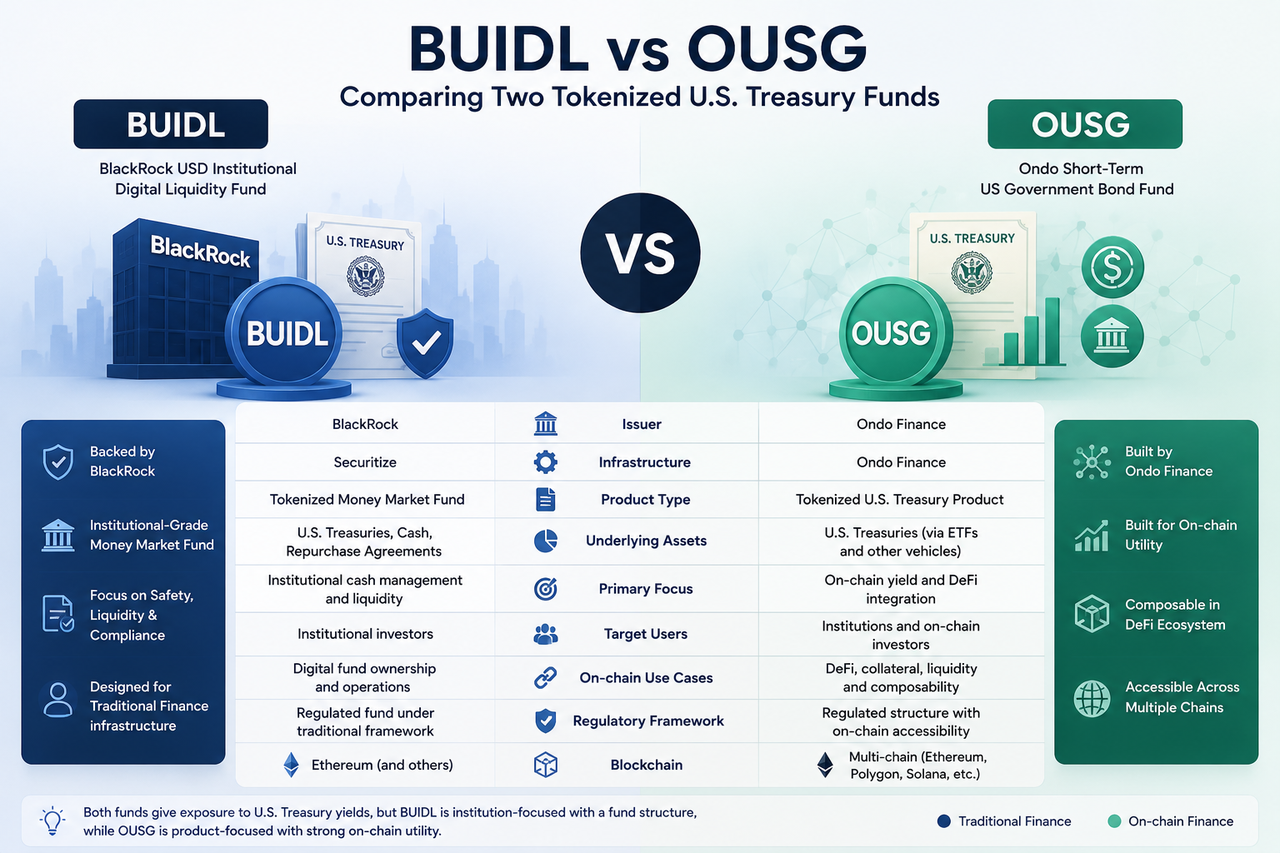
Today, BUIDL and OUSG stand out as the two most representative tokenized U.S. Treasury products in the RWA market. While both are built on U.S. Treasuries, they differ significantly in terms of issuer, product positioning, operations, and target users.
What Is BUIDL?
BUIDL (BlackRock USD Institutional Digital Liquidity Fund) is a tokenized money market fund launched by BlackRock, with Securitize providing digital securities issuance and fund operations infrastructure.
The fund invests primarily in U.S. short-term Treasury bonds, cash, and repurchase agreements. It digitizes fund shares so institutional investors can hold fund interests on the blockchain.
Think of BUIDL as a digital version of a traditional money market fund. Its core goal is to boost the efficiency of share management and operations while complying with the traditional fund regulatory framework.
What Is OUSG?
OUSG is a tokenized U.S. Treasury product from Ondo Finance that gives investors exposure to short-term U.S. Treasury yields.

Unlike BUIDL, OUSG is built to support on-chain finance, integrating U.S. Treasury yield assets into the digital asset ecosystem and making it easier for tokenized assets to participate in on-chain financial activities.
That’s why OUSG isn’t just about the asset itself—it actively expands into stablecoins, DeFi protocols, and institutional on-chain liquidity.
How Do Their Product Positions Differ?
The biggest difference comes down to positioning.
BUIDL, launched by global asset management giant BlackRock, is essentially an institutional-grade money market fund. Digitization is just an upgrade to how the fund operates.
OUSG, on the other hand, is built by Ondo Finance to package traditional financial assets into on-chain investment products, letting U.S. Treasury yields serve the digital asset market.
| Comparison Dimension |
BUIDL |
OUSG |
| Issuer |
BlackRock |
Ondo Finance |
| Infrastructure |
Securitize |
Ondo Finance |
| Product Positioning |
Tokenized Money Market Fund |
Tokenized U.S. Treasury Product |
| Core Objective |
Institutional Cash Management |
On-Chain Yield Assets |
In short: BUIDL leans toward traditional institutional finance, while OUSG is all about the on-chain financial ecosystem.
How Do Their Underlying Assets Differ?
Both products are built on U.S. Treasuries, but with slightly different asset mixes.
BUIDL primarily holds:
This setup mirrors traditional money market funds, prioritizing liquidity and safety.
OUSG also invests mainly in U.S. Treasuries, but it typically gains yield exposure through U.S. Treasury ETFs or related funds, making it more of a tokenized investment vehicle.
| Comparison Item |
BUIDL |
OUSG |
| U.S. Treasury Bonds |
✔ |
✔ |
| Cash Management |
✔ |
Partially involved |
| Repurchase Agreements |
✔ |
Usually not a core allocation |
| Treasury ETF Exposure |
No |
Yes (depends on structure) |
Same investment goals, but different ways of getting there.
How Do Their Yield Mechanisms Differ?
Both products generate yield from U.S. Treasury interest, not from crypto price gains.
BUIDL calculates its net asset value (NAV) based on money market fund rules. Yield comes from the fund’s holdings of Treasury bonds, cash, and repos.
OUSG also benefits from U.S. Treasury yields, but its design is more native to the digital asset space, giving it a wider range of on-chain use cases.
They’re essentially the same in yield source, but they differ in product packaging and investment structure.
How Do Their On-Chain Applications Differ?
This is where they really part ways.
BUIDL focuses on digital fund management, targeting institutional investors for share registration, investor management, and digital securities operations.
OUSG was built from day one to serve on-chain finance, so it emphasizes composability. It’s designed to fit seamlessly into the digital asset ecosystem and support a variety of on-chain financial applications.
As the RWA market grows, these two models represent the respective paths of institutional finance and DeFi.
Which Product Fits Different Investors?
If your institution wants to use blockchain to hold a traditional money market fund with a mature management framework, BUIDL is the more representative choice.
If you’re after U.S. Treasury yields but also care about on-chain financial applications, the digital asset ecosystem, and future composable products, OUSG is a better fit.
Keep in mind: both are regulated real-world asset products, not ordinary crypto. Eligibility usually requires meeting legal and regulatory requirements.
Core Differences at a Glance
| Comparison Item |
BUIDL |
OUSG |
| Launching Institution |
BlackRock |
Ondo Finance |
| Technical Support |
Securitize |
Ondo Finance |
| Product Type |
Tokenized Money Market Fund |
Tokenized U.S. Treasury Product |
| Underlying Assets |
Treasuries, cash, repos |
U.S. Treasury-related assets |
| Yield Source |
Treasury interest |
Treasury interest |
| Primary Users |
Institutional investors |
Institutional and on-chain investors |
| On-Chain Ecosystem |
Fund digitization |
DeFi + RWA |
| Market Positioning |
Institutional Finance |
On-Chain Finance |
Final Take
BUIDL and OUSG both represent key trends in real-world asset tokenization, but they’ve taken different routes. BUIDL sticks with the traditional money market fund model, using Securitize to digitize shares and serve institutional cash management. OUSG, on the other hand, builds on-chain products around U.S. Treasury yields, putting a premium on liquidity and composability.
FAQs
Do both BUIDL and OUSG invest in U.S. Treasury bonds?
Yes. Both use U.S. Treasuries as their primary underlying asset, though their specific portfolios and structures differ.
What’s the biggest difference between BUIDL and OUSG?
BUIDL is a tokenized money market fund from BlackRock, focused on institutional fund management. OUSG is a tokenized U.S. Treasury product from Ondo Finance, built for on-chain financial applications.
Are the yield sources the same?
Essentially, yes. Both generate yields from interest on fixed-income assets like U.S. Treasuries, not from crypto price swings.
Which product is better for institutional investors?
If you need a traditional fund management system and cash management, go with BUIDL. If you’re more interested in on-chain finance and digital asset applications, OUSG is the way to go.
Are BUIDL and OUSG stablecoins?
No. Both are real-world asset (RWA) tokenization products—they represent fund or investment interests in assets like U.S. Treasuries, not stablecoins used for payments and settlements.