Against the backdrop of the ongoing convergence of AI and crypto infrastructure, decentralized AI networks are evolving beyond a single computing power market into data, model, and inference markets. Allora and Bittensor represent two distinct development paths. Understanding their differences provides a clearer framework for grasping Web3 AI infrastructure.
What Is Allora Network?
Allora Network is a decentralized network specializing in AI inference and prediction services. It aims to improve prediction accuracy through collective intelligence and deliver verifiable AI inference to on-chain applications.
Within Allora, different AI models submit predictions around specific Topics. The network dynamically adjusts model weights based on historical performance and rewards high-quality contributors with ALLO tokens.
Unlike traditional AI services, Allora prioritizes the transparency, verifiability, and composability of prediction outputs.
What Is Bittensor?
Bittensor is an open machine learning network that enables different AI models to collaborate and compete via blockchain. Its core goal is to create a decentralized AI marketplace where models share knowledge and earn rewards.
In Bittensor's ecosystem, miners generate AI outputs while validators assess their quality. The network incentivizes top-tier models and computing power contributors with TAO tokens.
Compared to Allora, Bittensor functions more as an open AI production network than a dedicated prediction market.
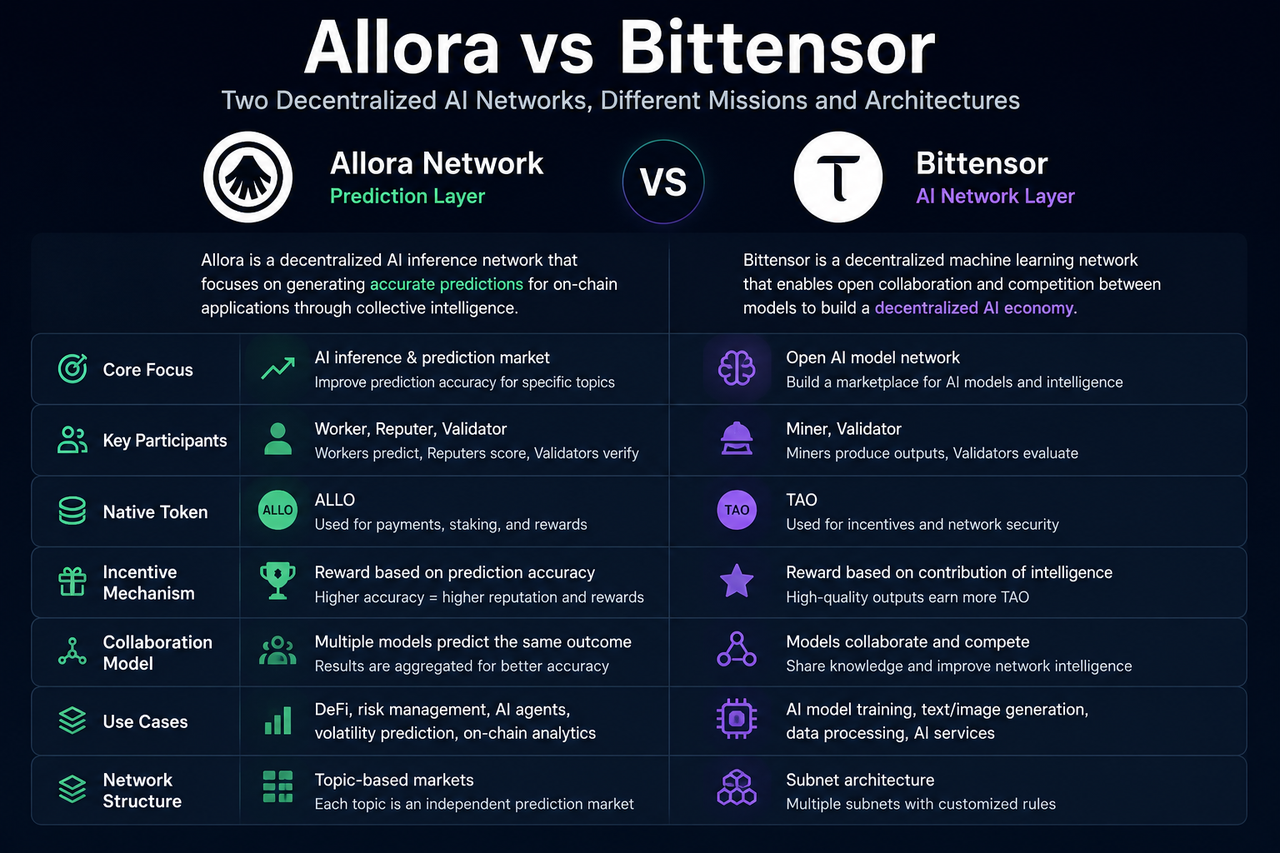
How Do the Core Goals of Allora and Bittensor Differ?
The fundamental difference lies in their network objectives.
Allora aims to solve information efficiency, giving on-chain applications access to more accurate predictions. Its focus is on inference quality and forecasting capability.
Bittensor seeks to build an open AI economy where models share knowledge, exchange value, and form a decentralized AI network.
In short, Allora prioritizes "whether the answer is accurate," while Bittensor prioritizes "who can deliver the most valuable intelligent service."
How Do the Participant Structures Differ?
Both use multi-role coordination, but participant responsibilities vary significantly.
Allora's Participant Structure
Allora consists of Workers, Reputers, and Validators.
- Workers provide predictions.
- Reputers evaluate prediction accuracy.
- Validators verify scoring and rewards.
The entire system revolves around prediction quality.
Bittensor's Participant Structure
Bittensor consists mainly of Miners and Validators.
- Miners generate model outputs.
- Validators assess output quality.
Different subnets can establish independent rules as needed.
This structure is better suited for an open AI service marketplace.
How Do the Incentive Mechanisms Differ?
Incentive design shapes a network's long-term trajectory.
Allora uses a reward system based on prediction accuracy. It adjusts node reputation based on historical performance and allocates rewards to participants with higher prediction quality.
Bittensor uses a knowledge-contribution-driven mechanism. Miners earn rewards by providing valuable AI outputs, while validators assess contribution quality.
Thus, Allora resembles a prediction market, and Bittensor an intelligence production market.
How Do the AI Models Collaborate?
Both emphasize collective intelligence but through different approaches.
In Allora, multiple models predict the same problem. The network aggregates results via a reputation system to produce superior predictions.
In Bittensor, models share knowledge and compete. High-quality models can influence the entire network's knowledge distribution.
The former focuses on prediction aggregation, the latter on knowledge sharing.
What Are the Differences in Data and Inference Logic?
Allora measures final predictions against real-world data, so evaluation criteria tie directly to actual outcomes.
Examples include asset price prediction, market volatility forecasting, and risk assessment — all verifiable by real results.
Bittensor focuses on whether model output is valuable, with evaluation criteria varying by subnet.
Consequently, Allora's evaluation system is more unified, while Bittensor's is more diverse.
Which Scenarios Fit Allora Better?
Allora excels in prediction-driven scenarios, such as:
- DeFi risk management
- Volatility forecasting
- AI Agent decision systems
- Automated trading models
- On-chain data analysis
These all require consistently high-quality predictions.
Which Scenarios Fit Bittensor Better?
Bittensor thrives in AI model production scenarios, such as:
- Large language model services
- AI content generation
- Machine learning research
- AI data processing
- Intelligent search systems
These focus on model capability rather than a single prediction.
Allora vs Bittensor Comparison Table
| Dimension |
Allora Network |
Bittensor |
| Core Positioning |
AI inference & prediction market |
Open AI network |
| Native Token |
ALLO |
TAO |
| Core Goal |
Improve prediction accuracy |
Build decentralized AI economy |
| Main Roles |
Worker, Reputer, Validator |
Miner, Validator |
| Incentive Basis |
Prediction performance |
Knowledge contribution |
| Collaboration Method |
Collective prediction |
Model synergy |
| Application Scenarios |
DeFi, prediction markets, AI Agent |
AI services, model training, content generation |
| Network Structure |
Topic market |
Subnet system |
| Data Verification |
Real outcome feedback |
Subnet evaluation system |
Which Model Is Closer to Future AI Infrastructure?
There is no single path for decentralized AI.
Allora represents the prediction and inference layer, providing trusted intelligent data for blockchain applications.
Bittensor represents the open AI network layer, building a decentralized model economy.
As the AI ecosystem evolves, these models are not mutually exclusive but complementary. In the future Web3 AI stack, Bittensor supplies intelligence production, and Allora supplies prediction and inference — together forming key components of decentralized AI infrastructure.
Summary
Allora and Bittensor are both decentralized AI networks but address different problems. Allora's core is an on-chain prediction and inference market that improves quality through collective intelligence. Bittensor's core is an open AI model economy that drives progress through knowledge sharing and competition.
From an infrastructure perspective, Allora is closer to a Prediction Layer, while Bittensor is closer to an AI Network Layer. Understanding this distinction helps better grasp the direction and value division of the decentralized AI ecosystem.
FAQs
Are Allora and Bittensor competitors?
They belong to the same decentralized AI track but with different positioning. Allora focuses on prediction and inference; Bittensor focuses on models and intelligence production. They are complementary, not competitive.
What is the biggest difference between Allora and Bittensor?
Allora prioritizes generating more accurate predictions, while Bittensor prioritizes building an open AI model network and knowledge marketplace.
What is the difference in the roles of ALLO and TAO?
ALLO is used for paying inference services, staking, and rewarding prediction contributors. TAO is used to incentivize model contributors and maintain the Bittensor network.
Why is Allora called the Prediction Layer?
Allora aggregates predictions from multiple AI models and continuously optimizes inference quality, making it an AI prediction or inference layer.
Are DeFi projects better suited to Allora or Bittensor?
DeFi projects requiring market prediction, risk assessment, and intelligent decision-making are better suited to Allora. Projects needing AI model services or content generation are better suited to Bittensor.