Dans les architectures blockchain axées sur la confidentialité, il est rare qu’un seul jeton remplisse efficacement à la fois les fonctions de transfert de valeur et de gouvernance de l’écosystème. C’est pourquoi BEAM sépare son jeton PoW de son jeton de gouvernance DAO, établissant ainsi des couches distinctes pour les paiements, les incitations et la prise de décision. Ce modèle est couramment adopté par les réseaux qui doivent conjuguer sécurité renforcée et gouvernance adaptable.
Ce défi s’articule généralement autour de trois dimensions : les mécanismes d’émission, la distribution des incitations et la structure de gouvernance. Ensemble, ces composantes déterminent la création et la répartition de la valeur au sein du réseau BEAM.
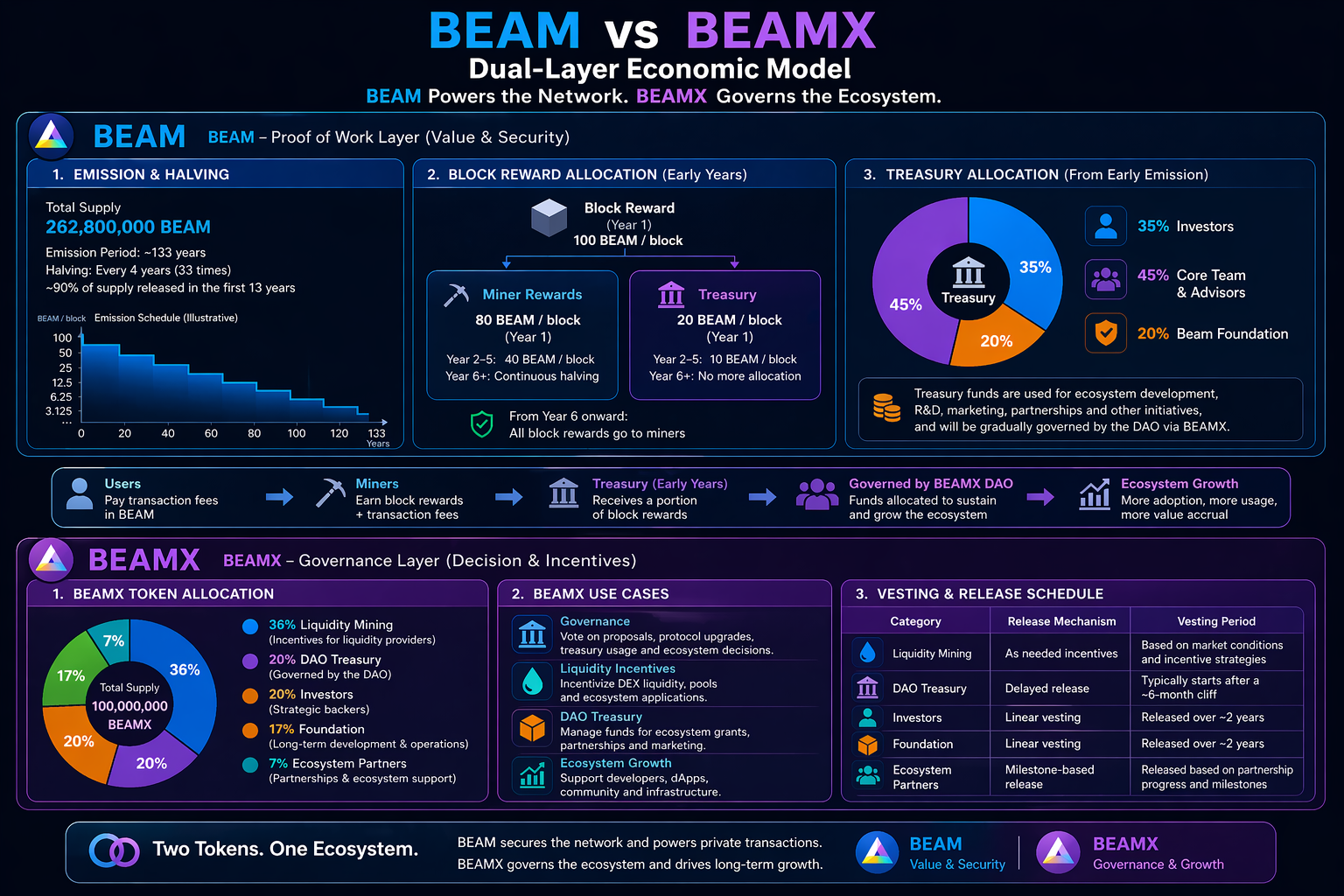
Quelles fonctions le jeton BEAM assure-t-il dans le système économique
En tant que jeton natif de la chaîne principale, BEAM est conçu pour soutenir à la fois les paiements et les incitations liées à la sécurité.
Concrètement, chaque transaction implique une consommation de BEAM en frais de transaction. Associés aux récompenses de bloc, ces frais représentent la principale source de revenu des mineurs et incitent la puissance de calcul à garantir la sécurité et la maintenance du réseau. Les frais de transaction rémunèrent non seulement les ressources informatiques, mais contribuent également à la gestion de la charge du réseau.
Sur le plan structurel, BEAM fonctionne à la fois sur le plan utilisateur et réseau. Les utilisateurs utilisent BEAM pour régler des paiements privés, les nœuds perçoivent des récompenses en BEAM, et le réseau s’appuie sur BEAM pour assurer sa sécurité. Ce jeton à valeur unique crée un lien entre plusieurs couches, générant ainsi une boucle économique fermée.
Ce choix d’architecture est essentiel, car il connecte directement les transactions privées à la sécurité du réseau : le fonctionnement du réseau dépend alors d’un usage réel et non d’apports extérieurs.
Quel est l’impact du mécanisme d’émission et de la politique de halving de BEAM sur l’offre
La compréhension de la structure de l’offre est fondamentale pour saisir le modèle économique.
BEAM est émis en continu via les récompenses de bloc, avec des halvings programmés pour réduire progressivement l’offre nouvelle. Dans les premières phases, l’émission est accélérée pour motiver les mineurs ; ensuite, la diminution de l’émission instaure la rareté du jeton.
Structurellement, l’offre totale de BEAM est plafonnée à environ 262,8 millions de jetons et la période d’émission s’étend sur près de 133 ans. La majeure partie des jetons est distribuée dès les premières années, suivant une trajectoire « front-loaded » qui permet au réseau de bâtir rapidement sa base de sécurité.
| Dimension |
Modèle BEAM |
| Offre totale |
262 800 000 BEAM |
| Période d’émission |
~133 ans |
| Intervalle de halving |
Tous les 4 ans |
| Rythme de distribution |
Distribution initiale accélérée |
Ce mécanisme permet d’ajuster l’équilibre offre-demande dans le temps, avec un niveau d’incitation variable tout au long du cycle de vie du réseau.
Le mode de distribution des incitations a un impact direct sur la participation au réseau.
Les mineurs reçoivent des récompenses pour la production de blocs, composées à la fois de BEAM nouvellement émis et des frais de transaction. Aux débuts du réseau, une part des récompenses de bloc est aussi allouée au Trésor afin de soutenir le développement de l’écosystème.
La répartition entre les mineurs et le Trésor évolue dans le temps : à mesure que le réseau gagne en maturité, la part du Trésor diminue progressivement alors que celle des mineurs augmente, jusqu’à ce que le réseau repose intégralement sur les mineurs et les frais de transaction.
| Phase |
Récompense mineurs |
Trésor |
| Année 1 |
80 BEAM |
20 BEAM |
| Années 2–5 |
40 BEAM |
10 BEAM |
| Phases ultérieures |
Halving continu |
Suppression progressive |
Ce schéma montre que BEAM soutient le développement initial de l’écosystème grâce à des allocations supplémentaires, avant d’évoluer vers un modèle axé sur les seules incitations sécuritaires.
Le Trésor sert de pont entre émission et gouvernance.
Une partie des récompenses de bloc est versée au Trésor pour soutenir le développement, le marketing et les partenariats de l’écosystème. Ce contrôle n’est pas entièrement centralisé et évolue progressivement vers une gouvernance décentralisée.
Dans un premier temps, l’allocation des fonds du Trésor est assurée par l’équipe projet et les parties prenantes ; au fil du temps, les mécanismes de gouvernance permettent une prise de décision plus largement distribuée.
| Bénéficiaire |
Part |
| Investisseurs |
35 % |
| Équipe principale & Conseillers |
45 % |
| Fondation |
20 % |
Ce dispositif garantit un soutien en ressources dans les phases initiales du réseau, tout en préparant la transition vers une gouvernance décentralisée.
La gouvernance s’opère au moyen de BEAMX.
BEAMX est un jeton de gouvernance utilisé pour le vote des propositions, l’attribution des fonds et l’orientation de l’écosystème. Contrairement au jeton principal, BEAMX n’a aucune vocation de paiement ou de minage ; il est dédié exclusivement à la prise de décision.
BEAMX transfère le contrôle du réseau d’une entité unique vers les détenteurs de jetons, encourageant ainsi une gestion décentralisée des ressources. Le cadre DAO permet à une grande diversité de participants d’influencer l’évolution de l’écosystème.
Cette conception élargit le système économique, passant de la « création » à « l’allocation de valeur » et instaure une boucle fermée globale.
La distribution de BEAMX détermine directement le pouvoir de gouvernance.
Avec une offre totale de 100 millions de jetons, BEAMX est réparti entre plusieurs catégories de participants. La libération des jetons se fait par phases afin de limiter la volatilité liée à une distribution trop concentrée.
Le liquidity mining bénéficie de la part la plus importante pour stimuler l’activité de l’écosystème, tandis que les allocations à la DAO, au Trésor et aux investisseurs favorisent la croissance et le financement à long terme.
| Catégorie |
Part |
| Liquidity Mining |
36 % |
| DAO Treasury |
20 % |
| Investisseurs |
20 % |
| Fondation |
17 % |
| Partenaires écosystème |
7 % |
Cet agencement équilibre gouvernance et incitations, en favorisant à la fois l’engagement à court terme et la stabilité sur le long terme.
BEAM et BEAMX composent une architecture multi-couche qui sépare la création de valeur du pouvoir de gouvernance.
BEAM génère la valeur et maintient le fonctionnement du réseau, tandis que BEAMX définit la manière dont cette valeur est allouée. Les transactions génèrent des frais, les mineurs perçoivent des récompenses, une partie des fonds est dirigée vers le Trésor, puis la gouvernance redistribue ces ressources.
Ce modèle dissocie paiements et gouvernance, permettant à l’activité économique et à la prise de décision de fonctionner indépendamment, tout en restant interdépendantes.
Un tel dispositif assure la stabilité opérationnelle du réseau tout en permettant des ajustements dynamiques.
Quelles sont les limites du modèle économique de BEAM
Tout modèle économique présente ses contraintes.
Si la structure à double jeton accroît la flexibilité, elle rend également la compréhension et la participation plus exigeantes, car l’utilisateur doit assimiler la logique des paiements comme celle de la gouvernance.
Le modèle repose fortement sur l’activité de l’écosystème : une demande transactionnelle faible risque de déséquilibrer la relation entre frais et incitations. Par ailleurs, la confidentialité réduit la transparence on-chain, compliquant l’analyse externe et la conformité réglementaire.
Ces limites soulignent que le modèle de BEAM est plus adapté à des environnements nécessitant un haut niveau de confidentialité et d’efficacité structurelle, plutôt qu’à des usages blockchain universels.
Synthèse
En dissociant les jetons de la chaîne principale et de gouvernance, BEAM module la création de valeur, la sécurité du réseau et l’allocation des ressources, permettant aux blockchains axées sur la confidentialité de concilier sécurité robuste et gouvernance flexible.
FAQ
Quel est le lien entre BEAM et BEAMX ?
BEAM sert aux paiements et aux incitations ; BEAMX à la gouvernance et à la répartition des fonds. Ensemble, ils forment un modèle économique à double couche.
Quelles sont les spécificités du mécanisme d’émission de BEAM ?
Il repose sur une émission de long terme avec des halvings périodiques, ce qui réduit l’offre progressivement et accentue la rareté.
Pourquoi BEAMX est-il un jeton indépendant ?
Ce jeton permet d’assurer les fonctions de gouvernance sans rattacher les décisions du réseau au jeton principal.
Quel rôle le Trésor joue-t-il dans le modèle économique ?
Le Trésor soutient la croissance de l’écosystème BEAM et répartit les fonds via les processus de gouvernance.
Le modèle économique de BEAM est-il complexe ?
Comparé aux systèmes à jeton unique, BEAM est plus complexe ; toutefois, cette complexité permet une séparation nette entre paiements et gouvernance.