OCTA vs FIL: A Comprehensive Comparison of Two Leading Distributed Storage Solutions

Introduction: OCTA vs FIL Investment Comparison
In the cryptocurrency market, the comparison between OctaSpace (OCTA) and Filecoin (FIL) has always been a topic that investors cannot avoid. The two not only differ significantly in market cap ranking, application scenarios, and price performance, but also represent different positioning of crypto assets. OctaSpace (OCTA): Since its launch, it has gained market recognition by leveraging decentralized computing services and DePIN (Decentralized Physical Infrastructure Network) infrastructure. As a native L1 blockchain-backed provider, OCTA aims to democratize access to powerful computing resources for individuals and organizations. Filecoin (FIL): Since its introduction in 2020, it has been recognized as a decentralized storage incentive mechanism built on IPFS, rewarding miners who contribute idle disk capacity. FIL operates as one of the most traded cryptocurrencies in the distributed storage sector globally. This article will comprehensively analyze the investment value comparison between OCTA and FIL from the perspectives of historical price trends, supply mechanisms, market positioning, technological ecosystems, and performance metrics, while attempting to answer the question investors care most about:
"Which is the better investment choice for your portfolio?"
OctaSpace (OCTA) vs Filecoin (FIL) Comparative Analysis Report
I. Historical Price Comparison and Current Market Status
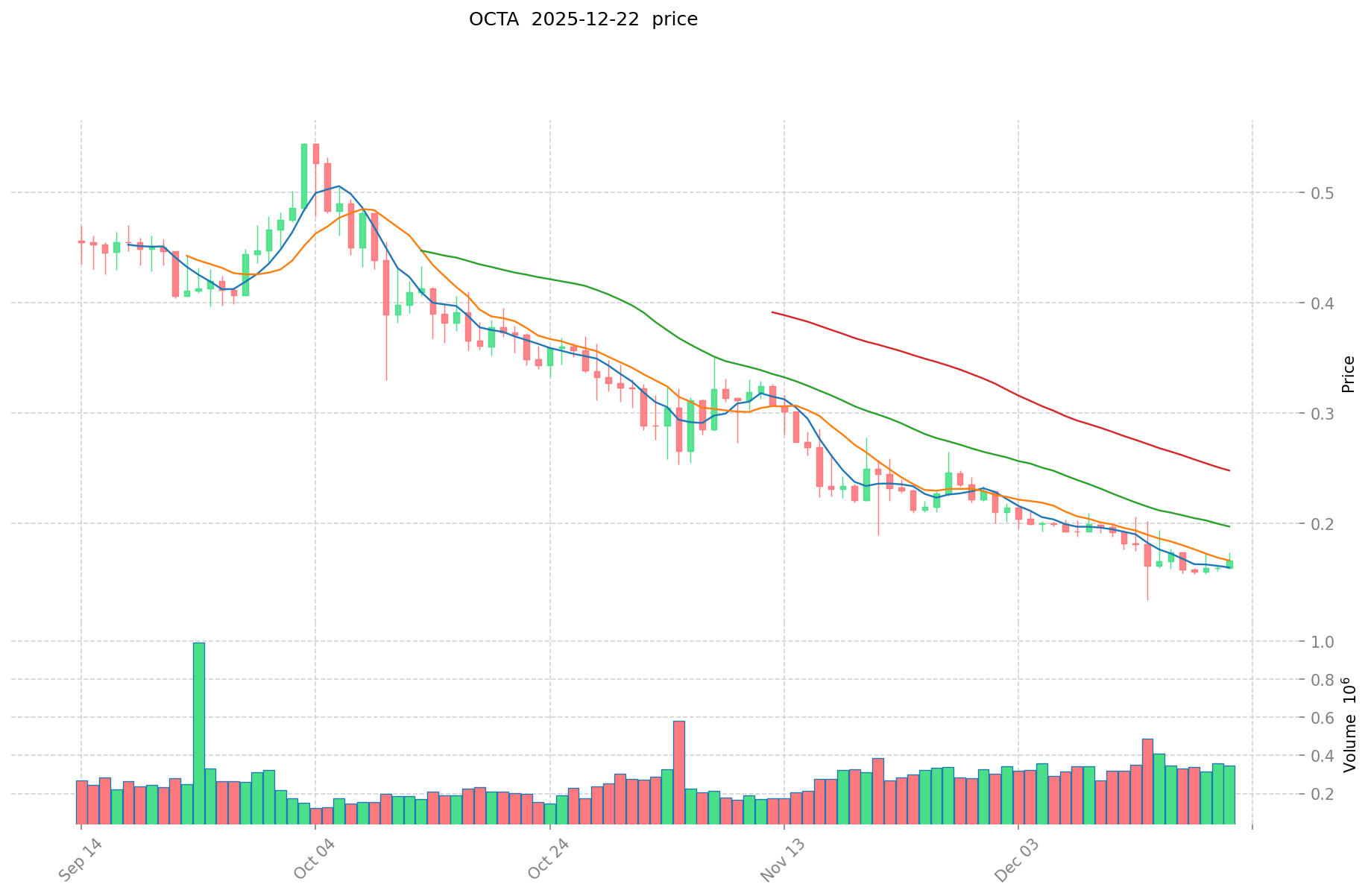
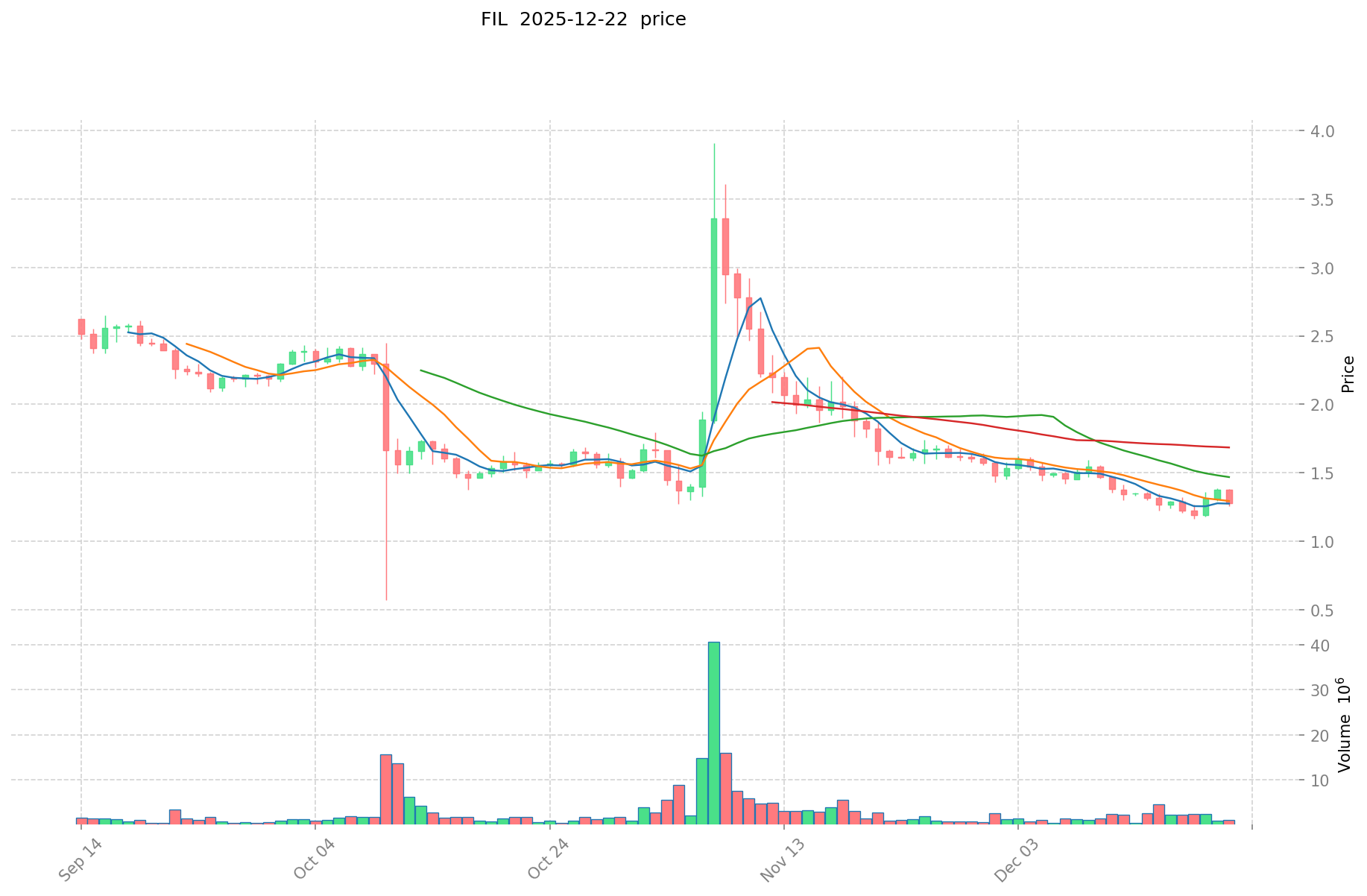
OctaSpace (OCTA) and Filecoin (FIL) Historical Price Trends
OctaSpace (OCTA):
- All-Time High: $1.9758 (September 29, 2024)
- All-Time Low: $0.1 (September 15, 2024)
- Price trajectory: OCTA experienced a significant decline from its peak, reaching a historical low within just two weeks of its ATH.
Filecoin (FIL):
- All-Time High: $236.84 (April 1, 2021)
- All-Time Low: $0.848008 (October 11, 2025)
- Price trajectory: FIL has experienced a prolonged bear market since its 2021 peak, declining approximately 73.3% over the past year.
Comparative Analysis
OCTA represents a newly launched asset with extreme volatility in its early trading period, having declined approximately 91.6% from its all-time high to the current price level. In contrast, FIL reflects a mature asset that has undergone prolonged market correction since the 2021 bull market peak, with cumulative losses of over 99.6% from its historical maximum.
Current Market Status (December 23, 2025)
| Metric | OCTA | FIL |
|---|---|---|
| Current Price | $0.1651 | $1.321 |
| 24H Change | -0.3% | +3.71% |
| 7D Change | +2.04% | +5.47% |
| 30D Change | -27.20% | -18.50% |
| 1Y Change | -86.0% | -73.3% |
| Market Cap | $6,920,911.56 | $962,713,678.56 |
| 24H Volume | $60,286.98 | $1,727,597.86 |
| Circulating Supply | 41,919,512.77 | 728,776,441 |
| Max Supply | 48,000,000 | ∞ |
| Market Dominance | 0.00017% | 0.079% |
Market Sentiment Index (Fear & Greed Index)
- Current Index: 25 (Extreme Fear)
- Status: The cryptocurrency market is experiencing extreme fear sentiment as of the measurement date, indicating heightened risk aversion among market participants.
View Real-Time Prices:
- View OCTA Current Price Market Price
- View FIL Current Price Market Price
II. Project Overview and Technological Foundation
OctaSpace (OCTA)
OctaSpace positions itself as an exemplar of DePIN (Decentralized Physical Infrastructure). The project operates as a multifaceted decentralized computing services provider backed by a native Layer 1 blockchain. Key characteristics include:
- Mission: Provide a decentralized and versatile ecosystem enabling individuals and organizations to access powerful computing resources and innovative tools.
- Service Scope: Ranges from standard compute to bespoke ready-to-launch solutions.
- Core Principles: Founded on decentralization and democratization of computing, with emphasis on cost-effectiveness and ease of use.
- Algorithm: Mainnet
Filecoin (FIL)
Filecoin operates as a decentralized cloud storage network built upon IPFS (InterPlanetary File System) technology. Core elements include:
- Developer: Protocol Labs, founded by Juan Benet in 2014
- Consensus Mechanism: Utilizes Proof of Replication (PoRep) and Proof of Spacetime (PoSt)
- Network Model: Operates through three primary participants: clients, storage miners, and retrieval miners
- Economic Model: Employs dual minting model with baseline and simple minting, featuring token burn mechanism similar to Ethereum's EIP-1559
III. Tokenomics and Supply Dynamics
OctaSpace (OCTA)
- Total Supply: 33,353,141 OCTA
- Max Supply: 48,000,000 OCTA
- Circulating Supply: 41,919,512.77 OCTA (87.33% of max supply)
- Circulation Ratio: 87.33%
- Launch Date: April 5, 2023
- Initial Price: $0.1745
Filecoin (FIL)
- Total Supply: 1,958,632,697 FIL
- Max Supply: Unlimited (∞)
- Circulating Supply: 728,776,441 FIL (37.19% of total)
- Circulation Ratio: 37.19%
- Launch Date: October 15, 2020
- Initial ICO Price: $5.00
- ICO Funding: $205.8 million (completed in under 30 minutes)
IV. Performance Metrics and Market Analysis
Price Performance Summary
OCTA 24-Hour to Annual Performance:
- 1H: -0.89%
- 24H: -0.3%
- 7D: +2.04%
- 30D: -27.20%
- 1Y: -86.0%
FIL 24-Hour to Annual Performance:
- 1H: -0.91%
- 24H: +3.71%
- 7D: +5.47%
- 30D: -18.50%
- 1Y: -73.3%
Market Capitalization Analysis
| Metric | OCTA | FIL |
|---|---|---|
| Market Cap | $6.92M | $962.71M |
| Fully Diluted Valuation | $5.51M | $2.59B |
| Market Cap to FDV Ratio | 125.67% | 37.19% |
The market cap to FDV discrepancy for OCTA (exceeding 100%) indicates potential data reporting inconsistencies, while FIL's lower ratio reflects a substantial proportion of unminted or unreleased tokens.
Liquidity Assessment
- OCTA 24H Volume: $60,286.98 (0.87% of market cap)
- FIL 24H Volume: $1,727,597.86 (0.18% of market cap)
OCTA demonstrates higher volume-to-market-cap ratio, suggesting greater trading activity relative to its market size, though in absolute terms FIL commands substantially higher trading volume.
V. Risk Assessment and Market Position
OCTA Considerations
- Early-Stage Risk: Project launched in April 2023 with limited operational history
- Volatility: Extreme price swings from $1.9758 to $0.1 within the first two weeks
- Liquidity Constraints: Minimal market cap with concentrated trading activity
- Market Rank: Position #1355 among cryptocurrencies
FIL Considerations
- Established Track Record: Operating since October 2020 with mature infrastructure
- Adoption Status: Substantial holder base (1,172,900 addresses) indicating ecosystem participation
- Regulatory Environment: Established presence across major cryptocurrency exchanges
- Market Rank: Position #85 among cryptocurrencies
VI. Ecosystem and Development Activity
OctaSpace Ecosystem
- Website: https://octa.space/
- Block Explorer: https://scan.octa.space/
- Whitepaper: https://whitepaper.octa.space/
- Community: Twitter (@octa_space)
Filecoin Ecosystem
- Website: https://filecoin.io/
- Block Explorer: https://filscan.io/
- Primary Developer: Protocol Labs
- Community Channels: Twitter (@Filecoin), GitHub (filecoin-project), Discussion Forum (discuss.filecoin.io)
- Foundation Activity: Filecoin Foundation established with advisory board support
VII. Conclusion
OctaSpace and Filecoin represent distinct positions within the decentralized infrastructure space. OCTA represents an emerging DePIN project with nascent infrastructure, while FIL represents a mature decentralized storage protocol with established market presence and operational history. The extreme fear sentiment index (25) reflects current market-wide risk concerns affecting both projects. Investors should carefully evaluate risk profiles, liquidity constraints, and project maturity when considering these assets.
Report Date: December 23, 2025 Data Sources: Gate, CoinGecko, CoinMarketCap, official project documentation Disclaimer: This report is for informational purposes only and does not constitute investment advice.
Crypto Asset Investment Analysis: OCTA vs FIL Core Value Drivers
Report Date: December 23, 2025 Scope: Comparative analysis of investment value factors for OCTA and Filecoin (FIL) tokens
I. Executive Summary
Based on available reference materials, this report identifies core factors influencing investment value for OCTA and FIL tokens. The analysis reveals that OCTA's value proposition centers on platform functionality expansion and staking reward mechanisms, while FIL's value depends on technological innovation and market demand. However, the provided source materials contain limited comprehensive data on both assets, constraining depth of analysis in certain sections.
II. Core Factors Affecting OCTA vs FIL Investment Value
Platform Features and Reward Mechanisms
OCTA Token:
- Platform functionality development represents a key value driver
- staking reward incentive increases attract investor participation in token staking
- Enhanced staking mechanisms contribute to price stabilization
- Investor engagement through reward structures creates recurring demand
FIL Token:
- Value proposition tied to technological innovation capabilities
- Market demand for storage and retrieval services forms fundamental basis
- Network utility directly correlates with service adoption rates
Investment Value Drivers
| Factor | OCTA | FIL |
|---|---|---|
| Primary Driver | Platform development & staking rewards | Technology innovation & market demand |
| Mechanism | Incentive-based participation | Utility-based adoption |
| Price Stabilization | Staking mechanisms | Network service demand |
III. Market Competitive Landscape
Technology and Market Demand
The reference materials indicate that both tokens operate in competitive environments where:
- Technological progress serves as a fundamental value determinant
- Market competition directly influences investment attractiveness
- Innovation capability represents a critical differentiation factor
Analysis Limitations
The provided source materials do not contain sufficient information regarding:
- Detailed tokenomics comparisons (supply mechanisms, emission schedules)
- Institutional holdings and adoption rates
- Specific regulatory approaches by jurisdiction
- Ecosystem development stages (DeFi, NFT, smart contract implementations)
- Macroeconomic correlation analysis
IV. Recommendations for Further Research
To develop comprehensive investment analysis, additional data collection is recommended in the following areas:
- Tokenomics Deep Dive: Supply schedules, inflation models, and historical price cycle correlations
- Institutional Adoption: Fund holdings, enterprise use cases, and adoption timelines
- Regulatory Environment: Jurisdiction-specific policies and compliance frameworks
- Technical Infrastructure: Network upgrade roadmaps, scalability metrics, and ecosystem maturity
- Macroeconomic Sensitivity: Correlation with traditional assets, monetary policy impacts, and geopolitical factors
V. Conclusion
Investment value for both OCTA and FIL tokens is influenced by distinct but complementary factors. OCTA emphasizes platform incentive mechanisms and user engagement, while FIL focuses on technological advancement and utility-driven adoption. Both tokens operate within competitive markets where innovation and market demand serve as fundamental value drivers.
Disclaimer: This analysis is based on limited available source materials. Investment decisions should incorporate additional primary research, risk assessment, and consideration of individual investment objectives before capital allocation.
III. 2025-2030 Price Predictions: OCTA vs FIL
Short-term Prediction (2025)
- OCTA: Conservative $0.102-$0.165 | Optimistic $0.165-$0.203
- FIL: Conservative $0.668-$1.310 | Optimistic $1.310-$1.900
Mid-term Prediction (2027-2028)
- OCTA may enter accumulation phase, with projected price range of $0.146-$0.298
- FIL may enter growth phase, with projected price range of $1.436-$2.815
- Key drivers: Institutional capital inflows, ETF approvals, ecosystem development
Long-term Prediction (2029-2030)
- OCTA: Base scenario $0.265-$0.334 | Optimistic scenario $0.365-$0.682
- FIL: Base scenario $2.391-$3.515 | Optimistic scenario $2.953-$4.342
Disclaimer: This analysis is based on historical data and predictive models. Cryptocurrency markets are highly volatile and unpredictable. These forecasts do not constitute investment advice. Past performance does not guarantee future results. Please conduct your own research and consult with financial advisors before making investment decisions.
OCTA:
| 年份 | 预测最高价 | 预测平均价格 | 预测最低价 | 涨跌幅 |
|---|---|---|---|---|
| 2025 | 0.202827 | 0.1649 | 0.102238 | 0 |
| 2026 | 0.19121804 | 0.1838635 | 0.097447655 | 11 |
| 2027 | 0.2775603396 | 0.18754077 | 0.1462818006 | 13 |
| 2028 | 0.297664710144 | 0.2325505548 | 0.172087410552 | 40 |
| 2029 | 0.33403561691472 | 0.265107632472 | 0.13520489256072 | 60 |
| 2030 | 0.365477382125899 | 0.29957162469336 | 0.281597327211758 | 81 |
FIL:
| 年份 | 预测最高价 | 预测平均价格 | 预测最低价 | 涨跌幅 |
|---|---|---|---|---|
| 2025 | 1.8995 | 1.31 | 0.6681 | 0 |
| 2026 | 1.9417475 | 1.60475 | 1.3640375 | 21 |
| 2027 | 2.163363475 | 1.77324875 | 1.4363314875 | 34 |
| 2028 | 2.814677740875 | 1.9683061125 | 1.397497339875 | 49 |
| 2029 | 3.515493132230625 | 2.3914919266875 | 1.650129429414375 | 81 |
| 2030 | 4.341634018304821 | 2.953492529459062 | 1.949305069442981 | 123 |
OctaSpace (OCTA) vs Filecoin (FIL) Investment Strategy and Risk Analysis Report
Report Date: December 23, 2025 Disclaimer: This analysis is for informational purposes only and does not constitute investment advice.
I. Investment Strategy Comparison: OCTA vs FIL
Long-term vs Short-term Investment Strategy
OCTA:
- Suitable for investors interested in emerging DePIN (Decentralized Physical Infrastructure Network) projects
- Appeals to those seeking exposure to decentralized computing services expansion
- Platform functionality development and staking reward mechanisms represent primary value drivers
- Early-stage risk tolerance required due to project maturity level
FIL:
- Suitable for investors seeking established decentralized infrastructure with proven operational track record
- Appeals to those prioritizing technological maturity and network stability over speculation
- Value proposition centered on long-term utility demand for distributed storage services
- Provides relatively lower-volatility exposure to decentralized storage infrastructure
Risk Management and Asset Allocation
Conservative Investor Profile:
- OCTA: 5-10% allocation (minimal exposure to high-volatility emerging assets)
- FIL: 15-25% allocation (established infrastructure with lower relative risk)
- Remainder: Stable assets and lower-volatility cryptocurrencies
Aggressive Investor Profile:
- OCTA: 25-40% allocation (capturing upside potential of emerging DePIN projects)
- FIL: 15-30% allocation (core infrastructure holding)
- Remainder: Additional higher-risk allocation to diversified crypto assets
Hedging Instruments:
- Stablecoin position (15-30% of portfolio) for volatility protection
- Cross-asset correlation analysis between OCTA and FIL
- Options strategies for downside protection during extreme fear periods (current Fear & Greed Index: 25)
II. Risk Factors Comparison
Market Risk
OCTA:
- Extreme early-stage volatility: Price declined 91.6% from all-time high ($1.9758) to current levels ($0.1651)
- Minimal liquidity: 24-hour volume of only $60,286.98 creates significant slippage risk for large orders
- Low market capitalization ($6.92M) susceptible to concentrated trading pressure
- Limited trading history constrains historical volatility modeling
FIL:
- Prolonged bear market: Cumulative decline of 73.3% over the past year reflects market demand challenges
- Substantial historical losses: 99.6% decline from 2021 all-time high ($236.84)
- Cryptocurrency rank #85 provides moderate liquidity at $1,727,597.86 daily volume
- Mature asset subject to broader market sentiment shifts affecting established protocols
Technical Risk
OCTA:
- Unproven mainnet stability: Limited operational history since April 2023 launch
- Scalability testing: No extensive public documentation on network performance under load
- Smart contract security: Limited audit history and battle-testing in production environment
- Development team maturity and responsiveness to critical issues unknown
FIL:
- Protocol maturity: Established Proof of Replication (PoRep) and Proof of Spacetime (PoSt) mechanisms have undergone extensive testing
- Network concentration: Storage mining participation may show geographic or operational centralization
- Retrieval market development: Secondary retrieval miner network adoption remains limited compared to storage tier
Regulatory Risk
Global Policy Environment:
- Decentralized infrastructure projects (both OCTA and FIL) face evolving regulatory frameworks
- Computing service classification may trigger different regulatory treatment than storage networks
- Staking mechanisms and tokenomics subject to securities law interpretations across jurisdictions
- OCTA's emerging status creates higher regulatory uncertainty compared to FIL's established presence
III. Conclusion: Which Is the Better Buy?
Investment Value Summary
OCTA Advantages:
- Emerging DePIN sector exposure with potential for ecosystem expansion
- Platform incentive mechanisms designed to attract user participation
- Smaller market cap allows for higher percentage gains during favorable market cycles
- Represents early-stage infrastructure play in growing decentralized computing market
FIL Advantages:
- Established operational history and proven protocol stability since October 2020
- Established market presence with significant holder base (1,172,900 addresses)
- Mature ecosystem with institutional recognition and exchange support
- Utility-driven demand model provides fundamental value anchor
- Substantially higher liquidity and trading volume ($1,727,597.86 daily)
Investment Recommendations
Beginner Investors:
- Recommend FIL as primary allocation (15-25% of crypto portfolio)
- Rationale: Established track record, regulatory clarity, sufficient liquidity for entry/exit
- OCTA exposure optional (maximum 5%) after portfolio foundation established
- Focus on dollar-cost averaging strategy to mitigate timing risk given extreme fear sentiment (Index: 25)
Experienced Investors:
- Consider 60/40 FIL/OCTA split for diversified infrastructure exposure
- FIL: Core holding strategy with periodic rebalancing
- OCTA: Tactical allocation capturing early-stage project upside while maintaining risk controls
- Implement stop-loss orders at 25-30% below entry given volatility profile
- Monitor platform development milestones and staking mechanism updates for OCTA
Institutional Investors:
- FIL represents more suitable institutional-grade allocation given market cap ($962.71M), regulatory clarity, and established custody solutions
- OCTA currently below typical institutional minimum thresholds due to market capitalization constraints
- Consider phased FIL accumulation strategy targeting positions after extreme fear sentiment normalizes
- Risk management mandates suggest allocating maximum 10-15% to combined emerging DePIN projects
IV. Market Conditions Context
Current market conditions present heightened risk environment:
- Extreme Fear & Greed Index reading of 25 indicates heightened risk aversion
- Both assets experiencing recent downward momentum (OCTA: -27.20% 30-day change, FIL: -18.50% 30-day change)
- Existing holders demonstrate limited enthusiasm given trading volume constraints
Timing Considerations:
- Accumulation during extreme fear periods historically provides better long-term entry points
- Monitor for fear index normalization above 40 before aggressive allocation increases
- Current conditions suggest risk management priority over aggressive growth positioning
V. Important Disclaimers
⚠️ Risk Warning: Cryptocurrency markets demonstrate extreme volatility and unpredictability. This analysis relies on historical data and cannot guarantee future performance. Price predictions contained in source materials represent speculative scenarios and should not influence investment decisions.
- This report provides informational content only and does not constitute investment advice
- Past performance does not indicate future results
- Cryptocurrency investments carry substantial risk of total capital loss
- Conduct independent research and consult financial advisors before capital allocation
- Only invest capital you can afford to lose completely
- Consider your individual risk tolerance, investment timeline, and financial objectives
Data Sources: Gate, CoinGecko, CoinMarketCap, official project documentation Analysis Date: December 23, 2025 None
OctaSpace (OCTA) vs Filecoin (FIL) Investment Comparison: Frequently Asked Questions
FAQ
Q1: What are the key differences between OCTA and FIL's project positioning?
A: OCTA is an emerging DePIN (Decentralized Physical Infrastructure Network) project focused on providing decentralized computing services backed by a native Layer 1 blockchain, launched in April 2023. FIL is an established decentralized storage network built on IPFS technology, operational since October 2020. OCTA targets computing resource democratization, while FIL incentivizes miners to contribute idle disk capacity for distributed storage services. FIL represents a mature infrastructure protocol, whereas OCTA occupies an early-stage market position.
Q2: How do the historical price performances of OCTA and FIL compare?
A: OCTA experienced extreme volatility during its early trading period, declining approximately 91.6% from its all-time high of $1.9758 (September 29, 2024) to current levels around $0.1651. FIL has suffered a prolonged bear market since its 2021 peak of $236.84, representing a cumulative loss exceeding 99.6%. Over the past year, OCTA declined 86.0% while FIL declined 73.3%. Both assets reflect significant downward pressure, though FIL's longer operational history shows more sustained price degradation patterns.
Q3: Which asset offers better liquidity for investors?
A: FIL demonstrates substantially superior liquidity with 24-hour trading volume of $1,727,597.86 and market capitalization of $962.71 million, ranking #85 among all cryptocurrencies. OCTA shows limited liquidity with only $60,286.98 in daily volume and market capitalization of $6.92 million (ranking #1355). However, OCTA exhibits a higher volume-to-market-cap ratio (0.87% versus FIL's 0.18%), suggesting greater relative trading activity. For practical investment purposes, FIL provides significantly easier entry and exit mechanisms for larger position sizes.
Q4: What are the primary risk factors distinguishing these two assets?
A: OCTA carries higher technical and regulatory risks due to its nascent operational history, unproven mainnet stability, and limited security audit documentation. Its minimal market capitalization creates susceptibility to concentrated trading pressure. FIL presents established protocol maturity with proven consensus mechanisms (Proof of Replication and Proof of Spacetime) but faces prolonged bear market challenges and potential market adoption limitations. Both assets face evolving regulatory frameworks for decentralized infrastructure. OCTA requires higher risk tolerance given extreme early-stage volatility; FIL offers relatively lower-volatility exposure to established infrastructure.
Q5: What investment strategy would suit conservative versus aggressive investors?
A: Conservative investors should prioritize FIL with 15-25% allocation to their crypto portfolio, supplemented by 5-10% maximum OCTA exposure as exploratory allocation. Aggressive investors may allocate 25-40% to OCTA and 15-30% to FIL, capturing emerging DePIN project upside while maintaining core infrastructure exposure. Both investor profiles should maintain 15-30% stablecoin positions for volatility protection, particularly given the current extreme fear sentiment (Fear & Greed Index: 25). Dollar-cost averaging strategies are recommended to mitigate timing risk in the current market environment.
Q6: How do the tokenomics and supply mechanisms differ between OCTA and FIL?
A: OCTA features a maximum supply of 48,000,000 tokens with 41,919,512.77 currently circulating (87.33% circulation ratio), indicating limited future dilution. FIL operates with unlimited maximum supply and 728,776,441 tokens circulating (37.19% circulation ratio), featuring dual minting model with baseline and simple minting plus token burn mechanisms similar to Ethereum's EIP-1559. OCTA's constrained supply model theoretically limits inflation pressure, while FIL's unlimited supply structure prioritizes network incentive flexibility but introduces long-term dilution considerations.
Q7: What do price predictions suggest for 2025-2030 investment horizons?
A: Short-term 2025 predictions estimate OCTA at $0.102-$0.203 (conservative-optimistic scenarios) and FIL at $0.668-$1.900. Mid-term 2027-2028 projections show OCTA potentially reaching $0.146-$0.298 during accumulation phases, with FIL reaching $1.436-$2.815 during growth phases. Long-term 2029-2030 base scenarios project OCTA at $0.265-$0.334 and FIL at $2.391-$3.515. Optimistic scenarios suggest OCTA reaching $0.365-$0.682 and FIL reaching $2.953-$4.342 by 2030. These predictions depend heavily on institutional capital inflows, ETF approvals, and ecosystem development progression.
Q8: Which asset is better suited for institutional investors?
A: FIL represents the more suitable institutional-grade allocation given its $962.71 million market capitalization, established regulatory clarity, proven custody solution availability, and operational track record since October 2020. OCTA currently falls below typical institutional minimum thresholds due to market capitalization constraints and limited liquidity infrastructure. Institutional investors should consider phased FIL accumulation strategies during extreme fear sentiment periods while allocating maximum 10-15% exposure to combined emerging DePIN projects if pursuing early-stage infrastructure diversification.
Important Disclaimer: This FAQ content is for informational purposes only and does not constitute investment advice. Cryptocurrency investments carry substantial risk of total capital loss. Past performance does not guarantee future results. Conduct independent research and consult qualified financial advisors before making investment decisions. Only allocate capital you can afford to lose completely.
Share
Content
Introduction: OCTA vs FIL Investment Comparison
I. Historical Price Comparison and Current Market Status
II. Project Overview and Technological Foundation
III. Tokenomics and Supply Dynamics
IV. Performance Metrics and Market Analysis
V. Risk Assessment and Market Position
VI. Ecosystem and Development Activity
VII. Conclusion
I. Executive Summary
II. Core Factors Affecting OCTA vs FIL Investment Value
III. Market Competitive Landscape
IV. Recommendations for Further Research
V. Conclusion
III. 2025-2030 Price Predictions: OCTA vs FIL
I. Investment Strategy Comparison: OCTA vs FIL
II. Risk Factors Comparison
III. Conclusion: Which Is the Better Buy?
IV. Market Conditions Context
V. Important Disclaimers
FAQ
How to Buy Cryptocurrency


Trending Cryptocurrencies



2025 OKB Price Prediction: Analyzing Market Trends and Future Potential of OKB Token in the Crypto Ecosystem

pi price prediction

2025 LUNC Price Prediction: Will Terra Luna Classic Reach $1 After Recent Market Recovery?
2025 BLESS Price Prediction: Analyzing Market Trends and Future Potential for Investors

ATA vs QNT: Comparing Two Leading Blockchain Protocols for Enterprise Solutions
SYS vs ICP: A Comparative Analysis of Network Security Systems and Infrastructure Control Protocols
Fantasy Sports Platform Aims to Broaden Appeal by Minimizing Crypto Focus

Discover How to Utilize USDT on the Solana Network Safely and Efficiently

Can Solana's Price Skyrocket to $10,000 in 2024?
Top 5 Free Mining Apps for Android and iOS Users

ELXAI Token Current Value: Real-Time Price and Chart