Is STBL (STBL) a good investment?: A Comprehensive Analysis of Risk, Potential Returns, and Market Position in 2024

Introduction: STBL's Investment Position and Market Prospects
STBL is an important asset in the cryptocurrency field. As of December 2025, STBL has achieved a market capitalization of $408.7 million with a circulating supply of 500 million tokens, currently trading at $0.04087. Positioned as a "decentralized, non-custodial platform redefining stablecoin utility," STBL has gradually become a focal point when investors discuss whether STBL is a good investment opportunity. The project combines yield generation, transparency, and real-world asset (RWA) backing through its mechanism for minting stablecoins (USST and YLD), offering unique advantages in the DeFi ecosystem including yield without staking, no lockup periods, and RWA-powered growth. This article provides a comprehensive analysis of STBL's investment value, price movements, future price projections, and associated investment risks to serve as a reference for investors.
STBL Crypto Asset Research Report
I. STBL Price History Review and Current Investment Value Status
STBL Historical Price Performance
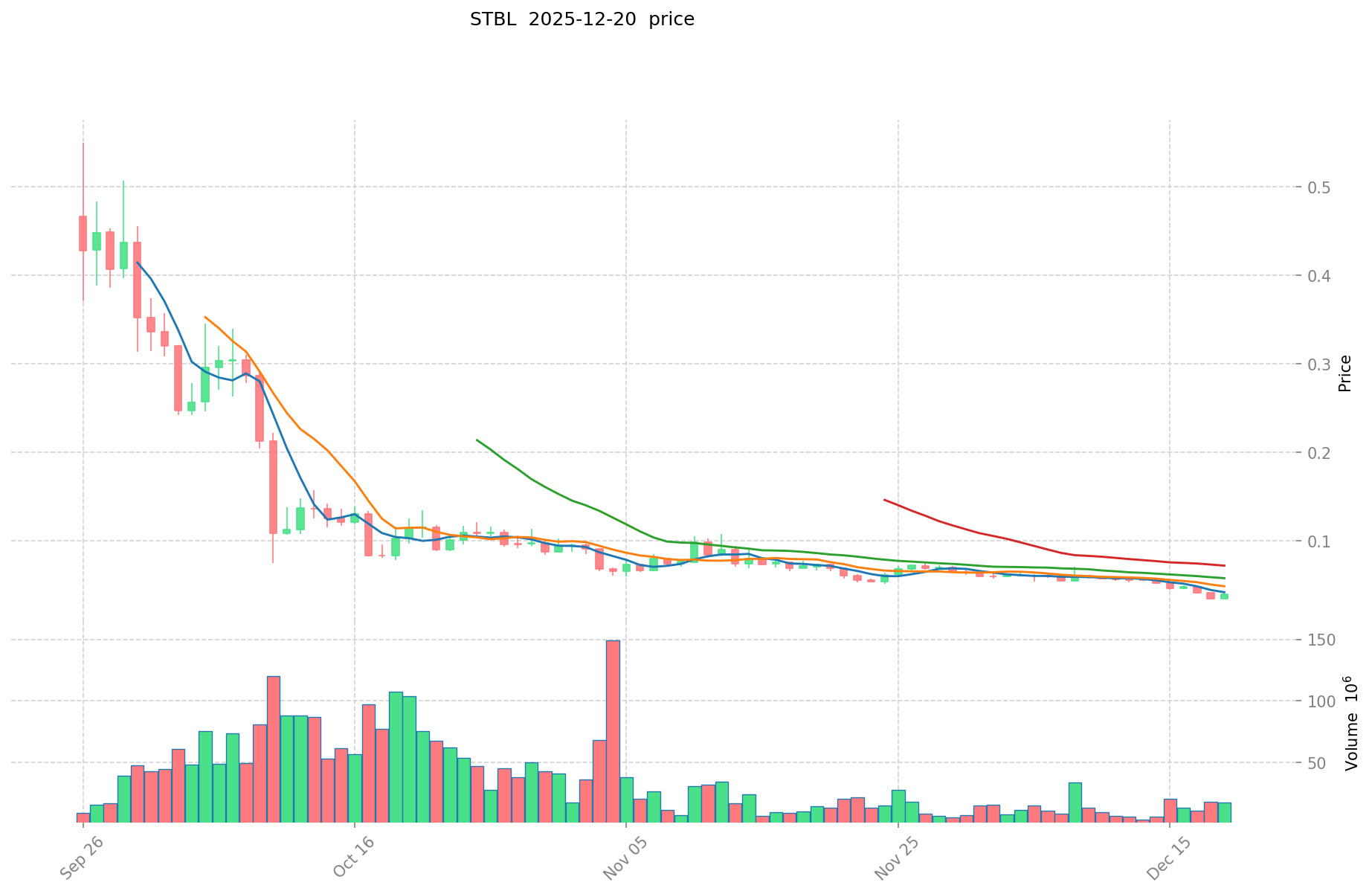
Based on available data as of December 20, 2025:
- All-Time High (ATH): $0.55 USD, reached on September 26, 2025
- All-Time Low (ATL): $0.03424 USD, reached on December 18, 2025
- Year-to-Date Performance: +226.99% (1-year return)
Price Volatility Summary:
- 1-hour change: -0.29%
- 24-hour change: +11.15%
- 7-day change: -26.77%
- 30-day change: -42.39%
The token experienced significant volatility, with a sharp decline from its September peak to near-record lows in mid-December, demonstrating substantial price instability over the review period.
Current STBL Market Status (December 2025)
- Current Price: $0.04087 USD
- 24-hour Trading Volume: $797,438.15 USD
- Market Capitalization: $20,435,000 USD (5% of fully diluted valuation)
- Fully Diluted Valuation: $408,700,000 USD
- Market Dominance: 0.012%
- Number of Token Holders: 15,051
- Trading Exchanges: 17 platforms
Token Supply Metrics:
- Circulating Supply: 500,000,000 STBL (5% of total)
- Total Supply: 10,000,000,000 STBL
- Maximum Supply: 10,000,000,000 STBL
View real-time STBL market data on Gate
II. Project Overview and Core Mechanism
Platform Architecture
STBL is a decentralized, non-custodial platform designed to redefine stablecoin utility by combining yield generation, transparency, and real-world asset (RWA) backing. The platform operates as a mechanism for minting stablecoins with distinctive DeFi advantages.
Native Stablecoin Products
The platform enables the issuance of two primary stablecoins:
- USST: Primary stablecoin offering
- YLD: Yield-bearing stablecoin variant
Key Platform Differentiators
- Yield Without Staking: Users can earn returns without locking capital into staking mechanisms
- No Lockup Periods: Complete liquidity flexibility for participants
- RWA-Powered Growth: Real-world asset backing drives economic sustainability
- Non-Custodial Design: Users maintain direct control of their assets
III. Technical Specifications
Blockchain Implementation
- Network: Binance Smart Chain (BSC)
- Token Standard: BEP-20
- Smart Contract Address: 0x8dedf84656fa932157e27c060d8613824e7979e3
- Block Explorer: BSCscan
Project Launch Information
- Launch Date: January 16, 2025
- Market Ranking: 859 (by market capitalization)
IV. Community and Official Resources
- Official Website: https://www.stbl.com/
- Documentation: https://docs.stbl.com/
- Twitter: https://twitter.com/stbl_official
- Discord: https://discord.gg/stbl
V. Market Analysis Summary
STBL demonstrates characteristics typical of early-stage DeFi protocols, with significant volatility and emerging market adoption. The project's focus on yield-bearing stablecoins backed by real-world assets positions it within the growing RWA-DeFi intersection. The low market dominance (0.012%) and relatively concentrated token distribution (only 5% of total supply circulating) suggest both growth potential and concentration risk. The sharp decline from September peaks to December lows reflects market-wide pressure and potential sector-specific challenges facing stablecoin protocols.
STBL Cryptocurrency Investment Analysis Report
Report Date: December 20, 2025
Asset: STBL (STBL)
Current Price: $0.04087
Market Capitalization: $20,435,000
Circulating Supply: 500,000,000 STBL
I. Executive Summary
STBL is a decentralized, non-custodial platform designed to redefine stablecoin utility by combining yield generation, transparency, and real-world asset (RWA) backing. The protocol operates on the BNB Smart Chain (BSC) and enables users to mint stablecoins—namely USST and YLD—with distinctive advantages including yield without staking, no lockup periods, and RWA-powered growth mechanisms.
As of December 20, 2025, STBL faces mixed market conditions. The asset has demonstrated significant volatility over recent periods, with a 24-hour gain of 11.15% offset by substantial losses over longer timeframes (-26.77% in 7 days, -42.39% in 30 days). However, the asset shows strong year-to-date performance with a 226.99% increase since inception.
II. Core Factors Influencing STBL as an Investment
I. Supply Mechanism and Tokenomics
Token Distribution:
- Total Supply: 10,000,000,000 STBL
- Circulating Supply: 500,000,000 STBL (5% of total)
- Fully Diluted Valuation: $408,700,000
- Current Market Cap: $20,435,000
The low circulating supply ratio (5%) indicates significant future dilution potential as additional tokens enter circulation. This structural characteristic affects long-term price dynamics and investment valuations, as increased supply pressure typically correlates with downward price pressure absent corresponding demand growth.
II. Protocol Architecture and Ecosystem Design
Three-Token Ecosystem:
STBL operates through a three-token ecosystem designed to separate liquidity from yield generation:
-
STBL Governance Token: Serves as the backbone of decentralized decision-making. Token holders participate in critical governance decisions including collateral approval, fee management, and protocol upgrades.
-
USST Stablecoin: A yield-bearing stablecoin backed by regulated, yield-generating real-world assets managed through transparent smart contracts.
-
YLD Token: Functions within the protocol's yield distribution mechanism.
Supported Real-World Assets:
The protocol accepts tokenized yield-bearing instruments including:
- Tokenized U.S. Treasury bills
- Money market funds
- Approved RWA tokens (BUIDL, USDY, OUSG)
Yield Stripping Mechanism:
STBL redistributes reserve yields to users, contrasting with traditional stablecoins (USDT, USDC) that retain all reserve yields. This value distribution model creates direct incentives for protocol participation.
III. Market Position and Adoption Metrics
Market Standing:
- Current Ranking: 859 (by market capitalization)
- Market Dominance: 0.012%
- Number of Holders: 15,051
- Trading Exchanges: 17
- 24-Hour Trading Volume: $797,438.15
The relatively modest trading volume and holder count suggest STBL remains in early adoption phases. The presence on 17 exchanges provides reasonable liquidity infrastructure for a project at this developmental stage.
IV. Macroeconomic Context: Tokenized Treasury Market Growth
The tokenized Treasury market exceeded $23 billion in 2025, providing favorable macro conditions for RWA-backed protocols. This expansion represents substantial market validation for the asset class and creates structural demand tailwinds for STBL's RWA-backed stablecoin model.
V. Development Roadmap and Integration Timeline
According to available roadmap information:
- Q4 2025: DeFi integrations targeting lending and borrowing markets
- Q1 2026: Institutional adoption initiatives for the USST stablecoin
These milestones represent critical inflection points for protocol adoption and ecosystem expansion.
VI. Price Performance and Technical Levels
Historical Price Data:
- All-Time High: $0.55 (September 26, 2025)
- All-Time Low: $0.03424 (December 18, 2025)
- 24-Hour High: $0.04284
- 24-Hour Low: $0.03585
Price Trends:
- 1-Hour: -0.29%
- 24-Hour: +11.15%
- 7-Day: -26.77%
- 30-Day: -42.39%
- 1-Year: +226.99%
The sharp decline from all-time high ($0.55) to current price ($0.04087) represents a 92.6% depreciation, indicating significant investor losses from peak levels and ongoing market consolidation.
III. Risk Factors and Considerations
Regulatory Uncertainty:
As a protocol operating in the RWA and DeFi space, STBL faces evolving regulatory environments across multiple jurisdictions. Stablecoin regulations remain unsettled in many markets, creating potential compliance risks.
Market Volatility:
STBL exhibits substantial price volatility despite its stablecoin ecosystem focus. The 42.39% decline over 30 days demonstrates sensitivity to broader crypto market conditions and sentiment shifts.
Early-Stage Adoption Risk:
With 15,051 holders and $20.4 million market capitalization, STBL remains relatively nascent. Early-stage protocols face significant execution, market acceptance, and competitive risks.
Dilution Pressure:
The 5% circulating supply ratio creates substantial dilution potential as the protocol matures and additional tokens unlock, absent corresponding demand expansion.
IV. Investment Considerations
The determination of whether STBL constitutes a suitable investment depends on individual risk tolerance, investment horizon, and portfolio construction objectives. Key decision factors include:
- Time Horizon: Longer-term investors may benefit from protocol development execution, while shorter-term traders face elevated volatility exposure.
- RWA Thesis Conviction: Investors bullish on real-world asset tokenization and RWA-backed protocols may view STBL's positioning as strategically valuable.
- DeFi Ecosystem Participation: Active DeFi participants seeking yield mechanisms without staking or lockups may find protocol utility alignment.
- Risk Capacity: The asset exhibits volatility characteristics requiring appropriate portfolio sizing and risk management.
V. Community and Information Resources
Official Channels:
- Website: https://www.stbl.com/
- Documentation: https://docs.stbl.com/
- Twitter: https://twitter.com/stbl_official
- Discord: https://discord.gg/stbl
- Blockchain Explorer (BSC): https://bscscan.com/token/0x8dedf84656fa932157e27c060d8613824e7979e3
Contract Address (BSC):
- 0x8dedf84656fa932157e27c060d8613824e7979e3
VI. Conclusion
STBL represents an innovative approach to stablecoin design through its RWA-backed, yield-generating protocol architecture. The project operates within favorable macroeconomic conditions defined by tokenized Treasury market growth exceeding $23 billion. However, substantial near-term risks exist including market volatility, regulatory uncertainty, early-stage adoption challenges, and significant dilution potential from locked token supplies.
Investment suitability varies by individual circumstances and risk profiles. Prospective participants should conduct independent due diligence, understand the protocol mechanics, and assess alignment with personal investment objectives and risk tolerance.
III. STBL Future Investment Predictions and Price Outlook (Is STBL worth investing in 2025-2030)
Short-term Investment Prediction (2025, short-term STBL investment outlook)
- Conservative Forecast: $0.0266 - $0.0400
- Neutral Forecast: $0.0401 - $0.0478
- Optimistic Forecast: $0.0479 - $0.0550
Mid-term Investment Outlook (2027-2029, mid-term STBL(STBL) investment forecast)
-
Market Phase Expectations: STBL is transitioning through early adoption phases with increasing ecosystem maturation. The 2027-2029 period is expected to see gradual price appreciation driven by real-world asset (RWA) integration and stablecoin utility expansion within the DeFi ecosystem.
-
Investment Return Predictions:
- 2028: $0.0347 - $0.0699
- 2029: $0.0313 - $0.0874
-
Key Catalysts: Real-world asset backing expansion, increased stablecoin adoption (USST and YLD), DeFi ecosystem growth, and regulatory clarity on RWA-backed tokens.
Long-term Investment Outlook (Is STBL a good long-term investment?)
-
Base Case Scenario: $0.0680 - $0.0783 (2030, assuming continued RWA adoption and steady DeFi market growth)
-
Optimistic Scenario: $0.0870 - $0.1200 (2030, assuming accelerated mainstream adoption of yield-bearing stablecoins and broader cryptocurrency market expansion)
-
Risk Scenario: $0.0200 - $0.0400 (2030, considering token dilution risks from prior unlocks, overall market downturn, or competitive pressures in the stablecoin space)
For detailed STBL long-term investment and price forecasts, visit: Price Prediction
2025-12-20 to 2030 Long-term Outlook
- Base Case Scenario: $0.0681 - $0.0783 USD (Corresponds to steady RWA adoption and gradual market penetration)
- Optimistic Scenario: $0.0874 - $0.1100 USD (Corresponds to large-scale stablecoin adoption and favorable market conditions)
- Transformative Scenario: $0.1500 USD and above (Assuming breakthrough progress in ecosystem development and mainstream adoption)
- 2030-12-31 Predicted Peak: $0.0783 USD (Based on moderate growth assumptions)
Disclaimer: This analysis is for informational purposes only and should not be construed as investment advice. Cryptocurrency markets are highly volatile and subject to regulatory changes. Past performance does not guarantee future results. Token unlocks, market sentiment, and macroeconomic factors may significantly impact price movements. Investors should conduct their own research before making investment decisions.
| 年份 | 预测最高价 | 预测平均价格 | 预测最低价 | 涨跌幅 |
|---|---|---|---|---|
| 2025 | 0.0478296 | 0.04088 | 0.026572 | 0 |
| 2026 | 0.049233828 | 0.0443548 | 0.023951592 | 8 |
| 2027 | 0.04960197284 | 0.046794314 | 0.03322396294 | 14 |
| 2028 | 0.069887307959 | 0.04819814342 | 0.0347026632624 | 17 |
| 2029 | 0.08738323402046 | 0.0590427256895 | 0.031292644615435 | 44 |
| 2030 | 0.078337888444828 | 0.07321297985498 | 0.068088071265131 | 79 |
STBL Investment Analysis Report
I. Project Overview
Basic Information
STBL is a decentralized, non-custodial platform designed to redefine stablecoin utility by combining yield, transparency, and real-world asset (RWA) backing. The platform operates a mechanism for minting stablecoins, specifically USST and YLD, offering unique advantages within the DeFi ecosystem.
Key Metrics (As of December 20, 2025)
| Metric | Value |
|---|---|
| Current Price | $0.04087 |
| 24H Change | +11.15% |
| Total Market Cap | $408,700,000 |
| Circulating Supply | 500,000,000 STBL |
| Total Supply | 10,000,000,000 STBL |
| Market Ranking | 859 |
| Active Holders | 15,051 |
| Exchange Listings | 17 |
Price History
- All-Time High: $0.55 (September 26, 2025)
- All-Time Low: $0.03424 (December 18, 2025)
- 24H High: $0.04284
- 24H Low: $0.03585
II. Performance Analysis
Price Trends
| Time Period | Change | Amount |
|---|---|---|
| 1 Hour | -0.29% | -$0.000119 |
| 24 Hours | +11.15% | +$0.00410 |
| 7 Days | -26.77% | -$0.01494 |
| 30 Days | -42.39% | -$0.03007 |
| 1 Year | +226.99% | +$0.02837 |
Market Dynamics
- 24-Hour Volume: $797,438.15
- Market Dominance: 0.012%
- Circulating Supply Ratio: 5% of total supply in circulation
- Fully Diluted Valuation (FDV): $408,700,000
The token demonstrates significant volatility, with a substantial pullback over the past 30 days (-42.39%) following its all-time high. However, year-to-date performance shows strong appreciation (+226.99%).
III. Platform Features and Technology
Core Mechanism
STBL operates as a yield-bearing stablecoin platform with the following characteristics:
- Yield Generation: Revenue without staking requirements
- No Lockup Periods: Immediate liquidity for users
- RWA Integration: Real-world asset backing mechanism for growth
- Non-Custodial Model: Users maintain full control of assets
Network Details
- Blockchain: BEP-20 (Binance Smart Chain)
- Contract Address: 0x8dedf84656fa932157e27c060d8613824e7979e3
- Explorer: BSCscan compatible
IV. Investment Strategy and Risk Management
Investment Methodology
Long-term Holding (HODL STBL)
- Suitable for conservative investors seeking RWA-backed yield exposure
- Appropriate for investors with medium to long-term horizons (12+ months)
- Benefits from platform development and potential market cap expansion
Active Trading
- Dependent on technical analysis during high volatility periods
- Recent 7-day decline (-26.77%) may present entry opportunities for tactical traders
- Requires monitoring of 24-hour volume and support/resistance levels
Risk Management Framework
Asset Allocation Guidelines
- Conservative Investor: 2-5% portfolio allocation
- Aggressive Investor: 5-15% portfolio allocation
- Professional Investor: Case-by-case strategic allocation
Portfolio Diversification Approach
- Combine with established stablecoins for stability
- Pair with blue-chip cryptocurrencies to reduce concentration risk
- Consider RWA-focused assets for thematic alignment
Security Considerations
- Hot Wallets: For active trading and frequent transactions
- Cold Storage: For long-term holding; hardware wallets (Ledger, Trezor) recommended
- Custodial Services: Evaluate exchange security ratings before deposits
V. Investment Risks and Challenges
Market Risk
- High Volatility: 73.3% decline from ATH ($0.55 to current $0.04087) demonstrates significant price fluctuation potential
- Low Trading Volume: $797K 24-hour volume relative to market cap may result in slippage on larger orders
- Market Concentration: Rank 859 indicates nascent market position with limited liquidity depth
Regulatory Risk
- Stablecoin Regulation: Evolving global frameworks may impact RWA-backed stablecoin operations
- Jurisdictional Uncertainty: Different regulatory approaches across major markets (US, EU, Asia) create policy risk
- Compliance Requirements: RWA backing may require enhanced regulatory compliance
Technology Risk
- Smart Contract Vulnerability: Platform relies on blockchain security; potential exploit risks in yield mechanism
- RWA Counterparty Risk: Real-world asset backing introduces dependency on external asset quality and custodians
- Liquidity Risk: Conversion mechanisms between USST, YLD, and STBL may face stress during market extremes
Execution Risk
- Platform Adoption: Success dependent on user growth and ecosystem development
- Competitive Pressure: Established stablecoin platforms present significant competition
VI. Conclusion: Is STBL a Good Investment?
Investment Value Summary
STBL presents a differentiated value proposition in the stablecoin space through RWA backing and yield mechanisms without staking requirements. The project demonstrates year-to-date appreciation of +226.99%, indicating strong long-term potential. However, the recent 42.39% correction over 30 days and elevated volatility require careful consideration.
Key Considerations:
- Emerging platform with moderate holder base (15,051 addresses)
- RWA integration aligns with growing institutional interest in crypto infrastructure
- Limited 24-hour volume suggests liquidity constraints
- Early-stage project status implies both growth potential and execution risk
Investor Recommendations
✅ Beginners: Dollar-Cost Averaging Strategy
- Invest fixed amounts on regular intervals to reduce timing risk
- Utilize hardware wallet storage for security
- Allocate no more than 3-5% of crypto portfolio to STBL
- Review quarterly for development progress
✅ Experienced Investors: Tactical Positioning
- Monitor technical support levels near $0.03-0.04 range
- Consider 7-14 day consolidation patterns for entry points
- Implement stop-loss orders at 20-25% below entry
- Allocate 5-10% for rotation strategies aligned with RWA market trends
✅ Institutional Investors: Strategic Long-Term Configuration
- Evaluate platform roadmap and team credentials
- Assess RWA partnerships and custodial arrangements
- Monitor regulatory developments in stablecoin jurisdiction
- Structure positions with 12-36 month investment horizons
Risk Disclaimer
⚠️ Warning: Cryptocurrency investments carry substantial risk including potential total loss of capital. STBL exhibits high volatility and limited liquidity relative to established crypto assets. This report is provided for informational purposes only and does not constitute investment advice, financial recommendation, or solicitation to buy or sell. Conduct thorough independent research and consult qualified financial advisors before making investment decisions. Past performance does not guarantee future results.
Report Generated: December 20, 2025
Data Source: Market data as of December 20, 2025, 15:22:44 UTC
STBL Investment Analysis: Frequently Asked Questions
I. FAQ
Q1: What is STBL and how does it differentiate itself in the stablecoin market?
A: STBL is a decentralized, non-custodial platform that redefines stablecoin utility by combining yield generation, transparency, and real-world asset (RWA) backing. Unlike traditional stablecoins (USDT, USDC) that retain reserve yields for their issuers, STBL redistributes yields to users through its native stablecoins USST and YLD. The platform operates on BNB Smart Chain and offers unique advantages including yield without staking requirements, no lockup periods, and RWA-powered growth mechanisms backed by tokenized U.S. Treasury bills, money market funds, and approved RWA tokens.
Q2: What are the key tokenomics and supply mechanics of STBL?
A: STBL has a total supply of 10 billion tokens with only 500 million currently circulating (5% of total supply). The current price stands at $0.04087 USD as of December 20, 2025, with a market capitalization of $408.7 million (fully diluted valuation). The low circulating supply ratio indicates significant future dilution potential as additional tokens unlock, which may create downward price pressure absent corresponding demand growth. This structural characteristic is crucial for long-term valuation assessment and investment risk evaluation.
Q3: How has STBL performed historically, and what is its current price trajectory?
A: STBL reached an all-time high of $0.55 USD on September 26, 2025, but subsequently declined to $0.03424 on December 18, 2025, representing a 92.6% depreciation from peak levels. Year-to-date performance shows +226.99% appreciation since inception. Recent volatility includes -42.39% over 30 days and -26.77% over 7 days, though the asset recovered +11.15% in the 24-hour period. This volatility demonstrates sensitivity to broader cryptocurrency market conditions and sector-specific stablecoin protocol challenges.
Q4: What price targets are projected for STBL through 2030?
A: Price projections vary by scenario through 2030: Base case scenarios project $0.0681-$0.0783 USD, assuming steady real-world asset adoption and gradual market penetration. Optimistic scenarios forecast $0.0874-$0.1100 USD, corresponding to large-scale stablecoin adoption and favorable market conditions. Transformative scenarios model $0.1500 USD and above, assuming breakthrough ecosystem development and mainstream adoption. Conversely, risk scenarios estimate $0.0200-$0.0400 USD if token dilution, market downturns, or competitive pressures materialize. These projections are subject to significant uncertainty and should be viewed as illustrative scenarios rather than predictions.
Q5: What are the primary risk factors associated with STBL investment?
A: Major risks include regulatory uncertainty surrounding RWA-backed stablecoins and evolving stablecoin regulations across jurisdictions; market volatility demonstrated by recent 92.6% decline from all-time high; early-stage adoption challenges given the relatively modest holder base of 15,051 and $20.4 million current market capitalization; significant token dilution potential from 95% of supply still locked; smart contract vulnerability exposure; real-world asset counterparty risks; and execution risks dependent on platform adoption and ecosystem development. Additionally, limited 24-hour trading volume ($797,438) relative to market cap may result in slippage on larger transactions.
Q6: Is STBL suitable for different investor profiles, and what allocation recommendations apply?
A: STBL suitability depends on individual risk tolerance and investment horizon. Conservative investors should limit allocations to 2-5% of crypto portfolios using dollar-cost averaging strategies and hardware wallet storage. Experienced investors may allocate 5-10% for tactical positioning while monitoring technical support levels and implementing stop-loss orders. Institutional investors should evaluate platform roadmap credentials, RWA partnerships, custodial arrangements, and regulatory developments with 12-36 month investment horizons. Beginners should prioritize security practices and quarterly development reviews, while active traders require monitoring of 24-hour volume and support/resistance levels during high volatility periods.
Q7: What macroeconomic factors support STBL's investment thesis?
A: The tokenized Treasury market exceeded $23 billion in 2025, providing substantial market validation and favorable macro conditions for RWA-backed protocols. This market expansion creates structural demand tailwinds for STBL's RWA-backed stablecoin model. Additionally, planned Q4 2025 DeFi integrations targeting lending and borrowing markets, combined with Q1 2026 institutional adoption initiatives for USST stablecoin, represent critical inflection points for protocol adoption and ecosystem expansion. These catalysts align with broader cryptocurrency market trends toward real-world asset tokenization and institutional infrastructure development.
Q8: What resources are available for conducting independent due diligence on STBL?
A: Official resources include the project website (https://www.stbl.com/), comprehensive documentation (https://docs.stbl.com/), Twitter updates (@stbl_official), and Discord community (discord.gg/stbl). Technical information is accessible through BNB Smart Chain block explorer (BSCscan) using the contract address 0x8dedf84656fa932157e27c060d8613824e7979e3. Market data is available on 17 trading exchanges. Prospective investors should review the protocol mechanics, assess team credentials, evaluate RWA partnerships and custodial arrangements, monitor regulatory developments, and analyze competitive positioning before making investment decisions. Independent due diligence is essential given the project's early-stage status and emerging market dynamics.
Disclaimer: This analysis is provided for informational purposes only and does not constitute investment advice, financial recommendation, or solicitation to buy or sell. Cryptocurrency markets exhibit substantial volatility and regulatory uncertainty. Past performance does not guarantee future results. Investors should conduct independent research and consult qualified financial advisors before making investment decisions. Token unlocks, market sentiment, and macroeconomic factors may significantly impact price movements and investment outcomes.
Share
How to Buy Cryptocurrency


Trending Cryptocurrencies



What Is the Core Logic Behind World Liberty Financial's White Paper?

GUSD: Stable returns backed by real-world assets on Gate.com, 2025
GUSD: The secure stablecoin for wealth management in 2025
GUSD: A stablecoin backed by Gate's assets, aimed at achieving stable returns by 2025.

Maximize Your GUSD Returns: Staking Strategies on Gate in 2025

Staking GUSD on Gate: Stable returns from stablecoins backed by real assets.

How does TRUMP coin price volatility compare to Bitcoin and Ethereum in 2025?
Understanding Ethereum's Daily Trading Volume
What is ZKP (Panther Protocol) Market Overview: Price, Market Cap, Trading Volume, and Supply Data?
Understanding Ethereum Record for Beginners

What is token economics and how does distribution, inflation, and governance mechanisms work?