CUDIS vs QNT: Comparing Two Emerging Blockchain Technologies for Enterprise Solutions

2025-11-21 16:12:25
Altcoins
Blockchain
Crypto Insights
Investing In Crypto
Article Rating : 4.9
half-star
0 ratings
The article "CUDIS vs QNT: Comparative Insights into Blockchain Solutions" explores investment values of CUDIS and QNT for enterprises. It addresses historical price trends, adoption dynamics, and risk management, equipping both novice and experienced investors with strategic insights. The text systematically compares tokenomics, institutional adoption, and technological ecosystems. Key factors include market resilience, future growth potential, and recommended investment strategies, emphasizing regulatory environments and supply mechanisms. Readers gain a comprehensive overview of these emerging blockchain technologies, enabling informed decision-making.
CUDIS vs QNT: Comparing Two Emerging Blockchain Technologies for Enterprise Solutions

Introduction: CUDIS vs QNT Investment Comparison

In the cryptocurrency market, the comparison between CUDIS and QNT has always been a topic that investors cannot avoid. The two not only have significant differences in market cap ranking, application scenarios, and price performance, but also represent different crypto asset positioning.

CUDIS (CUDIS): Since its launch, it has gained market recognition for its positioning as a longevity protocol aimed at extending health-span to 140 years.

Quant (QNT): Since its inception in 2018, it has been hailed as a technology provider enabling trusted digital interaction, leading in innovation and blockchain adoption for enterprises.

This article will comprehensively analyze the investment value comparison between CUDIS and QNT, focusing on historical price trends, supply mechanisms, institutional adoption, technological ecosystems, and future predictions, attempting to answer the question that concerns investors the most:

"Which is the better buy right now?"

I. Price History Comparison and Current Market Status

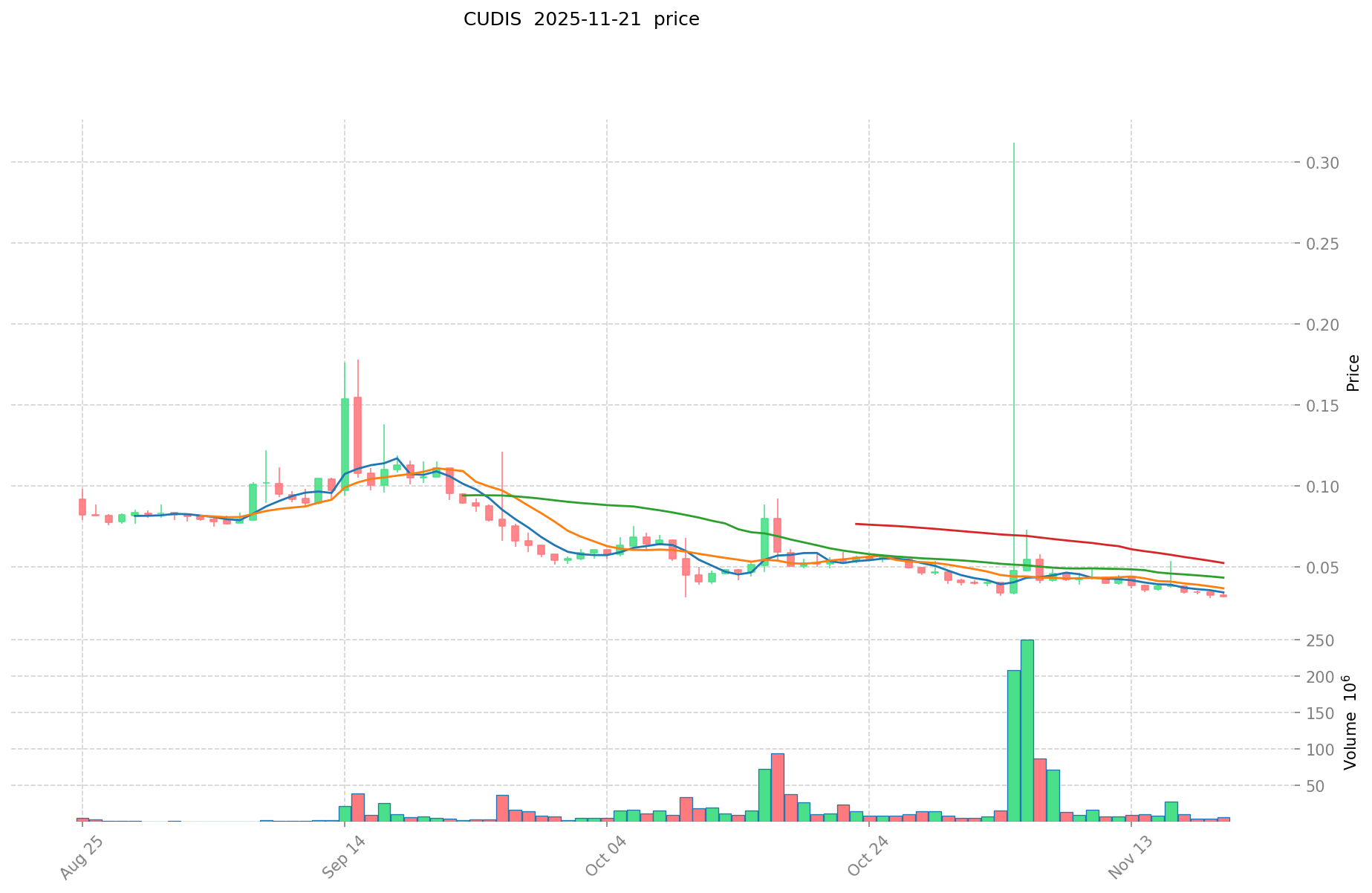
  • 2025: CUDIS reached its all-time high of $0.31204 on November 4, but has since experienced a significant decline.
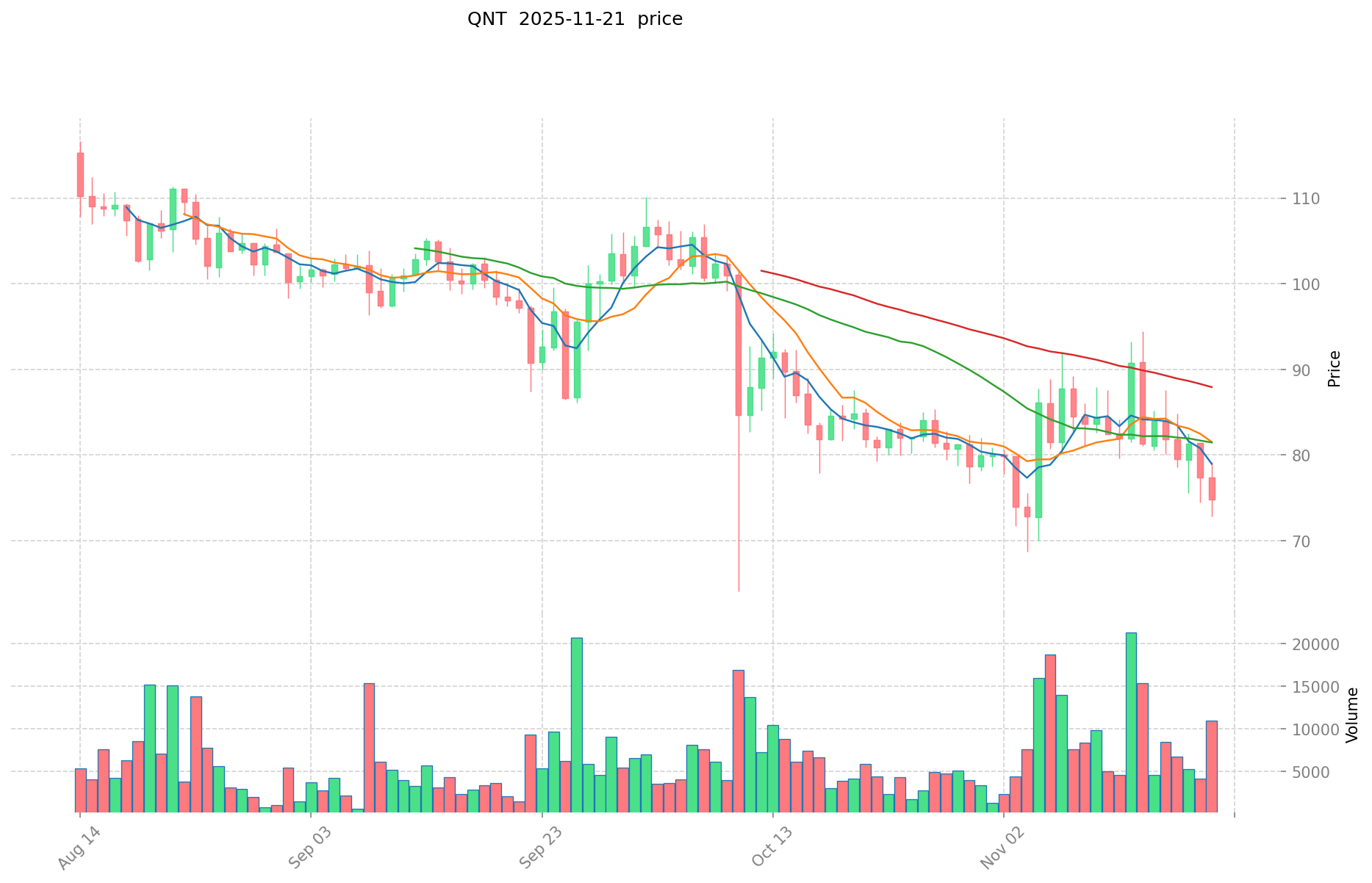
  • 2021: QNT achieved its all-time high of $427.42 on September 11, demonstrating strong market performance during the bull run.
  • Comparative analysis: In recent market cycles, CUDIS has dropped from its peak of $0.31204 to a low of $0.02873, while QNT has shown more resilience, currently trading at $70.55, significantly above its all-time low of $0.215773.

Current Market Situation (2025-11-22)

  • CUDIS current price: $0.03157
  • QNT current price: $70.55
  • 24-hour trading volume: CUDIS $235,162.84 vs QNT $1,041,031.32
  • Market Sentiment Index (Fear & Greed Index): 14 (Extreme Fear)

Click to view real-time prices:

  • View CUDIS current price Market Price
  • View QNT current price Market Price

price_image1 price_image2

II. Core Factors Affecting Investment Value of CUDIS vs QNT

Supply Mechanism Comparison (Tokenomics)

  • CUDIS: Fixed supply cap of 1 billion tokens, with approximately 12 million tokens currently in circulation
  • QNT: Limited supply of 14.6 million tokens with deflationary mechanism, burning tokens through transaction fees
  • 📌 Historical Pattern: Fixed and limited supply models typically create scarcity value over time, with QNT's deflationary mechanism potentially providing additional upward price pressure during periods of increased network usage.

Institutional Adoption and Market Applications

  • Institutional Holdings: QNT has gained more institutional traction, being listed on major exchanges like Coinbase and Kraken, while CUDIS is still in early adoption phases
  • Enterprise Adoption: QNT has established partnerships with major financial institutions for interoperability solutions, while CUDIS is focusing on small-to-medium businesses for its decentralized cloud computing platform
  • Regulatory Stance: QNT has maintained favorable regulatory positioning by focusing on interoperability between traditional finance and blockchain, while CUDIS faces typical regulatory uncertainty of emerging blockchain projects

Technological Development and Ecosystem Building

  • CUDIS Technology: Developing decentralized cloud computing infrastructure with focus on security and scalability, recently implementing AI capabilities
  • QNT Technology: Offers the Overledger network for cross-blockchain interoperability, positioning as an enterprise-grade solution for blockchain connectivity
  • Ecosystem Comparison: QNT has stronger integration with existing financial infrastructure and enterprise solutions, while CUDIS is building a more diverse ecosystem around decentralized computing services and emerging AI applications

Macroeconomic and Market Cycles

  • Inflation Performance: QNT's limited supply and enterprise adoption position it as potentially more inflation-resistant, while CUDIS's utility-driven value proposition is still being established
  • Monetary Policy Impact: Both tokens show sensitivity to broader market conditions, with QNT demonstrating more resilience during market downturns due to its established use cases
  • Geopolitical Factors: QNT benefits from increased demand for secure cross-border transaction systems, while CUDIS could potentially benefit from global demand for decentralized computing resources III. 2025-2030 Price Prediction: CUDIS vs QNT

Short-term Prediction (2025)

  • CUDIS: Conservative $0.0299-$0.0312 | Optimistic $0.0312-$0.0449
  • QNT: Conservative $54.83-$70.29 | Optimistic $70.29-$87.16

Mid-term Prediction (2027)

  • CUDIS may enter a growth phase, with prices expected in the range of $0.0306-$0.0593
  • QNT may enter a steady growth phase, with prices expected in the range of $65.92-$97.63
  • Key drivers: Institutional capital inflow, ETF, ecosystem development

Long-term Prediction (2030)

  • CUDIS: Base scenario $0.0373-$0.0644 | Optimistic scenario $0.0644-$0.0753
  • QNT: Base scenario $75.78-$135.31 | Optimistic scenario $135.31-$177.26

View detailed price predictions for CUDIS and QNT

Disclaimer

CUDIS:

年份 预测最高价 预测平均价格 预测最低价 涨跌幅
2025 0.0448992 0.03118 0.0299328 -1
2026 0.042604352 0.0380396 0.030812076 20
2027 0.05927330472 0.040321976 0.03064470176 27
2028 0.072206578522 0.04979764036 0.0343603718484 57
2029 0.06771234147951 0.061002109441 0.04636160317516 93
2030 0.075297953788498 0.064357225460255 0.037327190766947 103

QNT:

年份 预测最高价 预测平均价格 预测最低价 涨跌幅
2025 87.1596 70.29 54.8262 0
2026 88.171776 78.7248 48.809376 11
2027 97.63449696 83.448288 65.92414752 18
2028 130.3796051712 90.54139248 67.90604436 28
2029 160.16772329712 110.4604988256 92.786819013504 56
2030 177.2614854903816 135.31411106136 75.7759021943616 91

IV. Investment Strategy Comparison: CUDIS vs QNT

Long-term vs Short-term Investment Strategies

  • CUDIS: Suitable for investors focused on emerging technologies and potential growth in decentralized cloud computing
  • QNT: Suitable for investors seeking established enterprise solutions and interoperability in the blockchain space

Risk Management and Asset Allocation

  • Conservative investors: CUDIS: 20% vs QNT: 80%
  • Aggressive investors: CUDIS: 40% vs QNT: 60%
  • Hedging tools: Stablecoin allocation, options, cross-currency portfolios

V. Potential Risk Comparison

Market Risk

  • CUDIS: Higher volatility due to lower market cap and trading volume
  • QNT: Susceptible to broader crypto market trends and enterprise adoption rates

Technical Risk

  • CUDIS: Scalability challenges, network stability in early stages
  • QNT: Potential interoperability issues, security vulnerabilities in cross-chain operations

Regulatory Risk

  • Global regulatory policies may have differing impacts on both tokens, with QNT potentially facing less scrutiny due to its focus on enterprise solutions

VI. Conclusion: Which Is the Better Buy?

📌 Investment Value Summary:

  • CUDIS advantages: Potential for high growth in emerging decentralized cloud computing market, AI integration
  • QNT advantages: Established enterprise partnerships, strong interoperability focus, limited supply with deflationary mechanism

✅ Investment Advice:

  • Novice investors: Consider a higher allocation to QNT due to its more established market position
  • Experienced investors: Balanced portfolio with both CUDIS and QNT, adjusting based on risk tolerance
  • Institutional investors: Focus on QNT for its enterprise-grade solutions and regulatory-friendly approach

⚠️ Risk Warning: The cryptocurrency market is highly volatile, and this article does not constitute investment advice. None

VII. FAQ

Q1: What are the key differences between CUDIS and QNT? A: CUDIS is focused on decentralized cloud computing and longevity protocols, while QNT specializes in blockchain interoperability and enterprise solutions. QNT has a more established market presence and institutional adoption, while CUDIS is in earlier stages of development with potential for growth in emerging technologies.

Q2: Which token has shown better price performance historically? A: QNT has demonstrated stronger price performance historically. It reached an all-time high of $427.42 in September 2021 and has maintained a higher price level compared to its all-time low. CUDIS, being newer, reached its all-time high of $0.31204 in November 2025 but has since experienced a significant decline.

Q3: How do the supply mechanisms of CUDIS and QNT differ? A: CUDIS has a fixed supply cap of 1 billion tokens, with approximately 12 million currently in circulation. QNT has a limited supply of 14.6 million tokens with a deflationary mechanism, burning tokens through transaction fees.

Q4: What are the main factors affecting the investment value of these tokens? A: Key factors include supply mechanisms, institutional adoption, technological development, ecosystem building, macroeconomic conditions, and regulatory environments. QNT generally has an advantage in institutional adoption and regulatory positioning, while CUDIS offers potential in emerging tech markets.

Q5: How do the long-term price predictions for CUDIS and QNT compare? A: By 2030, CUDIS is predicted to reach $0.0373-$0.0753 in base to optimistic scenarios, while QNT is expected to reach $75.78-$177.26. QNT shows higher potential for price appreciation based on these predictions.

Q6: What are the recommended investment strategies for CUDIS and QNT? A: For conservative investors, a portfolio allocation of 20% CUDIS and 80% QNT is suggested. For aggressive investors, a 40% CUDIS and 60% QNT split is recommended. QNT is generally considered more suitable for long-term, stable investment, while CUDIS may offer higher growth potential with increased risk.

Q7: What are the main risks associated with investing in CUDIS and QNT? A: CUDIS faces higher market volatility, technical risks related to scalability, and regulatory uncertainty. QNT, while more established, is subject to enterprise adoption rates, potential interoperability issues, and broader crypto market trends. Both are exposed to general cryptocurrency market risks and regulatory changes.

* The information is not intended to be and does not constitute financial advice or any other recommendation of any sort offered or endorsed by Gate.
Related Articles
 How to Buy Crypto: A Step-by-Step Guide with Gate.com

How to Buy Crypto: A Step-by-Step Guide with Gate.com

In today’s rapidly evolving digital asset landscape, more and more people are looking to invest in cryptocurrencies. If you’ve been searching for "how to buy crypto," Gate.com offers a secure, user-friendly platform that makes entering the crypto market both easy and safe. This article will guide you through the step-by-step process of purchasing cryptocurrencies, while highlighting the unique advantages of using Gate.com.
2025-08-14 05:20:52
USDC stablecoin 2025 Latest Analysis: Principles, Advantages, and Web3 Eco-Applications

USDC stablecoin 2025 Latest Analysis: Principles, Advantages, and Web3 Eco-Applications

In 2025, USDC stablecoin dominates the cryptocurrency market with a market cap exceeding 60 billion USD. As a bridge connecting traditional finance and the digital economy, how does USDC operate? What advantages does it have compared to other stablecoins? In the Web3 ecosystem, how extensive is the application of USDC? This article will delve into the current status, advantages, and key role of USDC in the future of digital finance.
2025-08-14 05:10:31
2025 USDT USD Complete Guide: A Must-Read for Newbie Investors

2025 USDT USD Complete Guide: A Must-Read for Newbie Investors

In the cryptocurrency world of 2025, Tether USDT remains a shining star. As a leading stablecoin, USDT plays a key role in the Web3 ecosystem. This article will delve into the operation mechanism of USDT, comparisons with other stablecoins, and how to buy and use USDT on the Gate platform, helping you fully understand the charm of this digital asset.
2025-08-14 05:18:24
2025 SUI coin: price, buying guide, and Staking rewards

2025 SUI coin: price, buying guide, and Staking rewards

By 2025, SUI coin has become a powerful force in the crypto space, with its price soaring to $3.34. This guide explores SUI's blockchain technology, staking rewards, and comparisons with other cryptocurrencies. Discover why investors are rushing to buy SUI coin and learn how to maximize returns by leveraging its potential.
2025-08-14 05:08:09
Cardano (ADA) Price Analysis and Outlook for 2025

Cardano (ADA) Price Analysis and Outlook for 2025

Cardano's price surge to $0.91 has sparked intense interest in the cryptocurrency market. As ADA outperforms expectations, investors are closely examining its long-term outlook and investment potential. This analysis explores Cardano's technological edge, adoption trends, and how it stacks up against other cryptocurrencies in the evolving digital landscape.
2025-08-14 05:10:13
HNT Price in 2025: Helium Network Token Value and Market Analysis

HNT Price in 2025: Helium Network Token Value and Market Analysis

As of April 2025, the HNT price stands at $3.81, marking a 9.76% increase and a $690 million market cap, signaling strong potential for Helium blockchain ROI in the evolving digital landscape.
2025-08-14 05:03:30
Recommended for You
Gate Ventures Weekly Crypto Recap (March 23, 2026)

Gate Ventures Weekly Crypto Recap (March 23, 2026)

Stay ahead of the market with our Weekly Crypto Report, covering macro trends, a full crypto markets overview, and the key crypto highlights.
2026-03-23 11:04:21
Gate Ventures Insights: DeFi 2.0—Curator Strategy Layers Rise as RWA Emerges as a New Foundational Asset

Gate Ventures Insights: DeFi 2.0—Curator Strategy Layers Rise as RWA Emerges as a New Foundational Asset

Gain access to proprietary analysis, investment theses, and deep dives into the projects shaping the future of digital assets, featuring the latest frontier technology analysis and ecosystem developments.
2026-03-18 11:44:58
Gate Ventures Weekly Crypto Recap (March 9, 2026)

Gate Ventures Weekly Crypto Recap (March 9, 2026)

Stay ahead of the market with our Weekly Crypto Report, covering macro trends, a full crypto markets overview, and the key crypto highlights.
2026-03-09 16:14:07
Gate Ventures Weekly Crypto Recap (March 2, 2026)

Gate Ventures Weekly Crypto Recap (March 2, 2026)

Stay ahead of the market with our Weekly Crypto Report, covering macro trends, a full crypto markets overview, and the key crypto highlights.
2026-03-02 23:20:41
Gate Ventures Weekly Crypto Recap (February 23, 2026)

Gate Ventures Weekly Crypto Recap (February 23, 2026)

Stay ahead of the market with our Weekly Crypto Report, covering macro trends, a full crypto markets overview, and the key crypto highlights.
2026-02-24 06:42:31
Gate Ventures Weekly Crypto Recap (February 9, 2026)

Gate Ventures Weekly Crypto Recap (February 9, 2026)

Stay ahead of the market with our Weekly Crypto Report, covering macro trends, a full crypto markets overview, and the key crypto highlights.
2026-02-09 20:15:46